TL; DR
This article explains how culture is like a dance between who we are inside and how we live outside. Through songs, stories, clothing, food, language, and rituals, people express their deepest beliefs, fears, hopes, and memories. Culture becomes a mirror of the soul, shaping how individuals see themselves and how communities stay connected across time, borders, and generations. The piece invites readers to honor their own culture, learn from others without shame or pride, and see cultural expression as a living conversation about identity and meaning.
When I was a boy, I thought dancing was just about moving your legs and making sure you did not step on someone else’s toes. If you could keep up with the beat and avoid falling, you were doing fine. Or so I believed.
Then I saw a full traditional dance in my village.
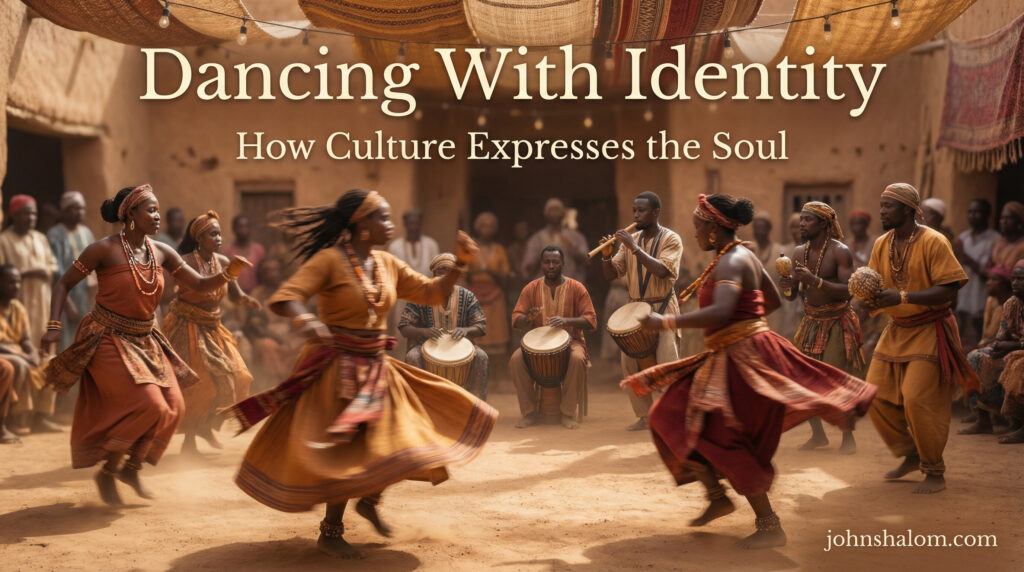
It was not just a performance. It was history in motion, identity in rhythm, and the soul of a people made visible. The drumming was not just noise. It was memory. The steps were not random. They were stories passed down without a single book, repeated so many times that even children who did not know the words still knew the meaning.
In that moment, I understood something: there are things that words can never fully say, but the body can.
Why Culture Dances Instead of Speaks
Culture does not always choose sentences. Sometimes it chooses rhythm.
You can sit people down to argue about politics, religion, or land, and they will fight for hours. Yet when the drums begin in a village, something strange happens. Even those who disagree feel the same beat under their feet. A song everyone knows rises from the crowd. Hands clap, dust rises, and for a few minutes, people who would never sit together in a meeting find themselves moving in the same circle.
Dance goes where words cannot.
Every tribe I know has dances. Rich or poor, educated or not, people will still gather, drum, and move. Why? Because dance is a way of saying, “This is who we are” without opening the mouth. It carries pride, memory, and emotion in a form that even a child can copy.
My First Dance Disaster
I wish I could say I joined that world easily. The truth is my first attempt at cultural dancing was a full comedy show.
I joined a youth group that had been asked to perform at a community event. I was sure I was born to dance. How hard could it be? You just jump, stamp, and shout, right?
Wrong.
From the first drumbeat, I knew I was in trouble. Everyone else moved left while I went right. They jumped forward and I was still trying to remember which foot led the step. At one point, I turned to face the wrong direction and found myself performing confidently to the drummer’s back. He almost choked trying not to laugh.
The crowd did not hold back. They laughed so much I considered disappearing into the nearest bush. Afterward, some elders teased me kindly. One said, “John, your heart is dancing, but your legs are still deciding which tribe they belong to.”
It hurt a little, but I also learned something important. Dancing is not just about the body. It is about the spirit. You can fake steps. You cannot fake soul. To truly dance your culture, you have to feel it, not just copy it.
Culture as a Mirror
When a community dances, it holds up a mirror to itself.
You see pride in the way people lift their heads. You see pain in the hard stamping of feet on the ground, as if trying to crush past suffering into dust. You see joy in shoulders that shake and hands that clap. You see resilience in bodies that still move even after famine, war, or displacement.
A war dance is not just a show of strength. It tells the story of courage, defense, loss, and survival. A harvest dance is not just fun after work. It is a thank you to God and the land. A wedding dance is not just entertainment for guests. It is a loud and public way of saying, “We are one now,” often more powerful than the formal words of a priest or government official.
In these dances, the tribe remembers who it is. Children watch and learn the steps long before they understand the full story. Yet those steps carry them into a shared identity that textbooks alone cannot give.
You might also like: The Ultimate Guide to Political Journalism: Ethics, Challenges, and Impact in the Modern World
Humor in Cultural Expression
Culture also knows how to laugh at itself.
I once attended a dance where an elder completely forgot his steps. He had been a famous dancer in his youth, known for high jumps and sharp turns. This time, his legs had other plans. Instead of stopping in shame, he invented new steps on the spot. He twisted his shoulders, swung his stick, and started hopping in a strange but joyful way.
The young dancers, thinking it was part of the performance, copied him. Soon the whole group was doing this “new” dance. The crowd roared with laughter, but also cheered. When the song ended, people said, “We have discovered a fresh style today.”
That day, I saw that culture is not frozen. It breathes, adjusts, and laughs. It allows mistakes to become new traditions. It holds both respect and humor in the same dance.
The Danger of Forgetting the Dance
Yet there is a danger hiding in our modern world.
As phones, television, and global music spread, many young people feel shy about traditional dances. They love hip-hop, Afrobeats, K-pop, and all kinds of global trends. There is nothing wrong with enjoying those. The problem comes when these new styles replace, instead of stand beside, their own heritage.
A young man may know the latest dance challenge on social media, but have no idea how his own people move in a traditional ceremony. A young woman may sing along to songs in foreign languages, yet be unable to sing the songs her grandmother used at weddings, funerals, or the start of the rainy season.
Slowly, the drum grows silent. The dance costumes stay folded in trunks. Elder dancers pass away without passing on their steps. The tribe becomes a group of individuals wearing old names but living new lives that no longer remember the old rhythm.
At first, it seems like a small loss. “It is only a dance,” some say. “We are modern now.” But it is not only a dance. It is a language. When you lose that language, something in the soul goes quiet.
Global Citizens With Missing Roots
Today, many young people in South Sudan and across Africa want to be global citizens. That is good. It is important to learn from other cultures, travel if possible, and use technology to connect with the world.
But global identity without local roots is dangerous. You can end up feeling like you belong everywhere and nowhere at the same time. You can rap in English, comment on American politics, and follow Asian trends, yet be unable to explain your own tribe’s history or why your people sing the way they do.
Culture is not about rejecting the world. It is about having a home inside yourself while you meet the world.
Traditional dance can be that anchor. Whether you are in Juba, Nairobi, Dubai, or London, one drumbeat from your people can pull you back to where you came from. One step you learned as a child can remind you of your own name.
Dance in the Diaspora
I have seen this power in diaspora communities.
Far from home, people gather in rented halls, school gyms, or public parks. Someone brings a drum. Someone else remembers the song. At first, everyone is shy, especially the youth who have grown up abroad. Then an elder starts to move. Another joins. Soon the circle grows.
Children who speak better English than their mother tongue watch with wide eyes. Then they join, copying clumsy versions of the steps. The adults laugh, correct, and encourage. That simple act of dancing together does something no long lecture on identity can do.
It tells the children: “You come from somewhere. These are your people. This is your rhythm.”
Dance as Reconciliation
I have also seen tribes reconcile through dance.
After conflicts, communities sometimes hold ceremonies where people gather not only to sign papers, but to share meals and dance. At first, the air is heavy. Old wounds sit in people’s eyes. The drums start slowly. People move with caution, each side watching the other.
Then children begin to dance more freely. Laughter breaks out when someone stumbles or exaggerates a move. Elders clap and ululate. In time, people from both sides find themselves in the same circle, following the same beat, repeating the same movements their ancestors used long before the recent conflict began.
In those moments, dance does what speeches cannot. The body says, “We are one people,” before the mind fully catches up. That does not solve every problem. It does not erase the need for justice and truth. But it opens a door to seeing the other not as an enemy, but as a fellow dancer in the same story.
Theology in Rhythm
For many African communities, dance is not just cultural, it is spiritual.
When people dance in church or at traditional religious ceremonies, they are not only enjoying music. They are praying with their bodies. They are telling God, “This is who we are, and we come to you as we are.”
I have seen older women dance slowly with tears in their eyes, their hands raised, their feet barely moving. I have also seen youth jump and shout with joy, dust exploding around them like smoke. Both are acts of theology in motion.
In our tribes, theology is not only written in books. It is written in rhythm. The way we move at funerals, weddings, thanksgiving events, or rites of passage shows what we believe about God, life, death, and community.
If we lose those dances, we risk losing the living expression of our faith. We may still say the right words on Sunday, but something will be missing from the soul of our worship.
My Grandmother’s Wisdom
My grandmother once told me, “A tribe that forgets its dance forgets its name.”
At first, I thought she was exaggerating for poetic effect. It sounded like one of those grand statements elders make to keep children in line. With time, I saw how true it is.
Dance is more than performance. It is identity written in rhythm. It is the body remembering what the tongue sometimes forgets. It is the story of a people acted out again and again until it sinks into the bones.
Forget the dance, and you risk forgetting yourself.
Practical Ways To Keep The Dance Alive
The question is not only what dance means, but what we can do about it. How do we keep cultural dances alive in an age of headphones, streaming apps, and global entertainment?
Here are some simple starting points.
Families can practice at home. Parents and grandparents can teach children a few basic steps during holidays, weddings, or quiet evenings. It does not have to be perfect. Even clumsy attempts keep the memory alive.
Schools can include local dance in their activities. Instead of only copying international songs for events, they can ask elders or local artists to teach traditional moves. This helps children feel proud of where they come from.
Churches and community groups can use dance wisely. They can include cultural elements in celebrations without turning worship into a show or turning tradition into an idol. The key is to remember the meaning behind the movement.
Young people can use technology to save tradition instead of only replacing it. They can record elders dancing, share short clips, explain the stories behind the dances, and even teach one another online. The same phone that distracts can also preserve.
Most of all, individuals can choose not to be ashamed. No matter how modern you are, you are never too educated or too urban to know your people’s rhythm.
Dancing With Identity
In the end, dancing with identity is not only about traditional events. It is about how we live daily.
Some people dance through life trying to copy every trend they see. Others dance with their own deep rhythm, grounded in heritage, faith, and community. One life feels scattered. The other feels rooted.
You do not need to be a perfect dancer to live with cultural identity. You only need a willing heart, a humble spirit, and the courage to move when your people’s drum begins.
You may step on a few toes. You may look foolish sometimes. You may forget the steps and invent new ones. That is fine. Culture that is truly alive always has space for mistakes, laughter, and growth.
What matters is that you keep dancing.
If you would like to know more about my path as a writer, including the struggles, lessons, and small signs of progress along the way, you can read the full story on my Wealthy Affiliate blog here: https://my.wealthyaffiliate.com/johnmaluth/blog
Reflection Questions
- What traditional dance from your culture carries the deepest meaning for you?
- How does dance express emotions that words sometimes cannot?
- Have you ever laughed during a cultural event, and how did that humor make the memory stronger?
- What risks do you see if younger generations stop practicing traditional dances?
- How might dance help reconcile divisions within families, tribes, or nations?
FAQs
- What does “dancing with identity” mean in this article?
It means the ongoing movement between our inner self and the cultural practices we live out. Like a dance, identity and culture respond to each other, shaping how we think, feel, and act in daily life. - How does culture express the soul of a person or community?
Culture expresses the soul through symbols, language, music, stories, and traditions. These carry memories, values, and beliefs that reveal what a person or community loves, fears, respects, and hopes for. - Can someone belong to more than one culture at the same time?
Yes. Many people carry mixed identities: village and city, local and global, traditional and modern. The article explains that this blend can be a source of strength if handled with honesty, humility, and respect. - What happens when a culture is ignored or looked down on?
People may feel ashamed of their roots, hide their stories, or try to copy others. This can create inner conflict and weaken community bonds. Respecting culture helps people stand tall without attacking others. - How can I honor my culture while still learning from other cultures?
You can learn other languages, customs, and ideas without despising your own. Celebrate your roots, listen to the stories of others, and look for shared human values such as dignity, respect, and kindness.