TL; DR
This article explains why learning that crosses borders, cultures, and time zones matters in today’s world. Education without borders uses books, travel, internet, and human connection to help students see beyond their village, tribe, or nation. It shows that other people’s stories are not threats but mirrors and windows. When we study with people from other countries, we sharpen our thinking, widen our hearts, and prepare ourselves for work, leadership, and friendship in a connected world.
When I was young, education looked like a classroom with a cracked chalkboard, a tired teacher, and students packed together like beans in a sack. The idea of learning beyond the village, or even beyond the country, felt as strange as dreaming of walking on the moon. Our world was small. Knowledge seemed trapped inside walls, inside borders, inside the limits of who could afford books or school fees.
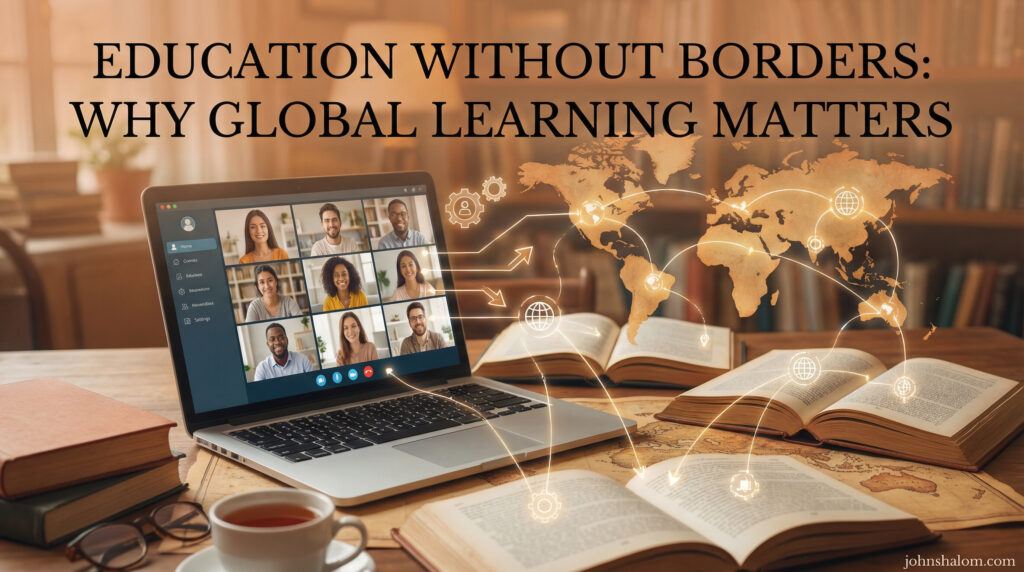
Today, a child in Juba can sit under a tree with a cheap smartphone and listen to a professor in London explain economics. A teenager in a refugee camp can watch a lecture from a university in America. A young mother can learn business skills from a trainer in India while her baby sleeps beside her. Education has broken through borders, and the world has quietly turned into one giant classroom.
From Chalkboard To Global Classroom
Back then, if the chalk finished, the lesson ended. If the teacher did not come, education paused. If the school had no library, then your mind had no extra food. Everything depended on who and what was physically present.
Now, knowledge travels freely. It lives inside videos, podcasts, e-books, online courses, and even short social media clips that manage to teach something between jokes and dancing. Borders still exist on maps, but knowledge has found its way around them.
Of course, the gap is still real. Not everyone has a smartphone or stable internet. Power cuts and poor networks are still daily visitors. But the door is no longer shut. If even one device exists in a village, that device can become a small window to the world.
Why Borders No Longer Work In Learning
Borders work to control land. They do not work well to control ideas. A line between two countries can stop a bus, but it cannot stop a thought. Once an idea enters the digital world, it can travel faster than any airplane.
In the past:
- If your school lacked books, your mind lacked information.
- If your village had no teacher, your future felt blocked.
- If your country was at war, your education often stopped.
Today, knowledge is less loyal to geography. A boy in South Sudan can study coding from a trainer in Silicon Valley. A girl in Uganda can learn public speaking from speakers in Canada. A farmer in a remote village can watch a video on how to improve yields using simple methods. A nurse can learn a new treatment protocol from an online health course.
Borders may still hold passports and soldiers, but they struggle to hold learning.
The Humor Of Global Learning
Of course, this new world of education comes with its own comedy.
I once joined an online seminar with people from five different countries. The host said, “Please introduce yourselves.” I started: “My name is John, from South Su…” and the internet froze. When the connection returned, I repeated, “My name is John, from South Su…” and it froze again. By the third attempt, everyone was laughing kindly. I had become “the man with the echo.” It was embarrassing, but also funny. And still, in that awkward space, I was learning alongside people I would never meet physically.
Another time, a young cousin asked me, “Uncle, why do you still go to school when Google already knows everything?” I laughed at first, but his question was serious. He thought that because information is online, teachers are no longer important. I had to explain that Google has many answers, but it does not know which answer is right for your life. It does not know your character, your story, or your needs. Teachers and mentors are still needed to guide, correct, and shape.
Global learning does not remove teachers. It simply invites new partners into the classroom.
You might also like The Ultimate Guide to Academic Writing: Structure, Style, and Success in Research
Why Global Learning Matters
Education without borders does more than teach new facts. It changes how we see ourselves, other people, and the future.
- It widens the mind
A child who only hears one country’s story grows up seeing the world in one color. A child who reads books from different nations, listens to different accents, and hears different histories begins to see the world in many colors.
When you read a local textbook about your country’s history, you often hear one version. When you read another book about the same events written in another country, you discover that stories have many angles. This does not have to confuse you. It can make you wiser, more thoughtful, and less quick to judge.
- It builds empathy
When you see videos of people in other parts of the world laughing at the same jokes, crying over the same disasters, and celebrating the same small wins, it becomes harder to hate them. Global learning reminds us that, under different flags and clothes, we share the same human heart.
A student in South Sudan watching a documentary about a family in Syria learns that pain speaks the same language. A young person in Europe listening to a South Sudanese story learns that hope grows in similar soil. Education without borders fights ignorance a little bit at a time.
- It sparks innovation
New ideas are often born when two different ways of thinking meet. A farmer can mix a planting trick from Israel with a local method from his grandfather. A health worker can mix a lesson from an online course in Kenya with her own experience in a rural clinic. A writer can combine African oral storytelling with Western structure.
Global learning allows ideas to cross-pollinate. It gives local wisdom fresh tools and gives outside knowledge local roots.
- It prepares people for a connected world
Work is changing. Many jobs now require you to work with people in other countries, even if you never leave your town. A graphic designer in Juba can design a logo for a client in Nairobi. A translator in Wau can work for an organisation in Europe. A student can take a remote internship with a company thousands of miles away.
Those who understand other cultures, time zones, and ways of working will adapt more easily. Those who refuse to learn beyond their borders may feel left out in a world that has quietly become a village.
My Own Global Lessons
As a writer and learner, I have travelled the world through books, screens, and friendships. I have learned from American poets who taught me to be bold with words. I have learned from European thinkers who challenged my assumptions. I have learned from Asian teachers who showed me discipline and quiet strength. I have been shaped by African authors from across the continent who turned pain into wisdom and war into poetry.
Some of my readers live in places I have never visited physically. When they send me messages saying, “Your story reminded me of my life in another continent,” I realize global learning is not just about consuming content. It is also about sharing it. Each of us can be both student and teacher in this wide classroom.
The Risk Of Isolation
The danger comes when we close our doors. A country that only teaches one narrative, one language, and one view of the world raises citizens who are sharp in a small circle but lost outside it. It is like teaching someone to swim in a tiny pond, then dropping them into the ocean. The skills do not hold.
Isolation in learning can produce:
- Fear of foreigners.
- Suspicion of new ideas.
- Inability to compete in global markets.
- Fragile confidence that breaks when challenged.
On the other side, there is another danger: global knowledge without roots. A young person might quote American films, sing Korean songs, and follow European trends, yet know nothing of their own tribe’s stories, songs, and heroes. That too is a kind of loss.
The Balance: Roots And Wings
Global learning should give us wings, not cut our roots. A tree cannot grow wide branches without deep roots. In the same way, a person cannot handle global ideas safely without a strong sense of who they are.
For a South Sudanese learner, this might mean:
- Knowing your tribe’s history and also reading world history.
- Speaking your mother tongue and also learning international languages.
- Singing traditional songs and also enjoying worldwide music.
- Understanding your local challenges and also studying global solutions.
Global education should not erase identity. It should strengthen it, then stretch it. When you know where you come from, you are not easily swallowed by the world. You can welcome new ideas while staying anchored.
The Role Of Faith And Values
Global learning also needs a moral compass. Technology can show you everything, good and bad. Without values, you can get lost in the noise.
Faith, character, and clear values give you a way to filter what you learn. You can ask:
- Does this idea respect human dignity?
- Does this practice build people up or exploit them?
- Is this lesson consistent with truth and justice?
Without such inner questions, global learning can turn into global confusion. With them, global learning turns into wisdom.
Practical Ways To Become A Global Learner
You do not need to leave your country to become a global learner. You can start where you are, with what you have.
Here are some simple steps:
- Read beyond your borders
Do not only read local authors. Add books from other countries. Even one or two a year can widen your view. If you cannot buy books, look for free e-books or library resources, or ask friends to share. - Use online courses wisely
Many platforms offer free or low cost courses. Pick one area that matters to you, such as health, writing, technology, business, or languages. Commit to finishing at least one serious course, not just starting many. - Join learning communities
Online groups, study circles, book clubs, or mentorship programs can connect you with people in other regions. Listen more than you speak at first. Ask questions. Share your own local wisdom too. Do not join only to consume. Join to contribute. - Learn at least one extra language
Each new language opens a door to stories, jokes, songs, and ideas that do not translate fully. Even basic phrases can change how you see others. Language is more than words. It carries a different way of seeing the world. - Teach what you learn
Global learning becomes deeper when you pass it on. If you watch a helpful lecture, summarise it for a friend. If you read a powerful book, share its key lessons with your community. Teaching turns knowledge into service.
A Vision For South Sudan And Similar Nations
Imagine a South Sudan where:
- Teachers in rural areas use a simple projector and downloaded videos to bring the world into their classrooms.
- Youth in displaced camps attend online workshops on peace building and entrepreneurship.
- Girls learn coding, public speaking, and leadership skills from global mentors, while still respecting their own culture.
- Pastors and imams study theology and ethics from schools abroad, then apply those lessons to heal local wounds.
- Farmers share their challenges in online groups and receive fresh ideas from other farmers in Kenya, Nigeria, or India.
This is not fantasy. The seeds of this future already exist. The challenge is to water them with wise policies, investment in technology, better networks, and a culture that honours learning for all, not just a few.
Leaders must see education not as a luxury, but as a national survival tool. Families must see global learning not as a threat to culture, but as a chance to strengthen it. Youth must see education not as a school phase, but as a lifelong road.
A Final Story
Some years ago, I mentored a young person who later received a chance to study abroad. When they left, people worried they would never come back. But they did return, with a degree in their hands and a new light in their eyes.
They did not come back to boast. They came back to start a small program for children who had dropped out of school. They mixed what they learned abroad with what they knew from home. The result was something neither country could have created alone.
Watching them, I understood again what “education without borders” really means. It is not about collecting foreign certificates. It is about going out to learn, then coming back to serve. It is about turning the whole earth into a classroom, while still calling one small piece of that earth “home.”
The academy of life is wide now. It stretches from small villages to giant cities, from mud classrooms to digital screens. None of us can control where we were born, but we can choose how far we learn.
If you would like to know more about my path as a writer, including the struggles, lessons, and small signs of progress along the way, you can read the full story on my Wealthy Affiliate blog here: https://my.wealthyaffiliate.com/johnmaluth/blog
Reflection Questions
- What global lesson have you learned recently that changed how you see yourself or other people?
- How can technology in your home, school, or community be used to remove barriers to learning, even in small ways?
- What risks do you see if education in your country focuses only on local views and ignores the wider world?
- How can you balance global learning with preserving and honoring your own culture and heritage?
- What one step can you take this week to move from being only a local student to becoming a global learner?
FAQs
- What does “education without borders” mean?
It means learning that is not limited by geography, tribe, or nationality. Students can study ideas, histories, and skills from many countries, and even interact with teachers and peers from other parts of the world. - Why does global learning matter today?
Because problems such as conflict, climate, health, and poverty ignore political borders. To solve them, we need people who understand other cultures, can work in teams across countries, and see humanity as one family. - How can someone access global learning without traveling abroad?
They can use online courses, digital libraries, language apps, virtual exchanges, and international webinars. They can also read books and follow thinkers from different countries to learn from their experiences. - What benefits does global learning bring to local communities?
It brings fresh ideas, better problem-solving, and wider networks. People who learn globally can return home with skills and examples that help improve schools, businesses, churches, and local governments. - Can global learning respect local culture and identity?
Yes. Healthy global learning does not erase local culture. It helps people appreciate their roots even more while learning to respect others. The goal is not to copy another culture, but to grow through mutual sharing.