TL; DR:
Faith at home is not mainly about long prayers or loud religion. It is about the quiet, repeated ways a family lives what it claims to believe. Children discover purpose by watching how their parents relate to God, handle pressure, treat one another, and respond to neighbours.
When faith is real at home, it shapes identity, trains responsibility, and gives a clear reason to love and serve. Even in broken or imperfect families, small honest steps can begin to pass on purpose instead of confusion or fear. Your home can become the first place where calling is noticed, tested, corrected, and shared.
Introduction: Faith, Family, and Meaning
1.1 Why purpose often begins at the kitchen table
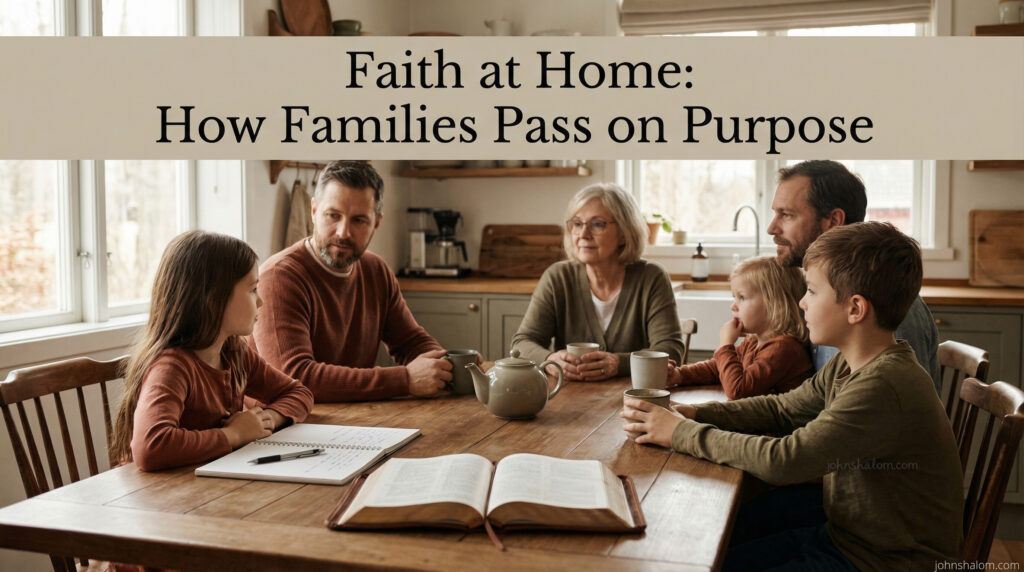
Before a child hears a formal sermon or reads a deep book, he or she quietly studies the adults at home. The first place most of us meet ideas about God, justice, mercy, and truth is not in a church building. It is in an ordinary room where people eat, argue, laugh, pray, and forgive.
As a boy along the Sobat River, I saw this long before I had language for it. We did not have a Bible college in the compound. No one handed out formal notes on theology. But I watched how my parents called on God in hard seasons, how they shared food when there was barely enough, how they tried to calm quarrels before they exploded.
Those small acts were my first lessons in faith. They planted questions and answers at the same time.
Is God real if we still suffer?
Does He care if we share what little we have?
Does my life matter enough for Him to listen?
My parents never wrote those questions on a blackboard, but their choices at the kitchen table began to answer them. That is where purpose quietly starts.
1.2 Faith that only lives in public is weak at home
In many African societies, public faith looks strong. We open meetings with prayer, close speeches with “God bless you,” and quote Scripture at national events. God’s name appears in our anthems, our songs, and sometimes even in our politics.
Yet those same societies often struggle with corruption, violence, fear in families, and deep mistrust between communities. Children grow up hearing one message about God in public and seeing a different message at home.
They hear that God loves the poor, yet they watch relatives cheat workers.
They hear that truth matters, yet they learn to lie to avoid trouble.
They hear that forgiveness is holy, yet they see silent grudges that last for years.
This gap does not produce purpose. It produces confusion, disappointment, and sometimes quiet anger toward God.
If we want to pass on purpose, faith must travel from public talk to private practice. It has to move from the microphone to the kitchen table, from the pulpit to the bedroom, from the stadium to the backyard.
What Faith at Home Really Looks Like
2.1 More than rituals on holy days
Faith at home is not just a prayer before meals, a quick verse on the wall, or a special outfit on holy days. Those things can help, but they are only small threads in a much larger fabric.
Real faith shows up in places where it is easy to forget God:
- How parents speak to each other when they strongly disagree.
- How money is handled when nobody outside the family will ever know.
- How the family treats the poor, strangers, guards, cleaners, and helpers.
- How truth is handled when a lie could protect our image.
- How we respond when something goes wrong and there is no one obvious to blame.
Children notice these details more than they notice our religious language. For them, this is what “faith” really means. If our prayers say one thing and our private life says another, they will believe what they see, not what they hear.
2.2 The quiet theology of ordinary life
You may never use big theological words at home. You may never explain doctrines formally. Yet your family life still answers very deep questions every day:
- Is God good, even when life is hard and unfair?
- Is every person valuable, or only those who are rich, educated, or influential?
- Is forgiveness real, or is it only a word we use when others are watching?
- Does honesty pay, or do clever lies bring better results?
- Is work a gift from God, or just a curse we try to escape?
Each time you choose patience instead of rage, truth instead of comfort, service instead of selfishness, you are preaching a silent sermon. Your children may not remember the exact words you prayed, but they will remember the way you lived when it was costly.
That quiet theology often shapes their view of God more than any official sermon on Sunday.
You might also like: The Ultimate Guide to Political Journalism: Ethics, Challenges, and Impact in the Modern World
How Children Learn Purpose by Watching Grownups
3.1 The stories we tell
Children learn purpose through repeated stories. It is not just the big events they remember, but the stories that are told again and again around food, fires, and family visits.
Some of the most powerful stories in a home include:
- Stories of how grandparents faced hunger, war, or sickness with faith and courage.
- Stories of doors that opened when everything seemed impossible, and how the family prayed through that time.
- Stories of failure, not hidden, but followed by repentance, change, and new beginnings.
- Stories of simple acts of kindness that changed someone’s life quietly.
If all the family stories are about revenge, clever manipulation, and shame, children learn that life is a game of power and survival.
If the stories show God’s presence in dark seasons, courage in weakness, and recovery after failure, children learn that their own lives can be part of a bigger hopeful story. They begin to see themselves not as random survivors but as characters in a continuing work of God.
3.2 The prayers we pray
Prayers at home do more than ask for help. They shape how children think about God and about themselves. In prayer, children quietly learn:
- Who we believe God is: close or distant, patient or harsh, generous or stingy.
- What we believe God cares about: only money and success, or also justice, mercy, and character.
- Whether we think we are orphans in the world or children who can talk to a Father.
If a family only prays for money, visas, jobs, and grades, children may grow up believing that God is mainly a tool for personal advancement.
If a family also prays for wisdom, courage to tell the truth, strength to forgive, peace in the community, and help for those who suffer, children see that faith is about calling and character, not only about needs.
3.3 How we suffer and how we celebrate
Children are always watching how adults handle both pain and joy.
In suffering, they notice:
– Do we curse everyone and everything, or do we cling to God and to each other.
– Do we only shout and blame, or do we also search for lessons, comfort, and a way forward.
– Do we isolate in shame, or do we invite trusted people to walk with us.
In celebration, they notice:
– Do we forget God completely when things go well.
– Do we become proud and look down on others, or stay humble and thankful.
– Do we share our joy with those who have less, or keep everything for ourselves.
These patterns answer a question that every child carries:
“Is life random and cruel, or is there a steady purpose that runs through both joy and pain?”
Rituals and Habits That Pass on Purpose
4.1 Shared meals with honest conversation
Eating together is one of the oldest faith practices on earth. You do not need plenty of food to turn a meal into a place of purpose. You mainly need attention and presence.
A simple habit can look like this:
- Decide to sit together for at least one meal a day, or a few times a week, without devices.
- Ask each person to share one thing they are grateful for and one thing that was difficult.
- Listen without rushing to correct or preach.
- End with a short prayer that mentions what was shared, thanking God and asking for help.
Over time, this small routine builds trust, gratitude, and a realistic faith that connects with actual life rather than with theory only. Children learn that God is not only for Sundays. He is involved in school stress, work drama, friendship conflicts, and small joys.
4.2 Weekly rest and worship
Many faith traditions include a regular rhythm of rest and worship. In a busy economy and unstable environment, rest can feel like a luxury, yet even a few protected hours can reset a whole home.
You can use this time to:
- Attend worship together if possible, even if the service is simple.
- Read Scripture or other wise writings as a family, even a few verses.
- Ask one or two questions: “What did this teach us about God?” and “How does this touch something we are facing now?”
- Share brief personal reflections without turning it into a long lecture.
This pattern teaches children that life is not only about work, survival, and noise. There is a God who stands above our struggles, who invites us to rest, remember, and reset.
4.3 Serving together as a family
Purpose grows when we look beyond ourselves. One of the strongest ways to pass on purpose is to serve others together as a family, in practical and simple ways.
For example:
- Visit someone who is sick, elderly, or lonely and sit with them for a while.
- Share food, clothes, or school supplies with a struggling neighbour or relative.
- Help clean a church, school, clinic, or community space.
- Support a family in crisis with time, presence, or small gifts.
Do not only send the children. Go with them. Explain why you are doing it:
“Because God has helped us, we want to help others.”
This teaches that faith is not just about getting blessings, but about becoming a blessing. Children begin to see service as normal, not as a rare special project.
When the Home Story Is Broken
5.1 Hypocrisy and the wound it leaves
Many people carry deep wounds because faith at home was harsh, fake, or used as a weapon. They heard about a loving God but experienced fear and control. They listened to sermons about mercy but felt only shame. They saw parents or leaders honour God in public and humiliate family members in private.
This kind of hypocrisy does more than hurt feelings. It damages a person’s picture of God.
If “faith” at home felt cruel, God begins to look cruel.
If “faith” meant constant criticism, God begins to sound like a voice of accusation.
If “faith” meant hiding family problems so others will think you are holy, God begins to feel like a judge who loves appearances more than truth.
It is no surprise that children raised in such homes may run far from the faith of their parents. For them, rejecting that version of faith feels like self-protection.
5.2 Starting again with honesty
If you recognise yourself in this story, either as a wounded child or as a parent who has made mistakes, there is still a way forward. It does not begin with pretending harder. It begins with honesty.
An adult can say to their children, even after many years:
- “Some of the ways I used faith at home were wrong, and I am sorry.”
- “I did not always show you the real character of God in my actions.”
- “I am learning to live my faith better now, and I need grace too.”
Children and young people respect adults who admit failure and change more than those who defend their wrongs. Honest confession does not erase the past, but it can open a new chapter.
From that point, you can begin to rebuild simple practices of trust: shared meals, fair apologies, gentle prayers. Faith at home can start again, even in wounded places.
Simple Steps to Begin Today
6.1 Clarify what you believe
Take time alone, with your spouse, or with trusted relatives and answer questions like:
- What do we really believe about God, not just in theory but in practice.
- What values must guide our home: truth, forgiveness, kindness, hard work, respect, generosity, self-control.
- What kind of adults we hope our children will become.
Write these ideas in simple language. This is part of your family “being.” It gives you a clear reference point when life gets noisy.
6.2 Choose two or three daily or weekly habits
From what you wrote, pick small habits that match your values. Do not start with ten. Start with two or three you are likely to keep. For example:
- A short prayer together in the morning or evening, even two or three sentences.
- A weekly reading and discussion time around a verse, story, or short article.
- A monthly act of service to someone outside the family.
- A rule about shared meals with phones put away.
Keep these habits realistic. Purpose is passed on more by what you do regularly than by what you do rarely and dramatically.
6.3 Guard the message beneath your words
Ask yourself often:
“What are my children learning about God and about purpose from how I act, not just from what I say?”
If you notice a gap, do not give up in shame. Adjust one small thing. Apologise if necessary. Explain why you want to change. Then try again.
Passing on purpose is not a one time event. It is a long, imperfect walk. Some days you will feel you have failed. Other days you will glimpse small signs of change. God is patient in that process. You can be patient too.
Conclusion: Your Home as a Small School of Purpose
Faith at home is one of the strongest tools God uses to pass purpose from one generation to the next. You do not need a perfect house, a large income, or advanced education to begin. You need a sincere heart, simple habits, and courage to live what you believe in front of people who see you on your worst days as well as your best.
As your family slowly learns to connect faith with daily actions, children begin to see their own lives as part of God’s work in the world. They discover that they are not accidents, but people with a calling. They realise that God is not only for special days, but for homework, conflict, choices, and dreams.
That discovery, made around your table and inside your ordinary routines, can shape not only their future, but the future of your community and country. Nations are quietly formed in living rooms long before they are measured in parliaments.
Faith at home may look small, but in God’s hands, it is a seed of purpose that can grow across generations.
If you would like to know more about my path as a writer, including the struggles, lessons, and small signs of progress along the way, you can read the full story on my Wealthy Affiliate blog here: https://my.wealthyaffiliate.com/johnmaluth/blog
FAQS
Q1: What if I am the only believer in my family?
A: Start with what you can control, which is your own life. Pray, live your faith quietly but clearly, show kindness, honesty, and compassion. Avoid preaching at people while living in anger. Over time, your example can soften hearts and open doors for conversation, even if others do not share your beliefs yet.
Q2: How can I pass on faith if I feel weak or unsure myself?
A: You do not need to know everything to begin. Be honest about your questions and struggles, share what you do know, and keep learning together with your family. Read, pray, and ask questions as a group. Children benefit more from seeing a genuine journey of growth than from watching someone pretend to be spiritually perfect.
Q3: What if our home has a history of conflict and hurt?
A: Begin with small steps of repair. This might include apologies, listening sessions without shouting, or seeking help from a trusted pastor, elder, or counsellor. Introduce gentle practices like shared meals, short prayers, or family check in times. Healing takes time, but purpose can still grow in wounded soil when people choose humility and patience.
Q4: How does faith at home connect to national change?
A: Children raised in homes where faith shapes character, honesty, and service often grow into adults who resist corruption, love peace, and care about justice. When many homes in a country practice this kind of faith, the quality of citizens and leaders slowly changes. National transformation usually begins in families long before it appears in laws.
Q5: Is it too late to start if my children are already grown?
A: It is rarely completely too late. Grown children still notice humility, change, and love. You can apologise for past failures, share what you are learning now, and offer support, prayer, and presence. Even if you cannot rewrite their childhood, you can influence their present and future through honesty, consistency, and renewed relationship.