
TL;DR
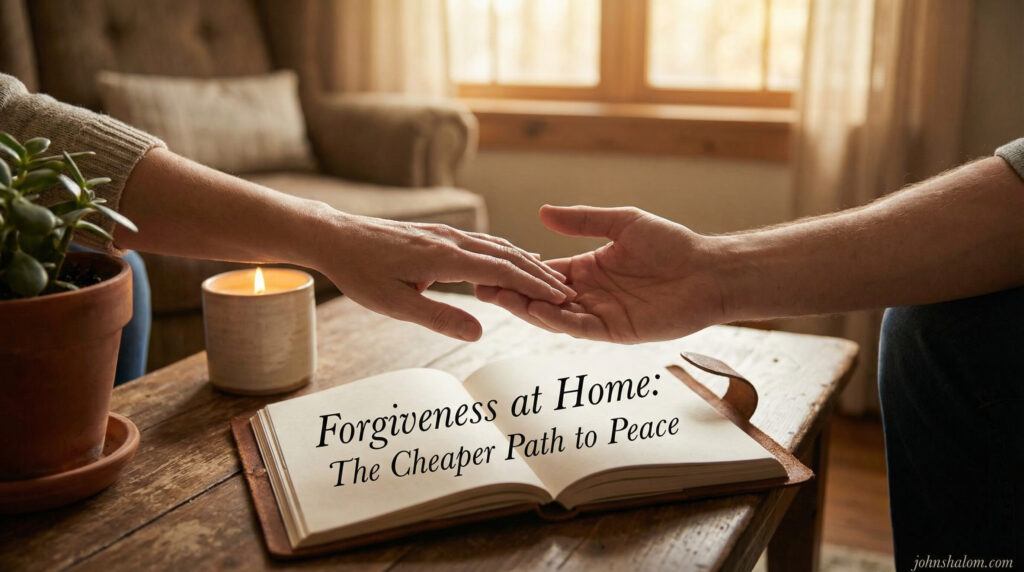
This article explains why forgiveness inside the home is the cheapest and most powerful path to peace. Instead of spending energy on fighting, cold silence, or revenge, families can choose apology, listening, and second chances. Forgiveness does not mean pretending wrong never happened. It means choosing healing instead of punishment. When parents forgive each other, and children learn to say “sorry” and “I forgive you,” the home becomes lighter, safer, and more joyful for everyone.
When I was growing up, quarrels in our family were as common as mosquitoes in the rainy season. Someone was always upset with someone. My brothers and I fought over who got the bigger piece of meat. My sisters argued about who had stolen the mirror or borrowed a dress without permission. Even the adults were not angels. Sometimes my parents disagreed about money, visitors, or which relative we should help next.
Yet there was a pattern in our house. Before the argument could grow teeth, my father usually stepped in with one simple line: “Let us eat first, then talk.” As a child, I thought he was just hungry. Later, I realized he was a quiet strategist. My father understood something many world leaders still miss. Forgiveness is cheaper than fighting.
Food calms stomachs. Forgiveness calms souls. Put the two together, and you can stop many wars before they begin, especially the wars at home.
Why Forgiveness Feels Expensive
On paper, forgiveness sounds easy. Just say, “I forgive you,” and move on. In real life, forgiveness feels like trying to carry a full sack of sorghum on one shoulder. Your pride screams, “Do not let them win.” Your pain whispers, “Make them feel what you felt.” Your mind starts counting all the times this person has done something similar.
Forgiveness feels expensive because it costs us our ego. It demands that we give up the story that says, “I am always right and you are always wrong.” It forces us to stop replaying the movie where we are the perfect victim and the other person is the perfect villain.
Unforgiveness, however, is far more costly. It robs families of peace. It keeps children walking on eggshells. It turns homes into battlegrounds where everyone is armed with sharp words instead of bullets.
I once refused to forgive my cousin for breaking my toy. To be honest, that toy was already half dead, but in my mind, it was a treasure. He dropped it, it cracked, and my heart cracked with it. For weeks, I refused to talk to him. I made sure he knew I was angry. Then one day, he roasted maize and shared with everyone except me. That maize smelled like heaven. My pride collapsed immediately. I forgave him, not out of holiness, but out of hunger.
That day I learned a simple truth. Forgiveness may feel costly, but holding grudges can cost you even roasted maize. In adult language, it costs you joy, sleep, trust, and sometimes even your health.
The Economics Of Forgiveness
Think about forgiveness like a family economy. Every fight that is not resolved becomes a kind of debt. Someone owes an apology. Someone owes an explanation. Someone owes respect. Over time, those unpaid emotional debts pile up like unpaid bills. The relationship becomes heavy. One small mistake can then release years of stored anger.
Forgiveness cancels those debts. It does not erase the memory. It does not call evil good. It simply says, “I release you from paying me back. I choose peace over revenge.”
In harsh economic terms, unforgiveness is a very expensive way to live.
It costs time. Couples who hold grudges can spend days or weeks avoiding each other in the same house. Children hide in rooms. Meals are eaten in silence. Life pauses until someone swallows their pride.
It costs emotional energy. Keeping a grudge alive is like keeping a fire burning. You must keep feeding it. You rehearse old hurts in your mind. You gather evidence to prove you are right. You read every new action of the other person through the old wound. It is exhausting.
It costs the next generation. Children who grow up in homes where forgiveness is rare learn that conflict is final. They grow up thinking mistakes must be punished, not healed. Those children then carry that belief into friendships, workplaces, and eventually into politics.
If wars between tribes are expensive, wars inside the home are even more costly. They damage the first place where human beings learn how to live with others.
Forgiveness, by contrast, is the cheaper road. It is hard at the start, but in the long run it saves years of bitterness, therapy, and broken relationships. It is like repairing a roof while the leak is still small. Ignore it, and one day you will be swimming in your bedroom.
Humor As Forgiveness
Sometimes forgiveness walks into the room disguised as laughter.
I once spilled water all over my father’s documents. These were not casual papers. They were important forms and letters that had taken him hours to gather. The moment I saw the water spreading, my heart sank. I expected shouting or at least a long angry lecture.
Instead, he looked at the wet papers, then at me, and said calmly, “Well, John, now they are baptized.”
We all burst out laughing. The water did not vanish, but the anger did. He still had to dry his documents, and I still had to be more careful, but the accident became a story instead of a scar.
That day I realized something. Forgiveness is not always a serious speech. Sometimes it is a joke that says, “Yes, you messed up, but I choose to laugh with you instead of shouting at you.”
Humor cannot fix deep betrayals by itself. But it can soften many everyday mistakes. It can remind us that we are all clumsy, all forgetful, all human. Laughter can open the door for forgiveness to walk in.
Children As Forgiveness Teachers
If you want to see forgiveness in its purest form, watch children.
Children can fight fiercely over a stone, a shoe, or a plastic ball. They push, shout, even cry. Then twenty minutes later, you see them chasing each other again, laughing as if nothing happened. If you ask, “Are you still angry?” they look at you like you are the strange one.
Children forgive because they live more in the present than in the past. They do not keep long records of wrongs. They get hurt, cry, shout, and then move on.
As adults, we complicate this simple skill. We tie our identity to our hurts. We start to think, “If I forgive, I look weak. If I release this, I have no power.” In reality, the opposite is true. Forgiveness is a sign of strength. Anyone can stay angry. It takes courage to say, “I choose to let this go.”
When parents practice forgiveness openly, children watch and learn.
If a father apologizes to a child after shouting, that child discovers that authority and humility can live together. If a mother admits she spoke harshly to a neighbor and goes to make peace, the child learns that dignity is not destroyed by apology. Those lessons go deeper than any lecture.
You might also like: How to Write Your Life Story: A Complete Guide to Autobiography Writing
My Mother’s Quiet Example
My mother understood this better than many books.
One day she quarreled with a neighbor over borrowed cooking oil. The neighbor had taken some and promised to return the same amount. Days passed. Nothing came back. Words passed instead. One thing led to another, and soon the air between them was thick.
The next morning, my mother baked bread. When it was ready, she divided it and carried a portion to the same neighbor. I followed her, confused.
“Why bring bread to someone who made you angry?” I asked later.
She smiled and said, “Because anger burns faster than oil. If I let it burn inside me, it will cook nothing.”
Her answer stayed in my mind. She showed me that forgiveness is not just about words. It is also about actions that say, “You matter to me more than this issue.”
That small act did more for peace than a hundred debates. The neighbor softened. The tension melted. The road between our homes stayed open.
Forgiveness As A Daily Habit At Home
We like to imagine forgiveness as a big dramatic moment. Tears, long speeches, maybe background music. In most homes, forgiveness is quieter. It lives in small daily habits.
Here are a few ways families can practice forgiveness as a lifestyle.
Speak early, not late.
Small hurts are easier to heal than old ones. If something bothers you, talk about it calmly the same day if possible. Do not let it grow into a monster in your mind.
Use simple, honest words.
“I was hurt when you said that.”
“I am sorry I spoke to you like that.”
“I forgive you. Let us start again.”
You do not need poetic language. You just need truth.
Create a “reset” habit.
Some families hold hands and pray before sleeping, even after a difficult day. Others have a rule: no going to bed without greeting each other. It does not mean every problem is solved at once. It simply means, “Even in conflict, we still belong to each other.”
Model apology from the top.
When parents never admit they are wrong, forgiveness feels like a child’s duty. When parents say, “I was wrong,” forgiveness becomes a family value. Children then find it easier to say, “I was wrong too.”
Separate the person from the problem.
Instead of saying, “You are always careless,” say, “This action caused harm.” Attack the issue, not the identity. That keeps the door open for restoration.
The Faith Side Of Forgiveness
Forgiveness is not only a psychological tool. It is also deeply spiritual.
Almost every faith tradition carries a call to forgive. In Christian teaching, God forgives us far more than we can ever forgive others. We are invited to pass on what we have received.
This does not mean ignoring injustice. It does not mean staying in abusive conditions. Healthy forgiveness can coexist with wise boundaries. You can forgive someone in your heart and still decide to protect yourself from continued harm.
What faith adds is this: you do not have to carry the full weight of judgment. You can release people to God and move forward with a lighter heart. You can believe that God sees, God knows, and God can deal with what you cannot fix.
In homes where faith and forgiveness walk together, peace has a stronger chance of surviving.
Forgiveness As National Policy
If forgiveness can heal a home, imagine what it could do for a country.
In South Sudan, many conflicts begin with small offenses that grow into long tribal memories. A cow is stolen. Someone is insulted. A person is killed. The pain spreads from one family to the wider clan, then to the whole tribe. Soon, no one remembers who started it. They only remember “what they did to us.”
If leaders practiced forgiveness at the same level as mothers in the village, many wars would end faster than they start. Forgiveness at the national level is not sentimental. It is strategic. It means choosing reconciliation processes, truth telling, and restoration over endless revenge.
Forgiveness does not erase history. It does not deny trauma. It simply says, “We will not let old wounds control our future.” That choice must begin in small circles, especially in homes.
Nations are made up of families. If homes become schools of forgiveness, those children will grow into citizens, judges, soldiers, and leaders who can say, “I know how to seek justice without feeding hatred.” That is how forgiveness at home can eventually heal a nation.
Facing Our Own Pride
To forgive at home, we must first confront our own pride.
Pride loves to wear different clothes.
Sometimes it says, “I never start fights. I only respond.”
Sometimes it says, “I will forgive, but I will never forget,” and then uses the memory as a weapon.
Sometimes it says nothing. It just keeps you from taking the first step.
I know this, because I have worn all those clothes.
I have sat in silence waiting for the other person to apologize first. I have practiced clever speeches in my head where I prove how right I am. I have delayed peace over small issues until the whole house felt heavy.
Each time, I discovered the same thing. My pride did not protect me. It only kept me lonely.
The moments I found real peace were the times I chose to release my right to win, walked across the room, and said, “Let us talk.” Not because the other person was perfect. Not because I was fully wrong. Simply because the relationship mattered more than the argument.
A Cheaper Path For The Next Generation
The question is not whether conflict will visit our homes. It will. The question is what our children will learn from watching us respond.
If they see parents holding grudges for months, they will copy that. If they see siblings never apologizing, they will copy that too. If they see jokes used to cover deep wounds instead of heal them, they will learn to hide.
If they see forgiveness practiced honestly, they will learn a cheaper way to live.
They will learn that relationships can survive mistakes. They will learn that anger is real but does not have to be final. They will learn that peace at home is not built by perfect people, but by imperfect people who forgive quickly.
One day, those same children will sit in offices, boardrooms, and even parliaments. They will bring that training with them. In that sense, every act of forgiveness at home is a quiet investment in the country’s future.
If you would like to know more about my path as a writer, including the struggles, lessons, and small signs of progress along the way, you can read the full story on my Wealthy Affiliate blog here: https://my.wealthyaffiliate.com/johnmaluth/blog
Reflection Questions
- What is one small conflict in your home right now that honest forgiveness could soften or solve today?
- How has your pride, hurt, or fear stopped you from forgiving someone you love, even when you know peace would cost less than the silence?
- What is the funniest moment in your family that turned into forgiveness through laughter, and what did that moment teach you about grace?
- In what practical ways can you model forgiveness for children or younger relatives who are watching how you handle conflict?
- If forgiveness at home can heal families, what signs do you see that the same spirit of forgiveness could one day help heal your community or nation?
FAQs
- What does “forgiveness at home” actually mean?
Forgiveness at home means choosing to let go of anger and resentment toward family members after they hurt or disappoint you, and working together to repair the relationship instead of holding grudges. - Why is forgiveness called the “cheaper path” to peace?
It is cheaper because conflict, revenge, and constant tension cost time, sleep, health, and sometimes even money. Forgiveness costs pride, but saves emotional energy and protects relationships. - Does forgiving someone mean I must forget what they did?
No. Forgiving does not erase memory. It means you decide not to use that wrong as a weapon again. You remember with wisdom, not with the desire to hurt back. - What if the other person never says “sorry”?
You can still forgive in your heart to free yourself from bitterness. You may still set clear boundaries, but you do not let anger rule your thoughts and actions. - How can parents model forgiveness for children?
Parents can admit when they are wrong, say “I am sorry,” and forgive each other openly. When children see adults apologize and reconcile, they learn that peace is possible after conflict. - Is it healthy to forgive serious hurts in the family?
Yes, but it must be wise. Forgiveness can go together with seeking help, protection, or counseling, especially in cases of abuse or repeated harm. Forgiveness is not permission for someone to keep hurting you. - What are simple steps to start practicing forgiveness at home?
Start by calming down before reacting, listening to the other person’s side, using “I feel” statements instead of insults, asking for forgiveness clearly, and agreeing on small changes to avoid the same hurt next time. - Can forgiveness really change the atmosphere of a home?
Yes. When family members forgive quickly, speak kindly, and refuse to keep old records of wrongs, the home becomes a safer place where people are not afraid of making mistakes and then trying again.


This resonated with me because I have seen how quickly small disagreements at home can grow heavy when no one wants to take the first step. I have learned that a simple apology offered early often saves days of quiet tension, and sometimes even a shared meal has softened conversations that could have turned into long grudges. Choosing forgiveness has not always been easy, but I have found that it protects the relationship far better than proving a point ever could.
Aly, thank you. That is true. Small conflicts become heavy when pride keeps feeding them.
I have seen the same thing. A quick apology can save days of cold silence. And a shared meal can lower the temperature enough for hearts to speak again.
In your experience, what makes it hardest to take the first step: fear of being blamed, pride, or feeling like your pain is not being seen?