TL; DR
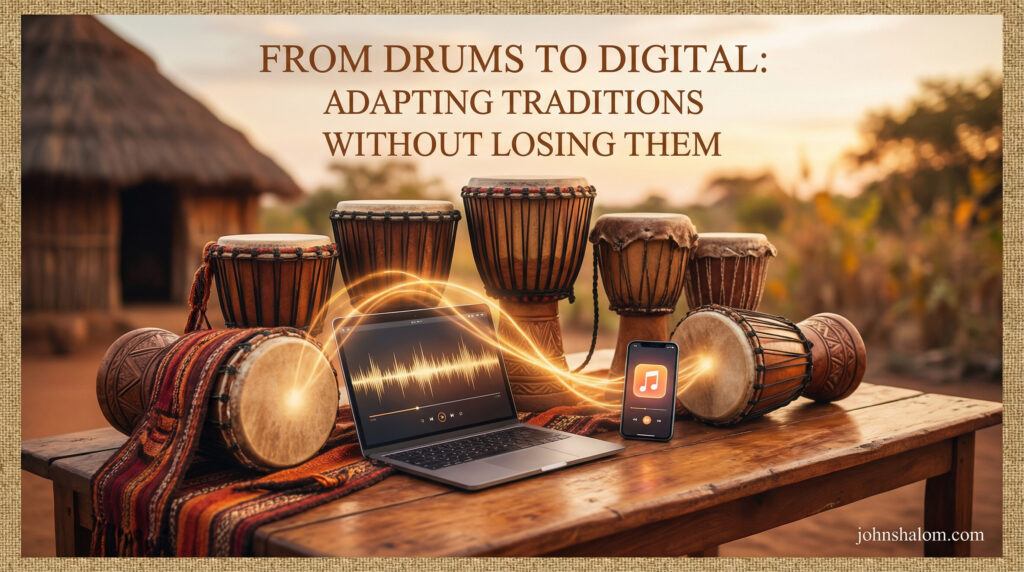
This article shows how communities can move from drums, fireside stories, and village gatherings to phones, cameras, and social media without losing their soul. Traditions do not have to die when they meet technology. They can be recorded, translated, shared, and even renewed online. The key is to keep the heart of the tradition alive: the values, the memory, the respect, and the human connection. Digital tools then become new drums, calling people together across distance and generations.
When I was a boy, the sound of drums meant something important was happening. You could be deep in the field or by the river, and once the drum spoke, your feet started moving toward the village center before your mind even caught up. A wedding, a funeral, a community meeting, a warning, a celebration – the drum carried the news faster than any newspaper ever did. It was our notification tone, our group chat, our breaking news alert.
The drum was not just wood and animal skin. It was a heartbeat. It told us we belonged to something larger than ourselves.
Today, the drum has a rival. We no longer wait for a rhythm to echo through the trees. We wait for a vibration in our pockets. WhatsApp groups, TikTok clips, Facebook posts, Telegram channels – they now carry the news that drums once announced. The tools have changed. The question is whether the meaning will survive the change.
Why Traditions Feel Like They Are Disappearing
Sometimes it feels as if culture is being swallowed by the digital world. Children who once gathered around fires to hear proverbs now gather around screens to watch strangers dance for likes. Weddings that once lasted for days with traditional songs now compete with loud speakers, DJs, and photo shoots designed more for Instagram than for community memory. Funerals that once brought entire villages together now share space with live-streams and online condolences.
It is easy to panic and say, “Our traditions are dying.” But traditions are tougher than we think. They bend, they stretch, they move across time. What kills a tradition is not change. What kills it is forgetting why it existed in the first place.
The first question is not, “Are we still using drums?” The first question is, “Are we still using anything at all to gather, to remember, to honor, to teach, to heal?”
The Comedy of Drums Meeting Digital
Change rarely arrives quietly. It often comes with confusion and comedy.
I once attended a wedding where the master of ceremonies shouted, “Now it is time for traditional dance!” In my childhood, that sentence would have made people spring to their feet, ready to jump, sing, and stamp the ground until dust joined the celebration.
At this wedding, half the young people did something else. They pulled out their phones.
Some stood to dance, but others stood to record. A few formed a circle, not to join the rhythm, but to capture the best angle for TikTok. An elder beside me shook his head and muttered, “They are watching the dance instead of becoming the dance.”
At first, I agreed with him. It felt like the phones were stealing the soul of the moment. Then I looked closer. A girl was filming her grandmother’s steps with a tenderness in her eyes that touched me. A young man whispered, “I want to send this to my cousin in the refugee camp so he can feel like he is here.”
That is when I realized something. The phone was not the enemy. The enemy was forgetting. If those videos are saved, shared, and remembered, they may one day teach a child thousands of kilometers away how his people once danced for a bride and groom. The tool looked modern, but the purpose was still ancient: do not lose the story.
Of course, not all attempts at digital adaptation go smoothly. One uncle of mine once tried to send a marriage proposal by email. No cows, no elders, no formal visit. Just carefully typed words and a “send” button. The girl’s family did not know whether to laugh or be offended. In their world, a proposal that arrives without elders is like a drumbeat with no drummer. To this day, we still tease him: “Are you marrying the family, or just the inbox?”
These clashes between drums and digital are not just problems. They are lessons. They show us where the form is changing faster than the meaning.
What Must Never Change
If we want to adapt traditions without losing them, we must separate form from heart.
The drum itself was never the most important part. The most important part was what it did.
The drum gathered people. The drum warned of danger. The drum called us to dance, to mourn, to pray, to listen. It said, “Come. You are part of this story.”
Today a WhatsApp group can gather people. A Facebook post can call for a meeting. A live video can invite scattered family members to share a wedding or mourn a loss. These tools can carry the same heart, or they can carry only noise. The difference is not the technology. The difference is intention.
Here is a simple test for any new digital form:
- Does it still bring people together, or does it isolate them further?
- Does it still honor elders, ancestors, and God, or does it only promote individuals?
- Does it still pass wisdom, or does it only chase entertainment?
- Does it still teach children who they are, or does it push them to copy strangers?
If the answer is “yes” to the first part of those questions, then the tradition is adapting. If the answer is “no,” then we are slowly dropping our identity to pick up a borrowed costume.
A Warning Story: When the Screen Swallows the Ritual
Not every digital innovation protects tradition.
I once watched a funeral that was being live-streamed. Phones were raised high, people were posting real-time updates, and someone even tried to “go live” during the prayer. It was as if half the people were more present for the screen than for the grieving family.
Later, I asked one of the elders how he felt. He said, “I do not mind if people far away join us by phone. That is good. But some of those standing next to the coffin were not really here. Their faces were with the camera.”
That is the danger. When the tool for sharing begins to replace real presence, tradition loses its weight. Mourning is not just about seeing the event. It is about standing next to someone who is crying, touching a shoulder, sharing silence, singing together. No camera can replace that.
Adapting our customs means asking, “How do we use digital tools to support the ritual, not to swallow it?” Maybe you record before or after the key moments instead of during the most sacred parts. Maybe you designate one person to film while the others participate fully. The goal is balance, not total rejection of new tools.
From Firelight to Screenlight
When my grandmother told stories, her technology was simple: fire, darkness, and voice. We would sit around her as she spoke of animals that talked, ancestors who crossed rivers, and spirits that watched over cattle. We did not have books. We had her memory.
Today, my “fireplace” is sometimes a screen. I write articles that travel farther than her voice ever did. I talk to readers who sit in apartments in London, buses in Nairobi, or villages in Uganda. Sometimes I speak to them through words. Sometimes through video.
For a while, I felt guilty. Was I betraying her tradition by moving from fire to keyboard?
Then I remembered what she once told me: “Stories are like water. They must keep flowing, or the people will dry out.” She did not say the water must always move in the same type of pot. She cared that it kept people alive.
You might also like: Essential Computer Skills for the 21st Century: From Basics to Advanced Tips
Her tool was the night fire. Mine is the internet. The important thing is whether the story still gives identity, wisdom, and hope.
Young Creators as Cultural Builders
One of the most encouraging sights I have seen recently is a group of young people recording elders as they share songs, histories, and rituals. They post the videos on YouTube and TikTok. They add translations in English so that those in the diaspora – and even foreigners – can understand.
At first, some elders were shy or suspicious. “Why are you filming me?” they asked. “Who will watch these old things?” The youths answered, “Our children. And theirs. And maybe the world.”
In that moment, I saw my Being + Doing = Meaning formula at work.
Being is identity, heritage, the stories that make us who we are.
Doing is the choice to use cameras, microphones, and editing tools to record and share.
Meaning appears when the old stories survive in new forms and touch new hearts.
These young creators are not just chasing views. They are guarding the memory of the tribe with the tools of the time. They are builders, not bystanders.
The Risk of Borrowed Culture
Global digital culture is strong. It has money, music, colors, and endless entertainment. If we are not careful, it will not just live beside our traditions. It will push them aside.
A child who knows every Western movie but no local folktales is like a tree with branches but weak roots. The first strong wind of identity crisis may uproot them. They know how to dance to global beats, but they do not know what their own drums once said.
The answer is not to lock children away from the digital world. That is impossible and unfair. The answer is to teach them to stand with two feet: one in their heritage, one in the global village.
We can encourage them to:
- Learn their traditional dances and also enjoy modern music.
- Listen to elders’ stories and also watch educational videos.
- Use English or other global languages and still speak their mother tongue proudly.
The goal is not to choose between drums or digital, but to let digital carry the sound of the drums further.
A Small Story of Balance
A friend of mine once organized a cultural day for youth. He invited elders to lead traditional dances and storytelling sessions. He also told the youth, “Bring your phones.”
During the first half of the day, everyone participated fully. No filming, no posting. Just dancing, singing, clapping, listening. Feet moved, dust rose, and the old songs woke up again.
In the second half, he said, “Now, film. Record your favorite part. Interview the elders. Share what you learned.” Suddenly, the place transformed into a small digital studio. Youth asked questions, elders explained the meaning of certain steps, and cameras captured everything.
Later, I saw the clips online with captions like, “This is how my people celebrate a bride,” or “This song reminds us of our cattle and our God.” The comments section filled with people saying, “I did not know this,” and “I remember this from childhood,” and “Please share more.”
That day showed me what balance can look like. Full presence first, digital preservation second. Both needed. Neither idolized.
Tradition, Youth, and the Future
Sometimes elders complain that young people are “lost in their phones.” Sometimes young people complain that elders are “stuck in the past.” If both sides keep shouting, the bridge between them will collapse.
What if we saw it differently?
Elders carry the original fire. They remember the songs, dances, rituals, and stories. Youth carry the new wires. They understand the apps, the networks, the platforms.
Fire without wires warms one small circle. Wires without fire carry nothing but noise. Put fire and wires together, and a whole nation can be lit.
That is the invitation:
Elders, do not be afraid of cameras and microphones. See them as new drums.
Youth, do not be ashamed of proverbs, dances, and rituals. See them as deep roots in a shallow world.
If both work together, traditions will not only survive. They will travel.
From Drums to Digital: The Real Question
The real question is not, “Are we losing our traditions because of technology?”
The real question is, “Are we willing to do the daily work of carrying meaning from old forms into new forms?”
If we remember why our people used drums, songs, dances, rituals, and proverbs, we can find digital ways to express the same truths:
We belong to one another.
We come from somewhere.
We answer to God.
We honor our dead.
We celebrate our unions.
We laugh in our pain.
We teach our children who they are.
The tool can be a drum, a fire, a book, a microphone, or a smartphone. The heart must remain the same.
If you would like to know more about my path as a writer, including the struggles, lessons, and small signs of progress along the way, you can read the full story on my Wealthy Affiliate blog here: https://my.wealthyaffiliate.com/johnmaluth/blog
Reflection Questions
- What tradition from your childhood do you think could be recorded or shared digitally without losing its meaning?
- When have you seen phones or social media weaken a cultural event, and how could that moment have been handled differently?
- What is more important to you in a tradition – the exact form it takes, or the meaning it carries? Why?
- How can you, in your own small way, use digital tools to protect and pass on the stories, songs, and values of your people?
- If your grandparents could see how you use technology today, what tradition would you want to show them proudly and say, “Look, we did not forget this. We just found a new way to share it”?
FAQs
- What does “from drums to digital” really mean?
It describes the journey from older ways of sharing culture, like drums, songs, and oral storytelling, to newer tools such as smartphones, videos, podcasts, and online platforms. - How can we adapt traditions without losing their meaning?
By protecting the core values and stories while allowing the form to change. A song can move from the village square to YouTube, as long as the language, message, and respect for elders and ancestors remain. - Can technology damage our culture instead of helping it?
Yes, if it leads us to mock our roots, replace our language, or chase likes instead of truth. But when used with wisdom, technology can help preserve songs, histories, and customs that might otherwise be forgotten. - What practical steps can communities take to protect traditions in the digital age?
They can record elders’ stories, document dances and songs, create online archives, teach children both local language and digital skills, and set clear rules about sharing sacred or private content. - How can young people honor tradition while using modern tools?
They can create content that respects their elders, uses local languages, explains cultural practices, and corrects harmful stereotypes. In this way, phones and laptops become tools for pride and protection, not for hiding where they come from.