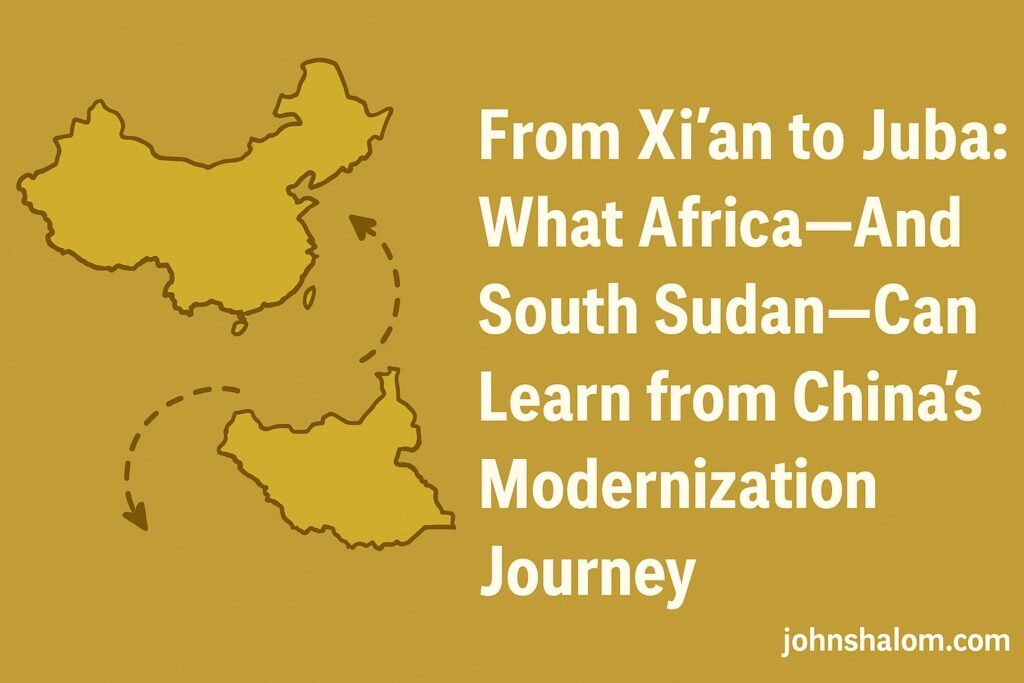
TL;DR:
China’s rise from poverty to power holds lessons for Africa and South Sudan. Its progress was built on discipline, vision, and long-term planning rooted in local realities. For South Sudan, modernization must mean more than infrastructure—it must unite people, empower citizens, and adapt lessons to local culture. True growth begins when a nation believes in its own potential.
On the 19th of July 2025, I sat in the echoing halls of Chinese wisdom, not in a palace of emperors but in a hotel that was once an imperial seat during the Tang dynasty in Xi’an—a city that could teach Juba and Johannesburg a thing or two about legacy, transformation, and how not to let your past limit your potential.
The experience, part of a broader academic and diplomatic exchange, presented two thought-provoking lectures that shook my African assumptions like a baobab tree in a dry season windstorm.
FAQs
1. What can Africa learn from China’s modernization?
That sustainable growth requires vision, investment in education, and self-reliance. Progress must come from within, not dependence on aid.
2. How is China’s model relevant to South Sudan?
China developed by focusing on stability, unity, and long-term planning—principles South Sudan can apply to rebuild its institutions.
3. What challenges could arise in following China’s example?
Cultural and political differences matter. Blind imitation won’t work; adaptation with respect for local context is key.
4. How does culture influence modernization?
Culture anchors progress. Nations thrive when modernization builds on traditional values rather than erasing them.
5. What’s the biggest takeaway for South Sudan?
Modernization is not just about roads or buildings—it’s about mindset. When citizens value education, peace, and purpose, development follows naturally.
Modern Agriculture with Chinese Characteristics
Professor Feng Yongzhong’s lecture on Modern Agriculture and Technology Innovation and Food Security pulled us right into the furrows of China’s transformation. He wasn’t preaching theories but presenting lived realities—how Chinese farmers, with the help of their government, transitioned from scratching the earth with little to show, to now feeding over 1.4 billion people with scientific precision.
Before technology? Poor yields. After intelligent irrigation, breeding innovation, and soil management? Food security and export power. The professor didn’t hold back on China’s challenges either: climate change, COVID-19, chemical overuse, and policy gaps. But what stood out was how China doesn’t avoid problems—they engineer solutions.
We learned about China’s policy and legal structures to guarantee food security. I couldn’t help but think: South Sudan has arable land, natural water resources, and a youthful population—but lacks organized policy frameworks, technological adoption, and long-term food security vision. Why? Because we plant seeds of hope but forget to water them with political will.
We also visited the Yangling Seed Industry Innovation Center and the Yangling Kiwifruit International Innovation Park—not your typical field trip. These were living museums of modern farming: where science and soil shake hands, and farmers wear lab coats. After a hearty lunch, we bussed off to Xi’an—China’s ancient capital with modern dreams.
Modernization with Chinese Characteristics
In the afternoon, Professor Li Lu gave a historical and ideological panorama titled Shaanxi Practices in Advancing Chinese Modernization. Here, history met ideology in an elegant academic waltz. Xi’an, once the capital of the Tang dynasty, became a case study in how a nation rooted in tradition could modernize without abandoning its soul.
According to Prof. Li, modernization is not one-size-fits-all. Western modernization, he argued, prioritizes individual wealth, secularism, and capitalist ideals. The Chinese version? A blend of spiritual and material prosperity, collective well-being, and harmony between man and nature. Think Confucius meets Artificial Intelligence.
He emphasized President Xi Jinping’s ties to Shaanxi and his role in the Forum on China-Africa Cooperation (FOCAC), asserting that China aims for “modernization for all,” not just the elite. For Africa, still grappling with colonial aftershocks and tribal suspicions, that phrase should be a policy blueprint.
Africa’s Mirror Moment
Let’s be honest—when Africans think of modernization, our minds jump to skyscrapers, imported SUVs, or adopting the latest Western apps. Rarely do we ask, “What modernization fits us?” China’s journey answers that: modernization must be domesticated. It must wear the local cloth, speak the native tongue, and nourish the local belly.
China did not copy the West. They examined their past—dynasties, wars, revolutions—and asked themselves what was useful. They adapted socialism, not as Soviet mimicry, but as “Socialism with Chinese Characteristics.” They never gave up on their civilization’s spiritual spine.
Africa, and South Sudan in particular, often tries to wear democracy as if it were a universal fit, forgetting that our villages still operate on chiefdoms, communal living, and oral law. We borrow Western structures, then wonder why our governments walk like crabs.
Agriculture: From Ox-Plow to AI
Professor Feng’s insights into China’s green revolution should alarm every African ministry of agriculture. China turned rice paddies into national pride, while we let fertile valleys turn into political battlefields.
The solution is not complicated. South Sudan can begin with:
1. Policy Frameworks that support research institutions and empower rural farmers.
2. Youth Empowerment programs that train local innovators in soil science and irrigation.
3. Public-Private Partnerships that bring tech firms into farming, not just urban fintech.
4. Legal Reforms that protect agricultural investments and land ownership.
Why can’t we have a Maban Maize Innovation Center or a Juba Sorghum Tech Park? Why not indeed?
Ideology: More Than Imports
Professor Li reminded us that ideology matters. China’s modernization succeeded because it aligned with the people’s belief systems. Africa, meanwhile, often adopts Western ideologies like fast food—quick, addictive, but not nutritious for our context.
We don’t need to reject democracy, but we must Africanize it. Our governance must be participatory but rooted in community wisdom. Our economic policies must pursue equity, not just elite enrichment. Our modernization must reflect ubuntu, pan-Africanism, and yes, even our grandmothers’ sayings.
China Didn’t Beg—They Built
Prof. Li boldly stated that China was held back for decades by Western interference—but they didn’t let that define them. They built. They resisted dependency. They invested in education, science, and self-respect. That, dear reader, is the real modernization.
Too often, Africa wears colonial wounds like badges of honor. We need healing, not memorialization. Modernization is not about forgetting the past but building a future that doesn’t depend on begging for aid or importing values that divide instead of unite.
From Tang Dynasty to Tribal Harmony
Sitting in the palace-turned-hotel in Xi’an, I thought: if these walls could talk, they would probably ask South Sudan, “Why do you still fight over cows when you can fly drones to monitor them?” Our tribal tensions, corruption cycles, and donor dependency are not modernization. They are a failure to modernize from within.
Just like the Tang dynasty left behind palaces, South Sudan can build legacy institutions, cultural centers, and innovation hubs that reflect our ancient wisdom and modern hopes. But we must do the work. Being African is not a weakness—it’s a raw potential waiting for vision.
You might also like: The Ultimate Guide to Political Journalism: Ethics, Challenges, and Impact in the Modern World
The China-Africa Connection: Real or Romance?
FOCAC isn’t a magic wand, but it’s a start. If China and Africa can cooperate—not as donor and recipient, but as *equal partners*—we might just break the development curse. As Prof. Li noted, China’s philosophy is not about conquest but cooperation. They didn’t colonize. They collaborated.
But Africa must meet China halfway. Let us:
* Send students who return to build, not settle abroad.
* Sign deals that benefit rural farmers, not just political elites.
* Invite Chinese technologies, but localize them.
* Embrace Chinese discipline without losing African joy.
A Final Word from the Road
As we head toward more field and factory visits, I’m struck by a recurring thought: Modernization is not a destination—it’s a discipline. China didn’t just rise—they rose consistently. They planted seeds of transformation in hard soil and watered them with stubborn vision.
Africa can do the same. South Sudan can too.
It starts with being proud of who we are, doing the hard work of development, and discovering the meaning that connects our past and future.
After all, as I like to say: M = {B, D²}
(Meaning = Being plus Doing, squared)
Author Bio:
John Monyjok Maluth is an author of 100 books, coach, and educator from South Sudan. He is passionate about transforming lives through education, civic thought, and development writing.