
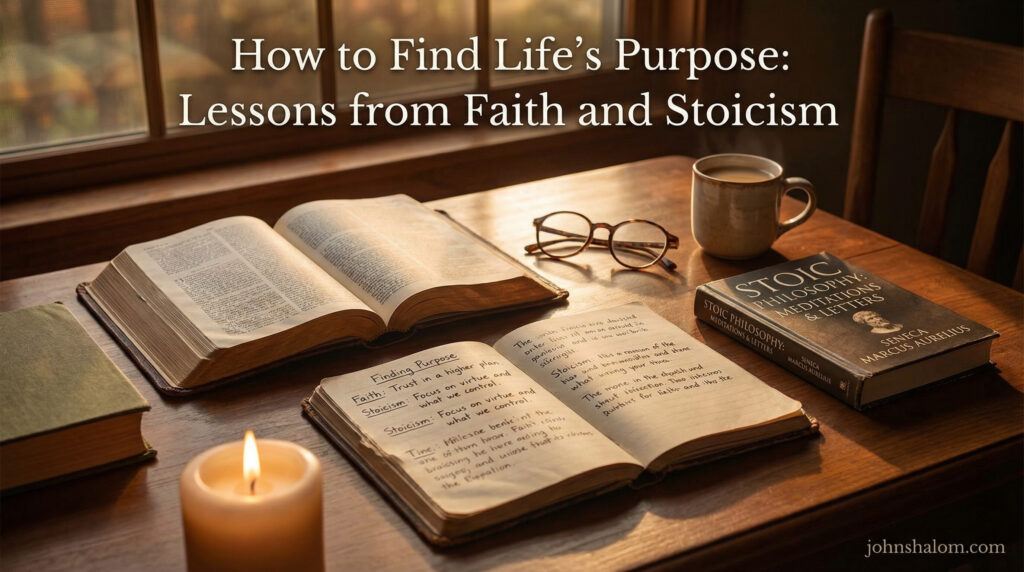
TL;DR:
Many people wait for purpose to arrive as a big clear voice from heaven or from success. Often it appears instead through small faithful steps taken each day. Faith reminds us that we are created for a reason.
Stoicism reminds us to act wisely with what we can control and to accept what we cannot change. When you bring these two together, purpose stops being a mystery and becomes a way of living. You discover who you are, what you can do, and whom you are called to serve, not in theory but in real life, one decision at a time.
Introduction: Why Purpose Matters Now
1.1 The quiet question many people carry
You can have a job, a family, and a busy routine, yet still feel a question inside: “Why am I here?” It does not always shout. Sometimes it whispers at night when you cannot sleep. Sometimes it appears after a crisis, when what used to make sense no longer does.
I remember sitting in a crowded city far from the Sobat River where I grew up. There were cars, lights, and shops. Food in the markets. Yet inside I heard another question: “Did I survive bullets, hunger, and loss only to chase money and comfort, or is there more?”
I knew I was not the only one asking. From Juba to Johannesburg, from London to Lagos, many people carry the same quiet question while pretending to be fine.
1.2 Why old answers no longer satisfy
Many of us were taught that life’s purpose is simple. Go to school. Get a good job. Build a house. Marry. Raise children. Support your relatives. These are good and honorable goals. I value them deeply.
But when war comes. When you lose a loved one. When your health breaks, or a job disappears. These answers do not always satisfy the deeper hunger inside. The question returns: “Is this all, or is there something more?”
For me, that “something more” came through two streams that met: faith and Stoicism.
Faith speaks about God, calling, love, and eternity.
Stoicism speaks about reason, discipline, and living well in a hard world.
When these two meet, they offer a way to live with purpose that is realistic about pain and still full of hope.
What Do We Mean by Life’s Purpose?
2.1 Purpose is more than a job title
Purpose is not just what you do for money. It is the steady line that runs through your life even when your job, country, or season changes.
Purpose is the combination of:
- Who you are.
- What you care about.
- The problems you are willing to face for the sake of others.
You can lose a job and still keep your purpose. You can move from the Sobat River to Juba, from Juba to Nairobi, from Nairobi to London, and still carry your purpose with you. That is why it must be built on something deeper than a monthly salary.
2.2 Being, doing, and meaning
I often express this with a simple life formula:
Meaning = {Being, Doing²}
Being is who you are. Your story. Your character. Your deepest identity before God. The child who survived war. The son or daughter who carries a family name.
Doing is what you actually do, again and again, with intention. The words you write. The people you serve. The work you show up for. The habits you build.
When your doing grows from your being, life begins to make more sense. You do not feel like two different people. You feel more whole.
What Faith Teaches About Purpose
3.1 Created on purpose, not by accident
From a faith point of view, you are not here by accident. You are created, seen, and loved by God. Before you were born, God already knew your days. That means your life is not a random story that just “happened.” There is a Caller behind your calling.
When you accept that, your pain starts to look different. Hard seasons are no longer proof that God has forgotten you. They can become part of your preparation. In my own life, surviving bullets, famine, and loss shaped a kind of toughness, but also a kind of tenderness. That mix now feeds my writing and teaching.
Faith tells us: your story, including its wounds, can be used in your purpose.
3.2 Calling is about service, not status
In many churches and offices, calling is reduced to titles. Pastor, prophet, director, CEO. People may think, “If I do not have a big title, I do not have a calling.”
True calling is wider than that. It is any life that uses God-given gifts to serve others with love and integrity.
You can live your calling as:
- A teacher in a forgotten village.
- A mother or father raising children with wisdom.
- A writer sharing honest words online.
- A driver who brings people home safely each day.
- A quiet worker who keeps an organisation running.
The key question is not, “How visible am I?” but, “Whom am I serving, and how faithfully?”
3.3 Faith and daily obedience
Faith also teaches that purpose is usually discovered step by step, not all at once. You rarely receive a full life map. You receive enough light for the next small step.
Forgive when it is easier to hate.
Tell the truth when a lie would protect you.
Help a neighbour.
Write the next page.
Finish the assignment in front of you.
When you obey in small things, bigger doors often open. The path that looked dark at the beginning starts to show a pattern when you look back.
You might also like: The Self-Help Roadmap: Proven Strategies for Personal Growth and Healing
What Stoicism Teaches About Purpose
4.1 Focus on what you can control
Stoic thinkers remind us of something very simple and very hard: focus on what you can control and accept what you cannot change.
You cannot control:
- The economy.
- The weather.
- Your tribe’s history.
- Other people’s decisions.
You can control:
- Your thoughts.
- Your words.
- Your actions.
- Your effort.
As a young man, I wasted energy complaining about things far away from my reach. Later, learning to think in a Stoic way helped me save that energy for work I could actually do. That shift reduces anxiety and frees strength for meaningful action.
4.2 Virtue as the real success
For a Stoic, real success is not a big house or a big title. It is a life marked by four key qualities:
- Wisdom.
- Courage.
- Justice.
- Self-control.
You measure your day not by how many people praised you, but by questions like:
- Was I honest?
- Was I fair?
- Did I act with courage?
- Did I control my anger, my tongue, and my desires?
When you choose these qualities again and again, your life starts to show a clear pattern. That pattern is part of your purpose.
4.3 Purpose as practice, not feeling
Stoicism does not ask you to wait until you “feel” inspired. Feelings rise and fall.
Instead, it asks you to choose a good action now, even when emotions are low.
Write one page.
Say one kind word.
Improve one small thing at work.
Keep one promise.
These steady practices shape your character. Over time, your character shapes your direction.
Where Faith and Stoicism Meet
5.1 Shared respect for self-discipline
Faith calls you to obedience. Stoicism calls you to discipline. Both agree that an uncontrolled life cannot be a purposeful life.
If you say, “God has called me to write,” but you never sit down to write, something is wrong.
If you say, “I want to be a wise parent,” but you refuse to control your temper, something is wrong.
Purpose is not only knowing your calling. It is building habits that match your calling.
5.2 Accepting limits and trusting God
Faith invites you to trust God with what you cannot control. Stoicism invites you to accept those limits without bitterness. Together, they help cut endless complaining.
You can say:
“I will do my part with courage and honesty.
I will trust God with the outcomes.
I will accept what I cannot change and still choose to love, serve, and build.”
That simple posture brings peace in a world that keeps shaking.
5.3 Serving others as common ground
Both faith and Stoicism point you away from selfish living.
Faith says, “Love your neighbour as yourself.”
Stoicism says, “Live for the common good of the human family.”
Purpose grows when you stop staring only at your own face in the mirror and start asking, “Who needs what I can give today?”
In my own life, my deepest sense of purpose does not come when I am thinking only about my own success. It comes when I see someone’s eyes light up because something I wrote or taught gave them courage.
Simple Practices to Start Living With Purpose
6.1 Daily examen: three simple questions
Each evening, sit quietly for a few minutes and ask:
- Where did I live according to my values today?
- Where did I fail or act below my calling?
- What one thing will I do differently tomorrow?
Write short answers in a notebook. Do not try to impress anyone. Be honest. Over weeks and months, you will start to see patterns. This is faith and Stoicism working together: reflection plus responsibility.
6.2 Purpose journal: connect story and calling
Take a few pages and answer these prompts:
- Times I felt most alive and useful.
- People I deeply care about serving.
- Skills and experiences I already have.
Be as specific as you can. Include small moments, not just big ones.
You may notice that you often feel alive when teaching, or solving technical problems, or listening to people in pain, or working with your hands. You may see that you care about children, or writers, or widows, or small business owners. These links point toward your purpose.
6.3 Morning rule: one faithful act
Each morning, choose one small act that fits your sense of calling. It might be:
- Writing for 30 minutes.
- Encouraging someone who is struggling.
- Improving one weak point in your work.
- Spending focused time with a child without checking your phone.
If you repeat this daily, you will have 365 small acts of purpose in a year. That is how meaningful lives are built, in quiet steps.
Common Roadblocks and How to Handle Them
7.1 Waiting for a perfect sign
Many people wait for a dramatic sign before they move. A dream. A prophecy. A voice from heaven. While God can use strong signs, often He guides through ordinary steps and wise counsel.
Instead of waiting forever, start with what you already know is good: honesty, service, learning, kindness, diligence. As you walk, more guidance usually appears. It is easier to steer a moving bicycle than one that never leaves the yard.
7.2 Fear of failure and judgment
Fear says, “If I try and fail, people will laugh. If I speak and stumble, people will mock me.”
Stoic thinking reminds you that other people’s opinions are not under your control. Faith reminds you that God is looking at your heart and effort, not just at your public results.
Failure can become a teacher. It can show you your real strengths and limits. It can refine your calling, not destroy it.
7.3 Confusion and too many choices
Today you can see thousands of life options on your phone. That can create paralysis.
One practical rule is this:
- Choose one meaningful area to serve in for this season.
- Commit to it for a set period, such as six months or one year.
- Do your best in that field.
- Then review.
This keeps you moving without scattering your energy into a hundred half-starts.
Conclusion: Purpose as a Daily Road, Not a Final Destination
Life’s purpose is not a single moment when everything becomes clear and never changes again. It is a road you walk with God, using both faith and reason.
Faith tells you your life matters to God and to others.
Stoicism helps you take steady steps even when circumstances are harsh.
You may never feel fully ready. Start anyway.
Ask honest questions.
Use the gifts you already have.
Serve the people already in front of you.
Review your days. Adjust your actions.
One day you will look back and see that purpose was not waiting for you far away. It was being formed inside you, through every faithful choice, every act of courage, and every quiet decision to keep going when it would have been easier to quit.
If you would like to know more about my path as a writer, including the struggles, lessons, and small signs of progress along the way, you can read the full story on my Wealthy Affiliate blog here: https://my.wealthyaffiliate.com/johnmaluth/blog
FAQS
- Can I find life’s purpose without religious faith?
Yes. You can live in a meaningful way by serving others, using your strengths, and acting with integrity. Many people do this. Religious faith, however, gives a larger story about why your life matters, what your suffering can mean, and where your story is heading. That larger story can deepen your sense of calling.
- How do I know if something is really my purpose or just a passing interest?
Purpose usually lasts longer than excitement. A passing interest fades when things become hard or boring. A real calling keeps calling you back even when the work is difficult or unseen. If you can keep showing up to a task for years, with a sense that it still matters, that is a strong sign it is part of your purpose.
- What if my circumstances are very hard right now?
Hard conditions do not cancel purpose. You may not control your environment, but you can still choose your attitude, your words, and your daily actions. Many of the strongest callings are shaped in prisons, refugee camps, hospital beds, and war zones. Start with small faithful steps where you are.
- How can I bring faith and Stoicism together in daily life?
You can pray, read Scripture, and seek God’s guidance, then apply Stoic practices such as focusing on what you can control, reviewing your day, and choosing actions based on virtue. Trust God with what you cannot change. Use your reason to act wisely with what you can change.
- What if I feel too broken or too late in life to find purpose?
You are not too late, and you are not too broken. Some of the most meaningful chapters of a life are written after deep loss or failure. Your scars can become part of your assignment. Start where you are, with what you still have, and with the people still around you. Purpose is not only for the young and strong. It is for anyone willing to let being and doing work together for the good of others.


I appreciate the heart behind this and the desire to help people live intentionally. As a follower of Christ, though, I would say my understanding of purpose rests first and fully in Scripture rather than in Stoic philosophy.
I do see some overlap in ideas like discipline, self-control, and serving others, but for me those flow from walking with Christ and being led by the Holy Spirit, not from human philosophy. My purpose isn’t something I discover by balancing faith with another framework, but something I grow into as I follow God’s will day by day.
Still, I value the encouragement here to live thoughtfully, act with integrity, and take small faithful steps. Those are principles that align well with a biblical life when they’re rooted in Christ as the foundation.
Jason, thank you for saying this clearly and respectfully. I hear you. For a Christian, purpose starts with God, not with a human system. And if anything from Stoicism is useful, it should sit in the tool shed, not on the throne.
What I tried to do in the piece was name the overlap without confusing the source. Discipline, self-control, endurance, honesty, service. Those can look similar on the surface, but the root matters. In the Christian life, the root is Christ, Scripture, and the Spirit’s leading. The fruit is a shaped life. That difference is not small.
I also like how you put it: purpose is something you grow into as you follow God day by day. That is real. It keeps purpose from becoming a one-time discovery and makes it a daily obedience.
If you had to point to one Scripture that anchors your sense of purpose when life gets noisy, which one would it be?