How to Use Blockchain Technology to Secure Your Online Transactions
TL; DR
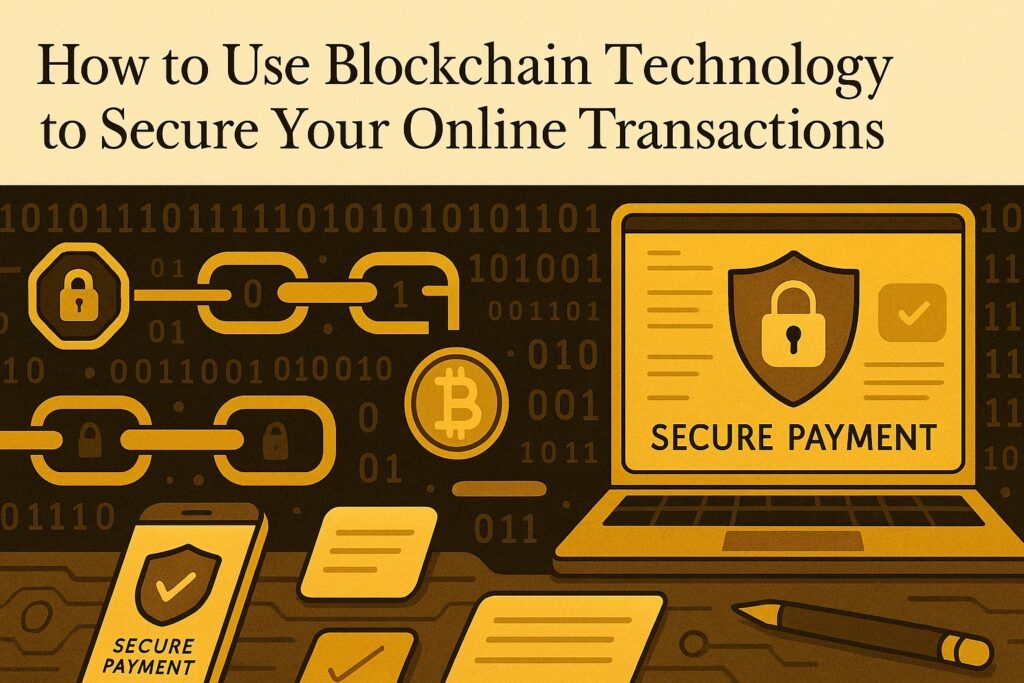
You can use blockchain to secure online transactions by recording them on a shared digital ledger that is hard to change, protected by cryptography, and verified by many computers instead of one central server. Each transaction is signed with private keys and grouped into blocks that are linked together, which makes fraud and tampering very difficult. When combined with secure wallets, good passwords, and trusted platforms, blockchain can help you move money and data online with higher security and transparency.
FAQs
1. What is blockchain in simple terms?
Blockchain is a special type of digital record where transactions are stored in blocks that are linked together in a chain. Many computers keep copies of this chain, so no single person or company fully controls it.
2. How does blockchain make online transactions more secure?
Each transaction is signed with cryptographic keys and checked by many computers. Once a block is added, changing it would require altering copies on most of the network, which is extremely hard and expensive.
3. What is the difference between blockchain payments and normal online payments?
Traditional payments pass through banks or payment processors that keep their own records. Blockchain payments are recorded on a shared ledger that anyone can verify, reducing single points of failure and making tampering easier to detect.
4. What are public and private keys and why do they matter?
A public key is like your account number that others can see. A private key is like your secret password that proves you own the account. You use the private key to sign transactions. If someone steals it, they can control your funds.
5. Do I need to build my own blockchain to secure transactions?
No. Most individuals and businesses use existing blockchains such as Bitcoin, Ethereum, or private enterprise blockchains offered by technology providers.
6. Are blockchain transactions completely anonymous?
Most public blockchains are pseudonymous, not fully anonymous. Addresses do not show real names, but all transactions are visible. With enough information, addresses can sometimes be linked to real people or companies.
7. How can a small business use blockchain to secure payments?
A small business can accept cryptocurrency payments, use stablecoins for lower volatility, or use blockchain based payment gateways. They can also use blockchain for secure invoices or records that customers can verify.
8. What are smart contracts and how do they help with security?
Smart contracts are programs stored on a blockchain that run automatically when conditions are met. They can enforce rules for payments or access without manual work, reducing human error and making processes more transparent.
9. What risks should I watch for when using blockchain for transactions?
Main risks include losing private keys, using insecure wallets, falling for scams, or relying on poorly written smart contracts. You should choose trusted services, back up keys safely, and test small amounts first.
10. How can I start using blockchain securely as a beginner?
Begin with a reputable wallet or exchange, enable two factor authentication, store recovery phrases offline, and move small test amounts before larger ones. Learn basic security practices and only use platforms with a clear track record and support.
Learn how to use blockchain technology to secure your online transactions today.
Introduction: From the Sobat River to Online Banking
I grew up on the banks of the Sobat River, where money moved in a very simple way. If my father sold a cow, he received his payment in front of everyone. People watched, counted the cattle, and went home. No passwords. No PINs. No one asked for a “one time code.” The community itself was the receipt.
Fast forward many years. I am in Juba, later in Nairobi, typing my card details into a website. The cow is gone. The face of the buyer is gone. The crowd is gone. What remains is a blinking cursor, a VISA logo, and a small warning: “Do not share your PIN with anyone.”
That is when fear enters.
Is this website safe?
Can someone steal my card details?
What if I press “Pay” and the money disappears into a digital bush, never to return?
If you grew up in a cash and cattle world, then jumped into online banking, mobile money, Payoneer, PayPal, and card payments, you know this feeling. You want the speed of technology, but you also want the safety of the village crowd watching every transaction.
Blockchain technology is one of the tools humans have created to bring that village-style trust into the digital world. It is not magic. It is not perfect. It is simply a different way of recording and verifying who owns what, and who sent what to whom.
In this article, I want to talk to you, not as a computer scientist, but as someone who has moved from mud to modem, from riverbank to online bank. I will explain what blockchain is, how it works, and how it can help secure your online transactions. Along the way, I will tell a few stories from my own journey with money, trust, and technology.
What Is Blockchain Technology? Explained in Simple Language
Before I ever heard the word “blockchain,” I already knew what a chain of trust was. In the village, when someone owed another person a cow, people remembered. Old men sitting under a tree could tell you who owed whom from ten years ago. The “database” was human memory and community records.
Blockchain is like that, but digital.
- It is a way of storing records
Blockchain is a special type of database that stores information in blocks. Each block contains a group of transactions, such as “Alice sent 0.1 coin to Bob.” - Each block is connected to the previous one
Once a block is complete, it is linked to the block before it using a cryptographic hash, which you can think of as a unique fingerprint. The blocks form a chain. That is why it is called “blockchain.” - It is shared by many computers, not owned by one
This is very important. The blockchain is not stored on one bank’s server somewhere in a building you do not know. It is stored on many computers, called nodes, which are part of a network. They all hold copies of the same chain.
- It is very hard to change past records
Because each block’s fingerprint depends on the previous block, changing one record would require changing many blocks on many computers at the same time. That is extremely hard and expensive.
So, in short:
Blockchain is a shared, append-only record of transactions stored in blocks, connected like a chain, and protected by cryptography.
You can use it for digital money, but also for other things such as land records, voting, or supply chains. The key idea is that it gives you a shared record people can trust without relying on a single authority.
A Personal Story: When Trust Went Missing
Let me share a simple story.
One day in Juba, I received an SMS. A “bank official” told me that my account was blocked and I needed to confirm my details. The message looked real. The phone number seemed very close to the official one. For a moment, I paused.
I remembered something. When I was younger, a man in the village once tried to buy a cow with false promises. He had no money, only words. My father said, “Money first, words later.”
So I did not reply to the SMS. I went to the real bank branch instead. The staff confirmed that it was a scam.
In the digital age, scammers stand between us and our money in ways our parents could not imagine. This is one reason why safer systems like blockchain attract so much interest. They promise a world where you do not always have to trust the person who sends you a message or the company that holds your data. You trust the rules of the system itself.
How Does Blockchain Technology Work During a Transaction?
Let us imagine a simple situation. You want to send money to a friend online using a blockchain based system. I will call them Alice and Bob, just like in computer science books, but you can imagine yourself and a family member between Juba and Nairobi or Juba and a refugee camp.
- Alice creates a transaction
Alice opens her wallet app and enters the amount she wants to send to Bob. She signs the transaction with her private key. You can think of the private key as a secret pen only she can use.
- The transaction is broadcast to the network
The wallet app sends the transaction to the blockchain network. Many nodes receive it and check it. They verify, for example, that Alice has enough coins, that her signature is valid, and that the transaction follows the rules.
- The transaction enters a block
Valid transactions are grouped into a block. This is like a page of a ledger.
- The block is confirmed by the network
Depending on the type of blockchain, different methods are used to confirm blocks. In Bitcoin, miners use computing power to compete to add the next block. In other systems, validators lock up some of their coins and are randomly chosen to add the next block.
But the idea is similar. Many independent participants agree that “Yes, this block is valid.”
- The block is linked to the chain
Once accepted, the new block is attached to the previous one. The transaction becomes part of the permanent record.
- Bob receives the money
Bob’s wallet shows the new balance. The network has agreed that Alice’s coins have moved to Bob’s address.
No single bank made that decision. No single company can secretly change it later. Many nodes agreed, and the chain now holds the proof.
From a Village Ledger to a Digital Ledger
In my village, when someone disputed a debt, people called witnesses. “Did you see this man paying that man?”
With blockchain, the witnesses are the nodes. Instead of old men under a tree, we have computers around the world checking the rules. Instead of memory, we have cryptographic hashes.
Why Many People Still Fear Online Transactions
Even with stronger systems, many of us still fear sending money online. Let me give you a few real reasons from my own journey.
- The Guangzhou airport incident
When I was passing through Guangzhou, some young African traders tried to convince me to “add a bit of their luggage” to mine. They wanted me to carry undocumented goods and pay for extra weight in my name.
They spoke softly. They even said the airline might “reward” me. But I understood that if I accepted, I would carry their risk on my passport and my name.
Online, something similar happens. People send links, “opportunities,” or “giveaway” pages. If you agree without understanding, you carry their risk on your card, your account, your name.
- The noisy phone and the silent thief
Recently in Kenya, my phone number was published in newspapers. Suddenly, calls started coming in every two minutes. Most of them were nonsense. I had to limit calls to only those in my contacts.
Imagine a world where your bank account receives that same noise. Fake transactions, fake orders, fake login attempts. This is our world now.
- Power cuts and broken cables
Not long ago, power went off in my building. Then my internet service line was cut, likely by Kenya Power or another provider working on nearby wires. I had to move houses, call the provider, and explain my address several times just to restore what I had already paid for.
If power lines and internet cables can be cut, so can data routes. Man in the middle attacks, fake websites, and hacked databases are the digital version of a broken cable.
You can see why people hesitate to trust digital systems with their money.
How Blockchain Helps Secure Online Transactions
Blockchain alone will not fix every problem. Scammers will still talk, fake websites will still appear, and people will still click where they should not. But blockchain gives us some powerful advantages over traditional systems.
- Decentralization
In a typical online payment, your data sits with one main company, such as a bank or payment processor. If a hacker breaks into their system, they can steal from many people at once.
In a blockchain system, the ledger is spread across many nodes. There is no single server to break into. To change a past transaction, an attacker would need to control a large part of the network. That is very hard and very costly.
This does not mean it is impossible, but it raises the cost of attacking the system.
- Immutability
Once a transaction is confirmed and included in a block deep enough in the chain, it is extremely hard to reverse.
Think of it like writing in wet cement that quickly becomes stone. You can write in it at first, but once it is hard, changing it means breaking the road.
For online transactions, this means:
– A fraudster cannot easily rewrite history.
– No one can secretly edit the ledger later to give themselves money.
– Disputes can be checked against the actual chain.
- Transparency with controlled access
On public blockchains, everyone can see the transactions, but not necessarily the real names behind the addresses. This gives a new type of accountability.
For example, if an NGO promises to send funds to a village, the transactions can be checked on-chain. People can see that money left the donor wallet and reached the project wallet. That is a big deal in countries where corruption has delayed many good projects.
At the same time, users do not have to reveal their personal details on every transfer. They use addresses and keys.
- Strong identity and signatures
Blockchain uses cryptographic keys. When you sign a transaction, you produce a digital signature that proves you own the address that sends the funds.
Unlike a handwritten signature, this one is very hard to fake. That is why your private key must remain secret.
This gives stronger assurance that:
– The transaction came from the real owner of the funds.
– The message was not altered on the way.
- Smart contracts and automatic rules
Smart contracts are small programs stored on the blockchain. They can hold money and release it when certain conditions are met.
For example:
– Pay a freelancer only when work is approved.
– Release funds for school fees only when a student is enrolled.
– Hold money in escrow until goods are delivered.
Instead of trusting a third party to keep its promise, you trust the code that everyone can inspect.
Stories From My Own Life That Show Why This Matters
Story 1: The long road of remittances
Imagine a South Sudanese in Australia sending money to family in Juba. Traditionally, money might pass through a bank, then a correspondent bank, then a local bank, then a money transfer agent, then finally the person in the village. At each step, there are fees and sometimes delays.
I know families who wait days, even weeks, for money that left the sender’s account long ago. They walk to town several times, spend money on transport, and still go home empty handed because “the system is down.”
With blockchain based transfers, funds can move directly from one digital wallet to another. There are still fees, but they can be lower and faster, especially across borders. The family can see the transaction on chain within minutes.
Story 2: The fake opportunity
At one stage in my online journey, I tried many programs: Amazon Associates, Payoneer, MailerLite, SFI, and others. Some were good, some were confusing, some were traps in fancy clothes.
What I learned is this: when you cannot see how money flows, it is easy to be fooled. When reports can be edited by a hidden admin somewhere, your income can vanish with one click.
One strength of blockchain based systems is that they can give both sides a clear view of what has happened on the chain. You can see when funds arrived, when they left, and sometimes even the conditions under which they moved.
Practical Ways Ordinary Users Can Benefit From Blockchain Security
You do not need to become a blockchain engineer to use some of its benefits. Here are some practical ideas.
- Learn the basics of crypto wallets
If you decide to hold any digital coin or token, take time to understand wallets.
– Use reputable wallet apps.
– Write down your recovery phrase on paper, not online.
– Never share your private key or seed phrase with anyone.
Treat your private key like the key to your house and the land title combined.
- Use platforms that publish on chain records
Some projects show on chain payment proofs, donation flows, or asset histories. If you are donating to a cause, investing in a project, or buying a digital asset, ask:
“Can I see this on chain?”
If the answer is always “no,” be careful.
- Combine blockchain security with good personal habits
Blockchain cannot protect you if you:
– Click every link you see.
– Share your passwords and PINs.
– Login on public Wi Fi without care.
So keep doing the basics:
– Use strong, unique passwords.
– Turn on two factor authentication.
– Update your phone and apps.
– Verify website addresses before entering card details.
Think of blockchain as a strong lock. It still needs a careful owner.
- Explore cross border payments
If you often send or receive money across countries, study services that use blockchain for remittances. Compare their fees, speed, and reliability with traditional options.
In some corridors, blockchain based routes are already faster and cheaper. In others, regulations might limit their use for now. Do not jump blindly, but stay informed.
Challenges And Limits Of Blockchain Technology
As I said earlier, blockchain is not a magic cure for all our problems. It brings its own set of challenges.
- Scalability and speed
Some popular blockchains handle only a limited number of transactions per second. When many people use them at the same time, fees can rise and speed can drop.
New designs and side chains are trying to solve this, but the problem is not fully gone.
- Energy use
Certain systems, like Bitcoin’s proof of work, require a lot of electricity. Others use less, but the overall debate about energy and climate continues.
- Regulation and law
Different countries react differently to blockchain and crypto. Some welcome it. Others restrict or ban parts of it.
If you live in a country with tight controls, you must understand the legal situation. Do not build your life on a tool that might be banned overnight where you live.
- Human error
You can still lose your funds if you send to the wrong address, lose your key, or fall for a scam. Blockchain is strong against many technical attacks, but not against human carelessness or greed.
I often remind myself:
– Technology is a tool.
– Character is a choice.
Both matter.
A Tale Of Two Payments: Western Union Line And The Blockchain Transfer
Let me paint a picture.
Scene 1: Western Union line
A young man stands under the hot sun in Juba, waiting outside a money transfer office. His sister in Canada sent him 300 dollars for school fees.
He arrived at 10am. At 12 noon, the line moves a little. The system is slow. The electricity cuts off for a while. The generator starts. People complain.
Finally, he reaches the counter. The teller says, “The system is down. Come back later.” He walks home with nothing.
Scene 2: Blockchain transfer
Now imagine the same sister, same young man, but this time she sends a stablecoin from her phone wallet to his wallet.
She pays a small fee. Within minutes, her app shows the transaction as confirmed. He checks his wallet on his phone. The new balance appears.
He still needs a path to convert that digital coin into local currency or use it directly. That part is not always easy today. But the movement of value itself took minutes, not hours or days.
These two scenes show the promise and the current gap. Blockchain can move value fast, but the bridge between digital coins and the local shop, the landlord, or the boda boda driver is still under construction in many places.
Future Possibilities For People Like Us
As Africans, we often join global trends late. We arrive when the train is already moving. With blockchain, we have a chance to board earlier.
I imagine a future where:
– Land records in South Sudan are on a public, tamper resistant ledger, so no one can secretly sell the same plot twice.
– NGO funds are tracked so that donors and communities can see where money actually went.
– Young African writers receive micro payments on chain for their work without losing half to middlemen.
– Refugees keep their academic and identity records on chain, so they do not lose their history when they lose their papers.
These are not dreams only. Small pieces of this are already being tested around the world. They will take time. They will meet resistance. But the direction is clear: more open, more verifiable, less based only on blind trust in a single office.
Final Thoughts: Tools Change, Trust Remains
From the Sobat River’s moonlight to the blue light of a smartphone screen, I have learned one constant lesson:
Money is about trust.
In the village, that trust came from faces, names, and witnesses. In the city and online world, it often comes from banks, regulations, and brand logos.
Blockchain offers a third path. It invites us to trust open rules, shared ledgers, and cryptography instead of a single human office. Used well, it can make online transactions more secure, more transparent, and sometimes faster and cheaper.
But it does not remove the need for wisdom.
– You still need to think before you click.
– You still need to ask questions before you join any scheme.
– You still need to build a strong inner life, because greed and fear are easier doors for thieves than any cracked password.
As a writer, I see blockchain as one tool among many in my “Tools” pillar, next to talks and texts. It helps me receive payments, protect my work, and think about new ways to serve my readers and clients.
As a human being, I remember this:
A tool cannot give you integrity. It can only express the integrity you already have.
So learn about blockchain. Use it where it fits your life and goals. Combine it with wise habits, strong values, and a clear sense of who you are.
Then, whether you are standing in line at a money transfer office or checking your blockchain wallet on your phone, you will not just be moving money. You will be practicing trust with your eyes open.