
TL; DR
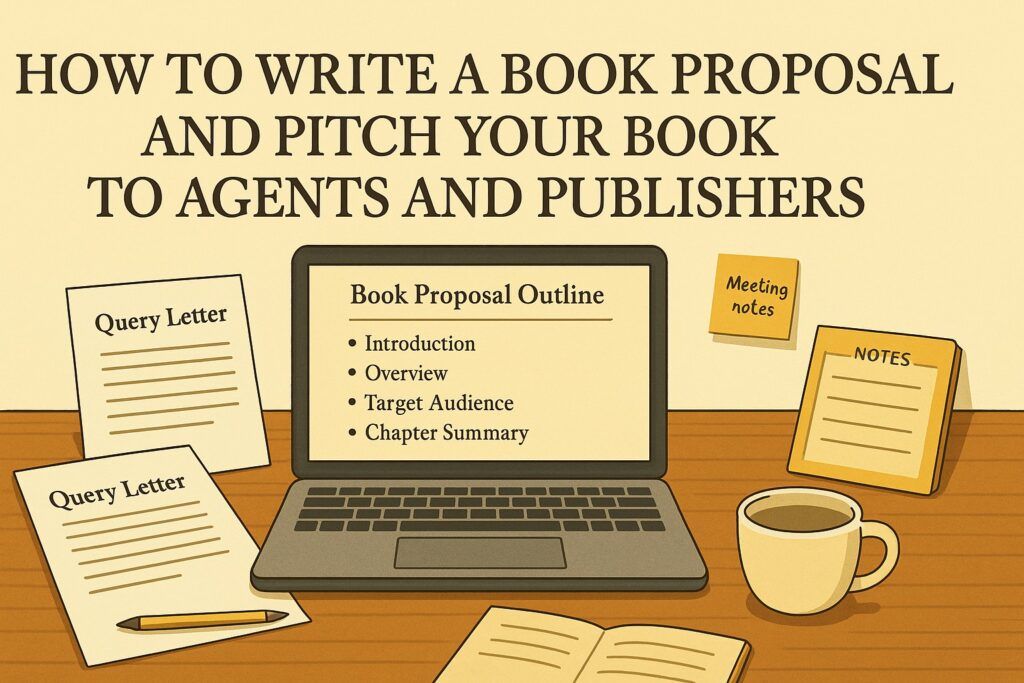
You can write a strong book proposal by clearly explaining what your book is about, who it is for, and why it will sell. A good proposal usually includes an overview, target audience, market comparison, author bio, marketing plan, detailed chapter outline, and sample chapters. To pitch your book, you send a short, focused query letter to agents or publishers, follow their guidelines, and show why your book is a good fit. Clarity, professionalism, and a strong concept give you the best chance of getting noticed.
FAQs
1. What is a book proposal?
A book proposal is a business document that explains your book idea, target audience, market potential, and your plan to help sell the book. It is mainly used for nonfiction and sometimes for certain types of fiction.
2. Why do agents and publishers need a proposal?
They use it to judge if your book can sell, fits their list, and if you are prepared to support it through marketing and platform building.
3. What are the main parts of a book proposal?
Most proposals include: a book overview, target audience, market analysis and comparable titles, author bio, marketing plan, chapter outline, and one to three sample chapters.
4. How long should a book proposal be?
Many proposals range from 15 to 50 pages, depending on the depth needed, the market, and the agent or publisher’s guidelines.
5. Do I need a full manuscript before writing a proposal?
For nonfiction, you usually do not need the full manuscript, but you do need strong sample chapters. For fiction, many agents prefer a full, polished manuscript before you pitch.
6. What is a query letter and how is it different from a proposal?
A query letter is a one-page pitch email or letter that briefly introduces you, your book, and why you are contacting that specific agent or publisher. The proposal is a longer document you attach or send if they request it.
7. How do I find the right agents or publishers to pitch?
Research agents and publishers who work in your genre, read their submission guidelines, and check the books and authors they already represent or publish.
8. What should I include in my query letter?
Include a strong hook, a short summary of the book, key details like word count and genre, a brief author bio, and a polite note on why you chose that agent or publisher.
9. How many agents or publishers can I pitch at once?
Many writers submit to several agents at the same time, as long as the guidelines do not forbid simultaneous submissions. Always follow each agent’s rules.
10. What if my proposal is rejected?
Rejection is common. Use any feedback you receive to improve your proposal, adjust your pitch, and continue submitting to others who might be a better fit.
Introduction
I wrote my first book before I knew what a book proposal was.
Like many African writers, I started with survival, not structure. I wrote to stay sane. I wrote to make sense of life along the Sobat River, of war, hunger, and all the questions that refused to leave my head. I did not know about query letters. I did not know about “platform.” I only knew I had something to say.
Much later, when I began to study how traditional publishing works, I discovered a hard truth. It is not always the best book that gets the traditional contract. Often, it is the best presented book. The best positioned book. The book that arrives on the agent’s desk with a clear proposal and a focused pitch.
That is where the book proposal comes in.
If you want to publish nonfiction through an agent or a traditional publisher, you need more than a finished manuscript. You need a document that proves three things:
- The idea is strong.
- The market is real.
- You are the right person to write and promote this book.
In this article, I want to walk you through how to write a book proposal and how to pitch your book to agents and publishers. I will mix the “rules” with my own journey as a writer from South Sudan who has lived through war, built a writing life step by step, and learned the business side of books the hard way.
Why Traditional Publishing Still Matters
I am a self-published author. I have published many books on my own. I love the freedom and speed of self-publishing.
So why should we even talk about book proposals and agents?
Because traditional publishing still offers things that can be hard to build alone:
• Wider print distribution in bookstores and libraries.
• External credibility in some academic, political, and media spaces.
• Professional editing, design, and positioning.
• Access to certain prizes, reviews, and speaking opportunities.
This is even more true if you write serious nonfiction. If you are working on books about nationalism, education, theology, African identity, or leadership, traditional publishing can help your ideas travel into boardrooms, classrooms, and policy spaces.
Not everyone needs a traditional deal. But if you want one, a clear book proposal is the bridge between your idea and their decision.
What A Book Proposal Really Is
Many writers think a book proposal is a formality. A long, boring document gatekeepers use to torture authors.
That is the wrong way to see it.
A book proposal is a business plan for your book.
It answers four basic questions for the agent or publisher:
- What is this book about?
- Who is it for?
- Why will it sell?
- Why should we trust this author?
It also forces you, the writer, to clarify your idea and your readers. Before you ask anyone to invest money in your book, you must invest thought in it.
When I first tried to outline a proposal for one of my nonfiction ideas, I realized something painful. I had passion, but my idea was still foggy. I could write pages, but I could not summarize in one paragraph who the book was for and why now.
The proposal process forced me to sharpen my thinking. It made me move from “I feel like writing this” to “this book solves a clear problem for a clear reader.”
Key Elements Of A Nonfiction Book Proposal
Most nonfiction book proposals contain the same core sections. Different agents and publishers may use slightly different terms, but the structure is similar.
- Overview of the book
- Target audience
- Competitive or comparable titles
- Marketing and platform
- Chapter outline or table of contents
- Sample chapters
- Author bio
Let us walk through each of these, with both strategy and story.
Overview Of Your Book
This is where many writers lose the room.
The overview is not the place for a long essay about your childhood unless it directly serves the book’s promise. It is also not the place for vague big claims like “this book will change lives” or “there has never been a book like this.”
The overview should:
• State clearly what the book is about.
• Explain what problem it solves or what desire it serves.
• Make a firm promise to the reader.
• Clarify the format, length, and tone.
Think about your reader first.
For example, if I write a book proposal for a nonfiction book about “How young African writers can turn their painful stories into powerful nonfiction,” my overview might say:
“This book is a step-by-step guide to help young African writers turn their lived experience into clear, honest nonfiction that can be pitched to agents, publishers, or self-published with confidence. It combines practical craft advice with real stories from conflict zones, displacement, and digital entrepreneurship.”
Straight. Simple. No smoke.
In my early writing days, if you asked me what my book was about, I might tell you my whole life. A proposal forces you to focus that life into one central promise.
Target Audience Analysis
“Everyone” is not a target audience.
Agents and publishers read “everyone” and translate it as “no one specifically.”
You must be clear about who you are writing for. Not only in terms of age and location, but in terms of need.
Ask yourself:
• Who is most likely to pick up this book without your help?
• Who will feel that this book was written for them?
• What pain, confusion, or curiosity does this book address?
For example, with my own work, I often write for:
• Young Africans who feel stuck between tradition and modernity.
• Readers who have seen war, displacement, or deep loss and still want to build something meaningful.
• Aspiring writers who have a story but feel intimidated by the publishing world.
If I were writing a proposal around those readers, I would describe their situation plainly. I might mention a young person in Juba scrolling social media, feeling that their life stories are too messy for books. Or a South Sudanese student in Nairobi trying to balance studies, family expectations, and a dream to write.
Agents want to see that you know your readers intimately, not theoretically.
Competitive Title Analysis
The first time I tried to list competitive titles, I made a mistake many writers make. I tried to argue that no other book was like mine.
That is not what publishers want to hear.
If there are no similar books, it may mean there is no market. They want to see:
• That people already buy books like yours.
• That you understand what has been done.
• That you can explain how your book fits into that shelf.
A good competitive analysis might include 5 to 10 recent books in your topic area. For each, note:
• Title and author
• Publisher and year
• Main promise or angle
• Strengths
• Gaps your book addresses
For example, if I were writing a book on African nonfiction storytelling, I would look at books on memoir craft, diaspora writing, African literature, and narrative journalism. I would not insult those books. I would honor them and then show where my book sits beside them.
The point is not “I am better than all of them.” The point is “here is how my book adds something useful to this ongoing conversation.”
Marketing Plan And Author Platform
This is often the most painful section for writers from places like South Sudan.
You read U.S. or U.K. advice and see phrases like “mailing lists of 50,000 subscribers” and “multiple TV appearances.” You look at your reality. Maybe you have a simple blog, a small but loyal audience, and a WhatsApp circle.
Do you give up? No.
Your job is to show:
• How you currently reach people.
• How those readers are engaged with your work.
• How you plan to grow that reach.
• Any special doors you have.
For me, my platform does not begin with “I have one million followers.” It begins with:
• Years of writing and self-publishing.
• Opinion articles in The DAWN Newspaper read by decision makers in South Sudan.
• Community and organizational networks: church leaders, NGOs, youth groups.
• Speaking engagements at universities and events.
• My website and existing readers worldwide.
You might have:
• A local radio program.
• A strong presence in a WhatsApp or Telegram community.
• A church or mosque network.
• A role in a university or NGO.
• A podcast serving a specific niche.
Mention real numbers where you can. Mention realistic strategies. Do not promise what you cannot deliver. Do show that you understand you are part of the marketing engine, not just the author who disappears after handing in the manuscript.
Chapter Outline
The chapter outline shows that your book is not just a good idea, but a workable structure.
It usually includes:
• Chapter titles
• Short summaries for each chapter
• Key stories, examples, or case studies
• Estimated word counts
When I outline my nonfiction, I like to imagine a reader walking through the book like a journey from the Sobat River to Nairobi. Where do we start? What must they understand first? Where will the hard truths be? Where will the hope grow?
A good chapter outline:
• Shows logical progression.
• Avoids repeating the same point in five different chapters.
• Balances teaching with stories.
• Leaves space for the reader to breathe.
Sample Chapters
The proposal sells the idea. The sample chapters prove you can actually write.
Agents and publishers usually want one or two full chapters. Sometimes they prefer your introduction and a middle chapter. Sometimes they recommend specific sections.
Choose chapters that:
• Represent your normal voice and structure.
• Contain strong stories or case studies.
• Show how you handle your subject, not just how poetic you can be.
In my own work, I often choose chapters where I weave personal experience with teaching. For example, a chapter where I move from a scene in Nasir or Paduay to a lesson about fear, resilience, or meaning.
Your sample chapters should be as clean as you can make them. Proofread. Edit. You do not need to be perfect, but you should respect the reader’s time.
How To Write Your Book Proposal Step By Step
Step 1: Clarify Your Core Idea
Before you open a single document, ask yourself three simple questions:
- What is my book about in one sentence?
- Who exactly is this book for?
- What change or result will they have after reading it?
Write those answers down. If you cannot answer clearly, you are not ready to propose yet. Keep thinking. Talk it out with a trusted friend. Journal about it. Pray about it if you are a person of faith. Walk around with the question until the answer becomes sharp.
Step 2: Research Your Topic And Market
Do not skip this. Even if you dislike marketing.
Look for:
• Existing books in your topic.
• Podcast episodes on similar themes.
• Articles and blog posts that mirror your idea.
• Questions readers are asking online.
You can use big tools like Amazon and Goodreads, but you can also use simple ones:
• Ask your own audience what they struggle with.
• Visit local bookshops and see what is on display.
• Talk to librarians, teachers, pastors, community leaders.
When I started writing about nationalism and South Sudan, I did not find many books that spoke from the inside in a practical, hopeful way. That gap encouraged me to move forward.
Step 3: Draft Your Overview
With your research and clarity, write a one to two page overview. Keep it reader focused. Avoid long theory. Speak plainly.
Picture one real person from your target audience and write as if you are explaining the book to them over tea.
Step 4: Describe Your Target Readers
Do not just list numbers and ages. Describe daily life.
A good target audience section might describe:
• Where your readers live or work.
• What they worry about at night.
• What they hope will change.
• What they already tried that did not work.
If I write for aspiring African writers, I will talk about data costs, electricity problems, cultural pressure to “get a real job,” and the fear of sharing personal stories publicly.
Step 5: Analyze Comparable Books
Choose five to ten books that are close to your topic. For each:
• Read the description.
• Scan reviews to see what readers loved and what they missed.
• Note how the book is positioned.
Then, describe where your book fits. You might say:
“This book will sit beside Book A and Book B on the shelf, but it is written specifically from a South Sudanese perspective and focuses on practical steps, not theory.”
Step 6: Build A Realistic Marketing Plan
List:
• Everything you are already doing: blogging, speaking, teaching, posting.
• Everything you can reasonably start within a year: newsletter, podcast, social media strategy.
• Any relationships you can use: organizations, churches, NGOs, universities, media contacts.
If you have published before, mention your sales numbers honestly. If you have not, focus on engagement: how often people interact with your content, share it, reply to you.
Step 7: Outline Your Chapters
Create a working table of contents. For each chapter, write 3 to 8 sentences that explain what happens there. Note key stories you will use. Make sure each chapter has a clear purpose.
Step 8: Write Your Sample Chapters
Choose your best chapters. Do not rush. Take the time to give them your full craft. These chapters are your audition.
How To Pitch Your Book To Agents And Publishers
Once your proposal is ready, you need to get it into the right hands. That is where pitching comes in.
You will usually use three main formats:
• Query letters
• Verbal pitches
• Simple pitch documents or “one sheets”
Query Letters
A query letter is a short email or letter that introduces you and your book to an agent or publisher.
It usually contains:
• A short greeting, using their name.
• A clear statement of your book title, category, and word count.
• A short hook that explains the book.
• A paragraph about the audience and market.
• A brief author bio.
• A polite closing with any requested attachments.
When I write queries, I try to sound like myself, not like a robot. I respect their time. I do not exaggerate. I do not beg. I simply present the book and ask if they would like to see the proposal.
Verbal Pitches
Sometimes you will meet agents or publishers at conferences or online meetings. You may get 30 seconds, 2 minutes, or 10 minutes to speak.
Prepare a short spoken pitch that covers:
• The core idea of the book.
• Who it is for.
• Why it matters now.
• Why you are the person to write it.
Practice saying it out loud until it feels natural. Not memorized, but clear.
In South Sudan, I often have to explain my writing projects to people who are not in publishing at all: community leaders, church elders, NGO staff. That practice helps. If you can explain your book to a village chief or a busy minister in plain language, you can explain it to an agent.
Staying Human Through Rejection
This part is real. You can write a good proposal and a clear pitch and still get rejected many times. Not every “no” means your book is bad. Sometimes it means:
• The agent has too many similar projects.
• The publisher tried something like this last year and it did not sell.
• The list is full for the next seasons.
• They do not see the market you see.
Rejections hurt. They especially hurt when you come from a place where recognition is already rare.
I have received my share of “no” in different areas of life. Sometimes with words. Sometimes with guns. Sometimes with silence.
What I learned is this: do not tie your entire identity to one decision from one gatekeeper. Respect the feedback. Improve what you can. Send the proposal again to someone else. And remember you still have the option of publishing independently if the traditional door stays closed.
Improving Your Chances Of Getting A “Yes”
While you cannot control everything, you can improve your odds by working on three areas at the same time:
- Your craft
- Your platform
- Your network
Your craft is your writing skill. The clearer, sharper, and more honest your writing becomes, the harder it is to ignore.
Your platform is your readership. Even a small, committed audience who consistently reads, comments, and shares your work is valuable.
Your network is your relationships. Other writers who can vouch for you. Editors who have seen your work. Leaders who respect your insight. Agents and publishers who have heard your name more than once.
You build these slowly. There is no shortcut. But over time, they change how people receive your proposals and pitches.
Final Thoughts
Writing a book proposal and pitching your book may feel like entering a strange world. It has its own language, expectations, and hidden doors. For a writer from South Sudan or any underrepresented place, it can feel even more distant.
But here is what I know.
If a boy who once ran from bullets near Nasir and almost starved in the swamps of Paduay can grow into a writer who understands proposals, pitches, and publishing, then you can too.
The same courage it takes to face war, hunger, or daily struggle is the courage you can now apply to learning this craft and this business.
So take your idea. Clarify it. Research it. Shape it into a proposal. Then knock on the doors you can reach.
Some will stay closed. Some will open a little. One may open wide.
And even if every agent and publisher in the world says “no” today, you still keep your voice, your story, and your power to publish by yourself.
The proposal process is not only about getting a contract. It is about becoming the kind of writer who understands their book, their reader, and their message so clearly that no rejection can erase it.

