
TL; DR:
Grief is heavy, and words often fail in the face of deep loss. Yet humor quietly sits beside sorrow and helps us breathe again. Laughter after loss does not erase pain or disrespect the dead. It gives the living enough strength to carry the weight of love and memory.
In homes, camps, churches, and graveyards, gentle jokes and funny stories become medicine for broken hearts. When used with care, humor becomes a survival tool. It reminds us that even in seasons of tears, life is still present, stubborn and sacred.
Introduction: When Death Refuses to Leave the Room
When my elder brother died in the 1989 Nasir battle, grief sat in our house like an uninvited guest who refused to leave. It occupied chairs, filled corners, and lay heavy on our beds at night. People came, cried, prayed, and sat with us in long, quiet hours.
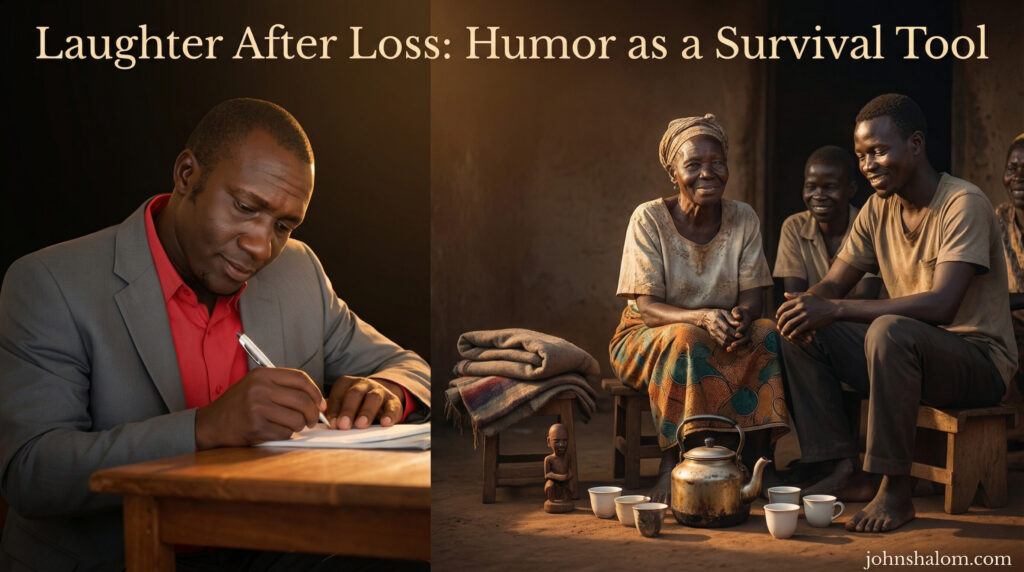
Then, in the middle of that heaviness, someone remembered a small story. My brother had once fallen badly while chasing a cow, legs and arms flying as if he was trying to catch the wind. The image was so vivid that even in that dark room, someone smiled, then laughed. Others followed. We laughed with tears running down our faces.
That laughter did not bring my brother back. It did not cancel the pain. But in that moment, it gave us oxygen. It reminded us that our love for him included joy, not only sorrow. Humor became our survival tool.
Why Humor Survives Where Words Fail
After loss, words often feel weak.
People say, “Be strong,” or “It is God’s plan,” or “You will be fine.” Sometimes they mean well, but the phrases arrive like stones instead of comfort. They land on wounds that are still open.
Humor works differently. It sneaks in gently through memory, surprise, or honest mistakes. It does not try to explain the loss. It does not pretend to fix anything. It simply changes the weight of the moment for a few seconds.
Think of humor like a small candle in a dark room. It does not remove the darkness. It gives enough light to see the faces around you and remember that you are not alone.
The Strange Comedy of Mourning
Funerals and mourning periods are serious, but they also carry their own strange comedy.
I remember one funeral where a man started a hymn with full confidence, then forgot the words halfway. Instead of stopping, he invented new lines on the spot. The tune was right, but the words made little sense. People tried to stay serious, but soon shoulders began to shake. Quiet laughter moved through the crowd. Some covered their faces with cloths, pretending to wipe tears, while they were really hiding smiles.
No one felt disrespected. If anything, that awkward hymn made the moment more human. It reminded everyone that the living are still learning how to walk through grief.
Another time, during mourning, a child asked in complete innocence, “Will the dead man come back for dinner?” Adults tried to correct him, but not before the room burst into surprised laughter. The question hurt and healed at the same time. It showed how confused children can be about death, but it also gave us a reason to breathe out some of the pain.
Humor as Quiet Resistance
In war, displacement, and hunger, I have seen humor act like rebellion against despair.
Refugees tell jokes about the long road they walked, the strange food they were given, or the endless registration lines. They are not laughing because suffering is funny. They are laughing because refusing to laugh would mean surrendering completely to the weight of pain.
In one camp, a man used to joke, “If I survive this porridge, I can survive anything.” The porridge was thin, tasteless, and almost grey. His joke was not an insult to those who provided the food. It was a way of telling his body and his neighbours, “We are still here. We are still human.”
Laughter in such places becomes resistance, not denial. It is a small protest that says, “You can wound my life, but you cannot fully kill my spirit.”
Shared Laughter, Shared Healing
Grief isolates. Even when many people sit in the same room, each person can feel alone inside their pain.
Shared laughter breaks that isolation. When a family tells funny stories about the one they lost, something shifts in the room.
The focus moves from “He is gone” to “He lived, and he lived well, and he made us laugh.”
You remember:
– The way she laughed so loudly that neighbours heard.
– The way he mispronounced a word in school and never lived it down.
– The time they fell into water, dropped a plate, or ran from a cow.
These stories do not remove the sadness. They wrap it with warmth. They say, “Yes, we are crying, but we are also grateful that this person existed.”
Today, when my brother’s name comes up, we do not only cry. We laugh at his stubbornness, his mistakes, and his courage. That laughter keeps him alive in our hearts in a way that tears alone cannot.
Walking the Line: When Humor Helps and When It Hurts
Humor after loss must walk a narrow road.
The right kind of humor:
– Comes from love and shared memory.
– Knows when to be gentle.
– Laughs with people, not at their pain.
The wrong kind of humor:
– Mocks the dead.
– Blames the suffering.
– Arrives too quickly, without respect for the fresh wound.
A joke told in the first minutes of someone hearing terrible news may feel cruel. The same joke told days or weeks later, when people have had time to breathe and cry, can bring relief. Timing matters. Tone matters. Relationship matters.
Humor should not be used to silence grief. It should walk beside grief, like a friend who takes your hand and says, “I know it hurts. Let us remember the good, too.”
You might also like: The Self-Help Roadmap: Proven Strategies for Personal Growth and Healing
My Mother’s Wisdom: “If We Do Not Laugh, We Will Die Twice”
My mother understood this balance better than any book.
In our hardest seasons of loss, there were days when she cried until her eyes were swollen. Then, unexpectedly, she would tell a small funny story about the one we lost. Not to erase the pain, but to loosen its grip on our throats.
Once, during mourning, she said, “If we do not laugh, we will die twice.”
I did not understand it fully then, but I do now. Unrelieved grief can crush the spirit. If we banish all laughter, we slowly bury our own joy, our own memories, even our own desire to live.
Her words taught me that laughter after loss is not betrayal of the dead. It is survival for the living. It is a quiet promise that life will continue, even if it will never be the same.
Humor as Memory Keeper
Laughter does something important for memory. It keeps the loved one from becoming only a sad story.
When all our memories of someone are covered only with sorrow, we may begin to avoid their name. We fear that speaking about them will always end in tears. But when we allow funny memories to surface, we open a new door.
We can say:
“Do you remember how he used to snore so loudly?”
“Do you remember how she danced off-beat but with full confidence?”
Those stories bring smiles before tears. They help us talk about the one we lost without feeling crushed every time. In that way, humor keeps the memory flexible. It gives it more shapes than only pain.
Humor and Faith in Seasons of Loss
Some people worry that laughing during mourning is disrespectful to God or to the dead. I understand that fear. There are moments when laughter clearly would not fit. There are moments that call for silence and tears.
But I also believe that the God who gave us joy does not forbid it at the graveside. The same God who made human faces is not surprised when they can cry and laugh in the same hour.
Humor in grief can be a form of faith. It says, “Even here, in this valley, I still see traces of goodness.” It acknowledges that death is real, but it also refuses to let death define everything.
How to Use Gentle Humor to Support Someone in Grief
If you want to support someone who is grieving, humor can help if used with care.
A few simple thoughts:
- Start by listening. Let the grieving person lead the way. If they begin to share funny memories of the one they lost, join them.
- Use stories that honour the person. Choose memories that celebrate who they were, not their flaws alone.
- Be sensitive to timing. In the early days, they may need space to cry first. Later, they may welcome more laughter.
- Watch their face and body language. If they smile or lean in, you can continue. If they withdraw, slow down.
- Always anchor your humor in love. The goal is not to escape pain, but to carry it together.
Even a small shared smile can be a strong comfort. You do not have to be a comedian. You only need to be present, human, and kind.
Laughter After Loss and the Story of Being + Doing = Meaning
Loss always raises questions about meaning. Why did this happen? What is the point of continuing? Who am I without this person?
Being + Doing = Meaning applies here too.
Being: Loss changes how we see ourselves. Are we still a brother, a sister, a son, a parent, now that the other is gone? Silence, tears, and prayer help us face those questions.
Doing: Laughter becomes one of the small actions that help us keep living. We tell stories, share food, help each other, and sometimes joke together. These actions do not cancel the loss. They show that we are still moving.
Meaning grows when we dare to carry both. We allow ourselves to feel the pain honestly, but we also allow small joys back into the room. Laughter becomes one of those daily choices that say, “I will keep living, for myself and for those who remain.”
Conclusion: Laughing With Tears, Not Instead of Them
Laughter after loss is not a sign that we loved the dead less. Often, it is proof that we loved them very much. We remember the whole person, not only their final moment.
Grief and humor are not enemies. They are two sides of being human in a broken world. We cry because love has been wounded. We laugh because love is still alive.
If we learn to hold both, our hearts do not break as quickly under the strain. We can sit in mourning with others, cry when we need to, and smile when memory invites us to. In that way, humor becomes a survival tool, a breathing space, and a quiet song that says, “Loss is real, but so is life.”
If you would like to know more about my path as a writer, including the struggles, lessons, and small signs of progress along the way, you can read the full story on my Wealthy Affiliate blog here: https://my.wealthyaffiliate.com/johnmaluth/blog
Reflection Questions
- What funny memory of a loved one brings you comfort in times of grief?
- How has humor helped you survive difficult seasons of loss or hardship?
- Can you think of a moment when laughter during mourning created healing rather than disrespect?
- How might you use gentle, loving humor to support someone who is grieving today?
- What balance between sorrow and laughter feels most healing for you after loss, and how can you honour that balance in your own life?
FAQs
- What does “laughter after loss” really mean?
It means allowing moments of humor and lightness to return after a painful loss. It is the freedom to smile, laugh, and remember good times without feeling guilty for not crying all the time. - Is it disrespectful to laugh when I am grieving?
No. Laughter does not erase your love or your pain. It can honor the person you lost by remembering their jokes, their stories, and the joy they brought, while helping your heart survive the sadness. - How can humor help as a survival tool in grief?
Humor gives short breaks to the nervous system. It releases tension, lowers emotional pressure, and reminds you that you are still alive. These small breaks make it easier to keep walking through the long journey of grief. - What if people judge me for laughing “too soon” after a loss?
Grief has no fixed calendar. You can gently explain that laughter helps you cope, and that you still feel the loss deeply. Their discomfort often comes from their own fears, not from your lack of love. - How can families use humor together after a painful event?
They can tell funny stories about the person who died, remember their habits, watch light-hearted movies together, or allow children to laugh naturally. Shared humor can become a safe bridge between sorrow and hope.

