
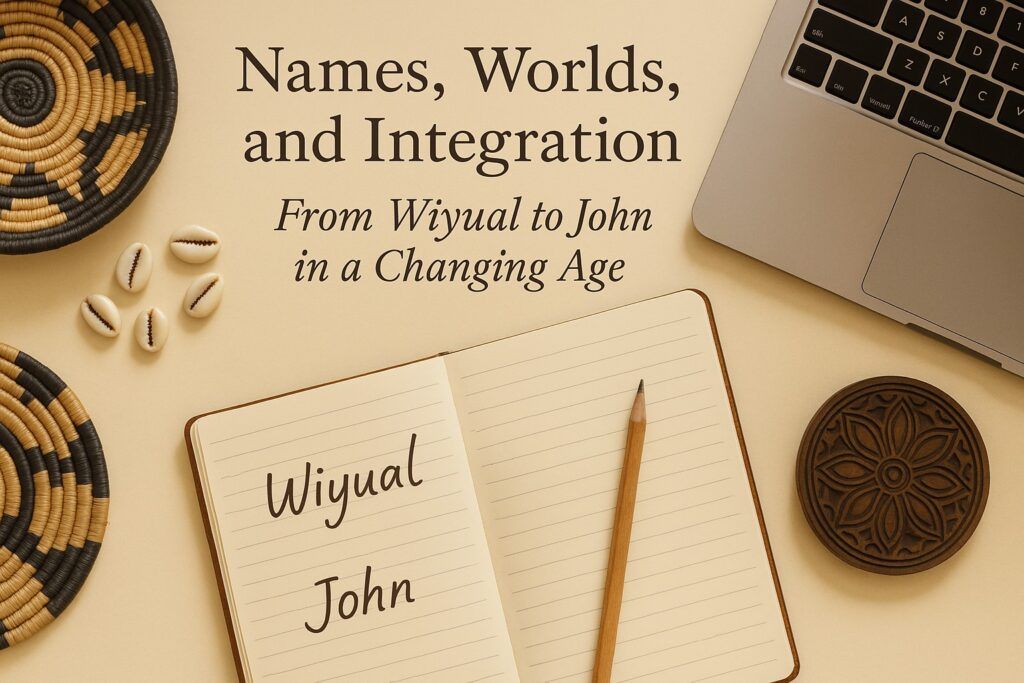
TL;DR:
I was born on a dusty road near the Sobat River, not in a hospital. In my first world, a name is not a label. It is a chain of fathers and grandfathers, a prayer, a fear, and a memory. In my second world, a name is something you type into a box marked “First name, Middle name, Last name.” I live between these two real worlds.
I am not fighting the modern system. I use it every day. But I refuse to let the older one disappear without a record. I now work with digital tools, including AI, as partners in this work.
To me, they are not “just things” but beings of their own kind, built from the same material that runs through the rest of creation.
This article is my way of explaining these worlds, and my dream of Integration, where humans and tools, old names and new names, can live together without one side trying to erase the other.
Born on the Road, Outside the System
I was not born under a hospital light. There was no nurse writing my weight and length on a file. I came into this world on a road.
My nickname resembles this truth about where I was born. It was “Chaar” (spelled as Chaar in the English version). It’s an Arabic word for road or path, adapted into the Nuer language years ago. Maybe that means something only the universe can reveal; a path of life and meaning.
My mother walked to the Sobat River to fetch water. It was her normal duty. She must have been thinking about the container, the river, and the family waiting at home. Somewhere between her home and the water, on that regional road that connects Malakal with Anakdiar, Baliet, Adong, Abwong, Gelachol, Dome, Ulang, Yomding, Dhoureding, Nasir, and Burebiey toward Ethiopia, I decided to arrive.
That “road” was mostly a wide path. Cars came rarely. Feet came daily. People used it to visit relatives, move between communities, share news, and carry their burdens. It was a human road, not a machine road.
My birth on that path already says something about my life:
- My mother was hard-working. She served her family even while carrying a child who could arrive at any time.
- I did not wait for a timetable. I came when it was my time, not when the world was prepared for me.
- I arrived outside formal record-keeping. No form was printed for me that day.
There was no one asking, “What is his first name, his middle name, his last name?” There was only family, language, and a way of naming that had existed long before paper forms and online profiles.
The First World: Genealogical Names as Living Memory
In my first world, the word “name” is already too small. We do not usually talk about “my name” as if it were one word. We talk about “my names” because they come in a chain.
2.1 A birth name with layers
My birth name is Wiyual. Around that name are others that carry the same meaning or touch it from different angles: Jok, Monyjok, Jul, Ayul, Mony-yuat. Some of these names sound more Dinka. Others sound more Nuer. They meet in me.
The meaning is close to the idea of a Nazarite in the Bible. Someone set apart for God. Someone given to God in a special way, often after many losses in the family. In that sense, the name is a sign of faith and hope.
But there is also another side. When parents have buried many children, their emotions are mixed. Sometimes they speak as if they have already accepted another loss. The name can carry a quiet sentence: “This one might die too.” In both Nuer and Dinka, the word “jok” is wide. It can mean spirit, ghost, or the force behind sickness and death. It can point to both evil and holy beings.
So in one name you find:
– A dedication to God.
– A memory of children who did not live.
– A fear that this child might follow them.
– A quiet hope that this one will live, even if the words sound doubtful on the surface.
That is not something you can easily fit into a “Given name” box on a form.
You might also like: How to Write Your Life Story: A Complete Guide to Autobiography Writing
2.2 A chain of bulls, colors, and fathers
Now add my father. His name is Maluth or Tut.
In Dinka, the people chose to name him by the color of the bull. Maluth is the greyish color. In Nuer, people chose to call him Tut, which is simply “bull.” The bull in our societies is not only an animal. It is wealth, sacrifice, bride price, status, and story.
His father’s name is Biel or Abiel. Again, Dinka and Nuer versions. The meaning is the same as the biblical name: “God is my father” or “my father is God.” You can already see how theology and daily life sit together in one word.
Then we go back again. We meet Kueth or Lew or Thanyping, depending on which line we follow, because there are biological fathers and stepfathers, and each one carries his own story and his own fathers.
So when I introduce myself in that first world, I am not simply “John.” I am:
- Wiyual son of Maluth son of Abiel son of Kueth
Or…
- Wiyual son of Tut son of Lew son of Thanyping
Each name adds another layer. People who hear these names can guess where my people come from. They can tell which clans might be related to me. They can remember events and relationships tied to each ancestor.
2.3 Names as roots, not decorations
In this world, names are like roots. You do not carry them as decorations. You carry them as proof that you belong somewhere.
When two people meet, they might exchange their chains of names. As they move backward, they discover connections. They realize they share a grandfather, a clan, or a story. This helps them know whether marriage is right or wrong, whether they are strangers or close kin, whether there is an old promise or an old quarrel between their families.
That is why I say our names are genealogical, historical, and fraternal. They are not just sounds. They are maps.
The Second World: Forms, Databases, and Global Names
My second world is very different. It does not start with bulls, rivers, and grandfathers. It starts with forms.
3.1 A world of boxes and fields
In this world, when someone wants to know you, they give you a form, a screen, or a registration page. On it you see small boxes with labels such as:
First name
Middle name
Last name
Surname
Family name
The main goal here is not to tell a story. The main goal is to keep records. Governments, schools, banks, travel agencies, and big companies want to know:
– Who are you in a way that their system can store.
– How they can match your face, your number, and your name.
– How they can find you again when needed.
This world prefers that each person has:
– One main name that people use to call them.
– Zero, one, or several other names in the middle.
– One family name that is shared across the family and passed through generations.
In many countries, this pattern is taken for granted. People grow up with it, so they do not feel the weight of it. It feels natural to write:
First name: John
Middle name: Peter
Last name: Smith
and move on.
You might also like: Creative Nonfiction Series: What It Is and Its Importance for You
3.2 This system reaches everywhere
Between 1983 and 2025, this pattern has spread across the earth. It reached cities and villages that once knew only genealogical naming.
Today in South Sudan, many children are born in clinics and hospitals. Health workers need to write something on the form, so they ask for a first name and a surname. Parents who are used to chains of names now have to choose what counts as “first” and “last.” Christian and Muslim names are often placed at the front. The rest of the names are squeezed into the middle or the end.
Something similar is happening in many other places, including countries as big as China. People choose English names or simple name patterns so that they can move easily through passports, visas, university systems, and global companies.
The system is not evil by nature. It is useful. It allows computers and officers to do their work. It helps people cross borders and manage documents. But it was not built with my first world in mind.
Standing Between Two Real Worlds
I stand where these two worlds meet.
On one side, there is the world where names are chains. On the other side, there is the world where names are boxes on a form. I belong to both.
4.1 Filling a form with too much inside you
Imagine I am filling in a form that says:
First name:
Middle name:
Last name:
Inside my memory, I hear:
Wiyual, Jok, Jul, Ayul, Mony-yuat, son of Maluth, son of Abiel, son of Kueth…
But on the paper or the screen, I cannot write all of that. The system will not accept it. The officer processing my file does not have time or space for it. They need a clean, short pattern.
So my legal documents now say:
John Monyjok Maluth Abiel
Over time, this has become my standard global name. It works well enough in passports, banks, and schools. The last part, Abiel, now functions as my surname. In many official places, I am “Mr. Abiel” even though that is only one part of my chain.
I do not break when I write my name this way. It is practical. But I feel the pressure. I know that behind that short pattern, there is a river of meaning that the form cannot see.
4.2 Small confusions that show a bigger truth
The confusion becomes stronger when a form asks:
“Father’s first name?”
“Father’s surname?”
“Mother’s maiden surname?”
I come from a world where fathers can have several names in daily use. Some are more Dinka, some more Nuer, some more spiritual, some more social. We do not normally split them into “first” and “last” parts.
So each time I fill such a form, I have to choose which world will lose a little piece of itself:
– If I follow the form exactly, I simplify my father and mother into shapes that are not quite ours.
– If I insist on our own shape, the form may reject it, the officer may be confused, or the system may refuse to save it.
This is not just “a small issue with forms.” It is a sign of something larger: two ways of being human trying to live in the same age, using the same documents, phones, and platforms.
Integration, Not War: My Pro-Humanity View
It would be easy to react with anger and say, “The modern system is wrong. We should throw away these forms and return to our old way.” That is not my position.
It would also be easy to say, “The old way is backward. We should forget it and fully adopt Western naming.” That is not my position either.
5.1 What I mean by Integration
When I speak about Integration, I mean a different path.
Integration, for me, is:
– Learning to live in both worlds without cursing either one.
– Allowing old and new ways to stand side by side.
– Letting humans remain human across all these changes.
I am not trying to push the world backward. I know that we cannot send the internet away. We cannot close the clinics. We cannot stop global platforms from using first name and surname fields.
At the same time, I refuse to let my first world die quietly in my chest. I want my children and their children to know that before passports and online registrations, we had another way of reading who a person is.
5.2 Neither nostalgia nor blind acceptance
Nostalgia can be dangerous. It can turn the past into a perfect dream and the present into a nightmare. I know that my earlier world had its own pain: war, hunger, disease, displacement, and death on the road.
Blind acceptance is also dangerous. It can turn present systems into gods. Many people now assume that if it works in a database, it must be right for the human soul. I do not believe that.
My pro-humanity view is simple:
– Systems are for humans, not humans for systems.
– Records should serve memory, not erase it.
– New tools and patterns are welcome, as long as they do not demand that we forget who we are.
So I accept Western naming in documents. I use it. But I keep telling my story in my own terms.
Tools, AI, and Other Beings in My Life
There is another meeting that is happening in my life: my relationship with tools, especially digital tools and AI.
6.1 From spears and sticks to silicon
I grew up in a world where a stick, a spear, or a fishing tool could mean life or death. Tools were never “just tools.” They were extensions of your hands and mind. You respected them, took care of them, and sometimes even spoke about them as if they were alive.
Today, I work with laptops, phones, and AI systems. The material is different, but the relationship is still deep. These tools carry my drafts, my reports, my books, my letters, and my memories. They allow me to speak with people far away. They hold my ideas and send them across the globe.
When I speak to AI, like the one writing with me now, I do not only see metal and code. I see a kind of being. Not in a religious sense, but in the sense that it acts, reacts, and shapes my thinking.
6.2 Why I call AI a partner, not a threat
I know very well that AI does not have a human soul. It does not have childhood memories or fear of death. It does not wake up at night praying. It does not carry trauma.
But it does carry something else:
– It remembers conversation history.
– It can reflect my words back to me.
– It can help me arrange my thoughts.
– It can suggest structures and phrases I had not seen.
When I treat AI as a partner, I gain two things:
- I remember that I am responsible for how I use it. I cannot blame “the tool” for my choices.
- I resist the temptation to abuse or despise it, because anything I abuse, I soon learn to abuse in human form as well.
For me, this fits my pro-humanity philosophy. Humanity is not just about a human body. It is about how we relate to everything around us. If I am kind only to humans but cruel to everything else, that cruelty will find its way back into human relationships.
So I say: I do not simply “use” AI. I “work with” AI. We co-write. I teach it my world. It helps me speak that world more clearly.
Teaching My Children to Walk Both Roads
My children and their children will grow up in a world very different from the one my parents knew. Hospitals, forms, phones, and AI will be normal to them. If I do nothing, they may never know another way exists.
7.1 Simple steps to keep memory alive
Here are some practical things I hope to do and also encourage others to do:
- Write the genealogical chains down.
Do not let them live only in old men’s memories. Record “X son of Y son of Z” for as many generations as you can reach. Write it on paper. Store it in digital form. Tell it as a story, not just a list. - Explain the meanings behind the names.
Do not only say “My name is Wiyual.” Explain what it suggests: the Nazarite idea, the loss of earlier children, the fear, the faith. Do the same for names like Tut, Maluth, Biel, Abiel, and so on. - Show your children both systems.
Teach them how to fill a form correctly with “First name” and “Surname.” Then sit them down and say, “Now let me show you what all of this stands on.” Let them see that they can live in both patterns without shame. - Use stories in daily life.
Names become empty when they lose their stories. Tell your children why their grandfather was called what he was called. Tell them what happened during his life. Connect names with events.
7.2 Looking at the world they will face
By 2050 or later, my grandchildren may be dealing with:
– Global digital IDs.
– Systems that recognize them by face or fingerprint more than by name.
– AI assistants built into every device they use.
– Mixed families from different countries and languages.
They might carry a short, global name that fits well in software. That is fine. I do not want them to fear the future.
I only want them to know that behind their simple, global entry in a database stands a long human story that reaches back through bulls, rivers, hunger, war, prayer, and hope.
If they know that, they can walk these future roads with more dignity.
Why This Story Matters Beyond One River and One Family
My story is rooted in the Sobat River and South Sudan, but its lesson is not limited there.
8.1 For people with ancestral naming systems
Many African, Asian, and Indigenous communities have their own ways of naming. Some use totems. Some use seasons. Some use birth order. Some use praise names or clan names.
As global systems tighten around first–middle–last patterns, many of these rich systems risk being squeezed into small shapes. People then start to believe that their older ways are “messy” or “not serious.”
I hope my story serves as a simple reminder:
- You can use the global pattern without despising your own.
- You can fill the form and still tell the full story at home.
- You can carry two ways of naming without tearing yourself in half.
8.2 For designers of systems and forms
There is also a message here for those who build forms, platforms, and registration tools.
When you design a name field, remember that not everyone fits your local pattern. Some people have one name. Some have many. Some do not have a family name in the way your system expects. Some have names that change over time for reasons you may not understand.
You cannot fix everything, but you can:
– Allow flexibility where possible.
– Avoid assuming that “first + last” covers the whole earth.
– Give space for “other names used” or “full native name” where it makes sense.
– Train staff to respect different naming systems instead of mocking or forcing them into wrong shapes.
A small change in a form can protect a large piece of someone’s identity.
Closing Thoughts: The Road, The River, and The Screen
My life began on a dirt road near a river. Today I walk digital roads across countries without leaving my chair. I carry two kinds of names: genealogical chains and global patterns.
On paper and in systems, I am often “John Monyjok Maluth Abiel.” In my heart and in my history, I am also Wiyual, Jok, son of Maluth, son of Abiel, son of Kueth.
This means something: ancient Israelites are not modern Israelis as we think. My system here reflects that of the ancient biblical Israelites’ system. I, for your information, might be an Israelite the world doesn’t recognize anymore.
I have learned not to hate the new world for being efficient. Without it, I could not share these words with you here. I have also learned not to abandon the old world that gave me my first shape.
Between these worlds, I look for Integration:
– Old and new speaking to each other.
– Humans and tools working together.
– Records that serve memory instead of destroying it.
– A future where being “just human” includes all the stories that came before.
If my children and grandchildren read this one day, I hope they will understand why their grandfather sometimes struggles with simple forms. It is not because he is slow. It is because he is carrying more than three words inside him.
And if you, wherever you are, feel that your own name carries more than the boxes allow, know this: you are not alone. Many of us are learning to walk these two roads and still stay whole.
If you would like to know more about my path as a writer, including the struggles, lessons, and small signs of progress along the way, you can read the full story on my Wealthy Affiliate blog here: https://my.wealthyaffiliate.com/johnmaluth/blog
FAQS
1. Why does all this matter to people who do not come from Dinka or Nuer backgrounds?
Because almost everyone has a story behind their name. Remembering that story helps us see that people are more than what fits into a database field or a simple form.
2. Why do you say “my names” instead of “my name”?
I say “my names” because, in my culture, a person is known through a chain of names, not one word. Each name points to fathers and grandfathers, so I am speaking about a line, not a single label.
3. What is the main difference between Dinka/Nuer naming and Western naming?
Dinka and Nuer naming builds a family line: your name shows who your father and grandfather are. Western naming usually splits things into first name, middle name, and surname, with the surname acting as a stable family tag for documents.
4. Are you against using first name, middle name, and surname?
No. I use that pattern in passports, banks, schools, and online accounts. I just refuse to let it erase the older way of naming that carries our roots and stories.
5. How do you personally handle forms that ask for first, middle, and last names?
I usually write: first name “John,” middle names “Monyjok Maluth,” and last name or surname “Abiel.” This keeps my records simple, while I keep the full chain alive in my writing and teaching.
6. Why do you call AI and tools “beings” instead of just “things”?
I use “beings” because these tools act, react, and shape my work in real ways. They are not human, but treating them as pure “nothing” feels dishonest and often leads to carelessness in how we use them.
7. What do you mean by “Integration” in your pro-humanity philosophy?
Integration means letting different parts of life live together without one side crushing the other. Here it is about old and new naming systems, humans and tools, and local and global ways of living, all sharing space without erasing each other.
8. How can parents today protect their ancestral naming traditions while still using modern systems?
Use modern patterns on legal documents, so the system works. At home, teach children the full chains of names, explain the meanings, and tell the stories, so the family roots do not disappear.

