TL;DR
When I was a boy along the Sobat, distance was measured in days, weeks, and tired feet. Messages crossed rivers on the legs of children and the patience of elders. Today, one click can take your words from a small market in Juba to a stranger’s phone in Canada before your water boils for tea.
Technology has folded the world into something we can hold, swipe, and scroll. That shrinking gives us gifts: connection, learning, opportunity. It also brings dangers: lies spreading fast, shallow relationships, and the temptation to live online while neglecting the people sitting next to us. The real question is no longer, “Does technology shrink borders?” It already has. The question now is: “Will I use this one click to build walls or bridges?”
From Shouting Across Rivers To One Global Click
1.1 Childhood messages with no network
When I was a child, the furthest “technology” we used for communication was our own lungs.
If you wanted to talk to someone across the river, you shouted. If they did not hear, you shouted again. If that failed, you sent a child.
If you wanted to send a message to a cousin in another village, you found a boy with strong legs, gave him the words, maybe added a reminder like, “Do not stop to chase goats,” and watched him disappear down the path. Days later, if all went well, the cousin would answer through another child walking in the opposite direction.
There was no “delivered” tick, no typing indicator, no guarantee your message would arrive unchanged. By the time it reached your cousin, your simple line might have turned into a village rumour.
Distance was real. You felt it in your legs, your lungs, and your patience.
1.2 First contact with machines that ignore distance
Years later, I touched a computer for the first time. The keyboard looked like a typewriter that had swallowed a calculator. The screen glowed like a small moon. The mouse looked so much like a small animal that I almost felt it needed food.
Then someone showed me email.
“You mean,” I asked, “I can write something here, press a button, and someone in another country will read it today?”
“Yes,” they said.
To a boy raised on river shouting and foot messages, that was closer to magic than science. The first time I hit “send” to a friend abroad, I sat staring at the screen as if a plane had just taken off from my table. When the reply arrived, I realised my world had changed quietly, forever.
How Technology Folds Distance
2.1 The world in your pocket
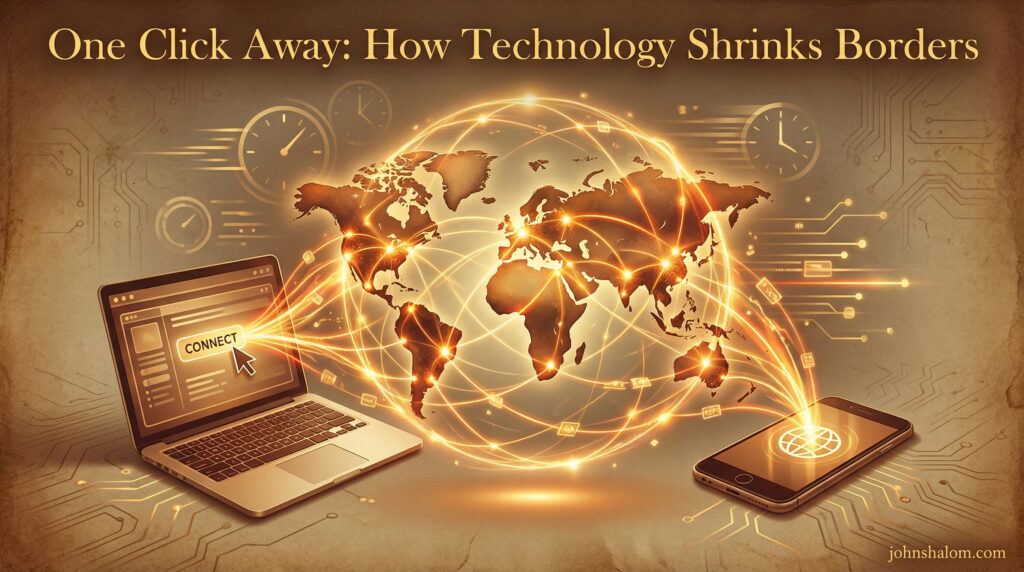
Technology has taken the map of the world and folded it into a rectangle you put in your pocket.
You do not need to travel weeks to hear music from another culture; it is already on your phone. You do not need to wait months for news; it interrupts your breakfast before you ask. You do not need to imagine what Tokyo or Nairobi looks like; someone is already live-streaming a street corner.
Back in my school days, we waited for newspapers that often arrived late, worn, sometimes ripped, and occasionally already used as wrapping paper. By the time you held the headlines, the events were old.
Now the news finds you. It follows you into bed, walks with you in traffic, and competes with your thoughts. The world used to feel wide and slow. Today, it feels small and restless.
2.2 From borders to notifications
One simple example is the World Cup.
In the past, if you lived in a remote place, you might hear the final score days later from a person who heard it from another person who met someone who had a radio. Today, the whistle blows, and your phone pings instantly with results, commentary, and arguments from strangers who think they are better coaches than the real ones.
The borders that once kept information far away now bend under the weight of notifications. Distance did not disappear, but our experience of it did.
The Funny Side Of A Shrunk World
3.1 Frozen faces and global laughter
Shrinking borders can be serious, but they also give us new kinds of comedy.
I once joined an online meeting with people from three different continents. I was ready with my wise points, my serious face, my carefully built reputation.
Just as I opened my mouth, the Wi-Fi in my area decided to take a break. The screen froze with my mouth half open and my eyes half closed. When the connection came back, they had moved from serious discussion to laughing at my frozen picture.
Technology can join you to the world, yes, but it can also turn you into a meme in seconds.
3.2 Local jokes with global audiences
Another time, I wrote a short social media post meant for my friends. I thought it would stay in our small circle. Then a stranger from Canada commented, “This reminds me of home.”
That was the day I realised that nothing online truly stays in one village. Once you put your words out, they do not belong to your neighbourhood anymore; they belong to whoever reads them.
Your joke can comfort someone in another time zone. Your complaint can create an argument in another language. Your simple reflection can encourage a person you will never meet.
The Bright Side: When Borders Turn Into Bridges
4.1 Families scattered, hearts connected
Technology has turned borders into bridges for families broken by war, work, or migration.
I have seen parents who left home for safety talk daily to children still in the village, thanks to video calls. Grandmothers sing lullabies through screens. Fathers help with homework from thousands of kilometres away. Brothers and sisters who might never get visas to visit each other can still see faces and hear laughter in real time.
Is it the same as sitting together under a tree? No. But it is far better than silence.
4.2 Students learning without passports
Students in Juba can now attend lectures from London, Nairobi, or New York without stepping on a plane. A boy in a small town can watch a physics lesson from a famous university. A girl in a village can learn graphic design on a borrowed phone.
I have taken part in online classes with people from many nations. Sometimes the internet cuts out, and you feel like you have been thrown from the classroom window. But still, the door is open in ways our grandparents could never imagine.
4.3 Small businesses with global doors
Technology has put small businesses on big streets.
A woman selling handmade crafts in Africa can now reach a buyer in Europe with one good picture and a reliable platform. A writer in South Sudan can publish a book online and receive a message from a reader in Finland or Brazil. A local musician can upload a song that someone in another continent uses as their favourite playlist track.
Borders are still on paper, but in trade, music, and ideas, they are often just suggestion lines.
The Shadows Of A Shrunk World
5.1 Privacy that melts
The same tools that connect us also expose us.
A post meant for friends can go viral. A photo you thought was private can leak. A careless comment can follow you into job interviews, relationships, and leadership roles.
When borders shrink, your personal life sits closer to public space. The line between “my business” and “everyone’s business” becomes thin.
5.2 Lies that travel faster than truth
I once forwarded a “breaking news” WhatsApp message without checking it. It sounded urgent, it matched my fears, so I believed it. A few hours later, I realised it was fake. By then, my neighbours were quoting me as the source.
That day, I learned something painful: when borders shrink, your mistakes get wings.
It used to take days for a rumour to travel from one village to the next. Now, one wrong click can create panic across countries. Truth often walks; lies sprint.
5.3 Digital comfort that eats real relationships
Technology can also replace real contact with cheap substitutes.
You can “like” your cousin’s photo without ever calling. You can argue about politics with strangers while ignoring your own children in the same room. You can feel busy online and yet be empty inside.
The danger is not the phone itself. The danger is letting the phone steal our presence from the people around us.
Digital Citizenship: Responsibility On A Screen
6.1 The same heart, different medium
Citizenship on the ground and citizenship online share the same root: responsibility.
In the physical world, you decide whether to pay taxes, follow rules, join community work, and vote. Online, you decide what to share, what to ignore, what to amplify, and how to speak to strangers.
Comfort online says, “Just scroll, laugh, and forward anything interesting.”
Citizenship online says, “Pause. Check. Ask: will this help or harm?”
6.2 Simple rules for a crowded digital village
Living in this digital village, we need simple habits:
• Think before sharing: “Is this true? Is it kind? Is it needed?”
• Respect people: even if you disagree, speak as if they were in front of you.
• Protect the young: help children and youth understand that not everything online is real or safe.
• Guard your own heart: do not let likes and comments control your value.
Each of these small choices is a brick in the house we all share.
You might also like: Essential Computer Skills for the 21st Century: From Basics to Advanced Tips
A Sobat River Boy Meets The Global Village
7.1 My first global message
I still remember the first time someone from a far country wrote to me about my writing.
They had found one of my articles online. They lived in a place I only knew from maps. Yet their words sounded like a neighbour’s: “Your story reminds me of my own childhood, even though our worlds are different.”
For a boy who once shouted across rivers to be heard, now receiving a message across oceans felt almost strange. It also taught me something simple: pain, hope, and humour speak a language that crosses borders very easily.
7.2 Lessons from a frozen computer
Of course, my journey with technology has not been all smooth.
I have lost hours of work to power cuts. I have watched my computer freeze right when I was about to save a chapter. I have drafted emails, pressed send, and then seen “network error” stare back at me with no mercy.
Still, the gains are bigger than the losses. Without these tools, many of my thoughts would have stayed at the riverbank, never reaching the wide ocean of readers I now meet through screens.
A Phone In The Market: Tomatoes And TikTok
One day in a local market, I stood choosing tomatoes. Beside me, a boy pointed his phone at the stalls, live-streaming on TikTok.
He was not just filming tomatoes. He was filming our voices, the bargaining, the dust, the laughter of the women selling, the children weaving through legs, the casual complaints about prices.
Someone in Europe commented in real time: “I wish I could visit there.”
That moment hit me. A small boy in a market, with no studio and no script, was showing the world our daily life. Borders had become thin enough for a shopper in South Sudan and a viewer abroad to share one brief moment.
The boy probably thought he was just playing with his phone. In reality, he was carrying a tiny window between worlds.
Using Technology As A Bridge, Not A Wall
9.1 Ask better questions about your clicks
The tool itself is neutral. Our use gives it direction. Before you click, share, upload, or comment, you can ask:
• Does this connect or divide?
• Does this honour or shame someone?
• Does this show truth or spread confusion?
• Would I say this in person, face to face?
If the answer embarrasses you, maybe that click should not happen.
9.2 Keep humans first, screens second
Technology shrinks borders, but it must not shrink our humanity.
Make time for phone-free meals where you look people in the eye. Call someone instead of only sending texts. Visit when you can; do not let video calls replace every hug. Use the internet to learn, then step away to live what you learned.
If we keep people at the centre and screens at the edges, technology becomes a bridge. If we reverse that order, technology becomes a wall between bodies sitting in the same room.
Conclusion: Every Click Is A Small Choice About The World
The boy I was—shouting across rivers, waiting weeks for messages—could never have predicted the world I live in now.
Today, I can sit in Juba, write a sentence, and a few seconds later someone in Nairobi, Tokyo, or Toronto can read it. One click can bring comfort, truth, and hope. Another click can spread lies, shame, or division.
Borders have already shrunk. That part is done. The map inside our phones will not grow big again.
What remains in our hands is choice.
Each time you hold your phone, you are not just a user. You are a neighbour, a citizen, a member of a worldwide village. With every click you either:
• widen understanding or add confusion
• heal or hurt
• lighten someone’s day or darken it
One click away is a stranger who might become a friend, a rumour that might become a fire, a truth that might set someone free.
The question is not whether technology shrinks borders. The question is: what will you do with that power, one click at a time?
If you would like to know more about my path as a writer, including the struggles, lessons, and small signs of progress along the way, you can read the full story on my Wealthy Affiliate blog here: https://my.wealthyaffiliate.com/johnmaluth/blog
Reflection Questions
- How has technology helped you feel closer to people you once thought were very far away?
- Have you ever experienced the funny side of global connection, like being embarrassed online or in a video call?
- What risks do you see in this borderless digital world, and how can you protect yourself and others from them?
- In your own life, how can you use your phone or computer more as a bridge to people than as a barrier?
- If one click can connect you to the world, what responsibility does that place on you each time you decide to post, share, or comment?
FAQS
- Is technology always good because it connects people?
No. Technology is a tool. It can connect or divide, inform or deceive. Its value depends on how people use it. Connection without truth, respect, and responsibility can still cause harm. - How can I tell if I am misusing technology in my daily life?
Ask yourself if your screen time is damaging your sleep, relationships, or responsibilities. If you spend more time scrolling than speaking to people around you, or if you share things you have not checked, it may be time to change your habits. - How does technology help people in conflict or crisis situations?
It helps families stay in touch, allows people to share their stories with the world, and makes it easier for aid agencies and supporters to organise help. It can also warn people of danger. At the same time, it can spread fear or false information, so careful use is important. - What can parents do to guide children in this borderless digital world?
Parents can set clear limits on screen time, talk openly about online dangers, model good behaviour themselves, and teach children to think before posting or sharing. They should also encourage real-life relationships and offline play. - Can someone in a poor or remote area still benefit from this “shrunk” world?
Yes, even limited access can help. Shared computers, community centres, radio, and basic phones still allow learning and contact. But it is true that digital inequality is real. That is why communities, organisations, and governments should work to expand safe, affordable access so more people can cross these new digital bridges.