TL; DR:
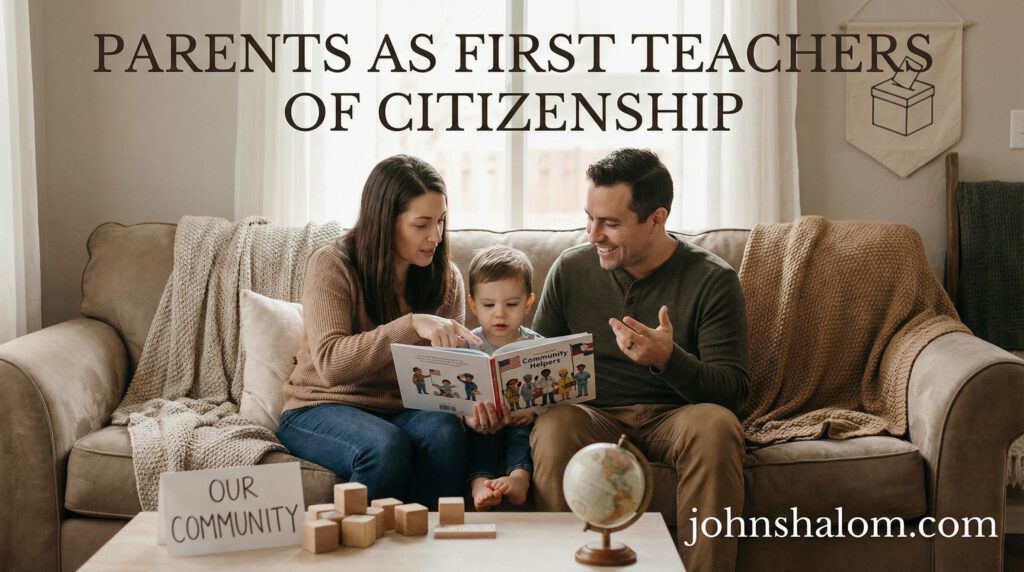
Citizenship does not begin at the ballot box or in a civics classroom. It begins in the way children are raised at home. Parents are the first teachers of how to use power, how to treat others, how to tell the truth, and how to respond to rules. When parents model respect, responsibility, and service, they quietly train future citizens who can strengthen communities and nations.
When they model dishonesty, blame, and selfishness, they train future citizens who will harm public life. You do not need a special degree to teach citizenship. You teach it every day through how you speak, act, keep promises, and handle conflicts in front of your children.
Introduction: Citizenship Starts Before School
1.1 The first lessons of public life happen at home
Long before a child learns the words “constitution” or “parliament,” he or she has already formed strong ideas about power, fairness, and belonging. Those early ideas do not come from books. They come from watching how parents and other adults rule the house, share food, settle arguments, and speak about neighbours and leaders.
I remember as a child listening quietly while my parents discussed village news. I watched their faces when they spoke about chiefs, soldiers, and church leaders. I noticed how they reacted when a decision was unfair or when somebody used power well. They were not giving me a formal civic lesson, but they were shaping my view of authority and my place in the community.
By the time a child sits in a civics classroom, many silent lessons about citizenship are already written in the heart.
1.2 Why governments cannot teach this alone
Governments can write good laws, hold elections, and put civic education in school timetables. These things matter. But no government can control the thousands of small decisions that happen inside homes every single day.
If the home teaches one message and the school teaches another, the home usually wins. Children trust what they see daily more than what they hear for one lesson per week. A teacher may say, “Do not litter,” but if the parent throws rubbish from a moving car, the child remembers the car, not the classroom.
This is why parents are the first and most powerful teachers of citizenship, even if they never use that word. Their daily choices either support or weaken whatever the government and schools are trying to build.
What Is Citizenship in Simple Terms?
2.1 Beyond passports and voting
Many people think citizenship is about papers: passports, national ID cards, and voter cards. Others think it is only about voting every few years. Those things are important, but they are not the whole story.
Citizenship is a way of living with others in a shared space, whether that space is a village, town, or entire country.
A good citizen:
- Respects others, including those who are different in tribe, belief, or status.
- Understands that rights and duties go together.
- Follows fair rules even when no one is watching.
- Takes responsibility for their actions instead of always blaming others.
- Looks for ways to protect and improve the common good.
These traits are not learned mainly from textbooks. They are absorbed from watching how parents live.
2.2 From “my family only” to “our shared home”
It is natural and right for parents to care deeply for their own children. Healthy citizenship does not kill that love. It widens the circle.
Children need to learn that:
– The street outside the gate is also their responsibility.
– The school compound is not just “for the government,” but also a shared home for students.
– The market, the clinic, the water point, and the whole country are places they share with millions of other people.
Parents help children move from “my house only” to “our shared home as a community and nation.” That change in thinking is one of the main tasks of citizenship.
How Parents Teach Citizenship Without Words
3.1 The law of example
Children are sharp observers. They may not remember every speech, but they notice every contradiction. If a parent tells a child to respect rules yet often breaks them, the child will follow the example, not the speech.
Some quiet lessons children learn at home include:
Negative lessons:
- If parents pay or receive bribes, children learn that rules are flexible for those with money or connections.
- If parents insult the tribe, race, or religion of others, children learn that some people are worth less than others.
- If parents throw rubbish on the street, children learn that public spaces do not deserve care.
- If parents cheat on bills or taxes and then boast about it, children learn that clever dishonesty is a skill to admire.
Positive lessons:
- If parents queue patiently, children learn fairness and respect for order.
- If parents say “I was wrong” and apologise, children learn humility and repair.
- If parents help neighbours in crisis, children learn that responsibility stretches beyond the gate.
- If parents keep promises, children learn that words can be trusted.
These small patterns write a powerful message about what it means to be a citizen.
3.2 How we speak about leaders and laws
At home, children hear adults talking about presidents, ministers, chiefs, pastors, police officers, and local officials. Those conversations quietly teach what to think and feel about public life.
From these talks, children learn:
- Whether authority is seen as always evil, always perfect, or sometimes good and sometimes wrong.
- Whether criticism can be wise and respectful, or only angry and reckless.
- Whether laws are viewed as tools for a few powerful people, or as common guides for everyone.
If we only curse leaders without thought, children may grow up either fearing public life completely or treating it like a game of insults. If we never question leaders at all, they may grow up thinking blind loyalty is the same as patriotism.
When we teach children to think, check facts, and even pray for leaders while still expecting accountability, we raise citizens who can engage wisely, not just emotionally.
You might also like: How to Write Your Life Story: A Complete Guide to Autobiography Writing
Key Citizenship Lessons Parents Can Teach
4.1 Respect for people, not just positions
Citizenship collapses when people are treated as things. Children need to see that every person has value, whether rich or poor, from our tribe or another, with a big title or no title at all.
Parents can teach this by:
- Speaking respectfully to workers, guards, drivers, cleaners, and domestic staff.
- Avoiding insults based on tribe, gender, disability, education level, or background.
- Teaching children to greet elders and peers politely, and to use kind words even in disagreement.
This shapes future citizens who see others as human beings first, not merely as tools, threats, or obstacles.
4.2 Truth and honesty in small things
Public life breaks down when lies are normal. Big national corruption often starts with small private lies that were never challenged.
Parents can build truthfulness by:
- Refusing to lie for their children in school matters or to employers.
- Admitting quickly when they themselves were wrong or dishonest.
- Praising honesty, even when it brings a short term cost or embarrassment.
- Making it clear that a small truth is better than a large lie.
A child who learns to tell the truth at home is more likely to tell the truth at work, in business, in court, and in leadership.
4.3 Responsibility and consequences
Citizenship is not only about rights and benefits. It is also about duties and consequences. Parents are the first trainers in this area.
They teach responsibility when they:
- Give children age appropriate chores and expect them to be done, not just promised.
- Allow children to feel reasonable consequences when they disobey or act carelessly, instead of always rescuing them.
- Show that promises matter, from “I will come to your school event” to “I will pay you back.”
- Encourage children to fix what they break and apologise to those they hurt.
Children who learn responsibility at home are less likely to treat public property as free loot or shared resources as nobody’s problem. They grow into adults who can manage offices, budgets, and community duties with more care.
4.4 Peaceful conflict resolution
How a family fights is a direct lesson in how a society will handle conflict. If the home uses threats and force, the child learns that power wins arguments. If the home uses silence and avoidance, the child learns that problems are buried, not solved.
Parents can model better citizenship by:
- Avoiding violence as a method of solving disagreements.
- Teaching children to use words, to listen, and to seek help from a trusted person when problems feel too big.
- Showing that people can disagree strongly and still live together and respect each other.
- Making peace after arguments instead of living with cold distance.
These skills are vital in countries that face political, ethnic, or religious tensions. A child who sees peaceful conflict resolution at home carries those skills to the village, school, workplace, and parliament.
Practical Ways Parents Can Teach Citizenship Daily
5.1 Use daily events as teaching moments
You do not need a formal classroom or long lecture to teach citizenship. Daily life is full of simple opportunities.
Examples:
- When you see litter on the road, ask your child what they notice. Pick some up together. Explain that caring for public spaces is part of loving your country.
- When there is a community meeting, church decision, or school election, explain the process to older children. Help them see how decisions are made and why their voice matters.
- When elections approach, sit with your children and talk about why character matters more than tribe, gifts, or empty promises.
- When you pay a bill honestly or refuse a bribe, tell your children why you chose that path, even if it cost you time or money.
Short, real conversations help children connect citizenship with their own street, school, and future.
5.2 Involve children in decisions that affect them
Citizenship includes participating in decisions that shape shared life. Parents can train this by involving children in simple family decisions, especially as they grow older.
For example:
- Let them help decide how to use a small part of the family budget for shared needs or for helping someone outside the home.
- Ask, “How should we plan our time this weekend so that everyone benefits and our duties are still done?”
- Discuss together how to respond when a neighbour is in need.
This practice teaches listening, weighing options, and thinking beyond self. It shows children that their voice matters, but it is not the only voice.
5.3 Serve the community together
Citizenship is incomplete if it stops at words and never touches service. Parents can make service normal by planning small acts of community care as a family.
Ideas include:
- Joining a community clean up day and letting children sweep, collect rubbish, or plant trees.
- Visiting an elderly or sick neighbour and allowing children to greet, carry, or help.
- Supporting a local project such as a clinic, school, or youth group with small resources or regular visits.
Always explain why you do these things:
“Because this is our community too.”
“Because God cares for these people.”
“Because a good citizen does not wait for the government for every small act.”
Linking service to citizenship helps children see themselves as active builders, not passive complainers.
5.4 Teach children about their rights and how to use them
Citizenship also means knowing your rights and using them wisely. It is not enough to raise obedient children. They must also know when and how to stand against wrong.
Parents can:
- Teach older children basic rights from the constitution or child protection laws using simple language.
- Explain what abuse and corruption look like in real life, and how they can report such things safely.
- Encourage children to speak respectfully when they feel something is unfair, instead of suffering in silence or exploding in anger.
- Remind them that protecting their own rights includes respecting the rights and dignity of others.
This helps raise citizens who can resist injustice without becoming unjust themselves.
When Parents Feel Unqualified or Weak
6.1 You do not need to be perfect
Many parents feel they have failed in some areas. They think, “Who am I to teach citizenship when my own life is not clean?” That feeling is understandable, but it should not paralyse you.
Children do not need perfect parents. They need honest ones. A parent who can say, “I did this wrong, and I am trying to change,” is already teaching citizenship by showing what responsibility and repentance look like.
When you stop pretending and start correcting, you invite your children into a more truthful and hopeful way of living.
6.2 Learning together with your children
Parents can openly learn about citizenship alongside their children. You do not have to know everything before you begin.
You can:
- Read simple civic education materials together and discuss them.
- Watch or listen to civic programs and ask what everyone thinks.
- Visit local offices and quietly explain what each office does.
- Talk through real news stories and ask, “What would good citizenship look like in this situation?”
This sends a strong message: learning is a lifelong duty for every citizen, not just for children in school.
Faith, Parenting, and Citizenship
7.1 Faith as the root of character
For many families, faith is the deepest source of values. Scripture, prayer, and worship help shape what parents believe about people, power, and justice. That faith can either stay in the building on holy days or move into daily life at home, where citizenship is formed.
Faithful parenting for citizenship means:
- Teaching that all people bear the image of God, so dignity does not depend on tribe, status, or wealth.
- Showing that honesty, mercy, and justice are serious commands, not decorations for religious language.
- Praying for leaders and the country, not only complaining about them.
- Linking service to God’s call, not only to human praise.
When children see that faith produces better citizens, not worse, they begin to understand that belief and public life are not enemies.
7.2 M = {B, D²} in parenting
If meaning can be expressed as M = {B, D²}, then parenting is a central part of both “Being” and “Doing.”
Being:
Parents help shape a child’s sense of identity.
– As a child of God.
– As a member of a family.
– As part of a tribe and a nation.
– As a person who matters and has a role to play.
Doing²:
Parents guide repeated actions, the daily habits that slowly build character.
– Chores, greetings, school work.
– Prayer, worship, and reflection.
– Acts of service and sharing.
– Telling the truth, even when it hurts.
Strong citizenship does not appear suddenly on voting day. It grows from thousands of small repeated actions guided by a clear sense of who we are. Parents are the first to plant and water these seeds.
Conclusion: Parents as Nation Builders in Ordinary Clothes
You may never sit in a national assembly or sign a law. You may never appear on television or address a large crowd. Yet every day you sit in a place just as important for the future of your country: your home.
There, without microphones or cameras, you are teaching citizenship.
Every time you choose truth over lies, you teach the value of honesty.
Every time you clean a shared space, you teach care for the common good.
Every time you admit a mistake and make it right, you teach accountability.
Every time you treat people with respect, you teach the worth of every human being.
These choices do not only shape your child. They shape the future of your street, school, market, church, workplace, and nation.
The role of parents as first teachers of citizenship is not just a theory for books. It is a daily calling that can be lived out in simple, imperfect steps. With God’s help, honest reflection, and steady habits, your house can become a small training ground for the kind of citizens your country desperately needs.
If you would like to know more about my path as a writer, including the struggles, lessons, and small signs of progress along the way, you can read the full story on my Wealthy Affiliate blog here: https://my.wealthyaffiliate.com/johnmaluth/blog
FAQS
Q1: Do I need special education to teach my children citizenship?
A: No. You mainly need a sincere heart and a willingness to live the values you want to see. Basic civic knowledge helps, but your example is far more powerful than complex explanations. Children learn citizenship by watching how you handle truth, responsibility, and respect every day.
Q2: What if my partner or other adults in the house do not support these values?
A: Focus on what you can control, which is your own behaviour and the time you spend with the children. Speak calmly about your values, pray for wisdom, and look for small areas where you can agree. Change in a home is often slow, but your consistency still matters and may influence others over time.
Q3: How early can I start teaching citizenship to my children?
A: Very early. Even small children can learn to share, to say “please” and “thank you,” to greet elders, and to help with simple tasks. These habits are early steps of citizenship because they teach respect, cooperation, and responsibility.
Q4: What if I have made serious mistakes in front of my children?
A: Admit the mistakes, apologise, and choose a different path. Children often respond well to real repentance and visible change. Your later actions can become a powerful lesson in recovery and responsibility, showing that even citizens who go wrong can turn around.
Q5: How does teaching citizenship at home connect to national change?
A: A nation is made of millions of private homes. If many homes raise children who value truth, respect, and service, those children will one day lead offices, markets, schools, and governments differently. National change does not begin only in parliaments. It begins with the everyday work of parents shaping future citizens around their own tables.