TL;DR:
Grief is the language of the heart, and poetry gives it a voice. These verses taught me that sorrow, when spoken honestly, can transform into healing. Through rhythm and imagery, poetry turns pain into meaning, reminding us that even in loss, there is beauty, memory, and hope whispering between the lines.
Grief is one of the most profound and universal experiences of being human. It transcends borders, cultures, and time, touching every life at some point. When I found myself navigating the turbulent seas of loss, poetry became both my anchor and my sail. It offered a space where I could give voice to my sorrow, find comfort in shared experiences, and slowly begin to heal. Poetry—both reading and writing it—emerged as a sanctuary, allowing me to explore and express emotions I could barely articulate. In this article, I will share how poetry serves as a powerful medium for processing grief and finding solace, as well as explore the timeless works that have guided me and others through loss.
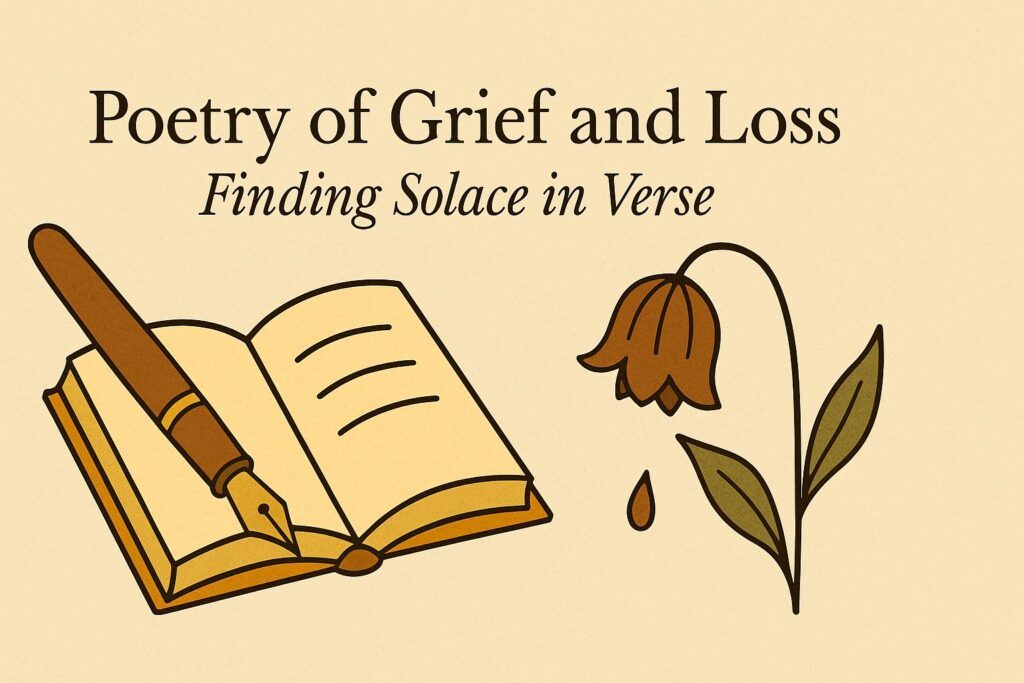
FAQs: Poetry of Grief and Loss — Finding Solace in Verse
1. How can poetry help in coping with grief?
Poetry allows emotions to flow freely. It provides a safe space to express pain, remember loved ones, and find peace through words and rhythm.
2. Why is poetry a powerful tool for healing?
Because it captures deep emotions with simplicity and grace. Writing or reading poetry helps process loss by transforming silence into expression.
3. What are some recommended poetry collections on grief and loss?
Books like The Year of Magical Thinking by Joan Didion, The Art of Losing by Kevin Young, and Mary Oliver’s poems beautifully explore mourning and renewal.
4. Can writing poetry help with emotional recovery?
Yes. Writing poetry can be therapeutic. It helps individuals make sense of pain, honor memories, and reconnect with hope after loss.
5. How can poetry connect people experiencing grief?
Shared poems remind us we’re not alone. They build empathy and community, showing that while grief is personal, healing often grows through shared words.
The Power of Poetry in Grief
Poetry is uniquely suited to address the complexities of grief. Its compact form and emotional intensity allow it to convey the ineffable—those feelings too raw or fragmented for prose. In my own journey, I found that poetry offered something more than words: it provided a rhythm, a cadence that mirrored the ebb and flow of my emotions. In the depths of my sorrow, I turned to poets like Mary Oliver, Rainer Maria Rilke, and Emily Dickinson. Their verses articulated feelings I could not name and reminded me that my grief, though deeply personal, was also part of the shared human condition.
One of the most comforting aspects of poetry is its ability to create connection. As I read works that spoke to my own experiences, I felt less alone. A line from Rumi—“Don’t grieve. Anything you lose comes round in another form”—became a mantra of sorts, a gentle reminder of impermanence and renewal. The universality of grief means that countless poets have explored its depths, leaving a treasure trove of wisdom and solace for us to draw upon.

Writing as Catharsis
Writing poetry can be as healing as reading it. For me, putting pen to paper became a way to externalize the pain I carried within. The act of crafting a poem felt like creating order from chaos—distilling the overwhelming jumble of emotions into something tangible. It didn’t matter if my poems were polished or even coherent; what mattered was the process. Each line I wrote became a small step toward understanding and accepting my grief.
Many people find that writing allows them to confront their feelings in a safe and structured way. According to a study by Pennebaker and Beall (1986), expressive writing—which includes poetry—can lead to significant improvements in emotional and physical health. Through writing, I was able to explore memories, express regrets, and even converse with my lost loved ones. Poetry gave me a voice when I felt silenced by grief.
Timeless Works That Console
Some poems have an almost magical ability to offer solace. During my journey, I discovered a few works that resonated so deeply they felt written for me. One of these was W.H. Auden’s “Funeral Blues,” with its stark portrayal of a world irrevocably changed by loss. The lines “He was my North, my South, my East and West” encapsulated the disorientation I felt in my own mourning.
Another poem that provided comfort was Elizabeth Bishop’s “One Art.” Her meditation on loss—both trivial and profound—reminded me of the resilience inherent in the human spirit. Despite her understated tone, the vulnerability in lines like “Even losing you (the joking voice, a gesture I love)” felt like an invitation to grieve openly.
For those grappling with loss, I recommend exploring the following poems:
- “Do Not Go Gentle into That Good Night” by Dylan Thomas: A powerful call to fight against the dying of the light, this poem captures the raw energy of resistance in the face of mortality.
- “The Wild Geese” by Mary Oliver: A reminder that life continues, and beauty persists, even in our darkest moments.
- “Remember” by Christina Rossetti: A tender exploration of remembrance and letting go.

The Modern Landscape of Grief Poetry
Today, contemporary poets continue to explore grief with depth and nuance. I’ve found solace in the works of poets like Ocean Vuong, whose book On Earth We’re Briefly Gorgeous blends personal history with universal themes of love and loss. His lines, “The most beautiful part of your body is where it’s headed,” remind me of the inevitability and beauty of life’s transience.
You might also like: The Complete Poetry Writing Guide: From Inspiration to Publication
Another modern poet who speaks to grief is Ada Limon. Her work often grapples with loss and transformation, as in her poem “The Carrying,” which reflects on the weight of living and loving in a fragile world. These contemporary voices bridge the gap between the past and the present, showing that poetry remains as vital and relevant as ever.
Creating a Personal Poetry Practice
If you’re navigating grief, incorporating poetry into your life can be a meaningful step toward healing. Here are some ways to begin:
- Read Widely: Explore different poets and styles to find works that resonate with you. Anthologies like The Poetry of Loss or online platforms such as the Academy of American Poets are excellent starting points.
- Write Freely: Don’t worry about form or technique. Start by jotting down whatever comes to mind—a memory, an image, a fragment of thought—and see where it leads.
- Create Rituals: Dedicate time each day or week to engage with poetry. Whether it’s reading a poem before bed or writing in the morning, these rituals can provide a sense of grounding.
- Share and Connect: If you feel comfortable, share your poetry with others. Joining a writing group or attending poetry readings can foster connection and validation.

Conclusion
In my experience, poetry is not a cure for grief but a companion. It walks beside us, offering solace and understanding when words fail. It reminds us that we are not alone in our sorrow and that beauty can coexist with pain. As I continue to navigate the complexities of loss, poetry remains a steadfast presence—a testament to the resilience of the human spirit and the power of art to heal.
If you, too, are seeking comfort in the face of loss, I encourage you to turn to poetry. In its lines, you may find the solace you need to move forward, one verse at a time.
References
Auden, W. H. (1938). Funeral Blues. In Another Time. Faber and Faber.
Bishop, E. (1976). One Art. In Geography III. Farrar, Straus and Giroux.
Limon, A. (2018). The Carrying. Milkweed Editions.
Oliver, M. (1986). Wild Geese. In Dream Work. Atlantic Monthly Press.
Pennebaker, J. W., & Beall, S. K. (1986). Confronting a traumatic event: Toward an understanding of inhibition and disease. Journal of Abnormal Psychology, 95(3), 274–281. https://doi.org/10.1037/0021-843X.95.3.274
Rossetti, C. (1862). Remember. In Goblin Market and Other Poems. Macmillan.
Thomas, D. (1951). Do Not Go Gentle into That Good Night. Botteghe Oscure.