TL;DR:
Religiosity follows structure; spirituality seeks connection. One focuses on rules and rituals, the other on inner transformation. Both can coexist beautifully—but when taken to extremes, religiosity becomes rigid, and spirituality turns self-centered. True faith lives where discipline meets compassion.
FAQs: Religiosity vs Spirituality Explained
1. What is religiosity?
It’s the outward practice of faith—rituals, traditions, and beliefs expressed through organized religion.
2. What is spirituality?
Spirituality focuses on personal connection with the divine or inner self, often beyond formal institutions.
3. How do religiosity and spirituality differ?
Religiosity emphasizes external worship; spirituality prioritizes internal experience and understanding.
4. Why can religiosity or spirituality become extreme?
When one replaces humility with pride—religiosity can become judgmental, and spirituality can turn self-absorbed.
5. How can we find balance between the two?
Embrace structure with openness—follow faith sincerely while nurturing a personal, compassionate relationship with God.
Introduction
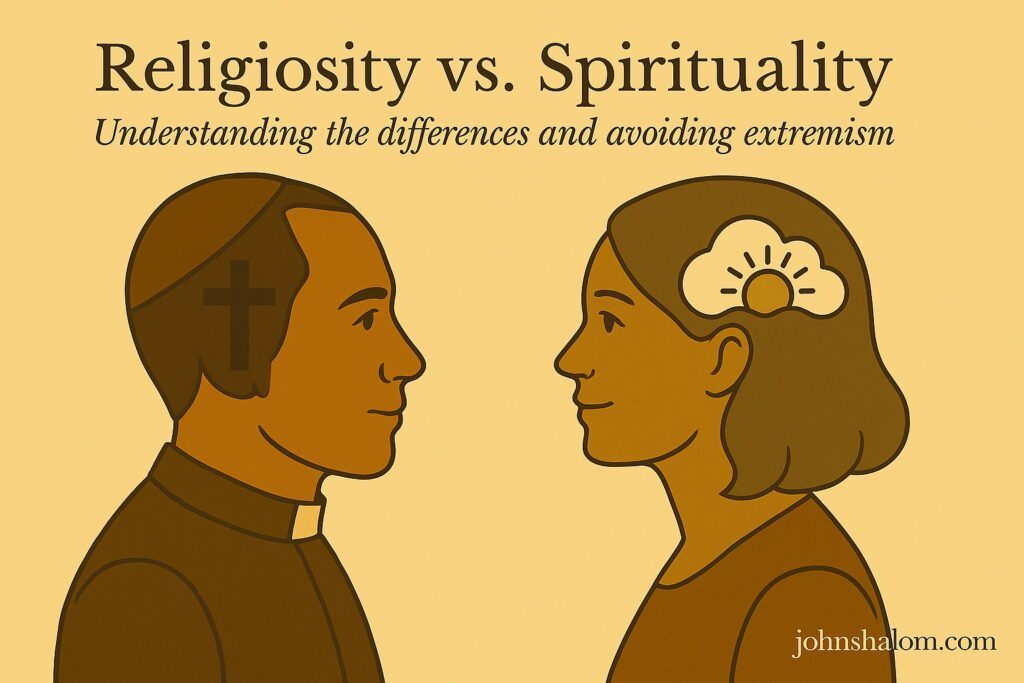
Religiosity vs. Spirituality is a topic that has been widely debated for centuries. People often confuse the two, assuming they are interchangeable. However, understanding their differences is crucial to developing a well-balanced perspective on faith, belief systems, and personal growth.
This article will explore the key distinctions between religiosity and spirituality, the dangers of religious extremism, and how to cultivate a balanced spiritual life. Whether you consider yourself religious, spiritual, agnostic, or atheist, this discussion will help you understand the broader implications of belief systems and how they impact society.
Let’s dive in.
What is Religiosity?
According to the English dictionary, religiosity is defined as “a strong religious feeling or belief.” However, in this article, we extend this definition to refer to the strict adherence to religious doctrines, traditions, and practices, sometimes without questioning their validity. Religiosity often involves rituals, dogma, and a structured approach to faith.
Religiosity and Tradition
Religious systems have existed for thousands of years, shaping cultures, communities, and governance. Religiosity is often rooted in traditions that may have been relevant in the past but are now challenged by modern science and human rights perspectives.
For example, some religious practices once considered normal are now seen as outdated or even harmful. Practices such as animal sacrifices, gender inequality, and extreme fasting were based on ancient beliefs, yet they continue in some cultures today despite scientific and ethical opposition.
When Does It Become Religious Extremism?
Religious extremism occurs when a belief system becomes rigid and intolerant, leading individuals to justify harmful actions in the name of faith. This could be seen in violent religious conflicts, discrimination, and radical ideologies that exclude or demonize others.
Some signs of religious extremism include:
- Blindly following religious leaders without questioning their teachings
- Rejecting scientific evidence that contradicts religious beliefs
- Persecuting or discriminating against those with different beliefs
- Engaging in harmful practices based on faith (e.g., refusing medical treatment, encouraging violence, etc.)
What is Spirituality?
Unlike religiosity, spirituality focuses on personal growth, inner peace, and the exploration of life’s deeper meanings beyond structured religious practices. According to the dictionary, spirituality is “the quality of being concerned with the human spirit or soul as opposed to material or physical things.”
However, spirituality is more than just an abstract concept. It is about seeking truth, wisdom, and a connection with a higher power or universal energy in a way that transcends religious dogma.
Spirituality and Personal Experience
One of the defining characteristics of spirituality is its emphasis on personal experiences rather than inherited beliefs. People who identify as spiritual may:
- Meditate or practice mindfulness
- Seek wisdom from multiple religious or philosophical sources
- Emphasize compassion, kindness, and interconnectedness
- Value experiences over doctrines
Unlike religiosity, spirituality is often flexible and evolving. Spiritual individuals are open to questioning, learning, and growing based on their life experiences rather than adhering to fixed religious rules.
The Logical Debate: Religiosity vs. Atheism
While religiosity is often seen as structured and based on faith, atheism rejects the notion of a deity altogether. Some argue that atheism, like religiosity, can also become dogmatic when individuals aggressively dismiss all spiritual or religious beliefs without exploring the possibilities.
You might also like: The Complete Guide to Theology: Faith, Reason, and Modern Interpretations
Atheism and religiosity are both extreme ends of the spectrum. Atheism asserts that there is no God or higher power, while religiosity often insists that faith alone is enough to explain everything. Both perspectives, when rigid, can be limiting in their own ways.
However, a balanced approach—where one remains open-minded and willing to learn—can lead to greater wisdom and understanding.
Religiosity vs. Spirituality: Key Differences
| Aspect | Religiosity | Spirituality |
|---|---|---|
| Definition | Adherence to religious beliefs and traditions | A personal search for meaning and higher consciousness |
| Focus | Doctrines, rituals, and structured worship | Inner peace, enlightenment, and connection with the universe |
| Flexibility | Fixed beliefs, often unquestioned | Open to learning and evolving |
| Community vs. Individuality | Collective, often governed by religious leaders | Personal journey, guided by intuition |
| Extremism Risk | Can lead to religious intolerance or radicalism | Rarely leads to extremism, as it encourages open-mindedness |
The Role of Science in Spirituality and Religion
Science has played a significant role in questioning many religious claims while also providing insights into spiritual experiences. For instance:
- Neuroscience has studied the effects of meditation and prayer on the brain.
- Quantum physics has explored consciousness and the possibility of interconnected energies.
- Psychology has examined the benefits of belief and faith in human well-being.
While religiosity may resist scientific findings that contradict its teachings, spirituality often embraces science as a tool to understand the unknown.
Finding Balance: How to Avoid Extremism
A balanced approach between spirituality and religiosity can lead to a fulfilling life. Here are some ways to achieve this balance:
1. Question Everything
Whether you follow a religious path or a spiritual journey, critical thinking is essential. Don’t accept beliefs blindly—ask questions and seek answers.
2. Embrace Scientific Understanding
Science and spirituality do not have to be enemies. Embracing scientific discoveries while maintaining faith in the unseen can create a well-rounded perspective.
3. Focus on Love and Compassion
At the core of both religion and spirituality is the principle of love. Avoid rigid dogma and instead focus on treating others with kindness and empathy.
4. Be Open to Learning from Different Cultures and Beliefs
The world is full of diverse traditions and wisdom. Being open to learning from different sources can enrich your understanding of life.
5. Avoid Fanaticism
Whether religious or atheist, extreme views can be harmful. Keeping an open mind and respecting others’ beliefs creates a more peaceful society.
Conclusion: Your Personal Choice
Ultimately, the choice between religiosity and spirituality—or a combination of both—is a deeply personal one. Understanding the differences, benefits, and potential risks can help you make an informed decision that aligns with your values and beliefs.
Whether you find comfort in structured religious practices or prefer a more fluid spiritual journey, the key is to avoid extremes and cultivate wisdom, love, and compassion.
Final Thought: At the end of the day, we are all seeking truth in our own ways. What matters most is how we treat ourselves and others on this journey.
Shalom and may you find wisdom in your quest for truth!