TL;DR
When I was a child along the Sobat River, oral stories were not a “cultural activity.” They were the air we breathed at night. My grandmother’s voice was our library, our news channel, our school, and our theatre. Today we have phones, Netflix, and TikTok, but the human need for stories has not changed.
Oral traditions still carry memory, faith, and identity in ways no screen can fully replace. If we lose them, we do not only lose entertainment; we lose part of ourselves. If we keep them alive, we give our children more than information. We give them roots.
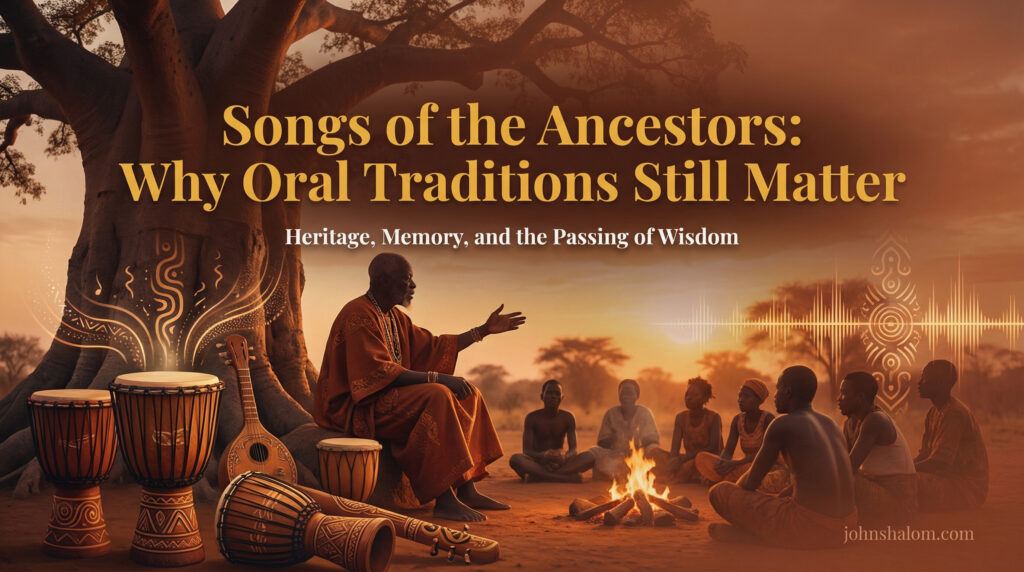
The Fire, The Night, And The Voice That Held Us
When I was little, my grandmother could hold an entire audience with nothing but her voice.
No microphone.
No PowerPoint.
No battery.
Just a flickering fire, a circle of children, and a woman who carried centuries in her memory.
She spoke of warriors and tricksters, of animals that behaved like people, of ancestors whose names carried both pride and warning. Some stories were long like the Sobat River. Others were short, like sharp arrows of wisdom.
At the time, I thought she was just keeping us busy until sleep defeated our eyelids. Only later did I realise she was doing something much bigger: she was shaping our identity, one story at a time.
Those nights were my first university. The curriculum was oral. The exams were invisible. The degree was a sense of belonging.
Why Oral Traditions Still Matter In A World Of Screens
Oral traditions are cultural hard drives. They store memory, values, and wisdom without needing electricity or data bundles.
A textbook might tell you what happened.
A story tells you why it mattered.
A proverb does not just give advice; it carries generations of testing and pain, boiled down into one short sentence. “The child who does not listen will walk in the rain without shelter” is more than grammar. It is history, warning, and love in one line.
Think about this: if all Wi Fi disappeared tomorrow, what would survive?
Not your memes.
Not your playlists.
Not even your favourite tutorials.
But your grandmother’s story about why the hare has long ears? That one can live as long as someone remembers it and feels brave enough to repeat it.
Storytelling As A School Without Walls
When elders told us stories, they were not just filling time. They were running schools without walls, timetables, or report cards.
Stories taught us:
• Bravery, through warriors who stood when others ran.
• Respect, through children who suffered when they ignored elders.
• Patience, through hunters who waited days for one chance.
• Wisdom, through animals who survived by thinking, not by strength alone.
A tale about a greedy hyena did more than make us laugh. It warned us that selfishness always comes back to bite you. A clever hare who escaped trouble by thinking fast taught us that a small brain used well beats a big body used badly.
Oral traditions teach through the heart as well as the mind. Lessons that arrive with emotions, laughter, and shared attention go deeper than facts memorised for exams.
The Comedy Hidden In Our Stories
Some of the funniest moments of my childhood were born around that fire.
There was one elder in our village with a special gift for exaggeration. If he described a lion, you were not sure whether he meant a real animal or some creature that escaped from another planet.
“This lion,” he would say, “was so big that when it roared, the moon went to hide behind the clouds.”
We laughed until our ribs complained.
That humour was not a side issue. It was a key. It glued the stories to our memories. When you laugh as you learn, your mind keeps the lesson longer. Even now, when I remember those jokes, I also remember the warnings and morals hidden inside them.
What We Lose When Oral Traditions Fade
If oral traditions disappear, we do not only lose old stories. We lose:
• A sense of where we come from.
• The link between our names and our ancestors.
• The meanings behind our customs and rituals.
• The shared memory that turns a crowd into a people.
We may raise young people who know how to code, drive, and use foreign languages, but who do not know where their great grandparents are buried, or why their clan behaves in certain ways.
We risk building citizens who are sharp in the head but empty in the heart.
Culture without oral tradition is like a smartphone with no useful apps. It may look shiny, but it does not do much that matters.
You might also like: The Ultimate Guide to Political Journalism: Ethics, Challenges, and Impact in the Modern World
My Grandmother’s Last Story
Before my grandmother passed away, she told me one final story. It was short. She did not have the strength for a long one.
She said, “When people forget their stories, they forget who they are.”
At the time, I nodded politely. I thought I understood. But years later, walking through cities where children knew cartoon characters better than their own clans, her words began to burn deeper.
I saw young people ashamed of their languages. I saw communities where traditional songs were replaced by borrowed noise. I met men and women who had degrees and money but felt secretly rootless.
Then her sentence returned: when people forget their stories, they forget who they are.
Her last story became my assignment. It is one of the reasons I keep writing, telling, and laughing through stories. For me, storytelling is not just entertainment. It is survival.
Oral Traditions In The Age Of Smartphones
Today, I can sit in Juba, Nairobi, or London and watch anything on a screen. I can listen to music from any country. I can read news from every continent. This is a gift. But it is not a replacement for the elders’ voices.
I have seen children who can swipe and tap with great speed, but who have never sat through one full story told by an older person. They know global jokes but not local proverbs. They know English idioms but not the sayings of their own grandparents.
The goal is not to reject technology. The goal is to make sure the phone does not silence the fire.
We can do both:
• Record elders telling their stories on video.
• Share proverbs on social media with explanations.
• Turn oral histories into books and audio.
• Use modern tools to carry old wisdom instead of replacing it.
The danger is not the phone itself. The danger is forgetting to look up from it when a wise voice starts speaking.
Simple Ways To Keep Oral Traditions Alive
You do not need a big budget to keep oral traditions alive. You need time, attention, and a bit of courage. Here are simple steps:
- Ask elders to tell stories
Do not wait for funerals. Visit them now. Ask, “Grandmother, can you tell me about your childhood?” or “Uncle, what was the funniest thing that happened in the war?” Then listen without rushing. - Record and write
Use your phone to record stories (with permission), then write them down. Saving even a few tales can preserve a lot. - Create family story nights
Choose one evening a week or month when someone tells a story. It can be about ancestors, childhood, or even recent funny events, as long as it is honest and shared. - Teach children proverbs
Share one proverb at a time. Explain it. Use it in daily life. Soon it will start coming out of their own mouths at the right moments. - Mix old and new
Let children retell old stories in their own style. Let them act them out, draw them, or turn them into short videos. As long as the heart of the story survives, the form can adapt.
Conclusion: Remembering So We Do Not Forget Ourselves
Songs of the ancestors are not only about the past. They are bridges between yesterday and tomorrow.
When we keep oral traditions alive, we do not freeze ourselves in history. We stay connected to the long line of people who walked this earth before us, suffered, celebrated, and learned hard lessons.
Their stories help us avoid old mistakes. Their proverbs help us name present dangers. Their humour helps us survive today’s pain.
If we let those stories die, we may still have tall buildings and fast internet. But inside, many people will move through life like strangers to themselves.
So, the invitation is simple:
Listen to the elders.
Repeat the stories.
Teach the children.
Laugh together.
Because when we keep the songs of the ancestors alive, we do more than honour the dead. We teach the living how to be fully human.
If you would like to know more about my path as a writer, including the struggles, lessons, and small signs of progress along the way, you can read the full story on my Wealthy Affiliate blog here: https://my.wealthyaffiliate.com/johnmaluth/blog
Reflection Questions
- Which oral story or proverb from your childhood still shapes how you think or act today?
- How could you begin passing down oral traditions in a family or community that spends a lot of time on screens?
- What role has humour played in helping you remember important lessons from stories or elders?
- How do oral traditions strengthen both tribal identity and national identity instead of opposing them?
- What would your family or community lose if its songs, stories, and proverbs disappeared in the next generation?
FAQS
- What exactly counts as an oral tradition?
Oral traditions include spoken stories, songs, poems, jokes, proverbs, prayers, and historical accounts passed from one person to another by word of mouth, rather than written texts. - Are oral traditions still useful if we already have books and the internet?
Yes. Books and the internet store information, but oral traditions carry tone, emotion, and relationships. Hearing a story from a living person connects hearts in a way a screen cannot fully replace. - How can young people who grew up with technology appreciate oral traditions?
They can start by listening to elders with curiosity, asking questions, and recording stories. Once they see how rich and dramatic these stories are, many discover they are more gripping than most shows. - Can oral traditions change over time and still be valuable?
Yes. Stories often gain small changes as they move through generations. As long as the core truth and values remain, this movement keeps them fresh and alive rather than frozen and forgotten. - What if my family has already lost many of its stories?
Start with what you still have. Ask older relatives what they remember. Collect even small fragments. Read and listen to stories from your wider community. You may not recover everything, but you can begin a new chain so that the loss stops with you and does not continue with your children.