
TL;DR
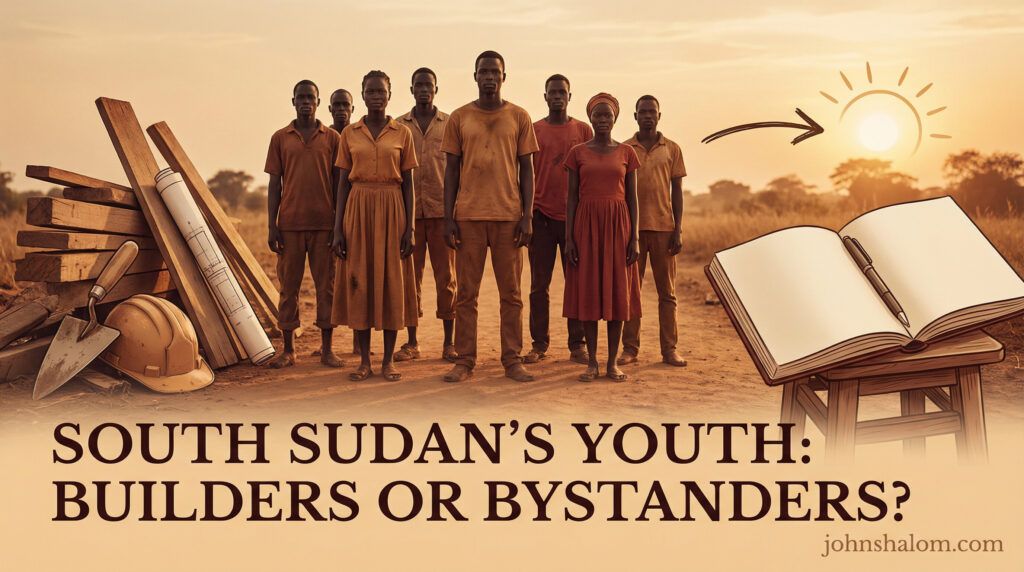
South Sudan is a young country in two ways: by age as a nation and by age of its people. Most citizens are under 30, which means the future does not belong mainly to today’s leaders, but to the youth sitting in schools, riding boda-bodas, farming, trading, and scrolling on their phones.
Each young person faces a quiet choice every day. Live as a builder who takes responsibility, or as a bystander who only complains. Builders are not only soldiers or politicians. They are teachers, writers, entrepreneurs, volunteers, artists, and ordinary people who decide to fix one thing around them.
Bystanders choose comfort, blame, and delay. If the majority of South Sudanese youth become builders, the country can rise. If they choose bystanding, others will keep writing South Sudan’s story while they stand and watch.
Why This Question Matters Now
1.1 Two futures in the same young faces
When I walk through Juba, Wau, Bor, or along the dusty roads of smaller towns, I see the same faces carrying two possible futures at once. A young man selling airtime by the roadside could one day run a communication company, or still be standing there at 50, blaming everyone else. A schoolgirl reading under a tree could become a doctor, or grow up to say, “Nothing changes here anyway.”
Inside the same young body, there is a builder and a bystander. The builder is ready to sweat, learn, and serve. The bystander is ready to sit, scroll, and complain. This is not only about “the youth out there.” It is about every young person reading these words.
1.2 Youth as the real majority
South Sudan’s population is heavily tilted toward the young. More than two thirds are under 30. The nation is not shaped only by the small group sitting in offices. It is shaped by the large group standing in queues, riding motorbikes, herding cattle, selling in markets, typing on phones.
If youth do not build, the nation cannot grow. If youth become passive, no amount of speeches will save the future. That is why this question is not a slogan. It is a survival issue: builders or bystanders.
Builders And Bystanders: What Do These Words Mean?
2.1 Who is a builder?
A builder is any person who chooses responsibility instead of excuses. You do not need a salary, title, or English certificate to qualify. Builders ask, “What small thing can I fix, improve, or start today?”
A builder can be the young woman who tutors children in her neighborhood. The youth who organises a weekly clean-up along the road. The boy who decides to stop spreading rumours and start speaking truth. The girl who learns computer skills and later teaches others.
Builders do not wait for perfect conditions. They act with what they have.
2.2 Who is a bystander?
A bystander is not simply someone who is poor or unemployed. A bystander is someone who chooses to stay on the sidelines. They sit at the tea place all day saying:
“They have failed us.”
“This country is finished.”
“One person cannot change anything.”
Bystanders like to talk about “they” and “them.” Builders talk about “we” and “I.” The bystander may be highly educated or not educated at all. What defines them is not their background, but their decision to watch instead of act.
What I Saw Growing Up: Youth In War And Survival
3.1 Young shoulders carrying old burdens
As a boy along the Sobat River, I saw youth carrying weight that should have belonged to governments and systems. Teenagers became providers when their fathers died. Young girls learnt to cook for 15 people while still children themselves. Boys my age drove cattle through dangerous territory or stood guard at night, listening for distant gunfire.
Youth were forced to grow up early. Some became tough and wise. Others became angry and tired. But one thing was clear: the strength of South Sudanese youth has always been there. The question is how that strength is used.
3.2 My brother’s sacrifice in 1989
In 1989, my elder brother went to war in Nasir. He was young. He could have chosen the path of comfort: stay at home, look after cattle, marry, and live quietly. Instead he chose the path of citizenship. He joined a struggle that he believed would open a future for our people.
He never returned.
His absence left a hole in our family. For my parents, it was not a chapter in a history book. It was an empty seat at the fire. But even in the pain, his choice taught me something. Youth are always at the centre of a nation’s turning points. The older generation may sign agreements, but it is the young who carry the cost.
The youth of today must ask themselves: will we honour that blood by building, or waste it by standing aside?
The Many Forms Of Building
4.1 More than guns and government positions
For many South Sudanese, the word “builder” is still tied to politics and armed struggle. We think of generals, commanders, and leaders with flags behind them. That is one part of the story, but not the whole.
A builder can be a nurse who shows up on time every day, even when medicine is short. A builder can be a teacher who explains fractions to a child who has never owned a textbook. A builder can be a mechanic who does honest work instead of cheating customers. These are not small things. They are the hidden stones in the foundation of a nation.
4.2 A street-cleaning story from Juba
Some years ago, I met a young man in Juba who decided he was tired of seeing rubbish piling up along his street. He had no contract and no donor. He had a broom, a few friends, and a sense of shame about the dirt.
He started alone. People laughed. “You think you are the government now?” they teased. But he kept sweeping. After a few days, one neighbour joined. Then another. Traders noticed that customers preferred the clean side of the street. Soon, the same people who mocked him were contributing sacks and tools.
That young man did not build a highway or a skyscraper. He built something deeper: a new standard. That is what builders do.
4.3 My own way of building with words
For me, building began with books and pens. I did not have cement or machines. I had memories of war, hunger, and survival, and a desire to make sense of them. Writing became my tool. Each article, book, and lesson was a small act of construction.
I do not pretend that words alone can feed people or build roads. But words can shape minds. Minds shape actions. Actions shape nations. My building looks different from my brother’s building with a gun in 1989. Yet both come from the same desire: to see South Sudan stand, not fall.
You might also like: The Ultimate Guide to Political Journalism: Ethics, Challenges, and Impact in the Modern World
Why Bystanding Is So Attractive
5.1 The comfort of sitting and blaming
Let us be honest. It feels good, for a short time, to sit and blame others. To say, “The leaders are bad,” “The elders failed us,” “The world forgot us.” These sentences roll off the tongue like tea pouring from a kettle.
Blame lets us feel clever without lifting a finger. It allows us to feel like judges while avoiding responsibility. But blame alone never fixed a broken window, never taught a child to read, never created a job.
5.2 Tea places, social media, and lost hours
I have sat in tea places for hours, listening to debates that could power a whole generator. Brilliant analysis. Sharp jokes. Clear understanding of what is wrong in the country.
Then everyone stands up and goes home. Nothing changes.
Online, it is the same. Youth can type powerful posts, share sharp comments, and forward angry voice notes. These may feel like action, but often they are only noise. Real building needs sweat and consistency, not only strong opinions.
5.3 The lie: “I am too small”
Another reason bystanding is common is the quiet lie inside many hearts: “I am too small to make a difference.”
In a young country with visible problems, it is easy to feel like a drop in a very large bucket. But remember the boy in Juba with his broom. Remember the young people who turned a rough field into a football pitch. Remember teachers running lessons under trees. None of them solved everything. None of them were “big enough” at the start. They started anyway.
Education, Skills And The Risk Of Decorative Degrees
6.1 Education as a building tool
Education is one of the strongest bricks in the hands of youth. A young person who can read, write, and think carefully can change more than his or her own life. They can change villages, counties, and generations.
Education is not only formal schooling. It is also learning from elders, from mistakes, from books, and from real work. It is learning how to handle money, how to listen, how to solve a problem without waiting for someone else.
6.2 When educated youth act like bystanders
One of the saddest things I see is educated youth acting like helpless victims. A degree is framed on the wall, but the owner spends all day saying, “There are no jobs,” while refusing to volunteer, create, or learn new skills.
Education without service becomes decoration. It looks good, but does not carry weight.
I remember standing in front of students with a textbook on African history in my hand. Their eyes were sleepy. So I put the book aside and told them my own story from the war. Suddenly they were alert. That day I saw something important. Knowledge must move from paper to life. The same is true for youth. Their learning must move from CVs to community.
6.3 Learning from elders as part of education
Some young people think “being educated” means despising elders who never went to school. This is a mistake. There is wisdom in the cattle camp, in the market, in the stories of grandmothers who never held a pen.
A builder learns from both systems: formal education and local wisdom. A bystander thinks learning ends with a certificate.
Digital Youth: One Phone, Many Roads
7.1 Technology as a stage for building
Today, many South Sudanese youth carry small machines in their pockets that are more powerful than the computers used to send rockets into space. With one phone, a young person can learn a skill, start a business page, promote a peace event, or share a story that reaches the world.
I have received messages about my books from people in countries I have never visited. That is technology shrinking distance. For youth, this is a huge chance. They can learn from global teachers, connect with mentors, sell goods online, and tell South Sudan’s story in their own words.
7.2 The danger of scrolling life away
The same phone can also steal whole years.
I know this temptation myself. You check one video, then another, then another. You promise to stop, but a “funny clip” pulls you in. Before you know it, darkness has fallen and your tasks are untouched.
A builder uses the phone as a tool. A bystander uses the phone as an escape. The device is the same. The choice is different.
7.3 A small digital example
I once saw a young boy in the market streaming live on social media. He showed the dust, the tomatoes, the jokes, the real life of his street. Someone commented from Europe, saying, “I wish I could visit this place.”
In that moment, the boy was not just a teenager with a phone. He was a small ambassador. He became a bridge between South Sudan and the wider world. That is building too.
Enemies Of Youthful Building
8.1 Corruption and bad example
When young people see older people steal public money and still be praised, they are tempted to think, “Only fools play fair.” Corruption poisons the imagination. It tells youth that honesty is for losers.
But youth can choose a different path. They can decide that their generation will be remembered for cleaning rather than repeating.
8.2 Trauma and hopelessness
Many young South Sudanese carry deep pain: loss of family members, years in camps, hunger, and humiliation. Pain can make you strong, or it can make you numb.
If trauma is never faced, it can turn into, “Nothing matters, so why try?” That is fertile ground for bystanding. Healing, whether through faith, counselling, or supportive friendships, is part of becoming a builder again.
8.3 Division along tribal lines
When youth are taught that their main job is to defend their tribe against other tribes, they spend their energy fighting each other instead of building together. A builder can be proud of his or her tribe, but still see beyond it.
Youth who choose to be builders ask, “How can my tribe’s strengths bless the whole nation?” not, “How can we win alone while others lose?”
8.4 Short term thinking
Some youth want quick results: instant money, instant respect, instant comfort. But building rarely works that way. It is more like farming. You clear the land. You sweat. You plant. For a while it looks like nothing is happening. Later, the harvest comes.
Bystanders eat quickly and suffer later. Builders plant and wait, then eat with peace.
From Complaints To Contribution
9.1 Moving from “they” to “we”
The first step from bystander to builder is a change in language. Instead of saying, “They should fix the road,” try, “What can we do about this road? What can I do today?”
Contribution does not always mean big projects. It may mean:
- Collecting trash in front of your own shop.
- Helping one child learn to read.
- Starting a small savings group with friends.
- Refusing to give or take a bribe.
9.2 Imperfect efforts still count
Some of my attempts at building have been laughable.
Once, a few youths and I decided to organise a community discussion meeting. We printed small notices, borrowed plastic chairs, and prepared our best ideas. On the day, we waited and waited. Only a handful of people came. For a moment, I felt foolish.
Later, I met one man who had attended. He said, “That meeting changed how I think about my role here.” One person. The bystander in me said, “Only one?” The builder in me answered, “It was worth it.”
Not every effort will look grand. Some will look like crooked football fields or half-attended events. That is fine. Nations are not built only in grand moments. They are built in patient, imperfect steps.
A Simple Roadmap For Youth Builders
10.1 Start with yourself
Before you rebuild a country, start with your own habits.
Ask yourself:
- Am I honest with money?
- Do I keep my word?
- Do I respect time?
- Do I care for my body and mind?
A nation is a collection of habits. When youth clean up their own inner lives, they are already laying stones for the national future.
10.2 Serve your family and community
Your first “ministry” or “office” is often your own home and neighbourhood. Help with chores without waiting to be told. Care for younger siblings. Greet neighbours. Fix small things around you.
If youth cannot serve where they are already known, they will struggle to serve well when they are given bigger roles later.
10.3 Grow skills and character together
Skills without character can damage a country. Character without skills can feel helpless.
Youth builders work on both.
They learn practical abilities: farming methods, trades, technology, languages, communication. At the same time, they grow inner strength: patience, truthfulness, courage, fairness. Over time, this mix makes them trusted people in any setting.
10.4 Think national and global, act local
It is healthy for youth to dream big for South Sudan and even for the continent. It is also healthy to think about their place in the wider world.
But all big dreams must start somewhere small. If you want to fight corruption nationally, start by refusing corruption personally. If you want peace between tribes, start by speaking respectfully about other communities. If you want South Sudan to be known for innovation, start by being creative with the tools you already have.
Final Call: What Story Will This Generation Tell?
One day, someone will sit under a tree or in a classroom and tell the story of the youth who lived through these years in South Sudan. The storyteller will say one of two things.
Either:
“They watched. They complained. They blamed. They waited for others. History passed them by.”
Or:
“They built. They tried. They failed and tried again. They cleaned streets, wrote books, started businesses, taught children, healed the sick, and refused to give up. They were far from perfect, but they were not absent.”
Each young person adds a line to that story through their daily choices.
You may feel small, but your choice today still counts. Builder or bystander. Tea place critic or quiet servant. Hopeless observer or hopeful worker. The nation you hand to your children will tell which one you chose.
If you would like to know more about my path as a writer, including the struggles, lessons, and small signs of progress along the way, you can read the full story on my Wealthy Affiliate blog here: https://my.wealthyaffiliate.com/johnmaluth/blog
Reflection Questions
- In your daily life, do you act more often like a builder or a bystander?
- What is one small action you can take this week to improve your home, school, workplace, or neighbourhood?
- How can you use your education, formal or informal, to serve more than just your own comfort?
- What fears or excuses keep you from acting, and how could you face one of them this month?
- If future children in South Sudan read about your generation, what do you want them to learn from your example?
FAQS
- What does it really mean to be a “builder” as a young person in South Sudan?
A builder is any youth who takes responsibility for improving something around them, however small. It can be starting a study group, cleaning a street, mentoring a younger child, or running an honest small business. - Can I be a builder even if I am unemployed or not in school?
Yes. Building is not limited to those with jobs or degrees. You can volunteer, learn skills, help at home, support community activities, and grow your character while you wait for other doors to open. - What is wrong with just waiting for leaders to fix the country?
Leaders have duties, but they cannot do everything. If citizens, especially youth, do nothing, even good policies fail. Nations grow when both leaders and ordinary people act responsibly. - How can technology help South Sudanese youth become builders instead of bystanders?
Technology can help youth learn skills, share ideas, connect with mentors, promote businesses, and tell their stories to the world. Used wisely, phones and computers become tools for learning and service, not just entertainment. - What first step can I take today if I want to stop being a bystander?
Start with one small, clear action. Clean one area. Help one person. Finish one task you have been avoiding. Then repeat tomorrow. Consistent small steps are how builders are formed.

This raises an important question about whether young people are being empowered to shape their country or simply coping with circumstances beyond their control. With such a large youth population, their role will inevitably influence South Sudan’s future, for better or worse. In fact, youth make up the majority of the population and face significant challenges like unemployment, insecurity, and limited opportunities, which can shape how they engage with society.
It would be interesting to hear more about what kinds of support or opportunities are most effective in helping youth move from bystanders to active builders.
Jennyse, thank you. You’re right, the youth question is the future question in South Sudan.
When opportunities are limited, young people do not stop acting. They just act where the door is open. Sometimes that becomes building. Sometimes it becomes survival choices that can harm society. That is why jobs, skills, and safety are not “extras.” They shape character and direction.
In your view, what would help youth most right now: practical skills training, access to small capital for businesses, or stronger security and rule of law?