
TL;DR:
Sometimes the best connection is disconnection. These books reminded me that stepping away from screens isn’t about rejection—it’s about recovery. When you trade endless scrolling for silence, reflection, and real presence, you don’t lose touch with the world—you rediscover it.
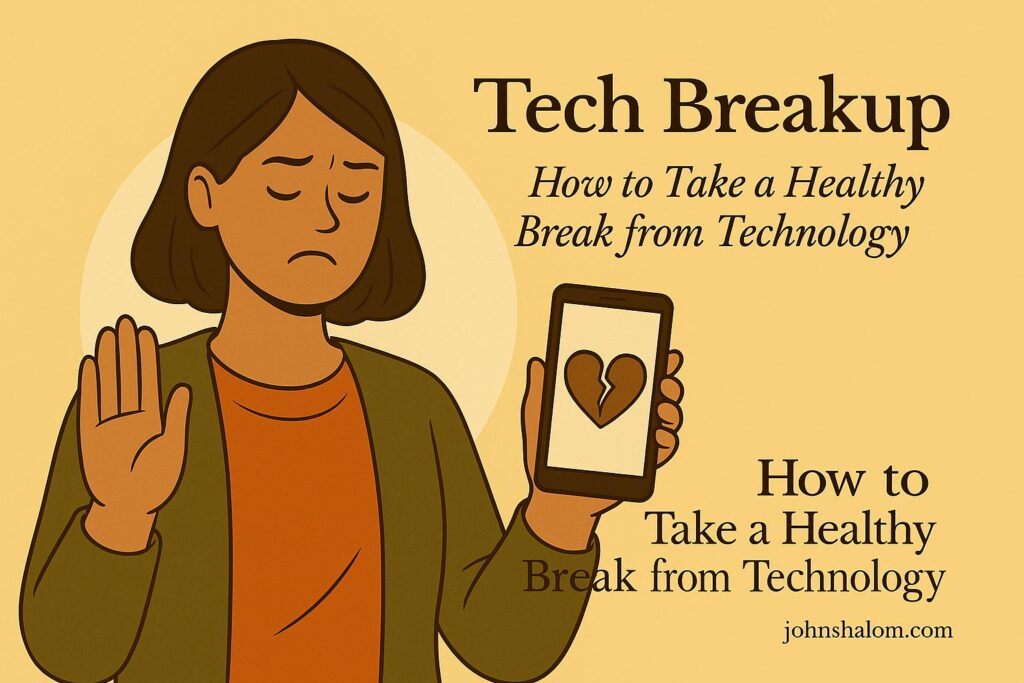
FAQs: Tech Breakup: How to Take a Healthy Break from Technology
1. Why is taking a break from technology important?
Because constant connectivity can drain focus, increase anxiety, and disconnect us from real relationships and rest.
2. What are the best books on digital detox and balance?
Top reads include Digital Minimalism by Cal Newport, How to Break Up with Your Phone by Catherine Price, and Indistractable by Nir Eyal.
3. How can I take a healthy tech break without quitting completely?
Set boundaries—like screen-free mornings, digital-free zones, or scheduled offline hours to recharge mentally and emotionally.
4. What are the signs you need a tech detox?
Feeling distracted, restless, or emotionally drained by constant notifications and online comparison cycles.
5. Who should read books about technology breaks?
Anyone overwhelmed by digital overload who wants to reclaim focus, peace, and meaningful time away from screens.
Part 1: The Unease
Panyim, a bright-eyed Nuer student with a mop of short curls, shifted uncomfortably in his seat. Professor James droned on about the intricacies of 18th-century British politics, a topic that felt about as relevant as a herd of cattle in a lecture hall. But it wasn’t the lecture that had Panyim fidgeting. It was the insistent buzz in his pocket – his phone, a glowing beacon in a sea of notepads.
He stole a glance at the screen. A notification blinked – a new level achieved in his favorite mobile game, “Nile Quest.” A surge of pride momentarily eclipsed the lecture. He’d been grinding for days to reach this point, strategizing cattle migrations and virtual crop harvests across the simulated Nile Valley.
But the pride was quickly followed by a nagging guilt. Professor James, bless his heart, was trying his best, but Panyim couldn’t help but feel a disconnect. The lecture felt like a dusty relic compared to the vibrant, interactive world in his pocket. He wasn’t just checking the notification; his thumb hovered over the unlock button, yearning for the familiar comfort of the game.
Just then, Nyakor, his girlfriend and a captivating teacher herself, caught his eye. Her lips were pursed in a way that told him she knew exactly what was going on. Nyakor wasn’t just beautiful, with her long, flowing braids and mischievous smile; she was brilliant, having aced her Law degree the previous year. He admired her focus, her ability to absorb information like a sponge. He wished he could be more like her during lectures.
As Professor James droned on about the Corn Laws, Nyakor leaned in and whispered, “Lost in the Nile again, Panyim?”
Panyim’s cheeks flushed. He sheepishly pocketed his phone, the notification silenced but the temptation lingering. “Just checking my, uh, progress on a… school project,” he stammered, the lie tasting bitter on his tongue.
Nyakor’s dark eyes twinkled. “A project that involves virtual cattle and pixelated crops, perhaps?”
Panyim winced. Nyakor always saw right through him. He mumbled a half-hearted confession. “Okay, maybe it’s not exactly schoolwork. But Nile Quest is so addictive! There’s just one more level, and then…”
“And then there’s always another level, another challenge,” Nyakor finished his sentence with a gentle smile. “Technology is a double-edged sword, Panyim. It connects us, informs us, entertains us, but it can also isolate us from the world around us.”
Panyim considered this. He glanced around the lecture hall. Most students were dutifully taking notes, but a few, like him, were battling the siren song of their phones.
“So, what are we supposed to do?” he asked, a note of frustration creeping into his voice. “Just become hermits and disconnect from everything?”
Nyakor shook her head. “No, of course not. Technology is a powerful tool, but like any tool, it needs to be used wisely. Maybe it’s time we considered a… tech break, Panyim?”
Part 2: Understanding the Pull
The following afternoon, Panyim found Nyakor sprawled beneath a shady Baobab tree, a worn copy of “Things Fall Apart” propped against her knee. He flopped down beside her, the weight of his phone heavy in his pocket.
“So, tech break, huh?” Panyim said, his voice tinged with skepticism. “How exactly does one break from something so… ingrained in our lives?”
Nyakor chuckled, the sound like wind chimes in the dry African air. “It won’t be easy, that’s for sure. But the first step is understanding why technology has such a hold on us.”
She closed her book and turned to face him, her gaze serious. “Our phones trigger the release of dopamine, a neurotransmitter that makes us feel good,” she explained. “Every notification, every like, every new level achieved is a tiny reward, a dopamine hit that keeps us coming back for more.”
Panyim’s eyebrows shot up. “Dopamine? Like a drug?”
Nyakor nodded. “In a way, yes. It’s a clever trick our phones play on us. We crave that next notification, that next dopamine rush, and it can be hard to resist.”
“But Nile Quest is more than just notifications,” Panyim protested. “It’s challenging, it’s strategic. I feel like I’m learning something while I play.”
Nyakor smiled. “Maybe a little bit. But is it the same kind of learning you get from Professor James, or from dissecting a poem in your literature class?”
Panyim hesitated. “No, I guess not.”
“Nile Quest rewards quick reactions and short bursts of focus,” Nyakor continued. “It’s good for hand-eye coordination, sure, but it doesn’t really challenge you to think critically or deeply.”
“So, what then?” Panyim asked, a hint of frustration creeping into his voice. “Am I supposed to just ditch my phone altogether? How will I stay connected with friends, or catch up on the news?”
Nyakor reached out and squeezed his hand. “There’s a middle ground, Panyim. We don’t have to become technophobes. We just need to be mindful of how we use technology.”
She sat up straighter, her eyes gleaming with an idea. “What if we made some rules? Designated phone-free zones, for example. Like, during meals, or when we’re studying, or maybe even…” she glanced playfully at the star-studded sky peeking through the branches, “during our evening stargazing sessions?”
Panyim considered this, a slow smile spreading across his face. “That could work. And maybe we could explore other ways to connect with our heritage. Like, learning some of those old Nuer folk songs you mentioned.”
Nyakor’s smile widened. “Now you’re talking! Imagine sitting around a campfire, singing songs passed down through generations. A far cry from the mindless scrolling of social media, wouldn’t you say?”
Panyim laughed. “Definitely. Alright, Nyakor, you’ve convinced me. Let’s do this tech break thing together. Maybe it’ll be an adventure after all.”
Part 3: Breaking Free
The first day of their tech break dawned bright and (somewhat) early. Panyim, used to hitting the snooze button repeatedly while scrolling through social media, jolted awake at the unfamiliar silence. No notification pings, no tempting glow from his bedside table. He felt a pang of… something. Disappointment? Anticipation? He couldn’t quite place it.
He stumbled out of bed, a strange sense of liberation washing over him. The morning sun, unfiltered by a phone screen, felt invigorating. He made breakfast, the rhythmic sizzle of bacon a welcome change from the cacophony of digital alerts.
However, by the time he reached the university, the withdrawal symptoms kicked in. During a particularly dry lecture on the history of irrigation systems, Panyim’s hand instinctively reached for his pocket. Then, he remembered the pact with Nyakor.
He sighed, forcing his attention back to the monotonous drone of the professor. A mischievous glint appeared in Nyakor’s eyes from across the room. She subtly raised her eyebrows, a silent reminder of their agreement. Panyim stifled a smile, the shared secret a welcome distraction.
The afternoon was a different story. Studying in the library without the constant lure of his phone proved surprisingly difficult. Panyim found himself fidgeting, his mind wandering to Nile Quest’s virtual Nile and pixelated cattle. He glanced at Nyakor, diligently highlighting a law textbook. Envy, a sharp and unfamiliar feeling, pricked him.
Suddenly, Nyakor slammed her book shut with a triumphant grin. “Bingo!” she declared. “I found a reference case that perfectly supports my argument for next week’s presentation.”
Panyim forced a smile. “That’s great, Nyakor. But… what if I told you I’ve discovered a hidden oasis in the library basement, stocked with the finest virtual cattle this side of the equator?”
Nyakor’s smile faltered for a moment, then she burst out laughing. “Oh Panyim, you and your Nile Quest! Alright, how about a compromise? We finish this chapter, then for ten minutes, you can tell me all about your virtual oasis.”
The deal struck, Panyim focused with renewed determination. Ten minutes of Nile Quest paled in comparison to the pride of conquering a challenging chapter with Nyakor. True to her word, after ten minutes of animated descriptions (and slight exaggerations) about his virtual exploits, Nyakor clapped her hands.
“Alright, Nile Quest master, back to reality! We have exams to conquer.”
The first few days were a constant battle. Panyim found himself reaching for his phone out of habit, only to be met with a blank stare from the coffee table where it now resided, phone-free zone.
One evening, during their designated phone-free stargazing session, Panyim confessed his struggles. “It’s harder than I thought,” he admitted, gazing up at the vast expanse of stars.
Nyakor squeezed his hand. “It’s a process, Panyim. But look around you. Isn’t the sky more breathtaking without the glare of a screen?”
He looked up again, truly taking in the Milky Way, a shimmering river of stars etched across the black canvas. A sense of awe washed over him. “It is,” he whispered, a newfound appreciation for the beauty around him replacing the digital world he’d become accustomed to.
The evenings became their haven. With no phones to distract them, they rediscovered the joy of conversation, sharing stories, dreams, and aspirations under the endless night sky. Nyakor taught him some of the old Nuer folk songs, their voices blending with the chirping crickets in a harmonious serenade.
Panyim even surprised himself by suggesting a visit to his uncle, a keeper of Nuer traditions. They spent the weekend learning the intricate patterns of beadwork, the rhythmic beat of the dhol drum, and the fascinating stories woven into their cultural heritage.
By the end of the week, the constant itch for his phone had subsided. He found himself more present, more engaged in real-life conversations, and his focus during studies had sharpened considerably.
One afternoon, while enjoying a cup of tea with Nyakor, he absentmindedly reached for his phone, only to realize it wasn’t there. He looked up and met Nyakor’s gaze, a knowing smile playing on her lips.
Panyim chuckled. “Looks like the tech break is working,” he admitted. “I barely even missed it.”
Nyakor leaned in and kissed him gently. “See, Panyim? Sometimes, the most valuable connections are made without a screen.”
You might also like: The Self-Help Roadmap: Proven Strategies for Personal Growth and Healing
Part 4: Reconnecting
Weeks turned into months, and the tech break became a way of life for Panyim and Nyakor. Their designated phone-free zones remained sacrosanct, creating pockets of focused study, meaningful conversations, and a rediscovery of the simple pleasures around them.
Exams loomed, and this time, Panyim faced them with a newfound confidence. Unburdened by the constant digital distractions, his focus was laser-sharp. He aced his exams, the results a testament to the power of a well-managed tech break.
One sunny afternoon, after a particularly grueling exam, Panyim and Nyakor decided to celebrate with a picnic under their favorite Baobab tree. Spreading out a colorful blanket, they unpacked a simple meal of fried plantains and passion fruit juice.
As they ate, Nyakor pointed to Panyim’s pocket. “Speaking of breaks,” she teased, “are you sure you haven’t snuck your phone back in there?”
Panyim laughed, patting his pocket for emphasis. “Nope, still safely tucked away on the coffee table. Besides, the real world is much more interesting these days, wouldn’t you agree?”
Nyakor grinned. “Absolutely. Remember that time we tried to learn the dhol drum from Uncle James? More bruises than beats, I’d say!”
They both burst into laughter, the memory of their fumbling attempts at the traditional drum still fresh. The tech break, it turned out, had brought them closer not just to each other but also to their heritage.
“Speaking of heritage,” Panyim said, a mischievous glint in his eye, “how about a challenge? Winner gets bragging rights for a month.”
Nyakor’s eyebrows shot up. “Challenge accepted. But what kind of challenge?”
“Let’s see who can recite the longest Nuer folktale from memory,” Panyim declared. “No cheating with online translations, of course.”
Nyakor’s smile widened. “Game on, Panyim. But don’t underestimate the power of a law student’s memory!”
The afternoon unfolded in a delightful competition. They traded verses of folktales passed down through generations, their voices echoing under the ancient Baobab. Panyim, to his surprise, emerged victorious, reciting a lengthy tale about a cunning spider who outsmarted a pride of lions.
Nyakor, a gracious loser, clapped her hands in mock defeat. “Alright, alright, you win. But just this once. Next time, I’ll be ready for your folktales.”
As the sun began its descent, painting the sky in hues of orange and pink, a comfortable silence settled between them. Panyim pulled Nyakor closer, gazing into her eyes.
“This tech break,” he said softly, “it’s been more than just a break from technology. It’s been a reconnection – to ourselves, to each other, and to our roots.”
Nyakor leaned in, resting her head on his shoulder. “Exactly, Panyim. Technology can be a powerful tool, but it’s important to remember that it’s just a tool. Sometimes, the most valuable connections are made without a screen, face-to-face, under a sky full of stars.”
They sat in comfortable silence for a while, the only sounds the gentle chirping of crickets and the rustling of leaves in the breeze. A shooting star streaked across the darkening sky, and Nyakor squeezed Panyim’s hand.
“Make a wish,” she whispered.
Panyim closed his eyes, a silent wish forming in his heart. A wish for a future filled with love, laughter, and meaningful connections – a future where technology played its part, but never overshadowed the beauty of the real world and the people in it.

