TL;DR:
Everything in creation has structure and purpose. John’s exploration of the Five Known Kingdoms reminded me that science and faith aren’t rivals—they’re reflections of the same truth. From minerals to mankind, and from life to divinity, each kingdom points to a greater design and the wisdom of its Creator.
FAQs: The Five Known Kingdoms: Inorganic, Organic, Animal, Human, and God’s Kingdom
1. What are the Five Known Kingdoms according to John Monyjok Maluth?
They are the Inorganic, Organic, Animal, Human, and God’s Kingdom—each representing a higher level of order, purpose, and consciousness.
2. How does this concept differ from scientific classifications?
While science explains physical life forms, John’s view integrates spiritual understanding, showing the progression from matter to divine life.
3. What is the message behind these five kingdoms?
That creation reveals a divine pattern—each kingdom builds upon the previous one, reflecting growth, intelligence, and purpose.
4. How does God’s Kingdom fit into this structure?
It represents the ultimate realm of perfection, where love, wisdom, and eternal truth govern all creation beyond the physical world.
5. Who should read about the Five Known Kingdoms?
Students of theology, science, and philosophy, and anyone curious about how the physical and spiritual worlds connect in divine harmony.
The Five Known Kingdoms
In this article, we are going to explore what the five known kingdoms are, how we know they exist, why it is important to know them, and finally, your own reflections on the subject.
As you read, you will be informed and encouraged to think deeply. Are there truly five kingdoms in nature and beyond? Let’s find out.
What Are the Five Known Kingdoms?
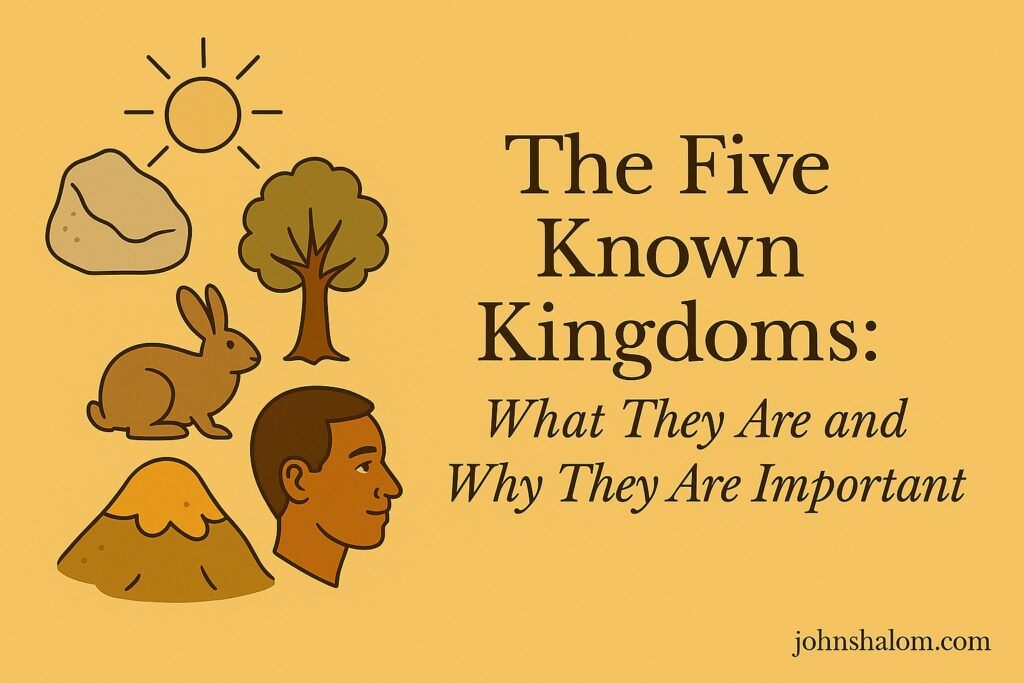
The five known kingdoms of life are: Inorganic Kingdom, Organic Kingdom, Animal Kingdom, Human Kingdom, and God’s Kingdom.
These are not the kingdoms we read about in ancient African, Eastern, or Western human history. Instead, this classification combines natural and spiritual knowledge.
The first four kingdoms are understood through human discovery—what ancient Greeks called gnosis, or scientific knowledge. We use our five senses to study the inorganic, organic, and animal kingdoms. But the fifth kingdom cannot be discerned this way. It requires something more—what can be called revelation knowledge, or epignosis.
Biologists classify life into five or six kingdoms (such as Plantae, Animalia, Fungi, Protista, Monera, etc.), but here, humans are recognized as distinct from animals, forming a Human Kingdom. In the same way, the Kingdom of God evolves beyond humanity.
To perceive the fifth kingdom requires a sixth sense. As Jesus taught, it is within us, not found in one direction or another. This knowledge is not discovered; it is revealed to the spirit.
How Do We Know There Are Five Known Kingdoms?
The first four kingdoms can be observed using our physical senses: sight, smell, touch, hearing, and taste. But the fifth requires revelation.
Revelation comes in three ways:
- Internal revelation — a hunch, intuition, or sudden awareness.
- General revelation — the natural world points beyond itself.
- Special revelation — sacred texts and traditions communicate truths beyond human discovery.
The fifth kingdom also divides into two realms: light and darkness. Those who live only by their senses often live under the influence of the kingdom of darkness. The kingdom of light is what the human kingdom is meant to evolve into—the Kingdom of God.
Evidence of the spiritual world is found everywhere. In Africa, possession and oppression are often visible realities. In the West, denial of spirits is itself a symptom of the spiritual. Even madness can reveal perception of unseen realities—things invisible to others, yet undeniable to the one experiencing them.
The inorganic, organic, animal, and human kingdoms are physical. We can measure, quantify, and study them. But the spiritual realm is both visible and invisible. It requires a different kind of light—revelation—to see clearly.
Is It Important to Know About the Five Known Kingdoms?
Yes. Knowing about the five kingdoms helps us understand life more fully. Knowledge that does not transform action is no knowledge at all. Understanding these kingdoms gives us an advantage in how we live, lead, and relate to the world.
Each kingdom depends on the ones below it. Rocks may appear lifeless, but plants grow from them. Trees may live longer than animals, but they cannot move freely. Humans rely on both organic and inorganic matter. In the same way, the spiritual kingdom encompasses and sustains all below it.
Theologians and philosophers have long wrestled with the problem of good and evil. Some traditions see both as originating from God. But in Christianity, Christ presents God as a loving Father, while Satan is the source of evil. Religion often distorts this truth, but Christ’s message is life, not empty ritual.
You might also like: The Complete Guide to Theology: Faith, Reason, and Modern Interpretations
What Do You Think About the Five Known Kingdoms?
Now, the question is yours. What do you think about these five kingdoms as outlined? Your perspective matters. If you need to reflect more, read the article again and form your own analysis.
My aim is to inform, instruct, and educate based on knowledge and personal experience. But your view counts. Even imagination, when honest, deserves respect. Truth is more than fact—facts change, but truth remains constant. Truth, in this sense, is God—unchanging and personal.
Cultural differences shape opinions. For example, in my language, God can be referred to as “he,” “she,” or “it,” without grammatical error. This flexibility shows how cultural perspectives influence theology. Still, beyond culture, each person has a responsibility to seek truth for themselves.
Conclusion
In summary, we have examined the five known kingdoms, how we know they exist, why it is important to recognize them, and finally, your opportunity to reflect personally on this subject.
What new insights have you gained? What did you already know? I’d love to hear your feedback in the comments—it helps me write better articles and engage with readers more meaningfully.
Thank you for reading. God bless you. Shalom!
Further Readings
- The Five Kingdoms — softschools.com
- Five Kingdom Classification — vedantu.com
- The Six Kingdoms of Life — thoughtco.com