TL;DR:
Life begins where chemistry meets purpose. John’s look into the Organic Kingdom reminded me that growth and renewal are the language of creation. From plants to microscopic organisms, this kingdom reveals God’s design for nourishment, reproduction, and balance—the living bridge between matter and mind.
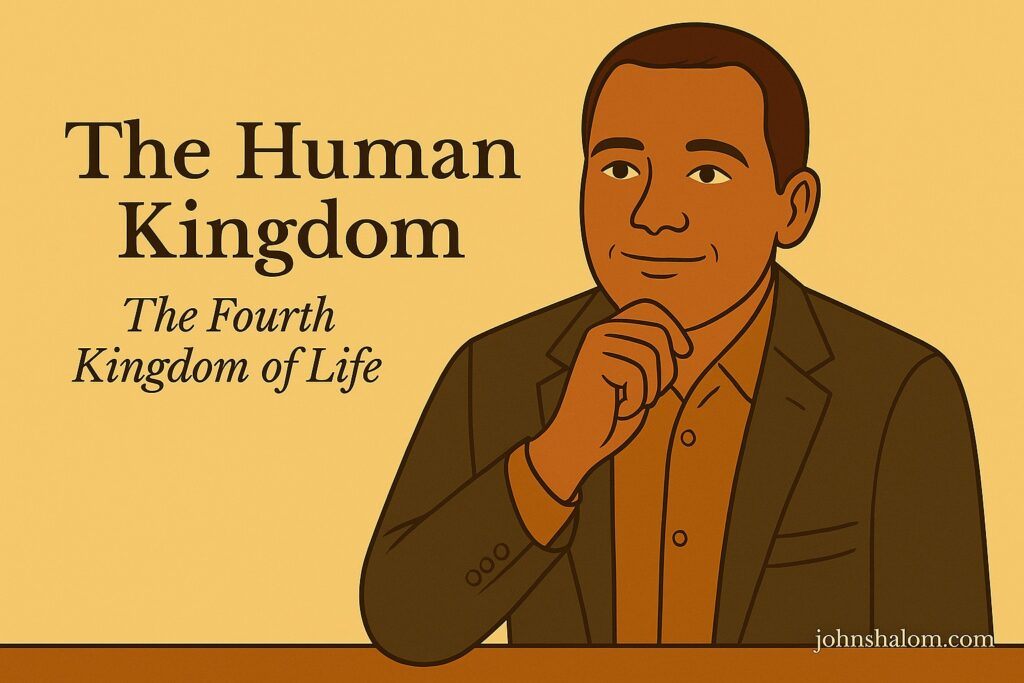
In this article, we will learn about the Human Kingdom—what it is, how we know about it, why it is important to understand it, and finally, your reflections on the subject. In earlier discussions, we looked at the Inorganic, Organic, and Animal Kingdoms.
These three form the first layers of life as we know it. Now, we turn to the fourth: the Human Kingdom. But the question arises—are humans simply part of the Animalia kingdom, or do we stand apart? Let’s explore.
FAQs: The Organic Kingdom: Definition, Existence, and Importance for Life
1. What is the Organic Kingdom according to John Monyjok Maluth?
It’s the second kingdom, composed of living organisms—plants, fungi, and other life forms that depend on the inorganic for survival.
2. Why is the Organic Kingdom important?
It sustains life on Earth, producing oxygen, food, and energy, and forms the foundation for ecosystems and biological growth.
3. How does this kingdom differ from the Inorganic Kingdom?
While the inorganic provides structure and materials, the organic introduces life, reproduction, and biochemical activity.
4. What spiritual insights does John draw from this kingdom?
That every living thing reflects divine intelligence—designed to grow, adapt, and serve a higher order of creation.
5. Who should read about the Organic Kingdom?
Students of biology, theology, and environmental science, and anyone interested in how life and spirit are intricately connected.
What Is the Human Kingdom?
The Human Kingdom is the fourth of the five known kingdoms. It comes after:
- Inorganic Kingdom – the mineral world.
- Organic Kingdom – carbon-based life, from unicellular to multicellular organisms.
- Animal Kingdom – all creatures driven by instinct and survival.
- Human Kingdom – us, Homo sapiens, evolved beyond other animals.
In natural sciences, humans are classified under the Animalia kingdom. Yet, from a broader philosophical and spiritual view, humanity deserves its own classification. Unlike animals, humans create tools, machines, and even artificial intelligence—machines that think and learn.
Humans also hold moral consciousness. We can distinguish right from wrong, good from evil, justice from injustice. We make laws, establish courts, and govern societies based on shared principles. This moral and intellectual leap separates us from the animal world.
Thus, the Human Kingdom is the highest organic kingdom. Beyond it lies only the Kingdom of God, which is spiritual and eternal.
How Do We Know There Is a Human Kingdom?
We know the Human Kingdom exists in two main ways:
- Through the five senses. We see humans around us, hear their voices, feel their presence, taste their food, and smell their creations. This is direct knowledge, observable and testable.
- Through the sixth sense (revelation knowledge). Some aspects of humanity go beyond biology—our spirituality, creativity, and consciousness. Humans are not just “thinking animals.” Some live with awareness of both physical and spiritual realities.
Natural science explains our differences from animals: our advanced brains, ability to reason, create, and imagine futures. Yet, spiritual experience adds another layer: those who are “spiritually alive” sense realities beyond human limitation.
This distinction leads to two categories:
- The Natural Man – who lives by instinct and physical senses.
- The Spiritual Man – who perceives the unseen, living in awareness of higher realities.
Why Is It Important to Know About the Human Kingdom?
Understanding the Human Kingdom is vital because:
- It is our own kingdom. Just as plants belong to the Organic Kingdom and animals to the Animal Kingdom, humans belong here. Knowing who we are gives us purpose.
- It defines our uniqueness. We share traits with animals, but our reasoning, morality, and creativity place us above them.
- It points to evolution. The Human Kingdom is not static. It is evolving toward the fifth kingdom—the Kingdom of God. This process shapes our moral, social, and spiritual growth.
- It leads to self-discovery. Those who truly understand their humanness stop chasing illusions. They accept themselves, forgive mistakes, and focus on gradual self-improvement rather than pretense.
You might also like: The Complete Guide to Theology: Faith, Reason, and Modern Interpretations
People who grasp the Human Kingdom live with resilience. Lack of money, food, or luxury does not destroy them. They understand life is more than material possessions. Others may still cling to survival instincts, but those who evolve know life stretches beyond the physical.
What Do You Think About the Human Kingdom?
Now it’s your turn to reflect:
- Do you agree that humans deserve a separate kingdom, distinct from animals?
- Do you believe we are evolving into a higher spiritual kingdom?
- Do you see how awareness of our humanness can change how we live?
These questions are not to be answered for me, but for yourself. Reflection helps us recognize where we stand: Are we still functioning mostly as animals, or have we stepped into higher awareness?
Conclusion
In this article, we explored the Human Kingdom—what it is, how we know it exists, why it matters, and how you can personally reflect on it. Humanity stands apart because we carry both animal nature and divine potential. Some live only in the physical; others already taste the spiritual.
What did you learn here that was new? What did you already know? Do you agree that humans are more than animals? Share your reflections in the comments, because your thoughts enrich the conversation.
Next, we will look at the fifth and final kingdom: the God Kingdom.
Thank you for reading. Shalom!