
TL;DR:
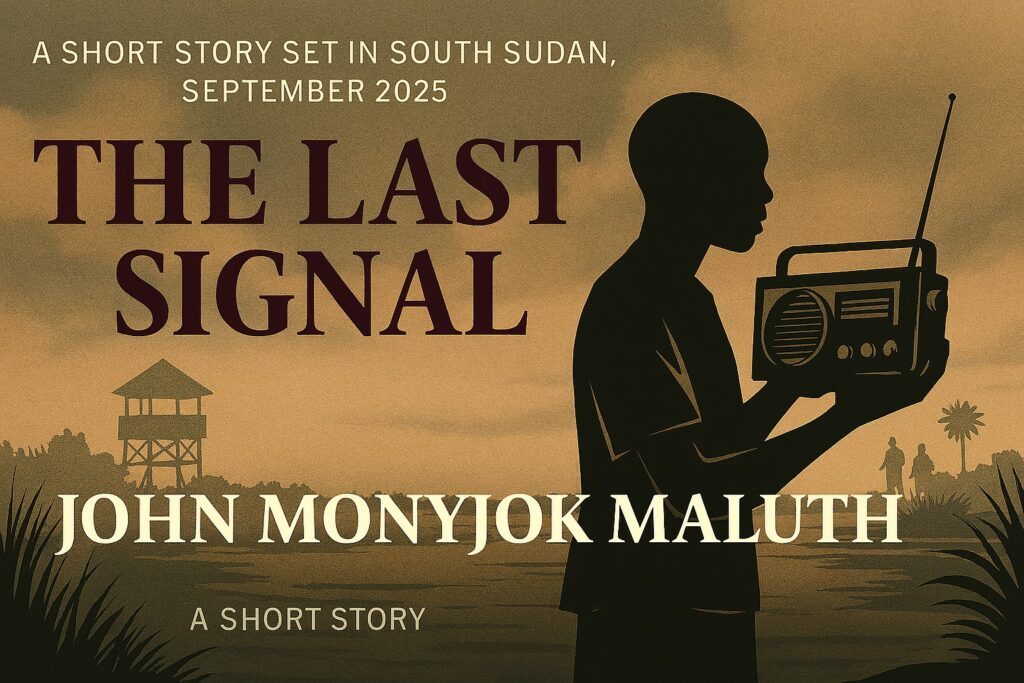
When the waters rise, truth sinks fast. The Last Signal captures the tension of a nation caught between natural disaster and political betrayal. In a flooded South Sudan, communication lines fail, loyalties shift, and one final signal may determine the country’s fate. It’s a story of courage, corruption, and the thin line between hope and despair in times of crisis.
The power had been out in Wau for three days. The only light came from the orange glow of cooking fires and the occasional sweep of a military truck’s headlights.
Ajang sat in his crumbling workshop, surrounded by coils of wire, battered transmitters, and the faint smell of solder. He had been repairing shortwave radios for years, but tonight was different — tonight, he was chasing a signal that wasn’t supposed to exist.
The rumor was that somewhere deep in the flood-affected north, a hidden transmitter was broadcasting messages about stolen aid, secret deals, and the names of people who had vanished. The government called it enemy propaganda. Ajang called it the truth.
FAQs: The Last Signal: Political Suspense in Flooded South Sudan
1. What is The Last Signal about?
It’s a political suspense story set during severe floods in South Sudan, exploring how disaster exposes greed, loyalty, and the human spirit.
2. Who are the main characters in the story?
A journalist, a rebel commander, and a government official whose intertwined choices decide whether truth or tyranny survives the storm.
3. What themes does the book explore?
It delves into power, faith, betrayal, and resilience—showing how crisis can both destroy and reveal true character.
4. Why is the South Sudan setting significant?
Because it reflects real struggles of displacement, governance, and environmental change, grounding fiction in authentic national challenges.
5. What makes The Last Signal unique?
Its blend of political realism and emotional depth. The story mirrors today’s world where information is both a weapon and a lifeline.
Static hissed in his headphones. Then, faintly, a voice:
“…if you can hear this, you are not alone…”
It was Nyandeng. He didn’t know her, but her voice had become a lifeline for those who still believed in change. She spoke in careful bursts, never long enough for the authorities to triangulate her location.
Ajang scribbled down the coordinates she hinted at — a place near the Sudd wetlands, not far from where the floods had displaced thousands. He knew that area. Panyim and Nyakor had passed through there weeks ago, carrying their own dangerous cargo of truth.
But the signal was fading. If he didn’t boost it, it would vanish forever.
The Visit
Boots crunched on gravel outside. Ajang’s heart pounded. He yanked off the headphones and swept the radio under a tarp just as two soldiers stepped in.
“Routine inspection,” one said, scanning the room. “We’ve had reports of illegal broadcasts in this area.”
Ajang forced a smile. “Only fixing radios for fishermen. Nothing political here.”
The soldier’s eyes lingered on the coils of wire. “Be careful, Ajang. The wrong frequency can get you in trouble.”
When they left, Ajang exhaled slowly. He knew they’d be back.
The Journey
That night, he packed the portable receiver, a small solar charger, and a battered motorbike. His plan was simple: get closer to the source, record Nyandeng’s full message, and find a way to relay it beyond the country’s borders — before the government’s jamming stations silenced her for good.
The road north was a ribbon of mud and broken tarmac. He passed convoys of aid trucks, some stuck axle-deep in floodwater, others mysteriously empty. In one village, he heard whispers of Nyakor’s reports — smuggled out weeks earlier — and how they had stirred quiet anger in the camps.
By the second night, the signal was stronger. Nyandeng’s voice was urgent now:
“…they are moving the food to private warehouses… the people in Fangak are starving… tell them we are still here…”
Ajang’s hands tightened on the handlebars. This was evidence — dangerous, undeniable evidence.
You might also like: Self-Publishing Made Simple: From Manuscript to Marketplace
The Crossing
At dawn, he reached the edge of the wetlands. The air was heavy with the smell of water and rotting vegetation. He found a trader willing to ferry him across in a dugout canoe, no questions asked.
Halfway across, the trader nodded toward the reeds. “Soldiers patrol here. If they stop us, you didn’t hear anything.”
Ajang tapped the pouch strapped under his shirt — the recorder holding Nyandeng’s words. “I didn’t hear anything,” he said.
On the far bank, a small group waited. Among them was a tall woman with a scarf wrapped tightly around her head. She stepped forward.
“You’re Ajang,” she said. “I’m Nyandeng.”
The Decision
They spoke quickly. Nyandeng had been moving from village to village, broadcasting from hidden transmitters, always one step ahead of the authorities. She had heard of Panyim and Nyakor’s escape, and now she wanted Ajang to take her recordings south — to the same network that had smuggled Nyakor’s notes out.
“It’s not just about telling the truth,” she said. “It’s about keeping the truth alive long enough for someone to act on it.”
Ajang looked at the swollen river, the soldiers in the distance, and the recorder in his hand. He knew the risk. But he also knew that if he turned back now, the silence would win.
He nodded. “Let’s move.”
Epilogue
Weeks later, in a cramped newsroom in Nairobi, an editor played the recording. Nyandeng’s voice filled the room, clear and defiant. The story went live within hours, picked up by international outlets.
In Wau, Ajang’s workshop stood empty. In the wetlands, Nyandeng kept moving, her signal still slipping through the static.
And somewhere in a refugee camp, Panyim and Nyakor heard the broadcast and smiled. The truth was still out there — and it was still speaking.

