TL; DR
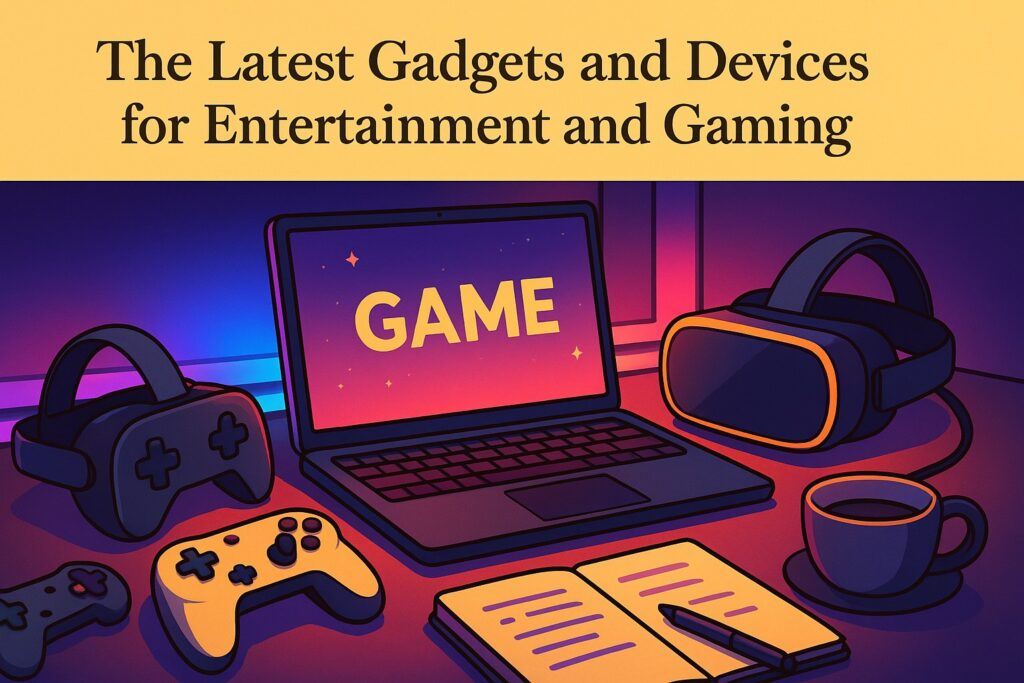
The latest gadgets and devices for entertainment and gaming focus on better graphics, smoother performance, and more immersive experiences. Modern gaming consoles, high-refresh-rate monitors, VR headsets, wireless controllers, and powerful gaming laptops let you play smoothly and enjoy sharp visuals. Smart TVs, streaming sticks, and quality headphones turn your home into a simple entertainment hub. Choosing devices that fit your budget, space, and favorite games or apps will give you the best experience for both fun and relaxation.
FAQs
1. What are the most popular gaming devices today?
The most popular devices include modern gaming consoles, gaming PCs, handheld consoles, and gaming laptops with strong processors and graphics cards.
2. Do I really need a gaming monitor?
A gaming monitor with high refresh rates and low response time makes games look smoother and feel more responsive, especially for fast-paced titles.
3. Are VR headsets worth buying for gaming?
Yes, if you enjoy immersive experiences. VR headsets put you inside the game world, but they require a compatible device and enough space to move around safely.
4. What gadgets improve my entertainment setup at home?
Smart TVs, streaming sticks, soundbars, and wireless headphones can upgrade your movie, music, and gaming experience without a complex setup.
5. Should I choose a gaming laptop or desktop PC?
Choose a laptop if you need portability, and a desktop if you want easier upgrades, better cooling, and more power for the same price.
6. How important are accessories like controllers and headsets?
Good controllers, keyboards, mice, and headsets improve comfort, communication, and control, which can make gaming more enjoyable and competitive.
7. How do I pick the right gadgets on a budget?
Decide your top priority first, such as graphics, portability, or sound. Then compare a few trusted brands, read reviews, and start with one or two key devices.
INTRODUCTION
When people talk about entertainment and gaming today, they usually see screens. A TV on the wall. A smartphone in the hand. A laptop on a desk. A child with a controller. A young adult wearing a virtual reality headset. A passenger on a bus with headphones on.
For many, this is normal life.
For me, it was not always this way.
I grew up along the Sobat River, between villages whose names many map makers will never learn to spell. Our version of “gadgets” were spears, sticks, fishing hooks, and handmade toys. We had cows instead of consoles. We had mud instead of screens. We had elders telling stories instead of Netflix. The only “surround sound” we knew was thunder, gunfire, and the night insects.
In those days, entertainment was not separate from survival. We played to forget hunger. We told stories to forget war. We laughed to forget fear. No one talked about “gaming performance.” We talked about staying alive one more day.
Today I sit in rooms with stable electricity, sometimes in Nairobi, sometimes in Juba, sometimes in other cities. I write on a laptop. I put on headphones to block the noise of the world. I watch people enter virtual worlds as easily as we once crossed shallow streams. Life has moved from mud huts to digital hubs.
This article is about the latest gadgets and devices for entertainment and gaming. But it is also about a journey. My journey. From a boy who ran from bullets in Nasir to a man who can now step into virtual reality with a headset. From a boy who almost starved in 1995 to a man who can order a gaming laptop online.
I want to show you what these gadgets are, what they can do, and what they could mean for a young African with a dream. I will talk about them honestly, mixing technical facts with the soil, sweat, and stories of the Sobat River and beyond.
MEANING OF ENTERTAINMENT AND GAMING IN MY LIFE
From Sobat River To Screens
My first “games” had no pause button. When conflict flared between Lou Nuer and Jikany Nuer in 1993 and 1994, the “game” was simple. If you move too slow, you die. If you choose the wrong path, you die. If you ignore the sound of gunfire, you die.
I was about ten years old when bullets first passed close enough to my body for me to feel their message. They were not virtual bullets. They were real. They did not reset. They did not forgive mistakes.
Compare that to the bullets in modern games like Call of Duty or Cyberpunk 2077. There, you can reload. You can restart. You can change difficulty. Real life never gave us that luxury.
As a boy, my toys came from nature. We made cars from wires. We created animals from mud. We played games that tested speed, memory, and courage. We did not know the word “gadget,” but we knew how to turn anything into a tool for play. A stone. A branch. A discarded tin.
When I finally met computers, I was no longer a boy. I was a young man who had already seen too much. My hands knew how to hold a spear, a fishing stick, a hoe. They did not know how to rest on a keyboard.
I learned slowly. Two fingers. One letter at a time. I was afraid of breaking the machine. Afraid of losing work. Afraid of pressing the wrong key. That fear did not stop me. Curiosity pushed me forward.
So when I talk about gadgets and gaming devices, I do not talk like someone born with a tablet in their hands. I talk like someone who walked from one world into another. I carry the Sobat River in my memory every time I enter a digital world.
VIRTUAL REALITY AND IMMERSIVE EXPERIENCES
Oculus Quest 2: Stepping Into Another Dimension
The first time I wore the Oculus Quest 2, I felt something I had not felt in a long time. A mixture of shock, delight, and disbelief.
One moment, I was standing barefoot in a small room in Nairobi. The next, I was inside a digital environment with objects floating around me. The walls of the real room disappeared. The ceiling of the physical building no longer mattered. My feet were in Nairobi, but my eyes and mind stood somewhere else.
The Oculus Quest 2 is a standalone virtual reality headset. That means you do not need a PC or a console to power it. Everything you need is inside the headset. It has a sharp display. A fast processor. Sensors that track how you move. Controllers that represent your hands inside the virtual world.
The hand tracking made me pause. I raised my hand, and suddenly, in front of me, a digital hand rose too. It reminded me of two very different moments.
One: my hand holding my grandfather’s heavy stick near Paduay in 2003, chasing a strange animal with claws, not knowing it was a dangerous predator until after I killed it.
Two: my hand typing slowly on my first laptop in the early 2000s, unsure whether each keystroke was allowed, as if there were invisible rules I might break.
Now I had a third moment. My hand controlling objects in a software-generated world built by people I have never met.
How VR Changes Play And Learning
VR games like Beat Saber make you move. It is not just pressing buttons. You swing your arms. You bend. You step to the side. You sweat. It is closer to dancing with light than simply playing a game.
Superhot VR does something else. It places you in scenes where time moves only when you move. If you stand still, the world slows. If you move quickly, everything speeds up. It teaches you that movement and time are connected.
The Walking Dead: Saints and Sinners puts you in a horror setting, where you must choose between fear and courage, planning and panic. For someone who has seen real fear in war zones, it feels strange to voluntarily enter a virtual fear just for entertainment.
But beyond these games, I see something bigger. I imagine African classrooms using VR for learning. I picture a child in a village school, with cracked walls and not enough chairs, wearing a VR headset to explore a 3D model of the solar system. I imagine a student in Juba using VR to practice biology by examining organs from the inside. I see an entire class traveling to ancient civilizations, not by bus, but by headset.
The same tool that makes people slice digital blocks could help teach physics, history, geography, and art. It could also be used for therapy, helping trauma survivors face controlled simulations instead of random triggers. For a continent that often lacks physical infrastructure, VR offers a virtual one.
HYBRID CONSOLES AND SHARED PLAY
Nintendo Switch OLED: A Community In Your Hands
When I look at the Nintendo Switch OLED, I remember the one radio in a village. Everyone gathered around it. We listened to announcements, music, or stories in whatever language the station chose. Nobody owned the experience alone. We shared every sound.
The Switch OLED continues that spirit, but with modern tools.
It has a bright 7 inch OLED screen. The colors feel deep. The dark scenes look truly dark. The audio is improved. The stand at the back is wider and stronger, so it can sit confidently on a table. The storage is larger, giving space for more games. There is a new white color that makes it look calm and clean.
One of the strengths of the Switch is its flexibility. At home, you can plug it into a TV and everyone can watch the same game. On the go, you can undock it and use it as a handheld device.
I experienced this personally on a long bus trip from Nairobi to Juba. Anyone who has traveled that route knows it is not a short journey. Hours of roads, checkpoints, and silence. I took out the Switch OLED and started playing Mario Kart.
The man sitting next to me kept stealing glances at the screen. At first he tried to pretend he was not interested. I recognized that look. I had worn it myself as a child when older boys had something interesting I did not want to ask for.
After a while, I asked him if he wanted to try. His face lit up. He took one Joy-Con controller. We chose our characters. Suddenly, two grown men on a bus became children racing virtual cars, laughing at every crash and overtake.
Design Lessons From A Small Console
The Switch teaches a design lesson that goes beyond hardware. It is not locked to one mode. It adapts to different lives and different moments.
TV mode when you want to share.
Handheld mode when you want to be alone.
Tabletop mode when you want to sit with a few friends in a small space.
That flexibility reminds me of what it means to be an African survivor. You must switch modes. You must be a student, farmer, son, father, leader, and worker at different times. You must adapt to electricity shortages, floods, conflicts, and unexpected opportunities. The Switch works because it understands that people live in multiple modes.
For young Africans interested in game design, storytelling, or user experience, studying such devices is useful. They show how thoughtful design can make one tool serve many contexts.
SOUND, SILENCE, AND FOCUS
Sony WH-1000XM4: Carrying My Quiet Room
Silence has a different meaning for people who grew up in conflict. Sometimes silence meant danger. When things suddenly became quiet in certain times, it meant something was wrong. Other times, silence meant peace. No gunfire. No screaming. Just nature.
In today’s cities, silence rarely happens by itself. Nairobi streets shout. Juba streets groan with generators, matatus, music, and conversations. Even when you sit inside, noise finds you. A crying child. A neighbor’s radio. Construction somewhere nearby.
When I discovered noise canceling headphones, especially the Sony WH-1000XM4, it felt like learning a new kind of magic.
These headphones listen to the world around you, then remove much of the sound. It is not perfect silence, but it is enough to let your mind breathe. They can also adjust based on where you are. On a plane, in a street, in an office. When you start speaking, they reduce the sound so you can hear your own voice and the person you are talking to.
The battery life is long. I can wear them through long writing sessions. A quick charge gives hours of use, which is helpful when electricity is not stable. The touch controls on the earcups feel natural after some practice.
Writing In A Noisy World
I wrote many opinion articles for The DAWN Newspaper and many blog posts for johnshalom.com with these headphones on. While the city moved outside, I created a small bubble inside. I could listen to calm music. Or turn music off and let silence do the work.
These headphones did not just improve sound quality. They protected my focus. They gave me a way to say “no” to some forms of noise without leaving the room.
It may sound like a small thing to someone used to quiet libraries and private offices. But to those of us who grew up in crowded houses and noisy neighborhoods, the ability to create a quiet zone around your head is a serious advantage.
POWER AND PORTABILITY ON A LAPTOP
Razer Blade 14: A Mobile Creation Hub
When I think about the Razer Blade 14, I do not think only of high frame rates in games. I think of possibility.
This laptop is small enough to carry in a backpack but strong enough to do work that older desktop machines struggled with. It has a 14 inch QHD screen with a 165Hz refresh rate. It includes an AMD Ryzen 9 processor and an NVIDIA RTX 3070 graphics card. It has enough RAM and fast storage for heavy tasks.
Yes, it can run demanding games like Cyberpunk 2077, Red Dead Redemption 2, and Call of Duty: Warzone at high settings. That is impressive for a machine of its size. But the same power that makes games look beautiful also makes serious work possible.
You can edit videos. You can process large photos. You can work with 3D models. You can run multiple heavy applications at once. You can code. You can test software. You can manage websites. You can run virtual meetings.
The laptop becomes a mobile studio.
From Fear Of Keyboards To Digital Freedom
My first experience with a computer keyboard was full of fear. I pressed keys as if each one might explode. I did not understand what was happening inside the machine. I only saw letters appearing on the screen and felt small.
Now I understand more. Not everything. Technology keeps changing. But enough to use it confidently.
When I look at a laptop like the Razer Blade 14, I see a tool that can shorten the distance between a young African’s dream and its realization. With the right skills and this kind of laptop, you can work for clients abroad, learn from global mentors, publish digital books, edit your own documentaries, and build apps.
In a world where physical infrastructure is often weak, digital infrastructure becomes critical. A strong laptop is part of that.
CHOOSING AND CARING FOR HEADPHONES
Choosing The Right Pair For Your Life
Headphones are not all the same. The best pair for a busy Nairobi street may not be the best pair in a quiet village. The right choice depends on your budget, your environment, your ears, and your habits.
In ear headphones are small and easy to carry. They sit inside the ear canal and can block a lot of outside sound. But some people find them uncomfortable over long periods.
On ear headphones sit on top of the ears. They are more comfortable than many in ear types, but they may let in some sound and can press on the ears after some hours.
Over ear headphones surround the ear completely. They often provide the best comfort and sound, but they are larger and less discreet.
Wireless headphones connect through Bluetooth. They let you move freely, without cables. They are good for travel, walking, and many daily tasks. But they need charging and can sometimes suffer from connection issues.
Wired headphones use a cable. They usually offer stable sound and do not need charging. But they limit movement and some modern devices lack headphone jacks.
My Own Mistake In Guangzhou
I learned some of these lessons the hard way. In Guangzhou, I once bought a pair of cheap headphones in a rush. I thought I was being smart by saving money. Within days, one side stopped working. The sound cracked. The wire failed.
Standing in a foreign city, holding broken headphones, I realized something important. When you rely on a tool daily, “cheap” can become expensive. You pay less at the start and more at the end. Since then, I choose audio devices more carefully. I research. I test where possible. I read real user experiences, not just sales pages.
Cleaning And Caring For Headphones
Headphones live close to your body. They absorb sweat, oils, and dust. If you do not clean them, they become small factories of dirt.
Cleaning is simple, but many people skip it.
Use a soft, slightly damp cloth with mild soap to wipe the surfaces.
Use cotton swabs with a bit of rubbing alcohol to clean creases and corners.
Use a small brush or a toothpick carefully around the speaker mesh to remove wax and dust.
Let everything dry before wearing them again.
I learned to respect tools from my parents. They knew that a broken item could not be replaced easily. Today, headphones and laptops should be treated with the same respect. They are not just electronics. They are lifelines to work, learning, and communication.
WHY THESE DEVICES MATTER BEYOND FUN
The African Reality
In many African countries, life is intense. People worry about food, rent, school fees, health, and sometimes sudden conflict. It may seem strange to talk about gaming devices in such a context.
But entertainment is not just escape. It is part of human survival.
People under pressure need moments of relief to stay sane. A game played after a long day can prevent a person from breaking. A movie watched with family can reconnect tired hearts. Music heard through simple headphones can carry someone through a lonely night.
Beyond that, these devices can become tools of exploration, education, and income.
A VR headset can bring museum experiences to villages that have never seen one.
A capable laptop can host an online classroom, a business, or a creative studio.
A console can inspire a young person to design their own games one day.
Headphones can help a student focus in a noisy household.
Technology, when used for growth, becomes empowerment.
Advice To Young Africans About Gadgets
If you are a young African reading this, here is my honest advice.
Do not fear technology.
Do not worship it either.
Use it.
Play games, yes. Enjoy them. Laugh, relax, and have fun. But also ask deeper questions.
What am I learning from this?
What skills am I building while using this device?
How can I use this same tool to improve my life and the lives of others?
A laptop that runs games can also run programming tools.
Headphones that play music can also help you learn languages.
A smartphone that scrolls social media can also host your online store.
The tool is the same. The use is different.
CONCLUSION
The latest gadgets and devices for entertainment and gaming are impressive. The Oculus Quest 2 takes you into worlds beyond your neighborhood. The Nintendo Switch OLED turns long bus trips into shared memories. The Sony WH-1000XM4 carries a quiet room into noisy cities. The Razer Blade 14 puts a powerful studio into a backpack.
Headphones of different styles let you carve out private sound in public spaces. Cleaning and caring for them keeps them faithful partners instead of disposable toys.
For me, as someone born near the Sobat River, shaped by war, hunger, and long journeys, these gadgets are not just “cool tech.” They are markers of how far life can move. From spear to stylus. From mud toys to VR worlds. From running for survival to playing for joy.
If you decide to use any of these devices, let them do more than entertain you. Let them wake up your curiosity. Let them support your studies. Let them strengthen your work. Let them help you tell your story better.
Because at the end of the day, gadgets will change. New versions will come. Old ones will fade. But the person you become while using them, the wisdom you gain, and the impact you make, those are the things that will outlive every model number and product name.