TL;DR:
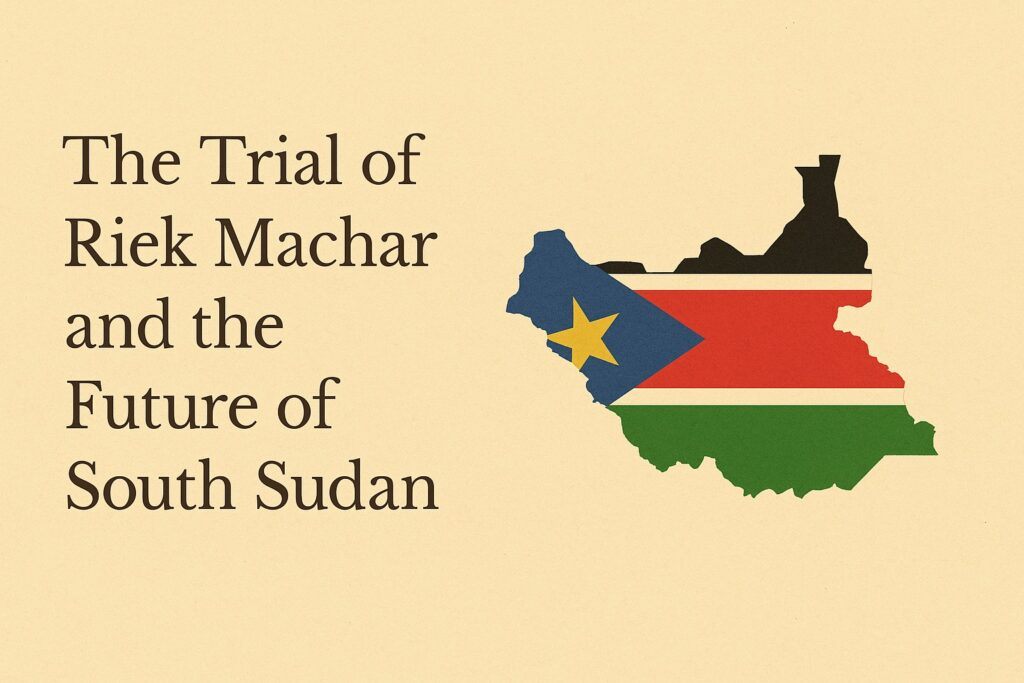
The trial of Riek Machar represents more than a political reckoning—it’s a test of justice, unity, and truth in a divided nation. Whether seen as accountability or political maneuvering, its outcome could redefine South Sudan’s path toward peace. The country stands at a crossroads: will the trial heal old wounds or deepen new ones?
When I hear about the trial of Dr. Riek Machar and his seven colleagues, my heart sinks, not because I am surprised, but because I feel we have been here before. For decades, our politics has been reduced to courtroom dramas, military calculations, and endless negotiations in hotels far from the hungry villages that wait for peace.
Every time a new legal or political storm rises, it seems to be less about the people of South Sudan and more about the fight for power. Power here is not service; it is a prize. It means immunity from law and order, it means authority over others, and most of all, it means access to resources for oneself and one’s group. This is where we have missed the mark as a nation.
FAQs: The Trial of Riek Machar and the Future of South Sudan
1. Who is Riek Machar?
Riek Machar is South Sudan’s opposition leader and a key figure in the country’s long struggle for peace and political stability.
2. Why is his trial significant?
Because it symbolizes South Sudan’s attempt to balance justice and reconciliation after years of conflict and mistrust among political factions.
3. What impact could this trial have on national unity?
It could either promote healing through accountability or widen divisions if perceived as biased or politically motivated.
4. How are citizens responding to the trial?
Public opinion is divided—some see it as justice long overdue, while others view it as a threat to fragile peace efforts.
5. What does this mean for South Sudan’s future?
The trial’s outcome will influence the nation’s stability, leadership credibility, and international relations, shaping its next chapter in statehood.
I grew up hearing stories of liberation. My elder brother Biel died in the 1989 Nasir battle, one of thousands of young men who gave their lives for the dream of South Sudan. They believed they were fighting for a nation where we could live with dignity, free from Khartoum’s grip. But today, when I look at how our leaders conduct themselves, I often wonder whether Biel’s sacrifice and that of so many others has been turned into a currency for personal power. The courtroom trials, the stalled peace agreements, the endless accusations—are these for the people of South Sudan, or are they just shields and swords in a battle for position?
If Dr. Riek Machar and those alongside him were truly for humanity, the path would have been different. Instead of calculating how trials can be used to delay elections, or how accusations can weaken a rival, they would have asked: what does the ordinary woman in Bor need today? What does the displaced family in Bentiu hope for tomorrow? What will give a farmer in Yei the courage to plant without fear of soldiers seizing his harvest? If they were for the people, their energies would not be wasted in legal battles that drag on like old songs; they would have been poured into building trust, unifying forces, and preparing a nation for secure, transparent elections.
And if the other side—the ruling faction that sees this trial as a lever to weaken Riek and his allies—were for the people, they too would have chosen another road. They would have asked: how do we demonstrate justice without weaponizing the courts? How do we prove that law is not selective, that it applies to every man and woman regardless of position? Instead, what we see looks like manipulation from both sides. The court becomes less about truth and reconciliation, and more about tactics and delay. Each side hopes the clock will move in its favor, that time will buy advantage. Meanwhile, the people’s clock ticks toward hunger, insecurity, and disillusionment.
I read social media posts by supporters of both sides, and I fear the mood of our nation. Opposition supporters call openly for a full-scale war to end what they see as humiliation toward their only trusted leader. Sporadic fighting continues in different states, fueled less by ideology and more by loyalty to individuals and tribes. The West, as usual, rallies behind the opposition because they believe there is a promise of minerals and resources should the opposition ever win—whether by the ballot or the bullet. Yet I do not blame the West, IGAD, the UN, or any outsiders. I blame our leaders. It is not the outsiders who have destroyed our chance at peace; it is our own obsession with power as a personal shield and a family inheritance.
I do not see any real difference between IG, IO, FDs, or any other faction. They are simply wings of the same bird: the SPLM. They may fly in different directions for a season, but they all return to the same nest, and the people of South Sudan remain beneath, exposed to their droppings. My generation has been asked too many times to rally behind this or that wing, but what has it brought us? More delay, more hunger, more disillusionment. The sad truth is that these factions are not alternatives to each other. They are mirror images, each repeating the same mistakes, each using tribe as a ladder and power as a prize.
I have lived in refugee camps where law and order meant little more than the strongest deciding for the weakest. We were called “refugees,” stripped of names, waiting for help from systems that were always slow. In those camps, I realized that humanity is not defined by titles or positions. It is defined by who brings water when others are thirsty, who shares food when others are hungry, who creates peace when others are afraid. If our leaders today were guided by humanity, their trials would be about accountability and healing, not about delaying a process that could finally allow South Sudanese to choose their own leaders through the ballot box.
But here we are, still rallying behind our tribes instead of our country. I am Dinka by birth, and I have lived among the Nuer. I know both sides well. The truth is, neither Dinka nor Nuer will win if South Sudan loses. When I was a child, my parents taught me that eating alone was shameful. In our culture, food was meant to be shared. Yet in our politics, we have leaders who eat alone and leave the rest to starve. The spirit of Makuach Ajak, who gave generously, and Chuol Thiechul, who embodied communal values, has been forgotten. Instead, we are living under the shadows of Chol Muong and Kolang Toat—independent, disciplined men, yes, but despised for eating alone. The tragedy is that our politicians now combine the worst of both worlds: they do not teach us discipline, nor do they share. They hoard power for their tribes and leave the nation hungry.
You might also like: The Ultimate Guide to Political Journalism: Ethics, Challenges, and Impact in the Modern World
The trial of Riek Machar is not just about one man; it is about a system where the courtroom has become another battlefield. It is about how both sides, instead of racing toward democracy, find ways to stall. The elections are postponed, the unification of forces delayed, the constitution rewritten in drafts that never end. A people who waited fifty years for independence are now told to keep waiting. But waiting is not harmless. While leaders delay, people die. While papers shuffle, children starve. While politicians speak of law and order, mothers bury their sons.
I believe that if either side truly cared for humanity, the path would be different. They would first unify the forces, because no nation can prosper when its guns point inward. They would guarantee elections, because no leader is legitimate without the people’s voice. They would strengthen institutions, not weaken them, because justice is only justice when it is impartial. They would stop using the courtroom as a chessboard and start using it as a place of truth, healing, and fairness.
The deeper question, however, is this: how long will we, the people, continue to rally behind Dinka or Nuer instead of a vision for South Sudan, Africa, and humanity? Why must every political contest reduce to tribal arithmetic instead of national vision? I have seen ordinary citizens—Dinka, Nuer, Shilluk, Bari, Zande—share food in displacement camps without asking tribe. Hunger unites faster than politics divides. Why then can’t our leaders learn from their own people? The woman who sells vegetables in Juba does not care whether her customer is Dinka or Nuer; she cares whether the buyer has money and whether she can go home safely at night. Our leaders could learn humanity from that woman.
The trial of Riek Machar and his colleagues will one day end, just as so many trials have ended before. But the deeper trial will remain: the trial of South Sudan itself. Can we rise above tribe? Can we build a nation where power is not a weapon but a responsibility? Can we reach a point where law is not an instrument of delay but a safeguard for all? The answers to these questions will not be given in a courtroom. They will be written in how we prepare for elections, in whether we unify our forces, in whether we finally place people before positions.
My fear is that both sides are playing for time, not for the people. Time, however, is not on our side. The world is moving forward, but South Sudan risks becoming a permanent story of unfinished promises. China sets goals for 2049, the centenary of the People’s Republic, and works steadily toward them. We, in contrast, cannot even keep peace for one election cycle. If our leaders continue this way, the children of South Sudan will grow up not with hope but with fatigue, tired of promises that never reach their villages.
I often think of my brother Biel, who died at Nasir. He did not fight for Dinka against Nuer, or Nuer against Dinka. He fought for a country that could be free. Yet here we are, thirty-six years later, still trapped in cycles of suspicion and delay. His sacrifice, and the sacrifice of thousands like him, demands more from us. It demands that we stop treating power as a prize and start treating it as a duty.
If Riek Machar and his colleagues, and those prosecuting them, truly wanted to honor humanity, they would end the manipulation. They would ensure the trial is swift, fair, and impartial. They would stop using it as a shield or a weapon. They would focus on preparing the nation for elections, unifying forces, and securing a future where children can grow without hearing gunfire as their lullaby. Anything less is betrayal.
We cannot keep rallying behind tribe. We must rally behind vision. Not just a vision for South Sudan, but a vision for Africa and for humanity itself. Our children deserve a country that is more than a courtroom stage. They deserve a country where law is real, elections are real, and peace is real. Until then, every trial in South Sudan is not just the trial of a leader; it is the trial of a nation.