TL;DR:
Theism and atheism shape how people see existence, purpose, and morality. Theism offers faith, hope, and moral grounding, while atheism values reason, evidence, and personal freedom. Understanding both helps modern humans find balance between belief and logic in a world seeking truth.
FAQs: Theism vs Atheism Explained
1. What is theism?
Theism is the belief in one or more gods who actively influence creation, morality, and human life.
2. What is atheism?
Atheism is the absence of belief in gods or deities, relying on reason, science, and evidence-based understanding of the world.
3. What are the strengths of theism?
It provides comfort, moral direction, community, and a sense of purpose rooted in spiritual connection.
4. What are the strengths of atheism?
It encourages independent thought, skepticism, and reliance on logic and human experience over religious authority.
5. Can theism and atheism coexist in modern society?
Yes. Respectful dialogue between both perspectives promotes understanding, tolerance, and shared pursuit of truth and meaning.
Introduction
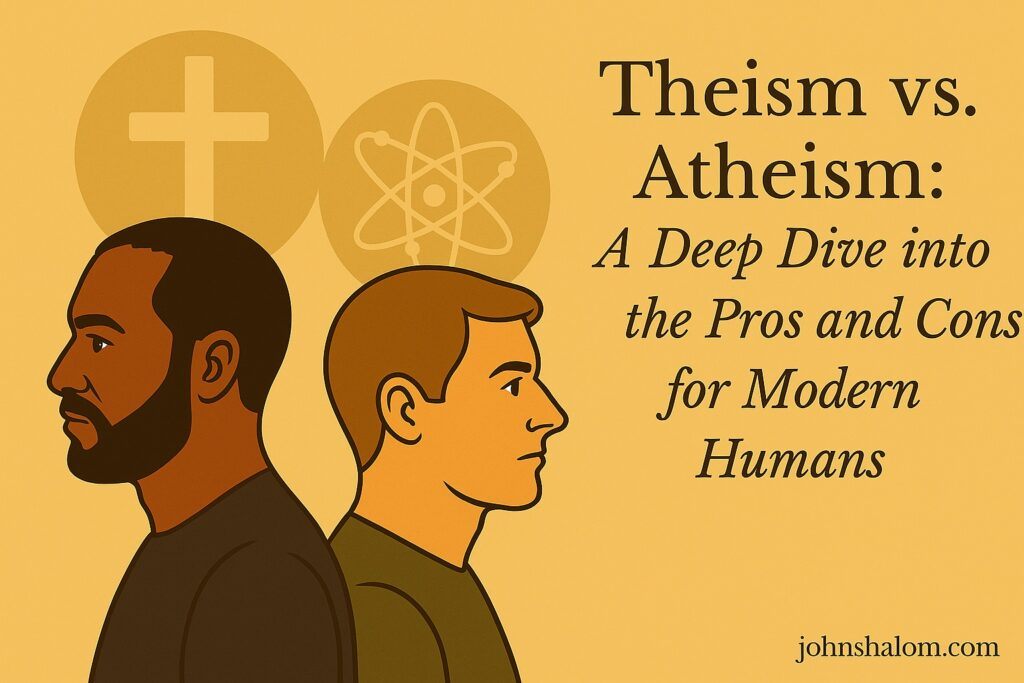
The question of whether God exists has been debated for centuries. It is one of the fundamental inquiries of human existence, shaping cultures, societies, and individual lives. Theism and atheism represent two opposite worldviews that seek to answer this question. Theism is the belief in the existence of God or gods, while atheism is the rejection of such belief.
Understanding these two perspectives is crucial for anyone who wants to explore the meaning of life, morality, purpose, and the nature of the universe. In this article, we will explore both worldviews in depth, examining their implications, strengths, and weaknesses in modern human life. Whether you are a theist or an atheist, this discussion aims to provide insight into where your views align or diverge with others.
Theism: Definition and Importance
Theism is the belief that a supreme being, or multiple deities, exist and play an active role in the universe and human life. Theists believe that life has a divine purpose, that morality is grounded in the will of God, and that there is an afterlife where justice is ultimately served.
A theist sees the world as an orderly creation of a divine being, rather than a product of random chance. The belief in God provides comfort, meaning, and guidance in life. Religious texts such as the Bible, the Quran, the Torah, and others provide instructions for how to live ethically and righteously.
For theists, fundamental concepts include:
- God and Satan
- Angels and demons
- Good and evil
- Life and death
- Heaven and hell
- Eternal life and eternal death
- Truth and lies
- Right and wrong
- Spirits and souls
These ideas shape a theist’s worldview, making them believe that their actions are meaningful and that they will be held accountable in an afterlife.
The Pros of Theism
- A Sense of Purpose – Many theists believe that life is not random but has a divine plan. This belief provides a strong sense of meaning and direction.
- Hope and Comfort – The belief in an afterlife and a benevolent God offers comfort in times of suffering and loss.
- Moral Framework – Religious teachings provide a clear sense of right and wrong, guiding ethical behavior.
- Community and Belonging – Religions often foster strong communities, offering support, friendship, and a sense of identity.
- Encouragement for Good Deeds – The belief in divine judgment encourages moral and charitable actions.
The Cons of Theism
- Conflict with Science – Some theistic beliefs contradict scientific theories such as evolution and the Big Bang.
- Religious Dogma – Strict religious doctrines may discourage questioning and free thinking.
- Intolerance and Division – Religious differences have historically led to conflicts, discrimination, and even wars.
- Dependence on Faith – Some argue that reliance on faith discourages critical thinking and inquiry.
- Fear-Based Motivation – The belief in hell and divine punishment can create anxiety and guilt in adherents.
Atheism: Definition and Importance
Atheism, in contrast, is the absence of belief in a deity or deities. While some atheists actively deny the existence of God, others simply see no convincing evidence to support the claim. Atheism rejects religious explanations for the universe, life, and morality, instead favoring reason, science, and empirical evidence.
For an atheist, life is not divinely orchestrated but a result of natural processes. Morality is not dictated by a higher power but arises from human reason, social contracts, and evolutionary instincts. The concept of an afterlife is often rejected in favor of the idea that consciousness ends with death.
The Pros of Atheism
- Personal Freedom – Atheists are not bound by religious rules and can make choices based on personal values and reason.
- Emphasis on Logic and Evidence – Atheism encourages critical thinking and skepticism, promoting scientific inquiry.
- No Religious Indoctrination – Without adherence to religious doctrines, atheists are free to form independent moral codes.
- Use of Personal Time – Without obligations like prayer, worship, or religious rituals, atheists have more time for personal pursuits.
- Focus on Human Responsibility – Atheists believe that solutions to societal problems come from human effort, not divine intervention.
The Cons of Atheism
- Lack of Cosmic Purpose – Without belief in a divine plan, life can feel meaningless or purposeless.
- No Ultimate Justice – The idea that evildoers may never face divine punishment can be unsettling.
- Self-Defined Morality – Without a religious framework, morality becomes subjective, leading to debates over ethical standards.
- Existential Anxiety – The belief that consciousness ceases after death can be difficult to accept.
- Social Stigma – In some cultures, atheists face discrimination or exclusion from religious communities.
Philosophical Debates: Theism vs. Atheism
The debate between theism and atheism touches on profound philosophical questions:
- The Existence of God – Theists argue that the complexity of the universe points to an intelligent designer, while atheists contend that natural processes sufficiently explain the universe.
- The Problem of Evil – If an all-powerful, all-loving God exists, why is there so much suffering? Theists argue that suffering has a divine purpose, while atheists see it as evidence against a benevolent deity.
- The Origin of Morality – Is morality divinely given, or does it arise from human reason and social contracts?
- The Afterlife – Theists believe in an afterlife, while atheists assert that death is the end of consciousness.
You might also like: The Complete Guide to Theology: Faith, Reason, and Modern Interpretations
Personal Choice: Where Do You Stand?
After reviewing both perspectives, it’s time for self-reflection. Do you find meaning in theism, or does atheism align more with your worldview? Consider the following questions:
- Do you believe in a higher power, or do you trust science and reason alone?
- Does the idea of an afterlife bring you comfort, or do you accept that death is final?
- Do you feel that morality requires a divine source, or can humans define ethics independently?
- Are religious communities valuable to you, or do you prefer individual spiritual exploration?
Regardless of where you stand, exploring different perspectives can lead to a deeper understanding of yourself and others.
Conclusion: The Ongoing Conversation
The debate between theism and atheism is unlikely to be resolved anytime soon. Both perspectives offer compelling arguments, and individuals will continue to grapple with these questions for generations to come.
For theists, faith provides meaning, hope, and moral guidance. For atheists, skepticism encourages intellectual freedom, critical thinking, and a reliance on empirical evidence. Neither perspective is inherently superior; rather, each offers a unique lens through which to view life.
Whatever you choose to believe, the key is to remain open-minded, respectful, and thoughtful in your exploration of life’s biggest questions.
What do you think? Share your thoughts below and join the conversation!