TL;DR:
In South Sudan, the line between civilian and soldier fades too easily. This reflection showed me that war isn’t just fought with guns—it’s fought in minds scarred by fear and betrayal. When people lose faith in peace, they pick up arms to protect what’s already lost. The real battle isn’t for territory; it’s for truth, trust, and a nation’s soul.
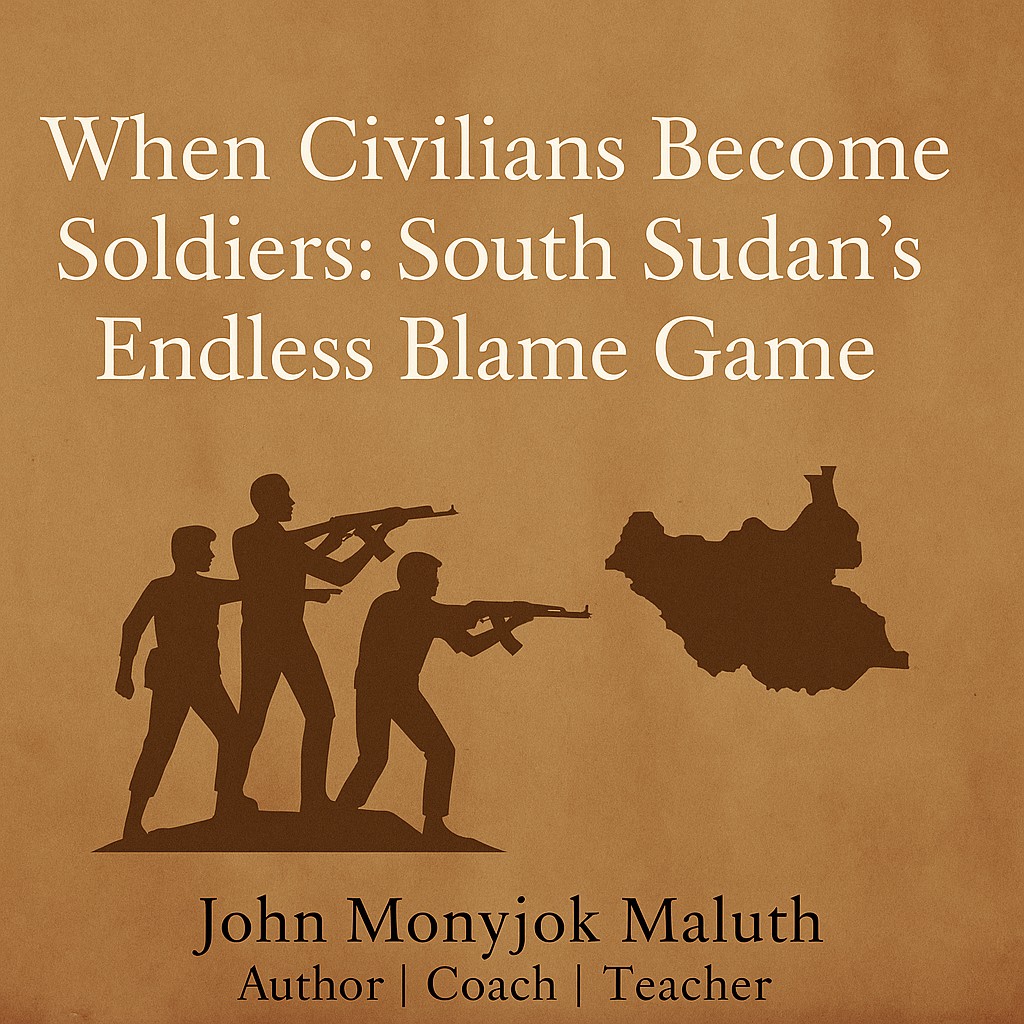
The courtroom exchange between Judge and General Duop Lam, Chief of Staff of the Sudan People’s Liberation Army-In Opposition (SPLA-IO), reads like a mirror reflecting South Sudan’s tangled political and military history. When asked whether the White Army belongs to the SPLM-IO, the General’s answer was both an admission and a denial, a truth-telling wrapped in diplomacy. Yes, he said, the White Army supported the SPLA-IO at the height of the 2013 civil war, just as Darfur rebels, Ugandan forces, and Mathiang Anyoor fought on the side of the government. But he was quick to clarify that after the 2018 peace agreement, the White Army’s role was dissolved. Those who wished to join the SPLA-IO became soldiers; those who did not returned to civilian life. In his view, the fighters who recently clashed with government troops in Nasir were not SPLA-IO’s White Army, but government-area civilians defending their territory.
FAQs: When Civilians Become Soldiers: South Sudan’s Endless Blame Game
1. Why do civilians in South Sudan often become soldiers?
Because survival replaces choice. Poverty, insecurity, and political manipulation push civilians to fight in defense or desperation.
2. What does the “blame game” refer to?
It describes how leaders and factions shift responsibility for violence while ordinary citizens bear the consequences.
3. How has this cycle affected national unity?
It has deepened divisions, destroyed trust, and turned neighbors into enemies, making reconciliation harder to achieve.
4. Can this pattern ever be broken?
Yes—but only through truth-telling, education, and leadership that values peace over pride and people over power.
5. What lessons can the world learn from South Sudan’s struggle?
That lasting peace requires justice and forgiveness—and that every nation must confront its wounds before healing can begin.
This explanation is clever, but it leaves more questions than answers. Why would civilians, who should rely on their government for protection, take up arms against that very government? Why does the White Army continue to appear in South Sudan’s conflicts if peace agreements supposedly dissolved all such militias? And why, ten years after independence, are the same cycles of accusations, denials, and community-driven wars still alive in a country that desperately needs national healing?
The White Army, historically a loose confederation of armed Nuer youth, has always been a controversial force. At one point, they were described as defenders of their communities against external threats; at another, they were accused of committing atrocities during the civil wars. Their loyalty has been fluid—sometimes aligned with the SPLA-IO, sometimes operating independently, sometimes clashing even with those they supposedly supported. General Duop Lam’s statement acknowledges this duality: yes, they once fought alongside us, but no, they are not under our command today.
Yet South Sudanese citizens, listening to this courtroom testimony, are left wondering who is responsible for their security. When civilians are armed and mobilized as fighting groups, even temporarily, they do not simply vanish when peace is declared. Guns do not dissolve into thin air. Leaders who benefit from civilian fighters during war cannot simply deny responsibility when those same fighters continue battling under new banners. That is the inconvenient truth neither government nor opposition wants to confront.
The government, for its part, has often portrayed community defense groups as criminals or rogue actors, even though some of them were armed, trained, or tolerated by state security at different points in history. The SPLA-IO, meanwhile, has used the White Army to strengthen its negotiating power but now seeks to wash its hands when civilians-turned-soldiers take independent action. Both sides point fingers, and ordinary South Sudanese are caught in the crossfire.
What makes the situation even more tragic is that peace agreements, including the 2018 Revitalized Agreement, have repeatedly emphasized the demobilization and integration of all armed groups into a single national force. In theory, this would resolve the problem. In practice, the integration process has been slow, underfunded, and plagued by mistrust. Opposition soldiers languish in cantonment sites without food, medicine, or salaries, while government recruits are trained separately. Civilians watch this dysfunction and conclude that picking up arms to defend their land might be more effective than waiting for a divided, politicized army to protect them.
But here is the heart of the matter: when citizens turn into soldiers, the state loses its legitimacy. A government is judged by its ability to provide security, justice, and order. If communities consistently feel the need to defend themselves with guns, it signals a collapse of trust in state institutions. In South Sudan, this collapse has been normalized. Both the government and opposition treat armed civilians as pawns in their struggle for power, useful when aligned, disposable when not.
Let us imagine a young man in Nasir. He was a teenager in 2013 when the war erupted. Perhaps his brother was killed, his cattle raided, his home burned. He joined the White Army, not out of ideology, but because his village was under attack. Years later, peace is signed in Juba. The leaders shake hands. But no one comes to his village to collect his gun. No one offers him a job, an education, or trauma counseling. The same government soldiers who fought his community in 2013 return to patrol his town in 2025. When violence flares, he is asked to put down his weapon because “peace has come.” Should he trust the same leaders who abandoned his security before? His answer is already in his hands: the gun he never surrendered.
You might also like: The Ultimate Guide to Political Journalism: Ethics, Challenges, and Impact in the Modern World
General Duop Lam’s words, then, are not surprising. They reflect a truth South Sudan’s elites have perfected: ambiguity is survival. Admit just enough to sound honest, deny just enough to avoid accountability. Yes, the White Army was with us. No, the White Army is not with us. Yes, some joined our ranks. No, those fighting in Nasir are not under our control. A neat balancing act that satisfies the courtroom but does nothing to address the root problem: why civilians are still fighting wars in a country that claims to be at peace.
This is where the government and opposition alike fail the people. Instead of answering the hard questions—why not unite the armies fully? Why not prioritize security sector reform over political appointments? Why not disarm civilians comprehensively?—they choose the easy path of finger-pointing. Ask the IO, ask the IG, ask the other side. Each side wants the other to explain the unexplainable, while the ordinary South Sudanese man or woman lives in fear of the next outbreak of violence.
But imagine if, just once, both sides chose love of country over love of power. Imagine if President Salva Kiir and Dr. Riek Machar declared together, “No more militias, no more excuses. We will build one army, for one people, under one flag.” Imagine if they committed not just in speeches but in actions—joint training centers, equal distribution of resources, transparent promotions. Imagine if they told their supporters, “Lay down your arms. The government is yours. The army is yours. You no longer need to fight.”
That is the dream of peace South Sudanese people long for. Not peace written on paper, not peace negotiated in hotels, not peace explained away in courtrooms, but peace lived on the ground. A peace where civilians are truly civilians and soldiers are truly professional soldiers. A peace where the White Army, Mathiang Anyoor, Arrow Boys, and all other community militias exist only in history books, not in daily news reports.
South Sudan cannot afford to normalize the abnormal any longer. The idea that civilians can endlessly rise as fighters and later be excused as “defending their communities” erodes the foundation of statehood itself. If this continues, the country risks being permanently trapped in a cycle where every grievance produces a militia, every militia produces a war, and every war produces another failed peace.
The courtroom exchange between Judge and General Duop Lam should be a wake-up call. It should push South Sudanese citizens to demand clarity from both government and opposition. Are you protecting us, or are you arming us? Are you building one nation, or are you dividing us into factions? Are you telling the truth, or are you hiding behind ambiguity? These are questions that cannot be asked only in court—they must be asked in homes, churches, mosques, schools, and markets across the nation.
The answer to those questions will determine the future of South Sudan. A future where citizens either continue to be soldiers by necessity, or return to being civilians by right. A future where peace is a reality, not a slogan. A future where the love of country outweighs the hunger for power.
Until then, civilians will keep fighting, generals will keep denying, and judges will keep asking questions that never find answers. And South Sudan will remain stuck in its endless blame game, a nation held hostage by its own leaders’ refusal to unite for the sake of their people.