Political systems often receive labels that describe how power is exercised. Two of the most striking are kakistocracy and kleptocracy. Although they are sometimes used interchangeably, they describe different problems in leadership. One focuses on incompetence, while the other focuses on corruption.
Understanding these concepts helps citizens recognize unhealthy patterns in governance and appreciate why integrity, competence, and accountability matter in public leadership. This is very important for countries like South Sudan.
This guide explains the difference between kakistocracy and kleptocracy while introducing several related forms of government that influence political life around the world. It draws on reflections and examples from the accompanying source material.
Quick Answer
A kakistocracy is government by the least qualified or most incompetent people, while a kleptocracy is government by leaders who primarily use public office to steal wealth and enrich themselves. Although the two often overlap, incompetence and corruption are not identical.
TL;DR
Kakistocracy is rule by the worst. Kleptocracy is rule by thieves. Both damage public trust, weaken institutions, and slow national development. Healthy societies instead promote accountable leadership, public participation, ethical governance, and leaders chosen for character and competence.
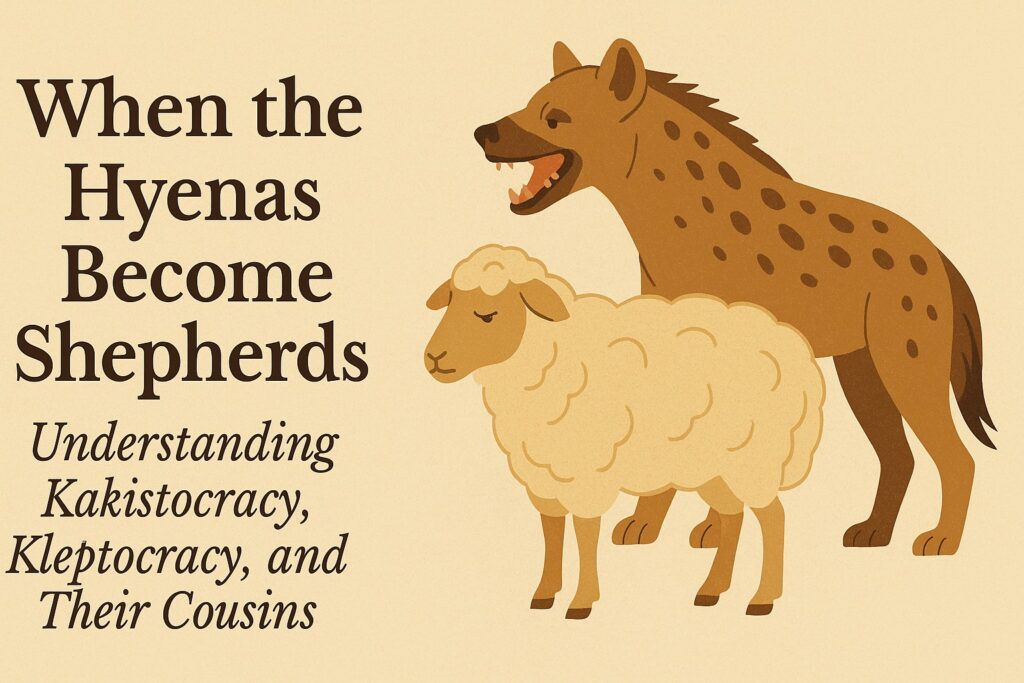
Table of Contents
- What Is Kakistocracy?
- What Is Kleptocracy?
- Key Differences Between Kakistocracy and Kleptocracy
- Other Forms of Government
- Why Leadership Matters
- Frequently Asked Questions
- Final Thoughts
What Is Kakistocracy?
The word kakistocracy comes from the Greek words meaning “rule by the worst.” It describes governments led by the least qualified, most incompetent, or most morally unfit individuals.
This is so true when the leaders are former rebel leaders or liberators. South Sudan is in the category in 2026 at the time of this writing. It’s doesn’t matter what you know; it matters who you know to find a job in government in my country.
In a kakistocracy:
- Incompetence replaces competence.
- Favoritism outweighs merit.
- Honest leaders are overlooked.
- Public institutions lose effectiveness.
- Citizens gradually lose confidence in government.
We can better illustrate this idea through the story of an unqualified youth leader chosen because of personal connections rather than ability. The result was confusion, division, and poor leadership. This is exactly the current situation my country.
What Is Kleptocracy?
A kleptocracy literally means “rule by thieves.” In this system, political leaders use public office primarily to enrich themselves instead of serving the public. The worst is that I have never seen a human who says it’s enough. National resources could keep disappearing each year, and the group taking it can never say it is enough.
Characteristics include:
- Misuse of public funds.
- Corruption.
- Nepotism.
- Diversion of public resources.
- Weak accountability.
Rather than investing in national development, kleptocratic leaders often treat government resources as personal property. This post describes how even the theft of books intended for a literacy project demonstrates how corruption can begin with seemingly small acts before expanding into larger abuses.
Key Differences Between Kakistocracy and Kleptocracy
Although both systems harm society, they are not the same.
| Kakistocracy | Kleptocracy |
|---|---|
| Rule by the least qualified | Rule by corrupt leaders |
| Focuses on incompetence | Focuses on theft and corruption |
| Poor decisions damage institutions | Misappropriation drains national resources |
| Leadership lacks ability | Leadership abuses authority for personal gain |
| Public services deteriorate through mismanagement | Public wealth disappears through corruption |
A government may exhibit characteristics of both systems when incompetent leaders also engage in corruption. This is true in South Sudan, Africa, and many other countries on the planet. I am writing this to reveal the reasons behind why nationals are not seeing their governments in action. No roads, hospitals, schools, and essential services.
Other Forms of Government
Understanding kakistocracy and kleptocracy becomes easier when viewed alongside other political systems discussed in the source. I will list for you other forms below so you can compare and contrast them all. This is good for personal learning. I hope it helps.
Autocracy
Autocracy concentrates power in one individual. While decisive leadership may sometimes provide stability, unchecked authority can suppress criticism, discourage accountability, and silence independent voices. This so true when the leader is evil at heart. A good leader is a blessing to many if he or she could use that power to build the nation.
Oligarchy
An oligarchy places political power in the hands of a small group of influential individuals or elites rather than the broader population. This is very common than we can tell all over the world even in 2026 and beyond. The bad thing is that most humans are heartless and don’t care about their subjects or citizens.
Plutocracy
A plutocracy is government heavily influenced by wealth, where financial power translates into political influence and public policy. I have seen this kind of government too because national wealth becomes personal wealth, and this is used as donation to the country by the very individuals owning it. National resources are not donations.
Theocracy
Theocracy places political authority in religious leadership. While faith can positively influence public values, problems arise when religious authority becomes immune from accountability. Leaders can have their own religious beliefs but using them on everyone else is evil in itself. But several countries think it’s the best way to lead.
Technocracy
Technocracy emphasizes governance by experts and specialists whose technical knowledge guides decision-making. This is very difficult to achieve in the modern world because those on power are always against those with the know-how part of things. Thos who know what to do are then blocked intentionally. This is the reality in South Sudan and in many countries of the world.
Bureaucracy
Bureaucracy depends on rules, procedures, and administrative systems. Efficient bureaucracy can improve governance, but excessive bureaucracy may lose sight of the people it is meant to serve. I experienced this in church, NGOs, government, and business sectors. It actually prevents work from being done.
Gerontocracy
Gerontocracy gives political leadership primarily to older generations, valuing experience while sometimes limiting opportunities for younger leaders. This can be good for some parts of governance. But older people know what younger people don’t, and the same thing can be said about the younger people. But wisdom comes from experience, not head knowledge.
Meritocracy
Meritocracy seeks to place leadership in the hands of those who demonstrate ability, achievement, and competence rather than wealth or family connections. I haven’t seen this in my country for the same reasons given above. Those in power block those who know what to do because of fear of being replaced at the end. But not every expert wants to overtake leaders.
Democracy
Democracy distributes political authority among citizens through participation, elections, and accountability. The source emphasizes that democracy depends not only on voting but also on active and responsible citizenship. This is the most complicated system in the world because it is a scam in all cases. The power is always in the hands of those in the office.
Why Leadership Matters
Political systems alone cannot guarantee good governance. Institutions matter, but so do the character and values of those who lead them. This is why I teach self-discovery and improvement. Leaders are individuals first before they go public. But training alone is not enough. Personality is a result of both nature and nurture. Bad and good leaders are born and also made. But nature precedes nurture, always.
Strong societies encourage leaders who demonstrate:
- Integrity.
- Competence.
- Accountability.
- Humility.
- Public service.
- Respect for the rule of law.
I have to conclude that lasting national progress depends not only on constitutions but also on the moral choices of both leaders and citizens. I have to argue that genuine leadership is measured by service rather than power. And this is where most leaders fail the test. No country gets better after independence until the third leader comes to power.
Frequently Asked Questions
What is a kakistocracy?
A kakistocracy is government led by the least qualified, most incompetent, or most unethical people.
What is a kleptocracy?
A kleptocracy is a political system in which leaders use public office primarily to steal wealth and enrich themselves.
Can a country be both a kakistocracy and a kleptocracy?
Yes. Incompetent leaders may also engage in corruption, allowing both conditions to exist simultaneously.
Which form of government best promotes accountability?
Many political scientists argue that healthy democracies with strong institutions, transparent laws, independent courts, and active citizens provide the greatest opportunities for accountability.
Why should citizens understand these political systems?
Recognizing different forms of governance helps citizens evaluate leadership, demand accountability, and participate more responsibly in public life.
Final Thoughts
The difference between kakistocracy and kleptocracy lies in their primary failures. Kakistocracy highlights incompetent leadership, while kleptocracy emphasizes corrupt leadership driven by personal enrichment. Both undermine public trust, weaken institutions, and limit national development.
Ultimately, no political system can succeed without ethical leaders and engaged citizens. Lasting progress depends not only on constitutional structures but also on character, accountability, and a shared commitment to the common good.
As I conclude, the true measure of leadership is whether people are able to live in peace under those entrusted with power. Power is and should be given to leaders not the other way around. But is Africa and South Sudan ready for such kind of leadership?
And if you want to know what’s happening in my world as a writer and digital nomad, check out my Wealthy Affiliate blog page here: https://my.wealthyaffiliate.com/johnmaluth/blog.

This was such a powerful and eye-opening article! I really liked how you used African proverbs and real-life stories to explain big ideas like kakistocracy and kleptocracy in a way that’s easy to understand. The message about leadership being a form of service, not self-interest, truly stands out.
I do have a question… What do you think is the first small step ordinary people can take to help bring honest leadership back to their communities?
Thank you, Jenny. Your question goes straight to the heart. Growing up by the Sobat River, I saw how real change often began when one person chose to act differently, to speak truth even when silence felt safer. Honest leadership doesn’t start in offices or campaigns. It starts in our homes, in how we treat others and what we allow.
If each of us guards integrity like we guard food in famine, the dishonest will soon have no ground to stand on. As we say back home, the same sun that melts the wax hardens the clay.
John