TL;DR
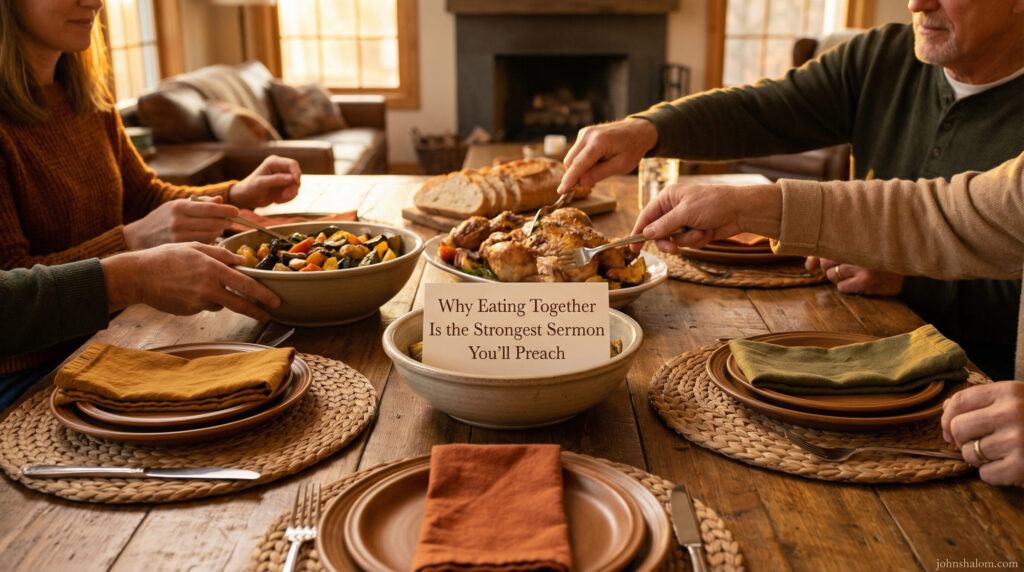
Eating together is one of the oldest and most powerful ways human beings teach love, respect, identity, and faith. Long before microphones, sermons were preached at the family table, around fires, and under trees with shared bowls and laughter.
When you sit and eat with others, you quietly teach equality, patience, generosity, and belonging without saying much. In modern life, screens and busyness are breaking this simple tradition, turning meals into fuel stops instead of family altars. If we want stronger homes, tribes, churches, and nations, we must bring back shared meals as daily sermons of unity, peace, and grace.
Introduction: The Table As A Pulpit Without A Microphone
When I was a boy, meals were not just about calories. They were about community.
In our home, you did not eat alone unless you were sick, travelling, or offended enough to announce it with your behaviour. If you tried to sneak a piece of roasted meat before everyone sat down, my mother’s eyes would find you faster than any modern Wi-Fi search. No word. Just eyes. Those eyes preached. You would quietly put the meat back and pretend nothing happened.
Looking back, I realise our table was a pulpit. No one called it that. There were no official sermons, no three-point outlines, no closing prayers with microphones. Yet the strongest messages I ever heard about respect, humility, gratitude, and unity were preached when plates were passed and hands reached into shared bowls.
You do not need a church building to preach. You do not need a title. All you need is a space, some food, and the courage to sit together. The table is one of the strongest pulpits on earth.
Childhood Meals: My First School Of Life
Before I met any trained teacher, my first classroom was a mat on the floor and a pot in the middle.
There, I learned:
- Patience
You never started before the elders. You waited. You watched. You learned to calm your hunger. That waiting trained more than my stomach. It trained my character. - Respect
If my father stretched his hand toward a piece of meat and my own hand reached at the same time, I knew I was in dangerous territory. Slowly, you learn to pull back, to honour age, to recognise order. - Gratitude
We did not always have plenty. Sometimes we had sorghum without sauce or thin soup with more water than flavour. Still, we bowed our heads, gave thanks, and ate together. That act taught me that gratitude is not about the size of the plate, but the presence of people around it.
I did not know words like “formation” or “values” then. I simply knew that at meal times, you tried to be your best self. The table was our training ground.
The Hidden Lessons Inside Ordinary Food
Every shared meal teaches something, even when no one is teaching on purpose.
- Eating together teaches presence
You cannot easily disappear into your own world when you share from the same bowl. You hear other people’s voices. You notice their faces. You sense their mood. The table forces us back into real time. - Eating together teaches sharing
When there is one big plate and many hands, no one can act as if the whole thing belongs to them. You learn to take enough and leave enough. This becomes a quiet lesson in justice and generosity. - Eating together teaches listening
At the table, stories flow. You learn family history, village rumours, jokes, and warnings all at once. You practice silence when others talk. You learn when to speak and when to let an elder finish. - Eating together teaches identity
You taste your people’s food. You hear your language. You repeat your prayers. You share your proverbs. Without anyone announcing it, you are being reminded, “This is who we are.”
One day you grow up, travel, and sit at other tables. You suddenly realise how much the first tables shaped your inner world.
When Meals Go Wrong: The Humor That Heals
One evening, my father decided to serve goat soup.
The smell travelled across the compound. Even the neighbours knew something special was cooking. We sat down, bowls ready, stomachs ready, hearts ready.
I took the first sip and nearly met my ancestors.
It was pure salt. Not soup with salt, but salt that had been baptised in water. My father had mistaken the salt jar for sugar. My face revealed the truth before my words did. One by one, everyone tasted. One by one, faces twisted. Then the laughter came.
We laughed until our sides hurt. My father laughed louder than all of us. That night, we did not eat much soup, but we fed heavily on joy. For years, that story followed us. Whenever he cooked, someone would ask, “Are you sure that is sugar?” and we would start all over again.
That salty disaster preached a quiet sermon.
Meals do not need to be perfect to be powerful. Sometimes the mistakes, the burnt bread, the spilled tea, the missing salt, become the strongest memories. They teach us to laugh at ourselves, to forgive honest errors, and to remember that togetherness matters more than perfection.
The Silent Preaching Of Eating Together
You can preach many sermons without opening your mouth.
When a father sits at the same level as his children, sharing the same plate, he is saying, “You matter. Your life is important.” When a mother serves others first, she is preaching sacrifice. When a family waits for the one who is late instead of eating everything, they are preaching patience and honour.
You do not need to say, “We are equal,” if you already share the same pot. You do not need to shout, “We forgive each other,” if you already keep a seat at the table for someone who once hurt you.
Food has a way of crossing walls that words cannot cross. You may not be ready to say “I am sorry,” but you can still eat from the same bowl. You may not know how to talk after a fight, but you can slowly rebuild contact over small shared meals.
Once, I visited a home where everyone ate in silence, each in a separate corner with a plate. The television was loud. The phones were louder. No one looked up. It felt less like a family and more like strangers using the same building.
That is when it hit me again. Eating together without screens, without rushing, is a form of preaching. It says, “You are worth my time. You are worth my eyes. You are worth my stories.”
You might also like: The Ultimate Guide to Political Journalism: Ethics, Challenges, and Impact in the Modern World
When Screens Replace Tables
Modern life is clever but often lonely.
It is now possible to live with people and barely see them. Everyone has their own schedule, their own shows, their own small screen. Meals become quick refuelling stops. You take a plate, disappear into a room, and scroll.
I have seen homes where the dining table is covered in papers, chargers, bags, and random objects. It has retired from service. The real table has become knees in front of a television or beds in dark rooms.
When that happens, we lose more than a piece of furniture. We lose a daily meeting point. We lose the chance to listen, to correct gently, to encourage, to notice when someone is not okay.
I am not against technology. It shrinks borders and connects cities. But if it replaces the table completely, it becomes a thief. It steals the sermons parents are supposed to preach without words.
If we are serious about raising strong children and building strong homes, we cannot let screens win every mealtime.
Shared Food, Shared Peace: From Family To Nation
This power of shared meals goes beyond family.
I have seen warring communities in South Sudan gather for reconciliation. There are speeches, prayers, and formal agreements. But there is also meat being roasted, water being poured, bowls being shared.
Two elders who once would not greet each other suddenly find themselves reaching into the same platter. Young people who grew up afraid of “the other side” now chew the same piece of goat. Something warm begins to melt cold suspicion.
You cannot eat with someone you are planning to kill. At least, not easily. Shared food forces you to see the other person as human, not just as an enemy category. You notice their wrinkles, their laughter, their children running around. The demon in your mind slowly becomes a neighbour.
This is why peace talks often include meals. It is hard to sign deep agreements on an empty stomach. Food relaxes the body and softens the heart.
At a national level, community meals, church feasts, school lunches, and neighbourhood gatherings are not small social events. They are quiet tools of nation building.
Poverty, Scarcity, And The Miracle Of Shared Plates
You might say, “John, this all sounds good, but what if there is barely any food?”
I know that feeling.
There were seasons when our family’s food could not impress any visitor. War, displacement, hunger, and poverty visited many of us. Sometimes we had only one main meal in a day. Sometimes the porridge was so light it moved like water.
Yet even then, the principle remained: we ate together.
When food is small and eaten separately, it feels even smaller. When food is small and eaten together, it somehow feels bigger. Unity multiplies the taste.
I remember days when visitors arrived unexpectedly. In many cultures, you cannot say, “We have nothing” while you are chewing. So we shifted quietly, stretched what we had, and made room. It meant smaller portions but larger hearts.
Those meals preached this sermon: “We may be poor in resources, but we are rich in togetherness.” That message gave me strength later in life when money or comfort tried to define my worth.
Simple Ways To Rebuild Meal Traditions Today
You do not need a big house, a perfect kitchen, or a lot of money to use meals as sermons again. You can start with very simple steps.
- Choose one daily meal to share
Maybe breakfast. Maybe supper. Decide that, as often as possible, you will sit together for that one meal. - Make a small rule about phones
You can say, “During this meal, no phones on the table.” It will feel strange at first. Soon, it will feel like breathing again. - Ask simple questions
You do not need deep topics. Ask: “What made you laugh today?” or “What was hard today?” Let everyone answer, even the smallest child. - Invite someone sometimes
Once in a while, invite a neighbour, a lonely friend, or a visiting student who has nowhere to go. Sharing your table extends your sermon beyond your walls. - Accept imperfection
Some days the food will burn. Some days someone will be in a bad mood. Some days the schedule will fail. Do not give up. The power is in the habit, not in perfection.
Passing The Table To The Next Generation
One of my deepest desires is that the next generation does not only inherit my books or my online content. I want them to inherit the rhythm of eating together.
Imagine children growing up in homes where:
They know they will be listened to at least once a day.
They see their parents pray with real gratitude.
They hear stories from grandparents instead of only reading quotes online.
They learn to bring their friends home, not just meet them on screens.
Those children will carry the table inside them, even when they move away. In university, they will be the ones who gather friends to cook together. In marriage, they will insist on family meals. In leadership, they will understand that people are not just numbers but human beings who need presence.
My mother never preached from a pulpit. But every time she called us to sit down, every time she refused to let us eat alone in a corner, she was preaching. Her message still rings in my mind:
“No matter how little we have, we are together. And together, we are rich.”
That is the strongest sermon many of us will ever hear.
Conclusion: What Sermon Does Your Table Preach?
You may never write a book. You may never stand on a stage. You may feel your life is simple, hidden, ordinary.
But three times a day, or at least once if you are busy, you have a chance to preach one of the most powerful sermons on earth. You preach it by how you sit, how you share, how you listen, how you invite.
Your table can preach greed or generosity. It can preach isolation or welcome. It can preach hurry or presence. It can preach pride or humility. It can preach division or peace.
You do not need special training to start. You only need the courage to say, “Let us eat together.”
And if you do that, again and again, over years, you may discover that your strongest legacy is not just what you said in public, but what you quietly lived around food.
If you would like to know more about my path as a writer, including the struggles, lessons, and small signs of progress along the way, you can read the full story on my Wealthy Affiliate blog here: https://my.wealthyaffiliate.com/johnmaluth/blog
Reflection Questions
- What is your favourite memory of eating together with family or friends, and what did it teach you?
- How have shared meals shaped your values more than formal lessons or speeches?
- When was the last time you invited someone outside your immediate household to share your table, and what impact did it have?
- What simple change could you make this week to restore or strengthen the habit of eating together in your home?
- If someone watched your mealtimes for a month, what sermon would they say your table is preaching about love, respect, and unity?
FAQS
- Why is eating together so powerful for families?
Eating together creates regular time for presence, conversation, and connection. It teaches children values like patience, sharing, and gratitude in a natural way that lectures cannot match. - What if our schedules are too busy to eat together every day?
Start small. Choose one meal a day or a few days a week where you prioritise sitting together. Even a short shared meal is better than none. - Do shared meals still matter if the food is very simple or scarce?
Yes. The strength of a shared meal is not in how fancy the food is, but in the act of being together, honouring one another, and giving thanks for what you have. - How can we reduce phone and screen use during meals?
Agree as a family that mealtimes are phone free. Put phones in another room or on silent. At first it may feel hard, but it quickly becomes a refreshing break. - Can shared meals help heal conflicts in families or communities?
They can help. Eating together lowers tension and creates neutral space for conversation. It does not replace honest apology or justice, but it supports both by reminding everyone of shared humanity and connection.