TL; DR:
Food is more than fuel. It is language, memory, and quiet diplomacy served on a plate. When people share a meal, suspicion softens and curiosity grows. Recipes carry history, geography, and family values. Diaspora kitchens become embassies of identity far from home. Even failed dishes and cooking disasters can create stories that unite people in laughter. Real bridge-building between cultures does not always start with conferences or speeches. It often starts with someone saying, “Come, sit, eat with me,” and being willing to taste what is unfamiliar with respect instead of fear.
Hunger as Our First Shared Language
Before we are citizens, tribe members, or believers of a certain faith, we are human beings with stomachs that complain in the same way. Hunger is one of the first experiences that levels us. A hungry child in Juba, Cairo, or London feels the same ache.
That is why food is such a powerful bridge. It speaks to something basic and honest inside us. You may not understand my language, you may not know my history, but when I place food before you, I am saying, “I see your humanity, and I want you to stay alive.”
In divided societies, people may refuse each other’s political views or cultural practices, but very few refuse a warm plate after a long day. Food gives people a reason to sit at the same level. Many important conversations begin only after plates arrive and hands reach forward.
When Suspicion Turns Into Chewing
I once attended a wedding where guests from different tribes sat on opposite sides of the compound. The music played, but the air was tense. People greeted each other with stiff smiles then quickly turned back to their own group.
Then the roasted goat arrived. Plates were passed across imaginary borders. At first, the only sound was chewing. Then someone from one side joked about how the cook had been too generous with salt. Someone from the other side answered with a playful comment about how their own people would have done worse. Laughter followed.
By the end of the evening, people were sharing bones, stories, and phone numbers. The goat had done more work than the speeches. The meat entered stomachs, but it also entered history as a small peace project. That night reminded me that sometimes the shortest path between two suspicious hearts is a shared plate.
When Food Fails and Friendship Wins
Not every food story is glorious. Some are completely embarrassing.
I still remember the day I proudly cooked beans for a friend from another community. In my mind, I was about to impress him with “my” recipe. In reality, I had underestimated the cooking time. The beans were hard enough to break teeth. After one bite, he frowned and asked, “John, are these beans or stones?”
For a moment, I wanted the earth to open and swallow me. Then we both burst out laughing. The beans were a disaster, but the friendship was not. That meal gave us a story we still tell years later.
Perfect food is enjoyable. Failed food is unforgettable. Shared laughter over a burnt pot or over-spiced stew often binds people together more than a perfectly executed dish. Humor at the table breaks the fear of looking foolish in front of each other. It reminds us that all cultures make mistakes in the kitchen.
Recipes as History Books
Every dish is a small history book, written in ingredients instead of ink.
Why do some communities eat fish often? Because their grandparents lived by rivers or lakes. Why do others rely on sorghum or millet? Because those crops survive harsh climates. Why is one dish rich in spices while another is simple? It may reflect old trade routes, past wars, or poverty that forced people to be creative with very little.
My grandmother’s sorghum porridge was not just food. It was survival training, patience training, and family theology on a plate. She stirred it slowly, without hurry. She always served others before herself. In those simple acts, she taught us that feeding others comes before comfort and that enduring hard seasons with dignity is a form of strength.
When you taste someone’s traditional food, you are tasting their climate, their economy, their history, and their values in one spoonful.
You might also like: How to Write Your Life Story: A Complete Guide to Autobiography Writing
Diaspora Kitchens as Embassies
For people living in diaspora, food becomes a passport that never expires. You may forget some words of your mother tongue, you may dress like the new country, your children may prefer burgers to boiled cassava, but when the smell of your traditional stew fills the apartment, everyone knows where they came from.
In foreign cities, small kitchens often carry bigger stories than embassies. A pot of kisra, injera, or ugali cooked in an upstairs flat becomes a quiet declaration: “We are still here. Our culture is not lost.”
Children born abroad may not fully grasp clan structures or old village stories, but when they sit on the floor and eat with their hands from a shared plate, they receive a silent lesson. They may speak English at school and the host language on the streets, but their first taste of identity often comes in the form of familiar food on a family mat.
Food as Quiet Diplomacy
We know that governments use formal dinners to build relationships. State banquets are carefully designed messages. But the most powerful food diplomacy rarely appears on the news. It happens when ordinary people invite those who are different into their homes.
Imagine peace talks that begin with negotiators cooking for each other. Imagine rival groups preparing one dish from each side then eating them together. It is harder to dehumanize a person whose food you have tasted respectfully. It is harder to insult someone whose mother’s cooking you have praised.
I still remember when my elder brother once brought home a friend from another tribe before the 1989 Nasir battle that later took his life. Our family was quiet at first, unsure how to behave. My mother simply placed food on the mat. Slowly conversation began. By the end of the meal, that guest was laughing like a brother.
He walked in as “someone from another tribe.” He left as “our guest,” which is one step closer to “our relative.” Food had moved him along that journey.
Tables as Classrooms of Respect
A shared meal is not only about what goes into the mouth. It is about how people behave around it.
Children learn early that food time is also manners time.
They learn to say “please” and “thank you.”
They learn to wait, to share, to offer the best piece to a guest or elder.
They learn not to mock someone’s way of eating or judge another person’s portion.
When people from different cultures eat together, those lessons stretch further. They learn to handle unfamiliar smells and textures without making faces. They learn to ask questions politely instead of criticizing. They learn that “strange” is often just another word for “new to me.”
In that sense, the table becomes a small school of hospitality. It trains citizens who can live with difference without fear.
When Food Divides Instead of Unites
Food can create bridges, but it can also build walls if we are careless.
Mocking another community’s food creates shame. Laughing cruelly at someone’s staple dish as “smelly” or “dirty” or “poor people’s food” deepens division. Even joking about food must be done with love.
Sometimes people use food as a weapon of exclusion. They deliberately refuse to eat with certain groups. They keep their table closed to those they dislike. In such cases, food becomes a tool of rejection instead of welcome.
The same dish that could have been a bridge turns into a fence. That is why intention matters. The power of food to connect cultures depends on the heart serving it and the attitude receiving it.
Faith, Fasting, Feasting and Friendship
Food is deeply woven into faith. Fasting, feasting, communion, iftar, Sabbath meals – all carry spiritual meaning. They teach self-control, gratitude, and community.
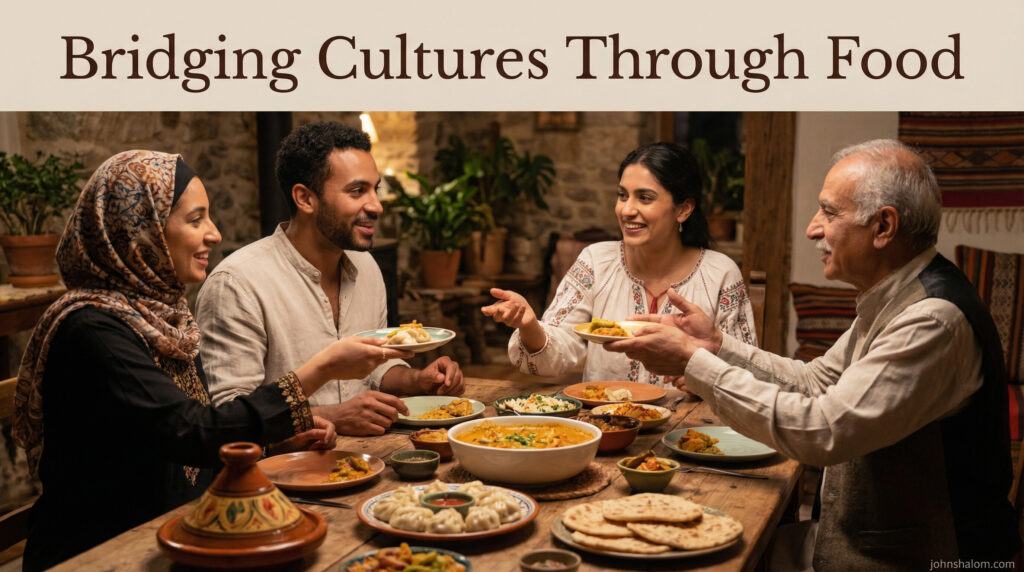
When people of different faiths share food respectfully, they quietly honour each other’s beliefs. A Christian invited to an iftar meal during Ramadan, a Muslim sharing food with Christians after church, a traditional believer sitting with both – these shared moments are more powerful than many formal dialogues.
No one needs to water down their beliefs to share a meal. They simply need to accept that the other person’s dignity is not up for debate. Food allows faiths to sit at the same table without shouting.
Practical Ways to Bridge Cultures Through Food
It does not require a big budget or a big kitchen to use food as a cultural bridge. Small steps are enough.
- Invite before you explain
Invite a neighbor or colleague from another background to eat with you. Do not over-explain or apologize for your food. Serve it with pride and warmth. - Ask before you judge
If something tastes unusual, ask about its story instead of criticizing. “How do you usually eat this?” is a better question than “What is this strange thing?” - Share recipes, not just plates
When someone enjoys your food, share the recipe. When you enjoy theirs, ask how they make it. Recipes are small pieces of culture that can travel across borders without needing a passport. - Host “mixed” tables
If possible, host meals where several cultures are represented. One dish from each background. Let people explain their dish briefly then eat together. It turns the meal into a gentle cultural exhibition without pressure. - Include children intentionally
Let children help cook and serve. Explain what each dish means. Encourage them to taste respectfully. Children who learn to love different foods will find it easier to love different people. - Use food in reconciliation efforts
After conflict, suggest shared meals where each side brings something. Eating side by side may open hearts that refused to open for speeches.
Laughter as a Spice for Peace
Food and humor belong together.
Someone drops a plate and everyone jumps then laughs.
Someone mispronounces the name of a dish and the cook teases them kindly.
Someone confuses sugar with salt and the whole table becomes a small comedy show.
These moments may look small, but they carry serious work inside them. Laughter relaxes the muscles of suspicion. Once people have laughed together over a cooking disaster, they find it easier to talk about harder topics.
My friend who once asked if my hard beans were stones did not insult my culture. He made fun of my cooking, which was fair. Our laughter that day seasoned the friendship. To this day, if food is too hard, he smiles and says, “John, your signature beans have followed me.” That private joke is a string tying our lives together.
Food, Memory, and the Weight of Loss
Food also holds memory, especially after loss.
When someone dies, the dishes they loved often become emotional. You smell their favorite stew and feel their absence more sharply. You taste something they used to cook and feel their presence in a different way.
When my elder brother died in the 1989 Nasir battle, many memories of him were linked to shared meals. I remember how he once brought home that friend from another tribe and watched carefully to see if we would treat him as family. I remember how he sometimes gave up his portion quietly when there was not enough for everyone.
Those food memories do more than make me miss him. They shape my values. They teach me that generosity and openness at the table are not soft things. They are strong acts that can outlive bullets and battles.
Setting More Tables Than Barriers
We live in a world where differences are often used as weapons. Tribe, race, religion, nationality – all can be turned into walls. Yet, three times a day, most of us sit before food. That table can become a prison of suspicion or a bridge of trust.
Roads, policies, and speeches matter, but they often feel distant. The table is close. If more families chose to feed people from other cultures, tribes, or faiths, many invisible walls would begin to crack.
You do not need to be a chef or a diplomat. You simply need to say, “Come, eat with me,” and mean it. Food will do the quiet work it has always done – warming bellies first, then slowly warming hearts.
If you would like to know more about my path as a writer, including the struggles, lessons, and small signs of progress along the way, you can read the full story on my Wealthy Affiliate blog here: https://my.wealthyaffiliate.com/johnmaluth/blog
FAQS
- Why is food such an effective way to connect people from different cultures?
Because food touches something basic and shared in all people. Everyone understands hunger and pleasure from good food. Sharing a meal lowers defenses, creates time for conversation, and shows respect without needing many words. It turns strangers into guests and sometimes guests into friends. - How can families in diaspora use food to keep their cultural identity alive?
They can cook traditional meals regularly, involve children in preparing them, and explain the stories behind each dish. Eating together in the mother tongue, using old recipes, and inviting relatives or friends to share those meals helps children feel they belong to more than one place, not to nowhere. - What if someone laughs at my traditional food in a hurtful way?
You can respond calmly, explain the meaning of the dish, and even use gentle humor to soften the moment. If the laughter continues in a cruel manner, you have the right to say it is disrespectful. True bridge-building requires both sides to be willing to honor each other’s food and, by extension, each other’s dignity. - Can food really help with serious issues like tribal conflict or political tension?
Food alone cannot solve deep conflicts, but it can create the atmosphere where honest conversations become possible. Shared meals remind people of their common humanity. When combined with sincere dialogue, justice efforts, and wise leadership, food can support reconciliation by turning enemies into people who have at least eaten together. - What simple step can I take this month to bridge cultures through food?
Choose one person or family from a different background and invite them to share a meal, either in your home or in a simple public place. Serve something meaningful from your culture and be ready to taste something from theirs in return. Let the conversation flow naturally around the table. That one meal may be the first brick in a new bridge.