TL; DR:
Roads, bridges, and shiny buildings are often presented as proof that a nation is progressing. But roads do not build nations; people do. A smooth highway cannot replace honest leaders, responsible citizens, or peaceful neighbors. Without integrity, unity, and service, roads simply move problems faster from one place to another. Real development begins inside people: in how they treat each other, how they handle power, and how they raise their children. When character is strong, roads become tools for shared growth. When character is weak, the same roads can carry corruption, conflict, and inequality.
Roads as Symbols, Not the Foundation
Politicians love to point at roads. They cut ribbons, pose for photos, and declare that “development has arrived.” The camera captures a new strip of tar, crowds cheering, flags waving.
Do roads matter? Of course. They connect towns, improve trade, and shorten journeys. They bring markets closer, ambulances faster, and opportunities nearer. But a road on its own is not development. It is only a tool.
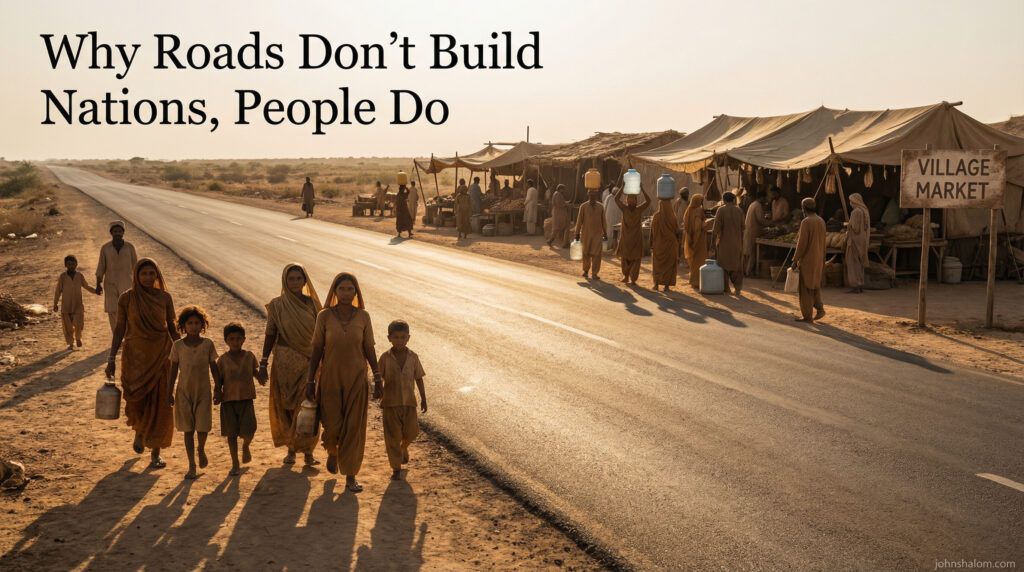
I once stood by a new road in a city. Cars passed quickly, dust was low, and the asphalt shone in the sun. But just a few meters away, families still lived in shacks, schools had no teachers, and clinics had no medicine. The road looked modern, but the pain was old. The road did not fix the nation’s heart.
That is the problem with using roads as proof. They show something has been done, but they do not show what kind of people are using them. A bad driver on a good road still causes an accident. In the same way, citizens without values still crash a nation, even if its roads look impressive from the sky.
When “Development” Becomes Comedy
Sometimes the obsession with roads turns almost into a joke. I remember one local leader proudly saying, “We now have a road!” People clapped. When they asked where it went, he replied, “Nowhere yet, but it is a road.” Everyone laughed, but the truth behind the laughter hurt.
What is the use of a road that leads nowhere in people’s daily lives? It reminded me of a man who builds a big gate to his compound but has no house inside. The gate looks rich, but the family still sleeps under a tree.
We have similar comedy in conversations about development. People say, “We have a road now; we are developed,” while children beg by the roadside and youth sit unemployed under nearby trees. Sometimes humor is the only way to cope with the gap between the official story and the real story.
People as the Real Infrastructure
Nations are not built from tar, cement, and steel. They are built from character.
A teacher who shows up in class every day builds a nation more than a thousand political speeches.
A nurse who treats patients with care builds a nation more than a new VIP lane on a highway.
A trader who refuses to cheat on the scale builds a nation more than a high bridge over a river.
My mother used to say, “A road will not cook for you. Only people can cook.” Her words were simple, but they carry a national truth. Infrastructure is helpful, but without responsible people to use and maintain it, it is just decoration.
You can build a modern hospital, but if workers steal medicine or ignore patients, the building is only a shell. You can build a big school, but if teachers never come, the building is a silent witness to wasted potential. You can build long roads, but if corruption and hatred travel faster on them, they become dangerous veins in a sick body.
Roads Without Unity
Roads increase movement. That is both a blessing and a risk.
With good roads, farmers can send their produce to markets before it spoils. Students can reach universities with less struggle. Families can visit each other more often. That is the positive side.
But roads also make it easier to move guns, mobilize fighters, and spread conflict quickly. A road does not ask why you are using it. It serves both the peacemaker and the troublemaker.
If people are still divided by tribe, revenge, and politics, roads can deepen the damage. Armed groups can move faster. Looted goods travel quicker. Lies and hate campaigns spread with more speed.
That is why peaceful people matter more than paved streets. Unity can build nations even with poor roads. Roads cannot build nations if people are at war in their hearts.
My Brother’s Death and the Question of What Matters
When my elder brother died in the 1989 Nasir battle, he did not die for better roads. He was not thinking about asphalt thickness or bridge designs. He was fighting for dignity, justice, and identity. He believed that the people he loved deserved a country where they could live without constant fear.
His death reminds me that nations are born from people’s courage, not from concrete. Roads can come later. They can help carry food, medicine, and ideas. But they can never replace the human price paid for freedom.
You might also like: The Ultimate Guide to Political Journalism: Ethics, Challenges, and Impact in the Modern World
That is why it is painful when, decades later, leaders boast about roads while people still suffer from injustice, corruption, and neglect. It can feel like putting makeup on a sick patient and calling them healthy.
The Hidden Road: Values
There is another kind of road that never appears on maps. It has no tar, no bridges, no traffic lights. It is the invisible road of values.
This road is made of honesty, forgiveness, responsibility, and service. It runs through homes, schools, churches, mosques, markets, and offices. It is walked daily by parents, teachers, farmers, children, elders, and leaders who choose to live differently.
When people tell the truth even when lies would be easier, they strengthen that road.
When neighbors reconcile instead of seeking revenge, they repair that road.
When officials refuse bribes, they extend that road.
When families raise children to respect others, they widen that road.
Physical roads connect cities. Value-roads connect hearts. If you only build the first and ignore the second, your nation will remain weak.
Everyday Nation-Builders
Nation-building is often portrayed as something done by presidents, ministers, and foreign donors. But the real builders are mostly invisible.
- Parents who raise children to love learning, share what they have, and respect others.
- Teachers who stay in classrooms even when salaries are late.
- Farmers who keep planting in seasons of uncertainty, feeding communities that may never know their names.
- Market women who stretch small capital every day and still refuse to cheat customers.
- Youth who resist the temptation to join violence and instead look for honest work.
These people rarely cut ribbons. They don’t appear on TV. Their names are not written on plaques next to projects. Yet they carry the nation on their shoulders day after day. They are walking, breathing infrastructure.
When Roads Expose Our Character
A road does not only serve people. It also reveals them.
You can see a nation’s character in how people use the road:
– Do drivers respect traffic rules or ignore them?
– Do pedestrians litter everywhere or keep public space clean?
– Do businesses along the road pay fair prices or inflate them to exploit others?
– Do citizens see public property as “ours” or “theirs”?
I once watched a group of drivers speed dangerously on a new highway, overtaking on blind corners, ignoring signs. Later, when accidents happened, they blamed “bad luck” or “spirits.” But the real issue was human behavior. The road simply gave them more room to reveal their carelessness.
In the same way, a new road through a village shows whether people are ready to handle opportunity. Some will start small businesses, improve transport, and develop the area. Others may use the road mainly to steal resources or move conflict. The difference is not in the tar. It is in the heart.
Humor as a Mirror of Fake Development
Humor often exposes the truth faster than serious speeches.
I once heard someone say, “In our country we measure development by how smooth the minister’s journey is, not by how safely a pregnant mother reaches the clinic.” People laughed, but it was bitter laughter. It pointed to a real problem: we often design roads for power, not for people.
Another joke said, “Our leaders love roads because they can drive away quickly when citizens complain.” Again, everyone laughed, but the joke carried pain. Humor becomes a mirror that shows the distance between what is promised and what is lived.
We need that humor, not just to entertain ourselves, but to remind us that development without justice, education, health, and peace is a half-built house.
What Leaders Should Remember
Leaders have a duty to build infrastructure. Roads, bridges, power lines, and internet connections all matter. No country can move forward without them. But wise leaders remember that:
- Roads are tools, not trophies. Their success is measured by how they improve ordinary lives, not by how they look in photos.
- A nation’s greatest asset is not its highways but its people. Investing in education, health, and justice is more powerful in the long run than any single mega-project.
- Development must balance the visible and the invisible: concrete and character, buildings and values, budgets and trust.
A leader who builds only roads but neglects people is like a man who waters only the leaves of a tree and ignores the roots. For a while it looks green. Then one day, it falls.
What Ordinary People Can Do
It is easy to blame leaders and wait for them to change. But ordinary citizens also make or break a nation.
We can:
- Treat public property as our own, not as something to destroy or neglect.
- Refuse to pay or demand bribes, even if it slows things down.
- Use humor to challenge fake development, but also use effort to build real development where we are.
- Raise children who understand that character matters more than show.
- Turn new roads into routes for peace and cooperation, not for revenge or exploitation.
A citizen who throws trash out of a bus window and a minister who steals millions from a road project are doing the same kind of harm at different levels. Both are saying, “This place is not truly ours.” Building a nation starts with undoing that attitude.
The True Road That Builds Nations
In the end, the most important road is not drawn on a map. It is the path people walk inside themselves and with each other.
The true road is:
– The decision to forgive instead of revenge.
– The choice to work hard instead of waiting for handouts.
– The commitment to tell the truth instead of hiding behind lies.
– The effort to listen, to reconcile, to include others instead of always dividing.
When enough people walk that inner road, physical roads begin to serve a new purpose. They no longer just link towns. They link hearts that are already learning to live as one nation.
Roads do not build nations. People do. If we forget that, we will keep building proud highways over broken hearts. If we remember it, we can turn every road, no matter how rough, into a path toward a better future.
If you would like to know more about my path as a writer, including the struggles, lessons, and small signs of progress along the way, you can read the full story on my Wealthy Affiliate blog here: https://my.wealthyaffiliate.com/johnmaluth/blog
FAQs
- Why do leaders focus so much on roads when talking about development?
Because roads are visible, measurable, and easy to show. It is simpler to point at a new highway than to prove that honesty, justice, and unity are improving. Roads photograph well. Values do not. That is why citizens must look beyond speeches and ask: who benefits, and how are people’s daily lives changing? - Are roads still important if people are the real builders of nations?
Yes, roads are important. They are part of healthy development. They help trade, transport, education, and healthcare. But they are not enough on their own. Roads must be combined with investments in people: schools, clinics, fair laws, and peaceful communities. A good road in the hands of responsible citizens becomes a blessing. In the hands of corrupt or violent people, it can become a curse. - Can a poor country delay building roads until people’s character changes first?
No, it is not either-or. Countries need both at the same time: infrastructure and character. Waiting for perfect people before building roads would mean waiting forever. The wiser path is to build roads while also strengthening education, justice, and moral leadership. As people grow in responsibility, they use those roads better. - What can ordinary citizens do to make sure roads truly help nation-building?
Citizens can use roads responsibly, protect them from vandalism, and demand transparency around contracts and budgets. They can start small businesses along roads that serve communities fairly. They can also use roads to connect across tribes and regions, visiting and working with others instead of staying in isolated groups. Their behavior turns a simple road into a real link between people. - What does it mean to say “people are the real infrastructure of a nation”?
It means that the most important “structure” in any country is its people’s character, skills, and relationships. A nation with honest, educated, peaceful citizens will progress even with limited physical infrastructure. A nation with corrupt, divided, and untrained citizens will struggle, even with many highways and buildings. People are the living roads on which every other form of development depends.