TL; DR:
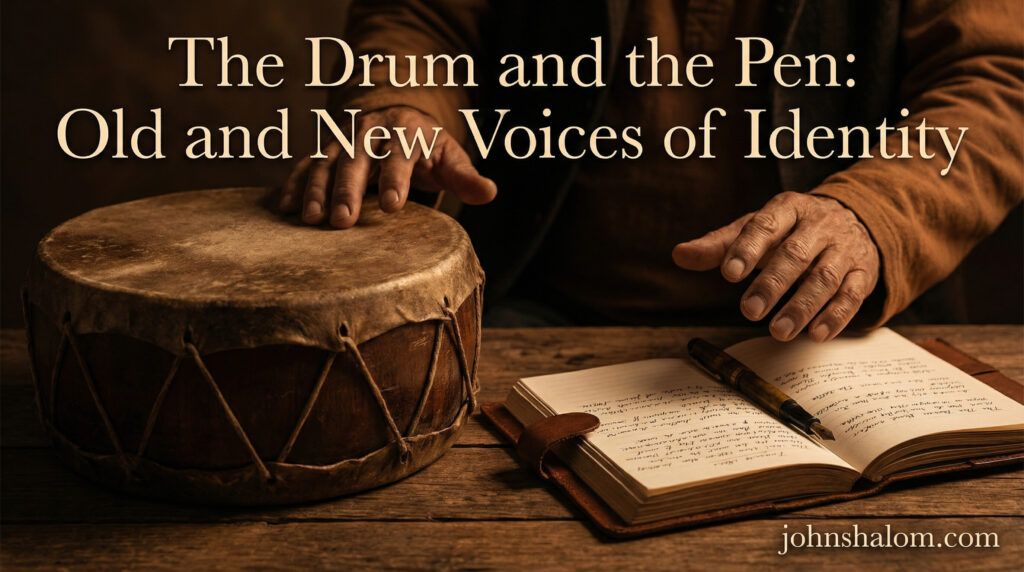
Before paper and screens, the drum was our public voice. It gathered people, carried news, warned of danger, and stitched communities together through sound. Later, the pen arrived with its quiet power to record, explain, and travel across distance and time. The drum speaks to the body and to the village in one moment. The pen speaks to memory and to people far away, even long after the writer has died.
When we treat the drum as “backward” and only respect the pen, we cut ourselves from roots. When we cling to the drum and reject the pen, we lose reach. A wise generation keeps both: the living rhythm of culture and the written word that carries identity forward. In a noisy digital age, we still need drum, pen, and now keyboard to protect who we are and who we want to become.
Two Voices That Carry Who We Are
Long before ink stained paper, the drum carried our identity. Its beats announced weddings, warned of danger, called people to gatherings, and celebrated victories. The drum was a voice that never needed translation. Everyone in the village knew the meaning of its patterns.
Then came the pen. First through schools and churches, then through offices and newspapers, and later through phones and computers. The pen promised something the drum could not offer. It could hold words still. It could store a speech, a law, a letter, or a memory on a page so that it could be read again and again.
The drum and the pen may look like strangers. One is carved from wood and stretched skin. The other is a small tube of plastic or metal. Yet both ask the same question: how do we carry who we are from one person to another, and from one generation to the next?
As a boy, I did not think about this. I only felt it. When the drum spoke, my body reacted. When the pen wrote my name for the first time, my heart reacted. Only later did I realise that these two tools were shaping my sense of identity from different sides.
The Drum as the First Newspaper
In many African villages, the drum was the first newspaper and radio combined. A certain rhythm meant someone had died. Another called people to a community meeting. A faster, sharper beat signaled danger on the way. Without a single spoken word, the drum united people in shared understanding.
I remember as a child hearing a drumbeat at night and watching the whole village move. Men, women, and children stepped out of their huts and walked toward the same center. No Wi-Fi, no radio, no text messages. Just a hollow log speaking louder than all that modern equipment. That was identity in sound.
The drum did more than carry information. It carried a feeling. A funeral drum created a heavy atmosphere even before anyone spoke. A wedding drum filled hearts with joy before the bride appeared. A warning drum could raise the hair on your arms before you knew the details. In that way, the drum did not simply tell you something. It made you feel it together with others.
The Humor Hidden in the Drum
Like every strong tool, the drum also had a playful side. It did not only cry and warn. It laughed.
At one wedding I attended, the drummer watched the groom dance. The groom’s steps were stiff and unsure, but full of effort. The drummer slowly changed the rhythm to echo those clumsy movements. People realised what was happening and burst into laughter. Even the groom laughed and tried to improve his steps.
In that moment, the drum was not just a serious instrument. It became a friendly mirror, teasing the groom and reminding him that joy includes the courage to look foolish. Humor was part of our identity, and the drum knew how to carry it.
When the Pen Entered the Story
Then the pen entered our world in a stronger way. Mission schools, government offices, and later local writers brought a new habit: putting words on paper. Suddenly stories were not only spoken or drummed. They could be written and read later.
The first time I saw my name written in school, I felt something unusual. My name was no longer just a sound that could disappear with the wind. It was a mark on paper. It said, “You exist in this wider system too.” I began to see that the pen was giving me another kind of identity. Not only the identity of my tribe and clan, but also the identity of a student, a future citizen, a future author.
Writing allowed us to:
- Record history instead of only remembering it.
- Explain events in more detail than a drumbeat could.
- Reach people far away who would never hear our drum.
- Leave messages for people who were not yet born.
The pen did not replace the drum immediately. For a long time, they lived side by side. People still listened to drumbeats at night and read letters in the day. Yet tension slowly began to grow.
Old vs New: A False Fight
Some elders worried that writing would kill storytelling. Some young people started to see drumming, oral stories, and local songs as “backward.” They wanted the modern world of printed books and foreign languages.
This created a false choice. As if we had to choose between the drum or the pen. As if identity could only live in one form at a time.
You might also like: How to Write Your Life Story: A Complete Guide to Autobiography Writing
The drum values community. Its message is public and shared instantly. The pen often begins in private. One person alone with thoughts and paper. The drum is quick and powerful in the moment, then fades. The pen is slow and quiet, but its marks can last for centuries.
Both have limits. A drum cannot store a long speech with exact words. A pen cannot pull a whole village out of their houses in three seconds. Each voice covers the other’s weakness.
There is a proverb that says a bird needs two wings to fly. For us, the drum and the pen are those two wings. If we cut off one wing in the name of progress or in the name of tradition, we do not protect identity. We cripple it.
My Brother’s Death: When Drum and Pen Met
When my elder brother died in the 1989 Nasir battle, the drum announced his death before any letter could arrive. Its deep, slow rhythm rolled over the village like distant thunder. No one needed translation. We all knew someone important had fallen. That drumbeat made grief a shared event.
Years later, when I began to write about him, the pen did something different. It did not call people to gather at once. It did not make anyone rush out of their home. But it carried his story farther than the drum could. People who never met him could read about his life, his jokes, his courage, and his sacrifice.
The drum gave our community a way to mourn together in one night. The pen gave me a way to honor him across time, across pages, and across borders. Both were necessary for his memory to live properly. The drum spoke to the village. The pen spoke to the future.
The Risk of Forgetting the Drum
Modern life often flatters the pen and now the keyboard. Children grow up typing more than listening. They write essays in foreign languages but may not know a single song of their grandmother’s youth. Microphones, cameras, smartphones, and social media can give a feeling that the old instruments of identity are no longer needed.
When we forget the drum, we risk losing:
- Shared emotional experiences that unite a community in the same moment.
- The skill of reading rhythm and body language, not only written lines.
- The feeling that identity is something you feel in your chest, not only something you spell with letters.
If a generation can write beautiful essays about culture but no longer dances, sings, or gathers around living sound, something vital is missing. We end up with identity written on paper but not beating in the heart.
The Risk of Rejecting the Pen
At the same time, there are those who cling to older tools and reject the pen. They say writing is for others, for outsiders, for people who left the village. They fear that written words will weaken oral tradition.
When we reject the pen, we risk:
- Losing control of our own story, allowing others to write it for us.
- Watching our languages and proverbs disappear because nothing was recorded.
- Being left out of decisions and systems that rely on documents, laws, and reports.
The pen is not the enemy of the drum. It is another drumstick, striking a different surface. It gives us the option to carry our songs, stories, and histories into courts, universities, libraries, and digital spaces where a physical drum cannot reach.
New Tools: The Keyboard and the Camera
Today, technology adds even more tools: keyboards, screens, cameras, voice recorders. Some people panic and say culture will die in front of phones. Others rush into the digital world and forget where they came from.
Yet the basic question is the same. How do we carry identity through tools? We can use keyboards to type our proverbs on websites. We can record elders drumming and upload the sound so grandchildren abroad can hear it. We can film dances, scan handwritten letters, and turn them into books.
Modern tools can threaten identity if we only consume foreign content and ignore our own. But they can also strengthen identity if we use them to preserve, share, and celebrate our roots. The tool is not the problem. The intention in the user’s heart is the problem or the solution.
The Drum, the Pen, and the Soul of a People
Identity is not hidden inside wood or ink. It lives in people. In their choices, their faith, their humor, their pain, their language. The drum and the pen are channels, not the source.
The drum reminds us that we belong to a group. When it speaks, nobody asks who owns the rhythm. It belongs to all who understand it. The pen reminds us that each voice also matters. It gives space for one person’s reflection, testimony, or confession.
We need both.
Community and personal voice.
Rhythm and reflection.
Sound that fills the air and words that fill the page.
As a writer who grew up in a culture of drums, I carry both worlds inside me. I love the quiet of the pen and the fire of the drum. My task, and perhaps yours too, is not to choose one and insult the other. It is to honor both and use them to serve life.
Practical Ways to Keep Both Voices Alive
We do not need big budgets to protect these voices. We need simple, deliberate habits.
- Record elders drumming and explaining the meanings of rhythms.
- Write down stories that have only lived in people’s mouths until now.
- Teach children both traditional songs and simple writing skills in their mother tongue.
- Use community events to mix practices: open a gathering with a drum, then read a written poem or story.
- Encourage youth who love music to also document and translate lyrics, so they do not get lost.
When we do this, we show the next generation that identity is not frozen in the past or dissolved in the present. It is carried on, using every honest tool available.
A Future With Roots and Wings
Imagine a world where a young person in diaspora listens to recorded drum patterns from their village while reading a book written by a local elder. Imagine a child learning to write their name in their mother tongue and then dancing to the family’s drum rhythms in the evening.
This is not a return to an old age or a blind jump into a new age. It is a wise choice to walk with both feet. To move forward without cutting off the past. To accept modern tools without kneeling before them.
The drum and the pen are old friends. If we treat them as enemies, our identity weakens. If we let them work together, our identity travels, grows, and survives.
If you would like to know more about my path as a writer, including the struggles, lessons, and small signs of progress along the way, you can read the full story on my Wealthy Affiliate blog here: https://my.wealthyaffiliate.com/johnmaluth/blog
FAQs
- What did the drum give communities that the pen could not?
The drum gave immediate, shared experience. It could call a whole village together in seconds, warn of danger, mark a death, or spark celebration without a single written word. It spoke to the body and emotions at the same time, and everyone who knew the patterns understood the message together. - How does writing help preserve what oral traditions and drums might lose?
Writing allows details to be stored and repeated with accuracy across time and distance. A drum can signal that someone died, but writing can describe who they were, what they did, and what they believed. Oral stories fade or change with memory. Written accounts keep names, dates, and lessons alive for people who were not present and for generations still to come. - Does modern technology destroy cultural identity or can it support it?
It can do both. If people use phones and the internet only to consume foreign content, identity weakens. If they use the same tools to record songs, scan old letters, share proverbs, and publish local stories, technology becomes a helper. The effect depends on whether we use these tools to forget ourselves or to remember ourselves better. - How can families balance oral stories with written records at home?
Families can keep telling stories around meals or at night while also writing down important ones in notebooks or digital files. Children can be encouraged to interview elders and write summaries. Parents can read printed stories in the mother tongue and then explain or expand them orally. In this way, spoken and written habits support each other instead of competing. - What do “the drum” and “the pen” symbolise in a person’s life today?
In a personal sense, “the drum” can represent everything that builds shared identity: songs, gatherings, body language, and communal memory. “The pen” can represent personal reflection, learning, planning, and the courage to put one’s own voice into words. A healthy life needs both. We need community rhythm and private reflection if we want to stay rooted and still move forward.