TL;DR:
Bedtime stories are not just a way to put children to sleep. They are one of the first tools families use to pass down values, identity, and faith. Inside funny animal tales and village legends, children quietly learn about courage, honesty, kindness, greed, and consequences. The act of storytelling itself also teaches love, safety, and attention.
Grandparents, parents, and older siblings become living books, shaping how children see themselves and the world. In busy modern life, it is easy to replace stories with screens, yet even simple nightly stories in any language can help children carry their family’s wisdom into the future. If we want the next generation to live with strong values, we should not underestimate one simple habit: telling a story before sleep.
INTRODUCTION: MORE THAN “ONCE UPON A TIME”
If you ask adults where their values came from, they might mention school, church, or life’s hard lessons. But if you keep listening, many will also smile and say, “My grandmother’s stories,” or “The tales my father told me at night.”
Bedtime stories may look like small things. A tired parent, a simple tale, a sleepy child. No certificates, no exams. Yet inside those quiet moments, whole value systems are planted. Long before textbooks and lectures, families passed down wisdom through stories told by firelight or whispered before sleep.
As a boy, I did not know this. I only knew that when my grandmother started a story, the whole world shrank into that small circle of light. Animals talked, chiefs made mistakes, poor people became wise heroes. Much later, I realised those stories were not only entertainment. They were training.
THE MAGIC OF STORYTELLING: VALUES WRAPPED IN IMAGES
2.1 Lessons hiding behind animals and heroes
A bedtime story is never just about animals that talk or heroes who win. It is a lesson wrapped in pictures.
When a hare outsmarts a lion, children learn that wisdom can win against raw power.
When a greedy character ends up shamed, they learn that selfishness carries a hidden cost.
When a faithful friend stays until the end, they learn loyalty in a way no classroom can fully explain.
I still remember one tale my grandmother told about a tortoise who tricked his way into every feast. The tortoise lied, flattered, and pushed his way into people’s homes to eat. In the end, one host set a trap. Tortoise fell into his own trick and was exposed in front of everyone.
As a child, I laughed at the picture of the tortoise stuck and embarrassed. Years later, the meaning became clear: greed will embarrass you before it feeds you. That single story still speaks to me more strongly than many warnings I heard later.
2.2 Humor that glues the lesson in place
Stories often use humor to deliver serious truth. Children remember the funny voices, the foolish characters, and the ridiculous twists. That humor is not an accident. It is glue that keeps the lesson in their minds.
I once told my niece a story about a foolish hyena who heard that two villages were having feasts on the same night. Hyena wanted both. He started walking to one village, then turned to the other, then back again, until he collapsed in the middle with an empty stomach. My niece laughed so hard she nearly rolled off the mat.
Weeks later, when she had to choose between two toys and was tempted to grab both, she stopped and said, “I do not want to be like the hyena.”
That is the secret power of bedtime stories. They let children laugh at foolish behavior before they repeat it.
THE BONDING POWER OF STORIES
3.1 Love hidden in the act of storytelling
Bedtime stories do not only pass values through words. The act of storytelling itself teaches something deep.
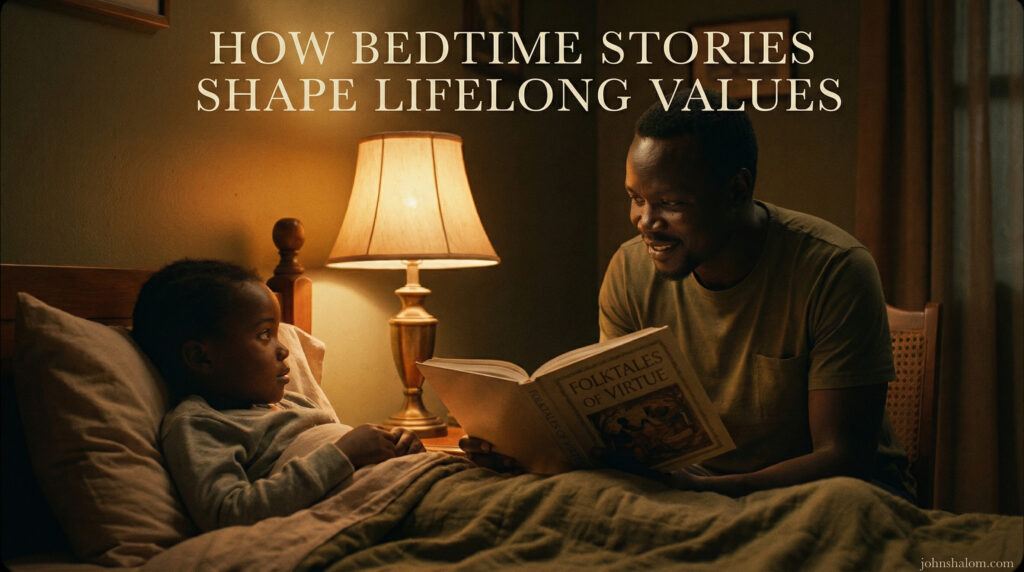
A child who is pulled close and covered with a blanket learns that love makes time. A grandmother who repeats the same story for the tenth time teaches patience and care. A father or mother who tells stories after a long day communicates: “You are worth my last strength.”
As a boy, I remember my mother coming home tired, yet still finding energy to tell us one short story. Her eyes were heavy, her voice sometimes slow, but she kept going. At that age, I mainly enjoyed the plot. As an adult, I see the lesson: real love gives even when tired.
Children do not always remember every line of the story, but they remember the feeling of safety and closeness. That feeling becomes part of their values. They learn that guidance is not only commands and punishments. It is also gentle words before sleep.
3.2 Listening as a hidden value
Bedtime stories also teach children to listen. They learn to wait, to ask questions at the right time, and to follow a chain of events in their minds.
In a world full of noise and distraction, this simple practice trains attention. A child who has learned to listen to a story can later listen to a teacher, a sermon, a friend in pain, or even to God. That ability to listen is itself a value that shapes how they will treat others.
You might also like: Creative Nonfiction Series: What It Is and Its Importance for You
STORIES AS MEMORY BANKS FOR CULTURE AND IDENTITY
4.1 Carrying the tribe inside the tale
Bedtime stories are not only about personal morals. They are also carriers of identity. In many communities, stories hold the history of clans, the meaning of names, the reason certain places are important.
Through stories, children learn:
– Why their people settled near a certain river.
– How their ancestors faced famine, war, or disease.
– What proverbs mean in real life.
– Which behaviors are admired and which bring shame.
These are things a simple government syllabus may never cover. Yet they shape how a child sees themselves: not as a random person, but as part of a long, living story.
4.2 Diaspora and the bedtime bridge
This becomes even more important in diaspora. Children raised far from their parents’ homeland are surrounded by new foods, new languages, and new customs. It is easy for them to feel rootless.
When parents in diaspora tell bedtime stories in the mother tongue, or share village tales in a foreign city, they build a bridge. The child learns that they belong to two worlds. They can navigate the new environment, but they also carry an older story inside them.
A family may live in Canada or Australia, but when a grandfather tells a cattle camp story on a video call, the child suddenly sits under stars above South Sudan in their imagination. That is the power of stories. They move the village into the bedroom.
MY BROTHER’S STORIES AND A QUIET LEGACY
Before my elder brother died in the 1989 Nasir battle, he used to tell me playful stories. He was not a famous storyteller. He did not sit on a special chair or carry a title. He was just an older brother who wanted his younger brother to laugh before sleep.
One night, he created a ridiculous story about a cow that wanted to learn to sing like a bird. The cow went from tree to tree asking for lessons. Every bird tried to teach it, but the mooing never turned into a song. I laughed until I drifted off. At that time, I only enjoyed the silliness.
Looking back, that story and many others carried something deeper. They showed me imagination, kindness, the joy of simple moments. After he died, those memories became part of my values. They taught me that you do not need power or wealth to shape another life. You only need a story and a willing heart.
Every time I remember those nights, I feel again the bond between us. That is another hidden truth of bedtime stories: they keep the voices of the departed alive inside us. Long after the storyteller is gone, the story keeps speaking.
WHY STORIES LAST LONGER THAN LECTURES
6.1 Instruction versus experience
Children often forget lectures, but they rarely forget stories. A teacher may say, “Be honest.” A parent may shout, “Stop lying.” These instructions have their place, but they rarely go deep on their own.
A story, however, allows a child to experience the value. They feel tension when the character faces a choice. They feel relief when the right thing is done, or discomfort when the wrong thing brings trouble. In their mind, they live that choice without suffering its real consequences.
This is why many adults can still recall childhood stories decades later, sometimes with word-for-word detail. The story tapped both heart and imagination, so it stayed.
6.2 Stories and the sleeping mind
There is another quiet factor. Bedtime stories are received just before sleep. The mind carries them into dreams. Children sometimes dream about the characters, retell the story in the morning, or ask for it again.
In this way, the value does not only enter through ears. It is replayed inside the child’s inner world. Over time, it becomes part of how they measure right and wrong, courage and cowardice, generosity and greed.
WHEN STORIES HURT INSTEAD OF HEAL
7.1 The danger of fear-based tales
Not all bedtime stories do good. Some are used to control and scare. Children are threatened with monsters, spirits, or curses if they disobey. This may produce quick obedience, but it can also plant deep fear and shame.
A child who grows up with nothing but fear-based stories may obey outwardly, but inside they carry anxiety and distrust. They may struggle later to see God as loving or elders as gentle.
7.2 Stories that mock or divide
Another danger is when stories mock other tribes, races, or groups. Children laugh, but they also learn contempt. Later, those seeds can grow into discrimination and even violence.
Families must be careful. Stories are powerful. They can heal or harm. The question to ask is simple: after this story, what will my child believe about themselves, about other people, and about God?
BEDTIME STORIES IN A DIGITAL AGE
8.1 Screens versus human voices
Today, many children fall asleep to cartoons, phones, or tablets. Screens tell the stories. Parents are busy, tired, or distracted.
Technology itself is not evil. Good films and audio stories can help when used wisely. But they can never fully replace the human voice in the same room. A screen cannot hug a child. It cannot pause to answer a question. It cannot adjust the story to what the child is feeling that day.
When we hand all storytelling duties to devices, we risk losing something personal. The child may still learn values from media, but they miss the loving face and tone of the storyteller.
8.2 Using new tools without losing the old wisdom
Families can also use modern tools in a helpful way. Audio stories in the mother tongue, recorded by grandparents, can be played for children who live far away. Parents who are not confident readers can use simple story apps to get ideas, then retell the stories in their own words.
The key is not to abandon storytelling to technology. Rather, we can let technology support us while we stay the main storytellers in our children’s lives.
PRACTICAL WAYS TO MAKE BEDTIME STORIES A VALUE SCHOOL
You do not need to be a professional storyteller to shape values at night. You only need willingness and a bit of creativity. Here are some simple ideas.
- Use simple structures
Most good stories follow a simple line:
– There is a person or animal with a problem.
– They face a choice.
– They make a decision.
– There is a clear result and a small lesson.
You can create such stories from your own childhood, from your village, or even from that day’s events.
- Mix real stories with imaginary ones
Children love animal tales, but they also need to hear real stories about their family. Tell them how their grandparents survived hunger, why their parents chose certain paths, how faith helped in hard times. These true stories give weight to the values you want them to hold. - Let children retell and create stories
Ask your child, “Can you tell me the story again in your own words?” or “What story would you tell if you were the elder tonight?” Listening to them helps you see how they are understanding life. It also trains them to become storytellers who will one day pass values to others. - Return to the same stories at new ages
The same story speaks differently at age five, ten, or fifteen. A young child hears adventure. A teenager hears moral struggle. Do not be afraid to repeat the “old” stories. Family legends gain power each time they are told. - End with a gentle question, not a heavy sermon
After a story, you do not need a long lecture. A simple question can open the child’s heart. “What did you like about that story?” or “Who do you want to be like in this tale?” Their answers will show you how the values are landing.
FROM LISTENERS TO STORYTELLERS
Every child who lies under a blanket listening to stories is also a future adult who may one day tell them. Bedtime stories are not only shaping values. They are also training future writers, speakers, parents, leaders, and elders.
As they grow, many will discover that the stories of their own lives are worth sharing. They may write autobiographies, give talks, or simply tell their children what God did for them in difficult seasons.
In a world that loves statues and slogans, personal stories are still one of the most powerful ways to pass truth from one heart to another. Bedtime storytelling is the training ground for that lifelong sharing.
CONCLUSION: ONE MORE STORY BEFORE SLEEP
Bedtime stories look small. One child, one voice, one evening. Yet inside that simple moment, something very large is happening. Values are being planted. Identity is being shaped. Faith is being modeled. Love is being proven.
You do not need a perfect story. You do not need perfect language. You do not even need a book. You need a willing heart, a listening child, and a bit of time before sleep.
Years later, that child may forget the exact words, but they will not forget the way stories made them feel, think, and hope. They will carry those lessons into friendships, marriage, work, citizenship, and even into how they relate to God.
If we truly believe values matter, then bedtime stories are not a small thing. They are one of the first and best schools of the heart.
If you would like to know more about my path as a writer, including the struggles, lessons, and small signs of progress along the way, you can read the full story on my Wealthy Affiliate blog here: https://my.wealthyaffiliate.com/johnmaluth/blog
FAQS
- What makes bedtime stories different from ordinary stories during the day?
A: Bedtime stories come at the end of the day, when a child is calmer and more open. The quiet atmosphere, the closeness to a parent or grandparent, and the nearness of sleep help the story sink deeper. It feels less like a lesson and more like a gift, which makes the values inside easier to accept and remember. - Do bedtime stories still matter if parents are not strong readers or formally educated?
A: Yes. You do not need high education to tell powerful stories. You can share simple memories from your own life, village tales you heard as a child, or short lessons using everyday events. Children do not need perfect grammar. They need real stories told with love and honesty. - Can stories from phones, TV, or books replace family storytelling?
A: They can help, but they should not fully replace human voices. Good media can introduce useful stories, yet it cannot offer personal attention, touch, or two-way conversation. The most powerful values are passed when a real person who loves the child is the one speaking. - How can families in diaspora use bedtime stories to protect culture and identity?
A: They can tell stories in the mother tongue, share village legends, explain the meaning of names, and talk about the history of their people. Even if children answer in another language at first, hearing these stories regularly helps them feel proud of their roots and understand that they belong to more than one place. - What if I did not grow up with bedtime stories myself – can I still start this habit with my children now?
A: Yes. You can begin at any time. Start small with short stories, even once or twice a week. You can learn stories from elders, books, or your own experiences. The important thing is not perfection but presence. The simple act of making time to tell a story before sleep can still shape your children’s values in deep and lasting ways.