TL;DR
Big tournaments like the World Cup and the Olympics make it feel, for a short time, as if the world is one village. I have felt that in South Sudan, in Nairobi, and along the Sobat River, listening to a radio crackling with commentary while a whole compound holds its breath. For a few minutes, people forget tribe, party, and passport.
Yet when the referee blows the final whistle, old divisions quietly return. Sports cannot erase injustice or history, but they create powerful rehearsals of what unity might look like. The real question is whether we leave that spirit in the stadium or carry it back into our homes, politics, and daily decisions.
The Question Behind the Whistle
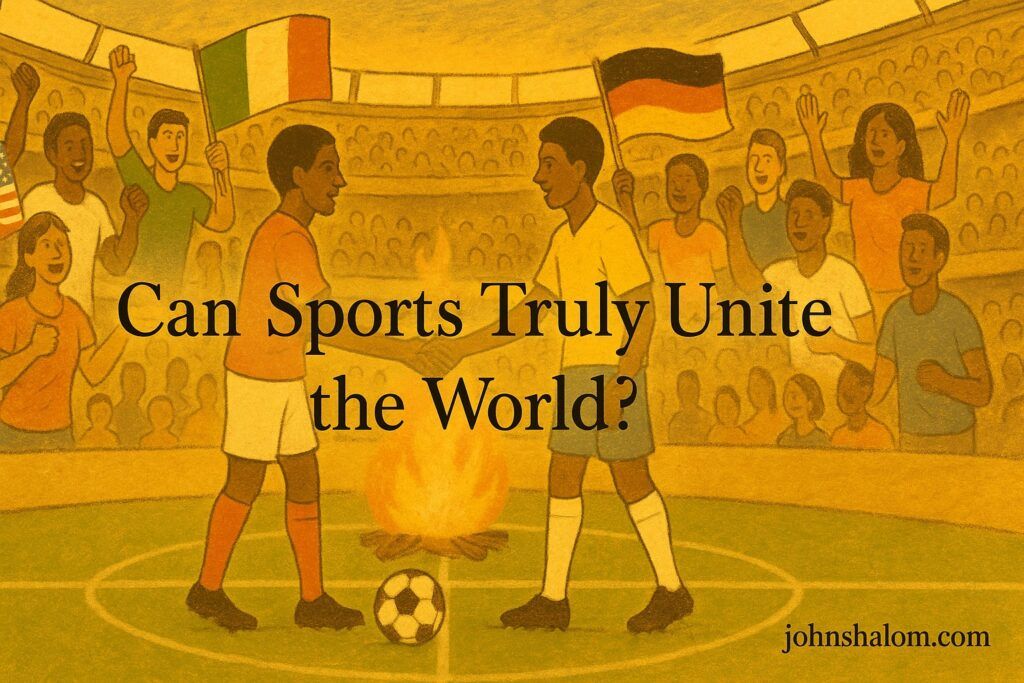
Every few years, billions of eyes turn toward the same ball, the same track, the same finish line. For ninety minutes, or for one race, the world seems to breathe together. Flags from rival countries hang side by side. People shout in different languages at the same moment of triumph or heartbreak.
Growing up along the Sobat River, we did not have satellite TV or big screens. Our “World Cup” often came through a small radio. An entire village would gather around one box. When the commentator’s voice rose, everyone leaned in. For those moments, we were not Nuer or Dinka or this clan or that clan. We were simply people, holding our breath for a goal thousands of kilometers away.
Then the match ended. The radio was turned off, and reality marched back in: cattle disputes, tribal tensions, hunger, political rumors. The question never left me: was that unity real, or just a temporary dream?
The Magic of the Game
Sports have a strange power to ignore human labels. On a football pitch, the ball does not ask your tribe or your bank balance. On a dusty field, a boy with no shoes and a boy with shiny boots chase the same rolling target. In that moment, they are equal. Their feet, lungs, and instincts decide more than their background.
I remember when South Sudan’s basketball team won an international game. I was not in the stadium, but I watched the reaction. People who had spent the previous week arguing about politics suddenly hugged, shouted, and jumped together. For one evening, the phrase “We are all South Sudanese today” sounded true on many lips, even on tongues that usually speak with suspicion.
My own uncle, who often spoke about “other tribes” as if they were rival worlds, found himself saying, “Today we all share this victory.” For me, that line carried more power than the final score. It showed how quickly sports can remind us of a deeper identity beyond our usual divisions.
As a boy, with stones for goalposts and a ball made from plastic bags tied with rope, I learned this magic. Children from families that did not always trust each other would still join the same team. On the field, you needed the boy from the other side if he could run fast or shoot well. You forgot his surname while he was sprinting toward the goal for your side.
That is the power that makes people say, “Sports unite the world.”
The Humor of Rivalries
Sports would be boring without rivalries. Fans argue, tease, and boast. But often, the humor inside these rivalries stops things from turning ugly.
I once watched two men in a tea place argue about whose football team was better. Their voices rose like a small storm. One man listed trophies. The other man listed “heart” and “passion.” It looked like a fight was coming, until one of them shouted, “At least my team owns shoes!” The whole place exploded in laughter. Pride dissolved. The argument turned into jokes about village teams and barefoot players.
I have had my own small rivalries. I remember following a European club on radio and later online. When my team lost, a friend would send a short message, just two words: “Sorry, doctor.” We both laughed, knowing that neither of us owned a single share of that club but we argued as if we did.
This kind of humor is healthy. It allows people to say, “I love my team more than yours,” without needing to punch someone. Laughter steps in where anger might have grown. In that sense, sports rivalries can actually teach us how to disagree without destroying each other.
Sports as a Mirror of the Heart
But sports do not always unite. They also expose what is already in us.
I have seen matches where the same energy that produced joy turned into violence after the final whistle. Fans insulted each other. Old tribal or political grudges appeared behind club colors. Celebrations became riots. The problem was not the ball. The problem was the hearts carrying old wounds into the stadium.
In some places, fans use sports puns to hide serious hatred. A song that starts as a joke about a rival team slowly becomes a weapon against a whole community. Flags that should represent pride in a team start to represent hostility toward neighbors.
Sports are like fire. They can warm a community or burn it down, depending on how people handle them. If a society is already full of unresolved anger and injustices, sports can sometimes add fuel instead of healing.
You might also like: How to Write Your Life Story: A Complete Guide to Autobiography Writing
Even personally, sports can reveal our character. My elder brother, who loved football before he died in the 1989 Nasir battle, insisted on fair play. If we cheated when he was around, he stopped the game. For him, football was not just entertainment. It was a training ground for fairness, patience, and respect.
When he died, I saw another side. Young men who had once gathered for games started gathering for war. The same energy that sprinted after balls now sprinted into battles. The field had lost one of its best referees.
My Brother’s Missed Game
Some of my most tender memories of my brother are linked to football. We did not have proper pitches. Our “stadium” was any clear space between huts. Goalposts were stones, slippers, or sticks. The ball was often handmade.
He would gather us, divide us into teams, and then demand fair play. If he scored from an offside position, he would cancel his own goal. At the time, I found that annoying. I wanted to win, by any means. He wanted the game to be honest.
Looking back now, I see he was teaching us something bigger. He believed that how we played mattered more than the score. That rule is still true for life, for leadership, even for nations. It is not just about whether we win, but about how we treat each other along the way.
Sometimes I imagine a different story. What if the disputes that later pulled him into the 1989 battle had remained on the football field? What if the passion that drove men into war had stayed inside games, with whistles and halftime and handshakes? How many brothers, across many countries, would still be alive if more conflicts were settled with matches instead of guns?
His missed games remind me that sports carry a map of a better world inside them. We just do not always follow that map.
Why Sports Work When They Work
When sports succeed in uniting people, it is usually because they create a shared story with clear rules and equal chances.
The ball does not recognize tribe, race, or religion. The whistle does not favor one language over another. For ninety minutes, everyone agrees to trust the referee, the lines on the field, and the scoreboard. You may not like the result, but you accept that the same rules applied to both sides.
That is a powerful picture of justice. Imagine if politics worked like that. Elections where everyone trusted the referees. Debates where people played by agreed rules. Decisions where leaders “passed the ball” instead of dribbling alone until they lose it.
Sports also work because they allow people to share joy and pain. When a small country beats a giant team, the victory belongs to all citizens, rich and poor. When the team loses in the last minute, everyone feels the same punch in the stomach. Shared emotions build social memory. Years later, people still say, “Do you remember that game?”
In my own philosophy, M = {B, D²}, Being and Doing, sports touch both. They reveal who we are (Being) when we win or lose. They train what we do (Doing) when we pass, defend, lead, or support. The meaning comes not just from the medal, but from the kind of people we become through the training and the games.
Beyond the Whistle
The danger is to leave unity inside the stadium. We allow ourselves to be one people for ninety minutes, then we walk out and pick up our old grudges at the gate, like shoes left at a mosque or church entrance.
True unity begins when we carry the lessons of sports into daily life. Fair play can shape business deals. Respect for rules can shape how we drive, vote, and govern. Teamwork can shape how families handle money and conflict. Joy in shared victory can shape how we celebrate others’ success instead of envying it.
I have seen small examples of this. Community tournaments where teams from rival groups are mixed on purpose. Church or youth events where the “enemy” becomes your teammate. After a few matches, it becomes harder to hate the person who passed you the ball that led to your goal.
If nations practiced politics like a good football team, we would see less hoarding of power and more passing of responsibility. Less playing alone, more working the ball until someone in a better position can score.
Sports alone will not reform corrupt systems. But they can give us clear pictures of how cooperation, discipline, and shared goals look in real time.
So, Can Sports Truly Unite the World?
The honest answer is both yes and no.
No, sports cannot erase history, heal every wound, or solve deep injustices. A country cannot play its way out of bad governance. A World Cup cannot cancel the pain of war or poverty. We should not pretend that a stadium celebration is a peace agreement.
Yes, sports can create real moments of unity, not just illusions. When strangers hug after a goal, when old rivals clap for a good move from the other side, when an entire village holds its breath over a radio, something genuine happens. People remember, even if only for a moment, that they belong to one human family.
Sports can light the torch, but they cannot carry it for us. The flame of unity will die quickly if we leave it in the arena. It must be carried into classrooms, parliaments, markets, and homes. That part is our responsibility.
So the question is less, “Can sports unite the world?” and more, “Will we allow the unity we taste in sports to change how we live when the game is over?”
If you would like to know more about my path as a writer, including the struggles, lessons, and small signs of progress along the way, you can read the full story on my Wealthy Affiliate blog here: https://my.wealthyaffiliate.com/johnmaluth/blog
Reflection Questions
- Have you ever experienced a moment when sports dissolved divisions in your community or nation, even if only for a short time?
- How can humor in sports rivalries help people stay friendly and relaxed instead of turning disagreements into real conflict?
- What lessons from teamwork in sports could leaders apply in politics, church, business, or family life where you live?
- Why do you think the unity people feel during big games often fades so quickly once the final whistle blows?
- If you could design one sport-related event to promote peace between rival groups in your area or country, what would it look like?
FAQS
- Can sports alone bring lasting peace between divided groups or nations?
No. Sports can open doors, build relationships, and create shared joy, but they cannot solve root causes of conflict by themselves. Lasting peace also needs justice, fair systems, honest dialogue, and responsible leadership.
- Why do some sports events lead to violence instead of unity?
Because sports reflect what is already in people’s hearts. If there is deep anger, unfairness, or unresolved pain, the excitement of a match can trigger that pain. Poor policing, alcohol, and hate speech can also turn normal rivalry into fights and riots.
- How can communities use sports to build unity in a practical way?
They can organize mixed-team tournaments, invite different tribes or neighborhoods to play together, set clear rules against insults, and use matches as chances for dialogue and shared meals afterward. Coaches and elders can teach discipline and respect, not only skills.
- What role can parents and teachers play in shaping how children see sports and unity?
They can model good behavior as fans, teach children to respect opponents, praise fair play more than winning, and use stories from sports to talk about teamwork, humility, and perseverance. Children learn quickly whether sports are about pride or about shared joy.
- Does every person need to love sports for sports to help unite societies?
No. Not everyone will be an athlete or a fan. But even those who are not active in sports can support events that bring different groups together, value the lessons sports teach, and encourage fair play and respect in other areas of life, like school, work, and family.
{ “@context”: “https://schema.org”, “@type”: “FAQPage”, “mainEntity”: [ { “@type”: “Question”, “name”: “Can sports alone bring lasting peace between divided groups or nations?”, “acceptedAnswer”: { “@type”: “Answer”, “text”: “No. Sports can open doors, build relationships, and create shared joy, but they cannot solve root causes of conflict by themselves. Lasting peace also needs justice, fair systems, honest dialogue, and responsible leadership.” } }, { “@type”: “Question”, “name”: “Why do some sports events lead to violence instead of unity?”, “acceptedAnswer”: { “@type”: “Answer”, “text”: “Because sports reflect what is already in people’s hearts. If there is deep anger, unfairness, or unresolved pain, the excitement of a match can trigger that pain. Poor policing, alcohol, and hate speech can also turn normal rivalry into fights and riots.” } }, { “@type”: “Question”, “name”: “How can communities use sports to build unity in a practical way?”, “acceptedAnswer”: { “@type”: “Answer”, “text”: “They can organize mixed-team tournaments, invite different tribes or neighborhoods to play together, set clear rules against insults, and use matches as chances for dialogue and shared meals afterward. Coaches and elders can teach discipline and respect, not only skills.” } }, { “@type”: “Question”, “name”: “What role can parents and teachers play in shaping how children see sports and unity?”, “acceptedAnswer”: { “@type”: “Answer”, “text”: “They can model good behavior as fans, teach children to respect opponents, praise fair play more than winning, and use stories from sports to talk about teamwork, humility, and perseverance. Children learn quickly whether sports are about pride or about shared joy.” } }, { “@type”: “Question”, “name”: “Does every person need to love sports for sports to help unite societies?”, “acceptedAnswer”: { “@type”: “Answer”, “text”: “No. Not everyone will be an athlete or a fan. But even those who are not active in sports can support events that bring different groups together, value the lessons sports teach, and encourage fair play and respect in other areas of life, like school, work, and family.” } } ] }