TL; DR
Cattle camps are not only about cows. They are about identity, discipline, responsibility, and shared life. Growing up in a culture shaped by cattle, I saw how young people learned to wake up before sunrise, protect what belonged to the community, and stay awake even when tired because others depended on them.
Modern cities have roads, offices, and flags, yet often lack that same spirit of shared duty. The lessons of the cattle camp are simple and sharp: your freedom is not separate from your responsibility, your wealth is not separate from your neighbor’s survival, and your character matters more than your title. Modern citizenship would look very different if we remembered what the cows already taught us.
Cattle Camps Were Our First Schools
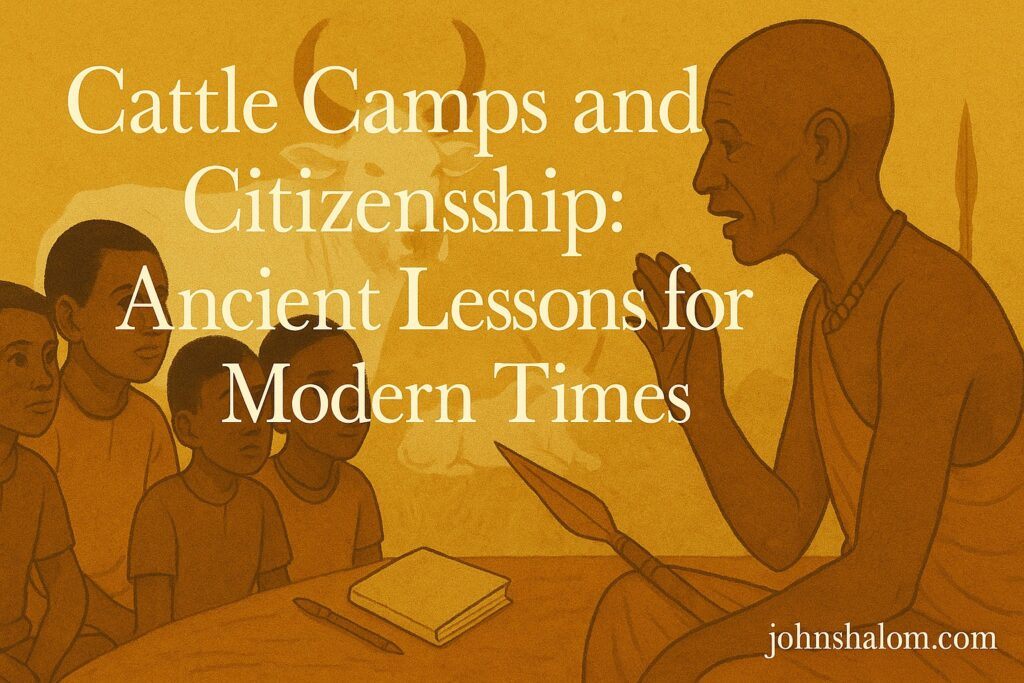
Long before some of us ever saw a classroom, the cattle camp was already a university.
There were no blackboards, but there were stars. No textbooks, but there were elders, songs, and scars. You learned by watching and doing. You learned that a cow is not just meat or wealth. It is history, identity, and relationship.
As a boy along the Sobat corridor, I saw how boys and young men left the comfort of home to live among the cows. Smoke from dung fires kept mosquitoes away. Songs carried through the night. The air smelled of ash, milk, and sweat. To an outsider it might look like chaos. To those inside, it was a school of character.
In the cattle camp, you watched how elders handled disputes, how they divided milk, how they treated the weak cows and the strong ones. You learned courage from those who walked out first when there was a strange sound in the dark. You learned humility when you were corrected for sleeping while others worked.
Modern schools teach reading and writing, and that is important. Cattle camps taught something many graduates struggle with today: how to live as part of a whole.
Responsibility Before Sunrise
In a cattle camp, the day does not wait for your feelings.
You wake up when the cows wake up, not when your body says it is ready. You milk before the sun is high. You drive the herd to pasture. You watch their behavior, check for sickness, keep an eye on the horizon for raiders or wild animals. You may be tired, but your tiredness does not change the needs of the herd.
I remember visiting a cattle camp with my elder brother before he died in the 1989 Nasir battle. He had already spent seasons there. To me, it felt like an adventure. To him, it was serious duty. One night, as others drifted toward sleep, he stayed sitting up, listening to distant sounds. I asked him why he did not rest.
He said, “Cattle camps teach you to stay awake even when you are tired, because others depend on you.”
At the time, I took it as a comment about cows. Today, I hear it as a definition of citizenship. Good citizens stay awake to their responsibilities. They do not say, “Someone else will lock the gate, someone else will pay the tax, someone else will keep the peace.” They understand that their choices can either protect or harm the whole.
A citizen who dumps trash in the river is not different from a herder who leaves the kraal open. Both put everyone at risk. Cattle camp life makes that link visible in a way city life often hides.
Jokes, Songs, And The Glue Of Community
Cattle camps are not only about hard work. There is a lot of laughter.
I still smile when I remember how one boy bragged about his favorite cow. He said the cow was so beautiful that even the moon bent lower at night just to see her. Another teased that his calf had better hair than most girls in the village. We laughed until our ribs hurt.
There were songs to praise cows, songs to mock lazy herders, songs to remember raids and victories. Humour and music made the long nights and early mornings bearable. Jokes softened corrections. A sharp rebuke followed by a funny line could teach more than an angry speech.
This kind of joy is not decoration. It is glue. It holds people together when life is hard.
Modern citizenship needs this too. A nation without humour is like dry grass without rain. Citizens who cannot laugh together will find it harder to work together. Healthy jokes across tribes, regions, and professions can weaken prejudice. Laughter shared between strangers can make them feel like neighbors.
The cattle camp teaches us that community is not built only on duty. It is also built on shared joy.
Shared Burdens, Shared Benefits
One clear rule in the cattle camp: no one survives alone.
If one cow is sick, others are concerned. If raiders are rumored to be near, no family says, “Those are not our cows, we will sleep.” When a storm threatens, everyone helps secure the herd. A boy who tries to ignore others’ problems soon finds his own animals in danger.
In that world, wealth has a social purpose. Cows are counted, not only to measure status, but also to know how many people can be fed, how many marriages can be supported, how many guests can be received during a crisis.
This stands in sharp contrast to some modern attitudes. In many nations, wealth is treated as purely personal. Leaders act like national resources are family inheritance. Citizens treat public property as “no one’s property,” free to damage and loot.
From a cattle camp perspective, this is madness. A stolen cow weakens the whole camp. A stolen public fund weakens the whole country. In both cases, shared protection breaks down.
You might also like: The Ultimate Guide to Political Journalism: Ethics, Challenges, and Impact in the Modern World
The cattle camp whispers a lesson to modern states: shared burdens create shared survival. Shared benefits create shared loyalty. Citizenship fails when everyone grabs for themselves and ignores the herd.
My Brother’s Cattle Camp Days
My elder brother’s years in the cattle camps marked him.
He came home with smoke in his clothes, new scars on his legs, and songs that he sang under his breath while working. More than that, he came back with a certain sharpness in how he saw responsibility.
He would watch how we behaved at home and make quiet comments that came straight from cattle camp logic. If I tried to avoid a task, he would say, “If you sleep when the herd is moving, you will wake up alone.” If I complained that something was not “my job,” he would remind me, “In the cattle camp, the lion does not ask whose cow it is.”
Those small sentences stayed. They followed me out of the villages into towns, into offices, into writing rooms. They whispered to me when I was tempted to say, “This problem is not mine.”
When he died in the 1989 Nasir battle, I felt I had lost not only a brother, but also a guide. Yet the lessons he carried from the cattle camp did not die with him. They became part of how I think about leadership and citizenship today: staying awake, taking responsibility, understanding that my life is tied to others.
From Cattle Ring To Parliament
If you want to know whether a modern state is healthy, sometimes you do not need to look at its skyscrapers. You can look at its habits and ask: do they align more with the selfish man who abandons the herd, or with the herder who watches through the night?
Imagine if politicians thought like cattle camp guards. They would understand that power is not decoration, but duty. They would see the nation as something alive and vulnerable, like cows that need care. They would not feast while the herd wanders near a cliff.
Imagine if citizens treated public institutions the way herders treat their cows. They would see schools, hospitals, and clean water systems as treasures that sustain life. They would not burn them during protests or neglect them during ordinary days. They would fix small problems before they became disasters.
The cattle camp is a picture of a social contract that works. Rules are respected because everyone knows what is at stake. Elders are listened to because they carry real experience. Young people are given responsibility early so they can grow.
Our constitutions and parliaments can benefit from remembering those simple patterns. Development is not only about new things. It is also about old wisdom applied in new settings.
Freedom, Duty, And The Whistle Of The Herd
Cattle camps were not prisons. There was a lot of freedom.
Young people could sing loudly, dance, tease each other, and dream. They watched the stars, told stories, and sometimes stretched their limits just to see what would happen. In that sense, the camp was a place of youth, adventure, and discovery.
Yet, freedom always sat inside duty. You could joke, but when it was time to move the herd, you had to move. You could sing, but if you ignored a crying calf or a limping cow, you would face consequences. Freedom without duty was unthinkable, because the cows did not know or care about your moods.
Our modern talk about rights often forgets this balance. People demand freedom of speech, freedom of movement, and many other freedoms. These are important. But if they are not matched by responsibility, they become noise.
Citizenship is like cattle camp life. Rights matter. So do duties. The herd still needs to be moved, gates still need to be closed, vulnerable ones still need to be protected. If we only talk about what we can do, and never about what we must do, we end up with noise instead of a nation.
The Call For Modern Citizenship
Cattle camps teach a simple but demanding truth: community comes before ego.
A young man who thinks he is too important to watch cows at night soon discovers that his pride cannot protect the herd. A family that refuses to help others in times of danger finds itself alone when its own cows are attacked.
Modern nations face the same test. Roads, offices, and armies may look modern, but without the spirit of shared duty, shared joy, and shared sacrifice, they are fragile.
True citizenship is not just about having a passport, voting in elections, or posting opinions online. It is about carrying one another. It is about staying awake when it is your turn, even if you are tired. It is about knowing that your choices can either open the gate to danger or close it for safety.
For those of us who come from cattle cultures, this is not only theory. We have seen what happens when people are watchful, and we have seen what happens when they are careless. The cows have already preached a long sermon on citizenship. It is time we listened.
If you would like to know more about my path as a writer, including the struggles, lessons, and small signs of progress along the way, you can read the full story on my Wealthy Affiliate blog here: https://my.wealthyaffiliate.com/johnmaluth/blog
Reflection Questions
- Which lessons from cattle camp life do you think apply most directly to citizenship in your town, city, or nation today?
- How have you seen humor, songs, or playful teasing strengthen community, whether in camps, villages, offices, or teams?
- In what ways do modern citizens neglect responsibilities that a cattle herder would never ignore without shame?
- How does my brother’s lesson, “stay awake because others depend on you,” speak to leaders in government, churches, businesses, and families today?
- If your nation were a cattle herd, what role would you choose to play to keep it alive and healthy: watcher, healer, singer, mediator, teacher, or something else?
FAQS
- Why compare cattle camps to modern citizenship?
Because cattle camps show, in a simple and practical way, how shared responsibility, discipline, and community keep everyone alive. Those same principles are needed in modern states, even if the setting looks different.
- Can old cattle camp values really help modern cities with technology and complex systems?
Yes. Technology changes tools, not human nature. Values like responsibility, care for the weak, respect for shared resources, and teamwork are just as necessary in a city office as in a cattle camp.
- Are cattle camps perfect models that we should copy completely?
No. Like any human system, cattle camps also have weaknesses and injustices. The goal is not to romanticize them, but to learn specific lessons about duty, community, and balance between freedom and responsibility.
- How can ordinary citizens practice “cattle camp citizenship” in daily life?
By taking small responsibilities seriously: not littering, paying what is due, helping neighbors in need, reporting wrongdoing, voting wisely, and treating public property as if it belonged to the whole family.
- What can leaders learn from cattle camp herders?
They can learn that leadership is watchfulness and sacrifice, not comfort. A good herder stays alert when others sleep, protects the herd before protecting his own comfort, and understands that his honor is tied to the safety of those he leads.
{ “@context”: “https://schema.org”, “@type”: “FAQPage”, “mainEntity”: [ { “@type”: “Question”, “name”: “Why compare cattle camps to modern citizenship?”, “acceptedAnswer”: { “@type”: “Answer”, “text”: “Because cattle camps show, in a simple and practical way, how shared responsibility, discipline, and community keep everyone alive. Those same principles are needed in modern states, even if the setting looks different.” } }, { “@type”: “Question”, “name”: “Can old cattle camp values really help modern cities with technology and complex systems?”, “acceptedAnswer”: { “@type”: “Answer”, “text”: “Yes. Technology changes tools, not human nature. Values like responsibility, care for the weak, respect for shared resources, and teamwork are just as necessary in a city office as in a cattle camp.” } }, { “@type”: “Question”, “name”: “Are cattle camps perfect models that we should copy completely?”, “acceptedAnswer”: { “@type”: “Answer”, “text”: “No. Like any human system, cattle camps also have weaknesses and injustices. The goal is not to romanticize them, but to learn specific lessons about duty, community, and balance between freedom and responsibility.” } }, { “@type”: “Question”, “name”: “How can ordinary citizens practice “cattle camp citizenship” in daily life?”, “acceptedAnswer”: { “@type”: “Answer”, “text”: “By taking small responsibilities seriously: not littering, paying what is due, helping neighbors in need, reporting wrongdoing, voting wisely, and treating public property as if it belonged to the whole family.” } }, { “@type”: “Question”, “name”: “What can leaders learn from cattle camp herders?”, “acceptedAnswer”: { “@type”: “Answer”, “text”: “They can learn that leadership is watchfulness and sacrifice, not comfort. A good herder stays alert when others sleep, protects the herd before protecting his own comfort, and understands that his honor is tied to the safety of those he leads.” } } ] }