TL;DR
Every election, old wounds wake up. Politicians pull them, communities feel them, and families argue over them. It is easy to turn the ballot into a quiet weapon for revenge. I have seen this in South Sudan and beyond, where people say, “I will vote to punish, not to build.” But revenge at the ballot box is still revenge.
It produces leaders chosen for their anger, not their character. Voting with values is harder and slower, but it gives our children a better inheritance. When we choose justice, honesty, and service over bitterness, we honor those who died for freedom and protect those who are still to come.
Elections Reveal What Lives In Us
Election seasons do something strange to societies.
For months, the air fills with songs, slogans, and bright posters. Faces smile from walls and billboards. Candidates promise new roads, new schools, and new jobs. People wear party colors and attend rallies. On the surface, it is about policies and manifestoes.
Underneath, something deeper often moves. Old resentments return. Old tribal stories are retold. People who have lived peacefully as neighbors start to measure each other by party, flag, and surname. The ballot paper becomes more than a choice of leader. It becomes a quiet battlefield for unfinished anger.
I have watched this pattern repeat. In tea places, people say, “This time we will show them.” At home, relatives whisper, “We must not let that group win.” Many of these statements have less to do with ideas and more to do with wounds.
Voting exposes what lives in our hearts. It shows whether we are guided more by hope or by hurt.
The Temptation Of Vengeance
It is very easy to vote with anger. In fact, revenge often feels like the most natural response when you have faced humiliation, loss, or betrayal.
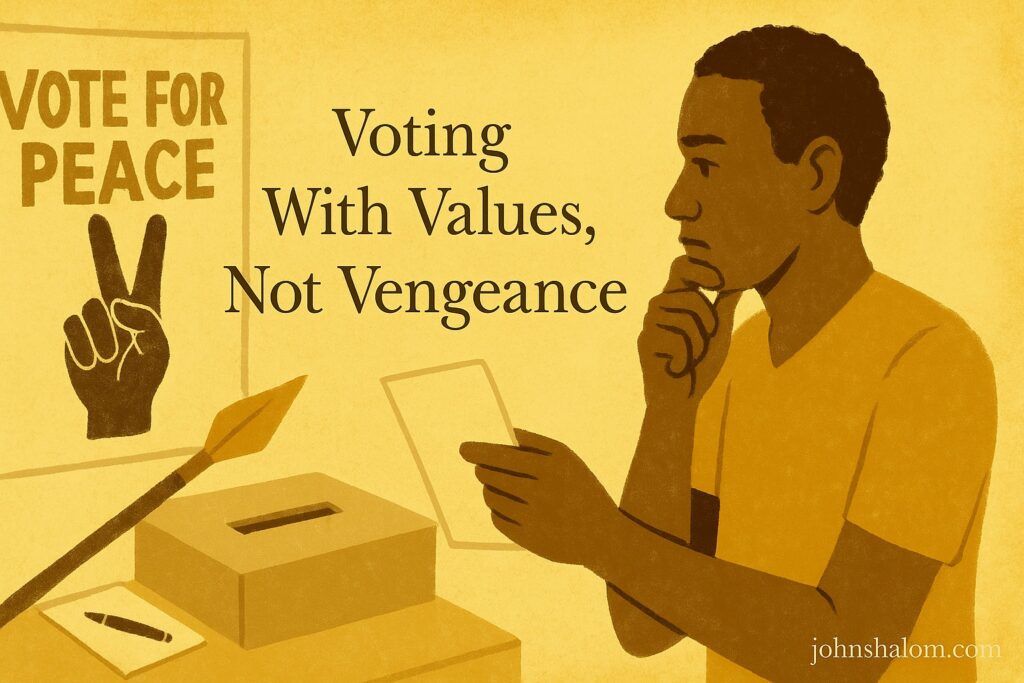
You may think, “That group wronged us, so we will block their candidate.” Or, “That leader insulted us, so we will punish them through the ballot.” It feels like justice without bullets. You do not need to lift a weapon. You only need to lift a pen.
I remember hearing a man boast during one election season, “I do not care if my candidate cannot read, at least he hates the people I hate.” People around him laughed, some clapped. But inside that joke, I heard a warning. When hate becomes the main qualification for leadership, everyone is in danger.
A leader who is chosen for his hatred will not stop with your enemy. Sooner or later, he will turn that same spirit back on you, your children, or your neighbors. Revenge never stays neat. It spills.
Revenge is blind. It does not ask, “Who can build schools and hospitals?” It only asks, “Who can make my enemy suffer?” It does not ask, “What kind of country will this decision create?” It only demands, “Who will bleed?”
Voting with vengeance is like swallowing poison and hoping only your rival will die.
Humor At The Ballot Box
Elections are sometimes so full of theatre that laughter is the only sane response.
I remember one candidate who promised almost everything. Free cows for everyone, free school for every child, free this and free that. One voter raised a hand and asked him, “Do we get the cows before or after you disappear with the money?” The crowd burst into laughter. In one sentence, that man said what many people feared.
Humor can sometimes reveal truth faster than analysis. When people joke about leaders who only appear during campaign season, or who promise the moon but cannot fix a leaking roof, they are exposing a gap between words and reality.
I have also been in homes where family members whispered about voting for “the one who will give us something today” while laughing at their own smallness. Humor becomes a way of admitting that we sometimes sell our future for a quick gift. It hurts less to laugh than to cry.
Used well, humor can puncture the false sense of seriousness around revenge-driven politics. It can help people see the foolishness of choosing leaders only because they insult the “right” enemies.
Values As A Compass
Voting with values means asking different questions.
Instead of, “Who will punish those I dislike?” we ask, “Who will protect justice for everyone, even people I disagree with?” Instead of, “Who belongs to my group?” we ask, “Who can serve the whole country fairly?” Instead of, “Who shouts the loudest?” we ask, “Who has shown responsible behavior when nobody was watching?”
My mother used to say, “Do not marry for revenge, do not vote for revenge.” For her, these two decisions were both about foundations. A marriage built on “I will show them” usually collapses. A country built on “We will show them” does the same.
Values are like a compass. They do not change because the weather changes. For me, core values include honesty, justice, respect for life, and stewardship. When I think about voting, I ask: Does this person respect truth? Do they inflame hatred or calm it? Have they stolen before? How do they treat those who cannot benefit them?
My personal equation M = {B, D²} – Being and Doing – also matters here. Who is this person in their inner life, their Being? What have they consistently done over time, their Doing? Meaningful leadership requires both.
Voting with values may not give us perfect candidates. It does help us avoid the worst ones.
My Brother’s Sacrifice And The Ballot
When my elder brother Biel died in the 1989 Nasir battle, I did not yet know how elections or constitutions worked. I only knew that young men were dying, and families were crying.
As I grew older and understood more about politics, I started asking what his death was really for. He was not fighting for one tribe to dominate another. He was not dying so that future elections could become ethnic score-settling contests. He and many others believed they were fighting for dignity, freedom, and a chance at better life for ordinary people.
If, after such sacrifices, we turn elections into weapons of revenge, we dishonor that blood. We build pyramids of new graves on top of old ones. We turn “freedom” into a word that has no connection to how we actually choose our leaders.
You might also like: The Ultimate Guide to Political Journalism: Ethics, Challenges, and Impact in the Modern World
Honoring the fallen means more than building monuments. It means refusing to use their names to justify hatred. It means voting in a way that protects life, not endangers it; that heals divisions, not deepens them.
Sometimes I imagine standing at my brother’s grave on an election day and asking myself, “Would he understand the person I am voting for? Would he say this vote continues the struggle for dignity, or turns it into a tribal championship?” Those questions are hard, but they keep my heart honest.
Planting Thorns Or Planting Trees
Voting with vengeance is like planting thorns.
You may feel satisfied when your rival steps on them and bleeds. You may cheer when a hated politician loses his seat. But thorns do not choose their victims. Sooner or later, you and your children will walk on that same ground. The pain comes back around.
Voting with values is like planting fruit trees. You may not eat the fruit tomorrow. The harvest takes time. Sometimes you will need to protect the young tree, water it, and be patient while it grows. But one day, children who did not even see the planting will rest in its shade.
Nations that vote with vengeance inherit cycles of blame. Every election becomes a chance to “fix” the last insult. Nations that vote with values inherit a different legacy. Their conflicts do not disappear, but they have a better base to solve them.
The question is not whether they have problems. The question is whether they keep adding poison to the soil or plant something that can feed the future.
The Responsibility Of Youth
Youth carry a special responsibility in this area.
Many elders are trapped in long histories of pain. They remember raids, killings, betrayals, and broken promises. Their hearts are heavy, their stories soaked with loss. It is very hard for them to hear words like “forgiveness” or “new beginning” without feeling their wounds burn.
Young people stand closer to the future than to the past. They know the stories, but they were not the ones who pulled the triggers decades ago. They are the ones who will live with the results of today’s votes.
I have seen young people repeat the grudges of their elders without asking questions. I have also seen youth bravely step out of that pattern. Instead of saying, “I will vote to punish,” they say, “I will vote to build.” They insist on asking candidates about policies, not just about tribal alliances. They challenge hate speech online and in person.
When youth choose values over vengeance, they change the direction of a nation quietly but powerfully. They may not control the whole system, but they control their own conscience.
If you are young, your vote is not just ink on paper. It is a small piece of the story your generation will tell your children.
A Personal Way Forward
For me, as a writer and a pro-humanity voice, voting is part of my larger calling. I do not want my books, articles, and speeches to say one thing while my ballot says another.
I have faced threats because of what I write. I know what it feels like to be tempted to support “strong” leaders who promise to crush those who disagree with me. That temptation is real.
But I also remember my childhood along the Sobat River. I remember hunger, displacement, and the funerals of those who died in conflicts that never needed to happen. I remember my brother’s face. I cannot, in good faith, promote more cycles of revenge.
So I ask myself before any vote: Will this choice move us, even slightly, toward a country where human life is more protected, where the weak are less exploited, where justice is taken more seriously? If the answer is no, then my conscience cannot be at peace, even if my tribe celebrates.
Voting with values is not about perfection. It is about direction. It is about asking whether my decision gives vengeance more oxygen or gives hope a little more space to breathe.
If you would like to know more about my path as a writer, including the struggles, lessons, and small signs of progress along the way, you can read the full story on my Wealthy Affiliate blog here: https://my.wealthyaffiliate.com/johnmaluth/blog
Reflection Questions
- What examples have you personally seen where communities voted with vengeance instead of values, and what were the results?
- How can humor, jokes, and stories help expose the foolishness of revenge-driven politics without causing more hatred?
- If you want your children or grandchildren to inherit a stronger nation, which specific values should guide your vote: honesty, justice, peace, competence, or something else?
- How can youth in your community resist being trapped by the political grudges of older generations while still respecting elders?
- If you had to sit down one day and explain to your grandchildren why you voted the way you did, would you be proud of the values you followed, or ashamed of the vengeance you carried?
FAQS
- Why is voting with vengeance so dangerous for a country?
Because it chooses leaders based on anger, not ability. Leaders chosen for their hatred are likely to fuel more division, weaken institutions, and ignore real problems. Revenge-based voting keeps a country trapped in old conflicts instead of solving present challenges.
- Does voting with values mean ignoring injustice and forgetting past wrongs?
No. Voting with values takes injustice seriously. It looks for leaders who will address wrongs through fair laws, truth-telling, and real reform, instead of simply shifting power from one angry group to another. It honors the past without allowing it to control the future.
- How can I discover my own values before voting?
Take time to write down what matters most to you: honesty, peace, fairness, respect for life, service to the poor, or something similar. Then compare candidates’ actions and records to those values, not just their words. Discuss with trusted people who think carefully, not only those who shout loudly.
- What role can youth play in changing revenge-based politics?
Youth can ask harder questions, refuse to spread hate online, support candidates on merit rather than tribe, and encourage friends to think long term. By voting to build rather than to punish, they can slowly change expectations about what leadership should look like.
- What if no candidate fully matches my values?
No human leader will be perfect. In such cases, choose the one who comes closest to your core values and who is least likely to harm the vulnerable or inflame hatred. You can also stay involved after elections by holding leaders accountable, supporting good policies, and continuing to speak for values in your community.