TL; DR:
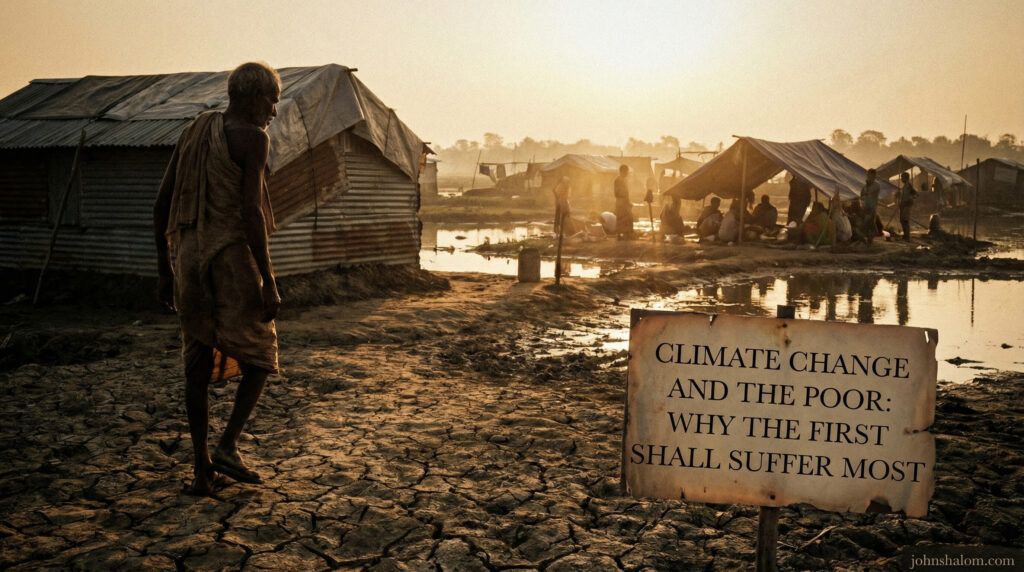
Climate change is not a theory for the poor. It is rising water in kitchens, cracking soil under bare feet, hungry children staring at empty plates, and animals dying in the dust. The people who contribute the least to global warming are the first to lose their crops, homes, and health because they have no savings, no insurance, and nowhere safe to run.
They survive through resilience, community, and humor, but resilience without support cannot carry this growing burden forever. If the world is serious about justice, climate action must put poor communities at the center, not at the edge of the discussion. Their wisdom, voices, and survival strategies are part of the solution, not side stories to the problem.
When Weather Was a Calendar, Not a Threat
1.1 Seasons you could trust
When I was young, the sky behaved like a reliable elder. You could almost read time in the clouds. We knew which month the rains would begin, when the river would quietly rise, and when it was safe to plant. Families did not need weather apps. They had memory, stories, and repeated patterns. The land spoke a steady language.
Along the Sobat River, life moved to that rhythm. When the first dark clouds gathered, people prepared seeds. When the water rose, fishermen got their nets ready. When the dry season came, people planned their movements, grazing, and journeys. The weather was not always gentle, but at least it followed certain rules. You could plan your future with a pencil that did not shake as much.
1.2 When the sky started to misbehave
Today, that sky feels confused. Rain falls when it used to rest. Heat arrives when crops need cool nights. Floods come without warning, and droughts stay longer than guests should.
I remember visiting a village after heavy rains. Roads had turned into rivers, and children were paddling in cut jerricans, laughing as if it was a holiday. But behind that laughter, their parents stood silently beside collapsed huts and destroyed fields. For them, climate change was not a global debate. It was supper, swept away by muddy water.
This is what climate change looks like for poor communities. Not graphs, but ruined harvests. Not long reports, but missing meals. Not only rising temperatures, but rising stress and fear.
Why the Poor Stand on the Frontline
2.1 No backup plan, no second chance
The poor do not have spare options. When a storm destroys a rich person’s home, they move to a hotel, call the insurance company, or stay with relatives in a safer city. When a storm destroys a poor person’s home, they move to a relative’s floor, a church compound, or a camp, with no clear road back.
When drought hits, wealthy families buy water, import food, or move to cooler places. Poor families stand and watch their last goat stumble and collapse in the dust. They feel every degree of heat directly on their skin, every failed rain directly on their plates.
Climate change punishes those with the least safety net. It is like a flood that first enters the lowest houses.
You might also like: The Ultimate Guide to Political Journalism: Ethics, Challenges, and Impact in the Modern World
2.2 Everyday signs of unfair suffering
For the poor, climate change shows up in small, painful details:
- A mother walking farther each year to find clean water.
- A father who now plants three times in one season because rain keeps coming and going.
- A child who misses school to help move cattle from flooded ground to dry land.
- Old people sitting on higher ground watching the fields vanish under water.
Rich countries discuss degrees and targets. Poor families count lost chickens, lost maize, and lost days of school. Both are real, but only one group has room to absorb repeated loss.
Humor Under a Burning Sky
3.1 Laughing so you do not break
In many poor communities, humor refuses to die, even when crops do. I once heard a man joke during a drought, “We do not need to wash clothes. The sun has already ironed them on our backs.” People laughed, although their stomachs were nearly empty. That laughter was not entertainment. It was survival.
Wealthy nations organize climate conferences with microphones and air conditioning. Poor villagers organize climate meetings under mango trees with jokes and shared sorrows. Both are responses to the same crisis, but only one comes with laughter strong enough to help people wake up and try again tomorrow.
3.2 Humor as a quiet protest
Humor in hardship is a kind of protest. It says, “You can stretch our limits, but you will not break our soul.” When someone makes a light comment in a heavy situation, they are not denying reality. They are refusing to let despair have the final word.
I have heard refugees joke about the quality of camp porridge, farmers laugh about fields that can now host fish instead of sorghum, and mothers tease their children about swimming skills in flooded compounds. These jokes are not cruel. They are a way of saying, “We are more than victims. We are still human.”
Wisdom Without Resources
4.1 The creativity of the poor
It is a mistake to think poor communities are helpless. Their daily life is full of adaptation:
- Raising houses on small mounds to escape floodwater.
- Planting different crops, hoping at least one will survive.
- Drying food in good seasons to save for bad ones.
- Sharing animals and seeds among relatives to spread risk.
I have seen broken jerricans turned into boats, torn mosquito nets turned into sieves, and old cloth turned into shade for seedlings. This is not laziness. It is creativity under pressure.
4.2 My mother’s moringa lesson
In the 1990s, when water sources were dirty and safe options were limited, my mother used moringa seeds to clean our drinking water. She would crush the seeds, stir them into the muddy liquid, and leave it to settle. Somehow, the dirt would gather and sink. The top became clearer, almost drinkable. That was climate adaptation at its simplest.
No foreign expert came to teach her. No donor funded that lesson. It was passed down through experience and survival instincts. That small act kept us alive many times.
This is what I mean by wisdom without resources. The poor often know what to do, but lack the tools to do it safely at a larger scale. Wisdom without support is like a doctor without medicine. Knowledge is present, but the power to apply it fully is missing.
4.3 The limits of resilience
Resilience is a beautiful word when used from a distance. Up close, it looks like a tired woman walking through water with a child on her back and a jerrican on her head. It looks like a man who plants and loses crops three years in a row but shows up again with seeds in his hands.
There is a dangerous temptation to praise the resilience of the poor while doing little to lighten their load. Yes, they are strong. Yes, they know how to improvise. But climate change is turning survival into an extreme sport, and the poor are running barefoot while others cheer from the stands.
Global Injustice: Paying for a Feast You Never Attended
5.1 Those who burn, those who burn out
The greatest injustice of climate change is simple. The people who contributed least to the problem are paying the highest price.
They did not build the factories that fill the air with smoke. They do not own the large ships, planes, and endless cars that pump carbon into the sky. Many of them have never turned on an air conditioner in their lives. Yet when storms, floods, and droughts strike, it is their houses, their cattle, and their children’s futures that are swept away first.
It is like being punished for a feast you were never invited to. Others ate the meat. The poor wash the dirty plates.
5.2 Invisible suffering
When a rich city floods, the images go viral. Drones fly. Reports are written. Donations flow. When a remote village loses its fields to unusual rain or heat, hardly anyone outside notices.
A child from such a village may grow up thinking, “Maybe this is just bad luck.” But it is not just luck. It is a global system of fuel, profit, and consumption that has been allowed to damage the sky we all share.
What the World Can Learn From the Poor
6.1 Repair instead of replace
Poor communities know how to make things last. They repair clothes, mend shoes, patch walls, and reuse containers. Nothing is wasted if it can be fixed.
Wealthy societies often throw away and buy new, which quietly feeds the climate crisis by demanding more production and more waste. If the world adopted even a small part of the repair culture of the poor, we would reduce pressure on the planet.
6.2 Sharing instead of hoarding
In many villages, if one family has food and the next does not, sharing is expected. It may not be perfect, but it is common. Survival is a community project.
In richer settings, people may live alone with full fridges while someone a few streets away goes hungry. The poor understand something simple: when crisis hits, the only lasting security is shared security. The planet needs that lesson.
6.3 Faith and storytelling as strength
Stories, songs, and faith practices are powerful survival tools. They keep hope alive when facts look terrible. They remind people that they are part of a larger story, not just random victims in a cruel storm.
Major climate discussions often focus on money and technology, which are important. But they sometimes ignore this spiritual and cultural strength. If we want climate solutions that last, they must speak to hearts, not only to budgets.
Toward Fair Climate Solutions
7.1 Listening to those under the flood
If climate conversations continue without the real voices of the poor, solutions will remain shallow. We cannot design all plans in air conditioned halls and only test them in flooded villages.
Poor communities should be:
- Consulted before projects begin.
- Included in decisions about land use, relocation, and new technology.
- Respected for their local knowledge of weather patterns and survival strategies.
Listening is cheaper than rebuilding failed projects. It is also a matter of dignity.
7.2 Real investment, not polite promises
Adaptation costs money. You cannot build strong dykes, move whole communities away from rising waters, or create proper irrigation systems with kind words alone.
If rich nations have gained prosperity through activities that harmed the climate, then part of their responsibility is to fund adaptation and recovery in places now suffering the consequences. That is not charity. It is a kind of repayment.
7.3 Local ownership instead of imported dreams
Even when money comes, it must not arrive as a finished foreign dream. Projects work best when communities help design them, understand them, and own them.
A simple, well maintained local system often does more good than a complex imported structure that breaks after the first year because no one nearby knows how to repair it.
7.4 The role of faith communities and storytellers
Faith groups, writers, and local leaders can help connect climate action with daily life. They can link Scripture, ethics, and hope with very practical messages:
- Conserving trees as an act of respect for creation.
- Sharing resources as obedience to the command to love neighbours.
- Speaking truth about corruption in climate funds as a matter of justice.
Stories and sermons that connect heaven and soil can move people more than dry reports.
The Role of Humor in Hope
8.1 Laughing without denying pain
I believe humor will remain one of the strongest tools in this struggle. You can lose crops, cows, and shelters, but if laughter remains, dignity remains.
I have seen families sharing jokes while seated on flooded rooftops, watching their compound become a temporary lake. That kind of humor is not foolishness. It is defiance. It says, “You may flood our land, but you will not flood our spirit.”
8.2 What else can survive the flood
If laughter can survive, what else can survive?
- Solidarity can survive, when people help each other move to higher ground.
- Faith can survive, when families still pray under trees after losing houses.
- learning can survive, when children still attend makeshift classes under tarpaulins.
- Courage can survive, when farmers plant again on land that betrayed them last year.
Climate change is real and harsh. But it does not have the right to erase everything. Some things can and must outlast the storms.
If you would like to know more about my path as a writer, including the struggles, lessons, and small signs of progress along the way, you can read the full story on my Wealthy Affiliate blog here: https://my.wealthyaffiliate.com/johnmaluth/blog
Reflection Questions
- Why do you think the poor are hit hardest by climate change, even though they contribute least to it?
- What lessons of resilience can wealthy nations learn from poor communities already coping with crisis?
- How have humor and storytelling helped your community survive difficult times?
- What practical steps could ensure that poor communities are included in climate solutions instead of only being victims of decisions?
- If laughter can survive floods and droughts, what other strengths might humanity be able to carry through crisis?
FAQS
- Why are poor communities more vulnerable to climate change than rich ones?
A: Poor communities often live in riskier areas, such as flood plains or drylands, because safer locations are too expensive. They rely heavily on natural resources for survival and have limited savings, weak infrastructure, and little access to insurance or credit. When disaster strikes, they have almost no cushion to recover, so the impact is deeper and lasts longer. - How does climate change affect daily life for the poor in practical terms?
A: It shows up as lost harvests, dead livestock, damaged homes, longer walks for water, more disease, and children missing school to help families cope. What may look like a slight change in rainfall on a chart becomes empty plates at dinner, lost income, and rising conflict over scarce resources. - What can wealthy nations do that truly helps, beyond speeches and promises?
A: They can reduce their own emissions seriously, fund climate adaptation and recovery in poorer countries, cancel or restructure unjust debts that block investment in resilience, and support locally led projects instead of imposing outside designs. They should also make room for leaders from vulnerable communities at negotiation tables, not only as guests but as decision makers. - How can ordinary people, not just governments, stand with the poor in this crisis?
A: Individuals can change consumption habits, support organizations that work directly with vulnerable communities, share accurate information, and use their voices to pressure leaders for fair climate policies. They can also listen to stories from affected areas and refuse to treat climate change as a distant issue happening “somewhere else.” - Is resilience alone enough for the poor to survive climate change?
A: No. Resilience is important, but it has limits. The poor cannot be expected to endlessly adapt to a problem they did not create, without proper support. Their strength and creativity must be matched by justice, resources, and fair policies. Survival should not depend only on how much hardship one can endure.