
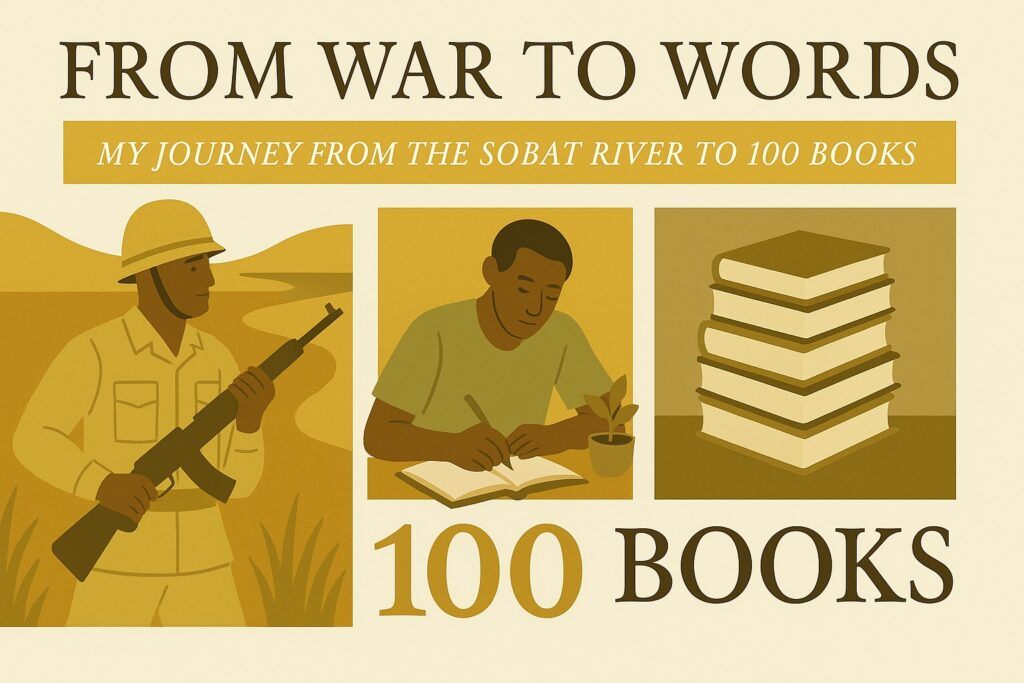
TL;DR:
From war’s chaos to a writer’s calm, my story traces how pain became purpose and how a boy by the Sobat River found his voice in words.
I was born in Dhuoreding Village, northwest of Kuany Lual Thoan, a place of deep history and layered meaning in what is now Upper Nile State, South Sudan. Long before the wars and borders, this land carried stories older than memory.
Historically, the Funj people lived along these areas. After them came the Anuak, then the Ngok section led by a warrior named Lual Yak. When Lual arrived, he found a small cat-like animal called Dhok in Dinka. The animal could be killed and eaten by humans, so the place was named Kuany Lual Dhok—meaning “Lual found Dhok there.”
Later, when the Jikany Nuer section led by their warrior Latjor Diyian came and dominated the area east of the current Ngokland, they absorbed the remaining Ngok Dinka people who lived there. In Nuer, the same animal is called Thoan, and so the name became Kuany Lual Thoan.
The word kuany in both Dinka and Nuer means “to find something lost or ownerless.” When the Arabs later arrived, they renamed the place Nasir, which they said meant “victory.” I’ve often wondered whose victory it was, and over whom.
The British and others adopted that Arabic name, and that’s how the town is still known today. But to those who trace their roots to this soil, the true and meaningful name remains Kuany Lual Thoan or Kuany Lual Dhok.
FAQs: From War to Words: My Journey from the Sobat River to 100 Books
1. What inspired this journey from war to writing?
A life marked by conflict and loss became fuel for hope. Writing became my way to heal, remember, and empower others.
2. Why is the Sobat River significant in this story?
It’s where my story began—amid hardship and resilience. The river symbolizes both struggle and the flow of inspiration that carried me forward.
3. How did you manage to write 100 books?
Through discipline, purpose, and faith. Each book was built one page at a time, turning pain into passion and experience into wisdom.
4. What message do these 100 books carry?
That meaning arises from both being and doing—our lives find purpose when we act with integrity, courage, and compassion.
5. What do you hope readers take from your journey?
That no wound is wasted. Every life can turn trials into testimonies if we choose to write our truth and share it with the world.
My father, Maluth Abiel, also called Tut Lew around Ulang, and my mother, Nyareth Deng from Chiengbidiit of Chieng-nyathol, raised nine children together. I was the ninth. The first six died of natural causes. Among them were my brothers Gatluak, Chamtuak, and Tungkuach, and my sisters Nyater, Nyakor, and Nyawuor. My seventh brother, Biel—also known as Abiel in Dinka—was killed in the 1989 Nasir battle while fighting for the liberation of our land. My eighth sibling, my sister Nyakueth, died in 1998 in Medeni, Sudan. I am the only surviving child.
Loss was my first classroom. I learned early that life could be both sacred and cruel. My mother taught me survival through simple acts, like purifying dirty water with moringa seeds. My father taught me integrity. He often said, “A man’s word must weigh more than his fear.” And he lived by that, even when life gave him every reason to give up.
We moved many times across the Sobat region—Mayom near Matar along Gay Stream, to Torkiel in 1986, then Lual (Nyangore) in 1987, and Wijin in 1990, where I first learned to read and write in Nuer. I still remember scratching letters in the dust with a stick while my parents looked on. That was the start of my love affair with learning.
In 1993, when fighting erupted between the Lou and Jikany Nuer, we moved again, from Ulang to Torbaar. Along the way, I learned the English alphabet in Yuomding Village beside the Sobat River. I can still hear the sound of frogs croaking as I traced letters on the ground and whispered them out loud. Education was my escape from the chaos around me.
In 1994, we returned to Paduay, then to Kotwithe and Tiaybuok, still fleeing conflict. By 2000, we finally settled in Ngokland, now Baliet County. Back then, it was known as Sobat County. That constant movement became my teacher. It shaped my resilience and planted in me the seed of storytelling.
Between 2001 and 2010, I studied whatever I could find in a war-torn Sudan. I took courses in Theology, Medical Studies, and Governance. I learned in classrooms, under trees, and in church halls, wherever knowledge could be found. In 2012, I earned my Bachelor’s degree in Theology from Emmanuel Christian Center, now Emmanuel University in Yei, through correspondence with the South African Theological Seminary. That achievement felt like defying gravity.
During my studies, I discovered my second passion—technology. Writing with a computer felt like freedom. I realized I could reach people far beyond my village. But my first real writing started in 2002 on UNICEF-donated paper in Magang (Malual Ding Village) in Ngokland. I wrote with whatever I had, sometimes using borrowed pens. Those pages became the first seeds of a journey I didn’t yet understand.
In 2012, I published my first autobiography through Amazon and CreateSpace. At that time, CreateSpace handled paperbacks while Kindle Direct Publishing specialized in eBooks. The internet was slow, the power unreliable, but my determination never flickered. From 2012 to 2024, I wrote and independently published 100 books. Some were typed under candlelight. Others were finished on a borrowed laptop with a fading battery. Every page was a prayer in disguise.
People often ask me, “John, how did you manage to write 100 books while living in South Sudan?” My answer is simple: one word at a time. Writing became my therapy, my act of faith, and my form of protest against despair. I wrote when I was hungry, when I was tired, and when I felt forgotten. I kept going because stories were my only form of hope.
In April 2025, I began contributing to The DAWN Daily Newspaper in Juba as a political opinion writer and commentator. My mission was, and still is, to inform, instruct, and inspire. I write to awaken purpose in those who believe their stories don’t matter. Because I know firsthand—they do.
From my life experience, I developed a philosophy I now live by: M = {B, D²}, which means Meaning = Being + Doing squared. Being is knowing who you are, your identity beyond tribe or nationality. Doing squared is multiplying your actions until they shape your destiny. When identity and action align, life produces meaning.
That belief guides everything I do. I see nations as individuals in larger form. When individuals lose purpose, families weaken. When families weaken, societies crumble. When societies crumble, nations fall apart. That’s why I begin with the individual. I help people rediscover faith, discipline, and purpose so they can build stronger families, tribes, and nations—and ultimately, a more humane world.
Faith has been my foundation. Faith without action is just a wish. I learned that the hard way. If I had waited for perfect conditions—stable power, reliable internet, or a quiet space—I would still be waiting. I wrote when the lights went out. I typed while the generator coughed its last. I uploaded manuscripts in internet cafés that smelled like dust and sweat. But I kept going, because once you understand your “why,” the “how” stops being an excuse.
When I joined Wealthy Affiliate, I found a global community that shared that same spirit. People learning, building, and creating from every corner of the world. It reminded me that knowledge is the new wealth, and persistence is the real capital. The internet, I realized, isn’t just a tool—it’s a bridge connecting dreams to opportunity.
I often think of those early days beside the Sobat River. I could barely spell my name then. Today, I build websites, teach others, and write books that reach people far beyond my homeland. That’s not magic—it’s perseverance. If someone like me, who began with UNICEF paper and no electricity, can do this, then you can too. Your beginning doesn’t define your limit. It defines your direction.
Writing 100 books didn’t happen because I had time. It happened because I made time. There were failures, rejections, and moments of silence. But I learned that consistency defeats doubt. Purpose grows stronger with every act of courage.
My books have connected me to readers across continents. Some write to say a story changed their perspective or gave them hope. That’s when I knew my purpose was working. Words travel faster than bullets and build stronger than walls. They heal what war tries to destroy.
To anyone reading this, whether you are a writer, blogger, or entrepreneur, remember this: you already have what it takes to begin. You don’t need perfect grammar or the latest laptop. You need faith, focus, and action. Every great story begins with one sentence. Every website begins with one post. Every dream begins with one step.
Many people at Wealthy Affiliate ask if their work matters. It does. Every blog post, every keyword, every small win—it all builds momentum. You may not see results right away, but the quiet effort you make today will echo tomorrow. Progress is silent before it sings.
If I could write 100 books in a country rising from war, you can build your dream from wherever you are. You can write 200, even 300 books if you keep showing up. The real miracle is not the number—it’s the journey.
As an old African proverb says, “No matter how long the night, the sun will rise.” I am proof of that. Your sunrise is coming, but you must keep walking toward it.
Keep believing. Keep building. Keep writing your story.
Because meaning is not found—it is made.


Hi John, your story about South Sudan is both humbling and inspiring. I really admire how you transformed pain into purpose—your voice through writing is a powerful reminder that resilience and meaning can grow even in the harshest conditions. I feel lucky to have come across someone from South Sudan here on WA—especially since I’m originally from North Sudan myself. It’s my first time connecting with someone from back home on this platform. I’ve just started my journey with WA, and I’ll admit—staying consistent can be tough with life’s many responsibilities. Your journey gives me hope. Any advice on how you kept going in the early days when things felt slow?
Thank you, Mohamed. It’s truly an honor to meet a brother from the North here on WA. Your words mean a lot to me. In the early days, staying consistent was hard too, especially when life felt heavier than hope. What helped me was remembering why I started to turn my pain into something useful. I wrote a few words every day, even when they made no sense. Small steps add up if you don’t stop walking. As we say in Africa, the sun does not forget a village just because it rises elsewhere.
John
Wonderful John, you have the art of transforming pain into a mission, and words into bridges.
Your testimony is a map of resilience, an embodied philosophy, and a universal invitation to create and move forward despite everything.
What to remember from this journey:
• the origin is not a limit
• writing as therapy, faith and protest
• consistency as courage
• technology as a bridge because from Wealthy Affiliate to Amazon, the Internet becomes a lever of emancipation, connection and transmission.
• the philosophy of meaning through the formula: M = {B, D²} — Being + Doing squared
• the call to all creators. We don’t need perfect tools, we just need faith, concentration and action.
Your post is a life guide for writers, bloggers, entrepreneurs and silent dreamers.
Lanicheduclip, your comment touched me deeply. You captured exactly what I hoped readers would feel, that pain can be turned into purpose and words can become bridges. I like how you summarized the key lessons, especially the idea that “the origin is not a limit.” That line alone speaks to so many people who are still trapped by where they began.
Your reflection on technology as a bridge also stands out. It’s amazing how tools like Wealthy Affiliate and Amazon can turn personal stories into global messages. I believe the real transformation happens when faith meets consistency, as you beautifully noted.
Which part of this journey, the inner healing, the digital growth, or the creative persistence, resonated most with your own story?
John