TL; DR
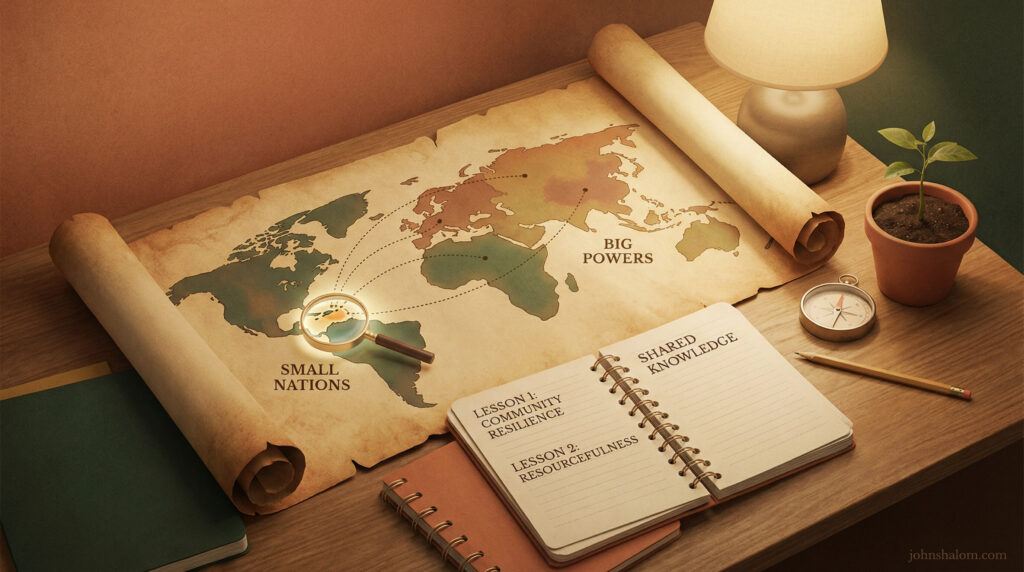
This article explains how small nations, often ignored in global debates, quietly carry lessons that big powers need. Through war, famine, pandemics, climate shocks, and economic crises, small countries are forced to innovate with limited resources, build community resilience, and balance survival with dignity. Their stories show what happens when policy meets real hunger, real displacement, and real fear. Instead of seeing them only as victims or aid receivers, the article invites the world to treat small nations as teachers of humility, flexibility, social cohesion, and moral courage in times of global crisis.
When I was younger, I believed only big nations had anything to teach the world. They had skyscrapers, airports, advanced armies, famous universities, and movies on every screen. Small nations like mine felt like the children of the global village. We were expected to sit quietly, listen, receive aid, and say thank you. The teachers were in Washington, Beijing, London, or Brussels. We, down here, were the students.
But life has a way of correcting our assumptions. War, famine, displacement, disease, and economic shocks do not knock only on big doors. They visit small huts first. Over time, I began to see something surprising. The very countries most people pity are often the ones carrying some of the world’s deepest wisdom about survival, dignity, and community.
Small Nations As Small Boats In Big Storms
Imagine the world as an ocean. Big powers are huge ships with many decks and strong engines. Small nations are small boats. When storms come, the big ships feel the waves, but the small boats feel every drop. They have no choice but to learn fast. A mistake that a large country can absorb for ten years can break a small nation in one season.
Because of that, people in smaller countries learn how to bend without breaking. They learn how to stretch food, how to rebuild after a flood or a civil war, how to keep children in school when schools are destroyed, and how to keep singing when everything looks lost. That kind of learning cannot be bought. It is carved into the soul.
I think of South Sudan here. In the midst of war, hunger, and repeated displacement, I have seen people still share food, still dance in dust, still laugh in crowded camps. To an outsider, this might look like denial. To me, it is a masterclass in endurance, taught by people who never asked to become teachers but became them anyway.
Humor In Hardship
If you want to see the courage of a small nation, do not start with its army. Start with its jokes.
I remember once standing in a long line for food aid. The line stretched around the compound until it looked like someone had drawn a new river across the land. We were tired, hungry, and unsure if the food would even reach our spot. A man behind me said, “If this line grows any longer, it will reach America before the food reaches us.”
We laughed. Our stomachs still complained, but our spirits rose. That joke did not put food on the plate, but it did something important. It reminded us we were still human. It reminded us that even in weakness, we could still speak, still smile, still resist despair.
Big powers sometimes treat humor as entertainment. In small nations under pressure, humor becomes medicine. It is a shield against madness. If larger, stronger countries listened carefully to the jokes coming from camps, markets, and broken cities, they would hear lessons about how to remain human when systems fail.
Lessons From Scarcity
Scarcity has been one of my toughest teachers. It shows up without invitation and never takes a day off. In families and communities across South Sudan and many other places, people have learned how to live with almost nothing. Shoes are repaired with wire. Old clothes are stitched again and again. Meals are created from ingredients that would not even be noticed in richer places.
I have watched mothers cook one small pot of food and still find a way to share with a neighbor. I have seen young people use broken tools to start small businesses. I have seen entire communities pool coins and labor to rebuild a fallen house. None of these acts appear in global reports. Yet they are living lectures in resource management, cooperation, and creativity.
When the world speaks about climate change or food insecurity, experts often gather in conference halls with lights and translators. They should also visit the women who have survived droughts for twenty years, the farmers who coax crops from dry soil, the fishermen who still find a way when rivers change. Scarcity has trained them in how to use little and waste nothing. That is wisdom the world will need more and more.
Peacebuilding Around The Fire
In big capitals, peace agreements often arrive in folders. They are written in difficult language, signed in expensive hotels, and announced at press conferences. There is a place for this kind of work, of course. But it is not the only classroom where peace is taught.
In small nations, especially those with long histories of conflict, peace also begins in quiet places. Under trees. Around fires. At meals. I have watched elders from rival groups sit down, share a goat, drink tea, tell stories, argue, and finally laugh. By the time they stand up again, something has shifted. The signatures may come later, but the real healing has begun.
I remember seeing cattle handed over as compensation, not because a law book demanded it, but because the community needed a visible act of restoration. People cried, forgave, and ate together. No cameras. No microphones. Only human beings choosing to share again.
Big powers could learn from these simple methods. Peace is not only a document. It is also eye contact, shared food, honest memory, and the courage to say, “We did wrong,” or, “We forgive.” When global crises of war and division grow, the world needs this style of peacebuilding as much as formal deals.
Identity As Anchor In The Storm
Global crises do not only destroy buildings. They also attack identity. When people lose homes, land, jobs, or whole villages, the question “Who am I?” becomes painful. In moments like these, small nations draw on something strong: identity.
Songs, dances, proverbs, and oral stories remind people where they come from. They connect a child in a camp to an ancestor by a river. They remind a mother in a strange city that she still belongs to a tribe, a clan, a country, and to God. This is more than culture for entertainment. It is an anchor.
My own family tasted this deeply. In 1989, my elder brother went to war. He did not go because he loved violence. He went because he wanted his people to have a name, a flag, and a place to call home. He never came back.
He did not die for a skyscraper or a bank. He died for belonging. His blood carries a lesson that big nations should not ignore. At the heart of security, development, and governance is not only material gain. It is dignity. People can endure hardship for a long time, but they will not quietly accept attacks on their identity.
You might also like: The Ultimate Guide to Political Journalism: Ethics, Challenges, and Impact in the Modern World
The Irony Of Expensive Advice And Cheap Wisdom
There is a strange irony in our world. Wealthy countries spend billions on research centers, expert panels, and strategy documents to handle crises. They should do serious study. But while expensive advice is being prepared, simple wisdom is already living and breathing in places the world calls “poor.”
A grandmother who has raised ten children with very little money understands economics in a way a spreadsheet cannot show. A village leader who has kept peace between clans for ten years without guns understands security in ways a foreign soldier may never grasp. A farmer who has adapted to changing rains for decades understands climate better than a short visit from any delegation.
Yet these people are rarely invited as teachers. They are visited as “cases” or “beneficiaries.” Their knowledge is used, but their voices are often ignored. Big powers look for solutions in boardrooms while answers sit patiently under mango trees.
Global Crises As Shared Classrooms
Pandemics, climate disasters, economic shocks, and wars remind us that no border is truly closed. Disease flies on airplanes. Economic collapse in one region shakes markets everywhere. Smoke from one country’s fire darkens the sky of another.
In such a world, it is dangerous for big powers to see themselves only as instructors. They are also students. They need to pay attention to how small health centers manage with little medicine and few staff. They need to notice how communities organize to share water in drought. They need to watch how informal savings groups help families survive when formal banks fail them.
In South Sudan, I have seen neighbors contribute handfuls of grain to a family that lost everything. I have seen youth create local groups to clean streets, educate children, or support widows, all without waiting for formal funding. These actions may look small, yet they hold patterns the world can learn from. When global systems shake, it is often these thin but strong local threads that keep people from falling apart.
Small Nations Without Inferiority
For many years, small nations have been spoken to with a certain tone. They are “developing,” “fragile,” “post-conflict.” These words may have some truth, but they also carry a hidden message: “You are behind, we are ahead.”
I believe the time has come for smaller nations to drop the habit of constant apology. Yes, we have much to learn. Yes, we need better governance, stronger economies, and more stable institutions. But we also have lessons worth exporting. Our suffering has not been meaningless. It has produced knowledge, character, and courage.
Small countries do not need to shout to teach. They simply need to speak honestly from their experience. When they talk about displacement, they are not theorizing. When they describe hunger, they are not quoting statistics. When they discuss resilience, it is not a slogan. This honesty is exactly what a crisis-filled world needs.
A Humble Future
Maybe the future will not be shaped only by big speeches at the United Nations, or by documents written in the offices of major capitals. Maybe it will also be shaped by quiet exchanges that look unimportant at first.
A health worker from a rich country might learn from a midwife in a village who has delivered babies safely for forty years. A climate expert might learn from a cattle keeper who reads the sky without any device. A peace negotiator might learn from elders who know how to sit enemies side by side and make them eat together.
For this to happen, big powers must practice humility. They must be willing to sit in plastic chairs, drink simple tea, and listen without rushing. They must resist the temptation to appear as rescuers all the time and instead come as partners, even as students.
At the same time, small nations must see their own worth clearly. We must stop thinking our only gift to the world is our pain. We also bring wisdom, humor, faith, and creativity. Our broken roads and crowded camps hold lessons that can help prevent other places from breaking in the same way.
From World Stage To Village Path
When I imagine the future, I do not only see huge conference halls and shiny microphones. I also see dusty paths where real knowledge is shared.
A young activist from a powerful country might sit with a South Sudanese youth leader who kept a group of teenagers out of violence through football and storytelling. A famous economist might listen to a woman who runs a small stall in the market and has never missed feeding her children, even in crisis. A global health planner might watch how communities organize to care for each other during an outbreak when formal systems fail.
These meetings are not romantic pictures. They are urgently needed classrooms. Global crises do not respect borders. Our learning should not either.
Small nations are not only statistics in global reports. They are living textbooks. Their pages are written in tears and laughter, in hunger and hospitality, in funerals and weddings, in losses and comebacks. If big powers are wise, they will read these pages carefully. Because tomorrow’s storms will not ask who is “developed” and who is not. They will simply come. And those who survive best will be the ones who listened widely and learned humbly.
If you would like to know more about my path as a writer, including the struggles, lessons, and small signs of progress along the way, you can read the full story on my Wealthy Affiliate blog here: https://my.wealthyaffiliate.com/johnmaluth/blog
Reflection Questions
- What lesson from a small nation or community has challenged your view of where real wisdom comes from?
- How does living with scarcity, whether money, time, or resources, shape creativity and resilience in ways abundance often hides?
- In your own life, what crisis has taught you something that no classroom could teach?
- Why do you think big powers and big institutions often overlook the everyday wisdom of people in villages, camps, or informal settlements?
- If you come from a smaller or struggling nation, how can you share its lessons with confidence, without losing your identity or turning your story into a performance for others?
FAQs
- What does the phrase “global crises, local lessons” mean?
It means that big world problems like pandemics, wars, and climate change can be better understood and faced when we listen to how smaller nations experience and respond to them on the ground. - How can small nations “teach” big powers anything?
Small nations live with limited budgets, weak infrastructure, and high pressure. When they find ways to keep peace, share resources, or rebuild after disaster, their solutions often hold practical and moral lessons that richer countries can learn from. - What kind of lessons do small nations offer during crises?
They model community solidarity, creative use of scarce resources, reliance on local knowledge, and the ability to negotiate peace or coexistence under extreme stress. They also show the real human cost of global decisions made far away. - Why do big powers often ignore these lessons?
Pride, politics, and profit can make powerful nations think they already know best. Media and diplomacy also tend to focus on big economies and military powers, pushing small-country stories into the shadows. - How can the world start learning from small nations more honestly?
By listening to their leaders, scholars, faith communities, and grassroots movements; including them meaningfully in global forums; funding research led by them; and treating their people not as case studies, but as partners and co-teachers in shaping a fairer world.