
TL; DR
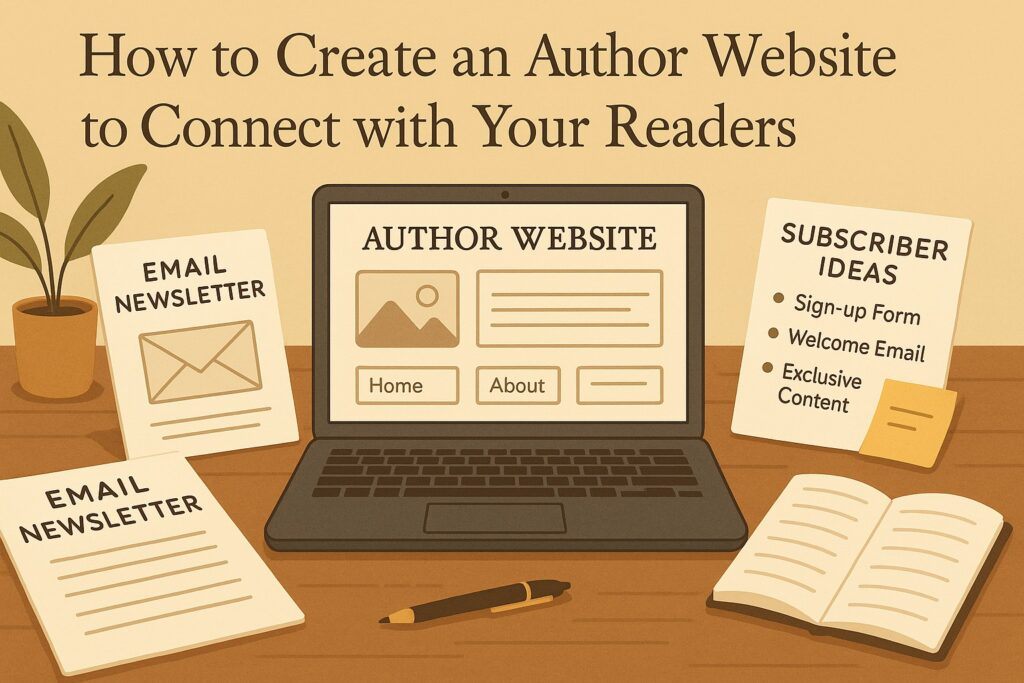
You can create an effective author website by choosing a simple platform, using a clear homepage, and highlighting your books, story, and contact details. Add an email signup form in key places and send a regular newsletter with updates, behind-the-scenes stories, and special offers. Over time, this helps you build a direct relationship with your readers that no social platform can take away.
FAQs
1. Why do I need an author website?
An author website gives you a home on the internet that you control. It lets readers find your books, learn about you, and join your email list in one place.
2. What pages should my author website include?
Most authors start with a homepage, an “About” page, a “Books” or “Works” page, a contact page, and a simple blog or updates page.
3. Do I need a blog on my author site?
A blog is useful but not required. If you can post updates, articles, or short notes regularly, it helps attract new readers and keep current readers engaged.
4. How do I collect email addresses from my website?
Use an email marketing service and place signup forms on your homepage, at the end of blog posts, and on a dedicated “Join my newsletter” page.
5. What should I offer in exchange for newsletter signups?
You can offer a free chapter, a short story, a checklist, or a simple welcome series that shares more about you and your books.
6. How often should I send my author newsletter?
Aim for a regular schedule you can keep, such as once or twice a month. Consistency is more important than high frequency.
7. What kind of content should I include in my newsletter?
Share book updates, release dates, personal stories, writing progress, reading recommendations, and special offers or discounts.
8. How is an email list better than social media followers?
You own your email list and can reach readers directly. Algorithms and platform changes cannot block your messages in the same way.
9. Do I need a fancy design for my site and emails?
No. Clean, simple design with clear text, easy navigation, and a visible signup form is more important than fancy graphics.
10. Can I start with a free website and email tool?
Yes. You can begin with free or low-cost plans, then upgrade later as your audience and income grow.
Introduction
For many years, my “author platform” was a plastic chair, a notebook, and a mind full of stories along the Sobat River.
No website.
No newsletter.
No contact form.
If you wanted to hear from me, you had to meet me in person, or later, bump into one of my books somewhere online.
That worked for a while. But slowly, I started to see the same pattern:
Readers would finish one of my books and ask, “Where can I find more of your work?”
Other writers would ask, “How can I follow what you are doing?”
Some people wanted to invite me to speak, but they had no central place to learn about me.
I realised something simple and painful:
If you do not build your own digital home, you are always renting a corner in someone else’s market.
An author website is that home.
A newsletter is the path from your home to your readers’ hearts and inboxes.
In this article, I want to show you how to build both, using my own journey as a working author who moved from dusty notebooks to johnshalom.com, from Facebook posts alone to an email list of real humans who can reply to me directly.
Why Every Author Needs A Digital Home
Let us start with a clear picture.
Social media is like a busy street.
Your website is your house on that street.
Your newsletter is the private sitting room where you talk to visitors.
If you rely only on social media:
- Algorithms can hide your posts.
- Your account can be restricted or closed.
- You do not own the relationship with your readers.
If you own a website and email list:
- You control your message and your design.
- You can collect email addresses with permission.
- You can talk to readers without gatekeepers.
When I first started johnshalom.com, I did not fully understand this. I just wanted a place to put my books and ideas. Later, when I lost some things in a hosting transition and had to rebuild, it became very real to me:
Platforms change.
Themes break.
Accounts disappear.
But your domain name and your email list, if you guard them well, stay with you as long as you renew them and treat your readers with respect.
Step 1: Choose Your Domain Name And Platform
This step feels technical, but it is more personal than you think.
Your domain name
Your domain is your address on the internet. For most authors, the best choice is still something like:
yourfullname.com
I chose johnshalom.com because “John Monyjok Maluth” is long for a domain and “johnshalom” has been my personal brand for years.
You can:
- Use your exact name, if available.
- Add “author” or “writer” if your name is taken.
- Use a simple phrase tied to your brand if your name is very common.
Avoid:
– Long, complicated phrases.
– Many hyphens and numbers.
– Names you will outgrow, like “newwriter2024.com”.
When you pick this name, think 10 or 20 years ahead. Imagine it on book covers, slides, email signatures, and podcast interviews.
Your website platform
Now you need a place to build the actual site.
Most authors choose one of these paths:
- WordPress with hosting
- All in one site builders (like Squarespace or Wix)
- E commerce focused platforms (like Shopify) for heavy stores
In my own case, I use WordPress because:
– It is flexible.
– It has many themes and plugins.
– I can move hosts without changing the whole system.
But this came with learning and some pain. I once moved my site from one host to another and discovered my articles were not where I thought they were. I had to rebuild many things by hand. It was a good lesson: always know where your content is and keep backups.
For simplicity and control as an author:
– If you want maximum flexibility and are willing to learn, use WordPress.org with reliable hosting.
– If you want beauty and ease and do not plan to heavily customise, an all in one builder can work.
– If your main focus is selling physical products, courses, or a big store, a commerce platform may make sense.
Remember, the platform is a tool. The main thing is that you can publish pages, blog posts, and connect an email service.
Step 2: Design A Simple, Clear Author Website
You do not need a fancy site to connect with readers.
Readers want:
– To know who you are.
– To see your books.
– To contact you.
– To join your list if they like your work.
That is all.
My first site had too much going on. Too many widgets, too much text, and not enough clarity. Over time, I moved toward a simple structure with a clear menu.
The essential pages
You can start with these:
- Home
- About
- Books (or “Work”)
- Blog or Articles
- Contact
- Newsletter sign up (this can also appear on several pages)
Let us look at each.
Your homepage
Think of your homepage like the front yard and front door of your house.
It should answer four questions quickly:
- Who are you?
- What do you write?
- Who is this for?
- What should the reader do next?
For example, your homepage can include:
– A short headline: “John Monyjok Maluth – Author of African Nonfiction, Nationalism, and Self Help”.
– A short subheadline: “Helping young Africans find meaning in their stories through books, tools, and talks”.
– A clear call to action: “Join my newsletter for weekly thoughts and updates” or “Start with this book”.
– A photo that looks like you, not a stranger.
– A short introduction with a link to “About” and “Books”.
When someone lands on your homepage, they should not have to scroll for 10 seconds before understanding what you do.
Your about page
This is where your story lives.
Many authors write a stiff, CV style about page. You are an author. People want to feel your humanity.
You can include:
– Where you were born or grew up.
– Why you started writing.
– What themes are important in your work.
– A few key facts: awards, publications, organisations, or causes you care about.
– A few personal details: hobbies, food you like, where you live now.
My own story includes growing up along the Sobat River, facing war and hunger, and later teaching myself technology and digital publishing. These details are not there to brag. They help readers understand why I write the way I do.
Remember, your about page is not only about your past. It is also about what you are trying to do for the reader now.
Your books page
This page is your digital bookshelf.
For each book, include:
– Cover image.
– Title and subtitle.
– One paragraph description focused on what the reader will gain or feel.
– Links to where they can buy or download.
– Maybe one or two short reader quotes or review highlights.
Do not overwhelm people with long sales letters for each book. Give them enough to decide if they want to click through.
You can group books by:
– Series.
– Genre.
– Type (fiction, nonfiction, poetry, etc.).
Your blog or articles page
This is where your living voice appears.
You can:
– Share behind the scenes of your books.
– Teach lessons from your field.
– Reflect on national or personal issues.
– Answer reader questions in article form.
For me, articles became a way to develop ideas that later turned into books. They also became a way for readers to see my thinking outside of Amazon pages or newspapers.
Your contact page
Do not hide.
Make it easy for:
– Readers to write you.
– Journalists to contact you.
– Event organisers to invite you.
Include:
– A simple contact form.
– An email address.
– Selected social media links.
You can also add short guidelines, like how long you take to reply or which requests you can handle.
Step 3: Make Your Website Reader Friendly And Search Friendly
Now you have a basic site. The next step is to make it pleasant for humans and discoverable for search engines.
Reader friendly basics
Think of someone reading on a small phone in a matatu or on a slow connection.
Do this:
- Use short paragraphs.
- Use headings to break long text.
- Use readable fonts and enough spacing.
- Avoid clutter and too many moving parts.
- Make buttons clear and large enough to tap.
Many African readers deal with unreliable internet. Heavy themes, too many images, or auto playing videos can make your site frustrating.
Search friendly basics
SEO may sound technical, but at the base it is simple:
- Use clear titles that include your main topic.
- Use descriptive headings that match what people might search.
- Mention your main keywords naturally in the text.
- Give images descriptive file names and alt text.
- Link between related posts on your site.
- Link out to relevant trusted sites when helpful.
For example, an article called:
“5 Lessons I Learned Writing My First South Sudanese Memoir”
is better than:
“Thoughts on My Book”.
Over time, search engines start to notice which pages:
– Answer questions well.
– Keep people reading.
– Get shared and linked.
You do not need to become a full SEO expert. Just write clearly, stay on topic, and organise your site well.
Step 4: Set Up Your Author Newsletter
Now let us move from your house to your sitting room.
An author newsletter is simply an email you send to people who have chosen to hear from you.
Why a newsletter matters
Social media posts appear and vanish quickly. Algorithms decide who sees them. Your newsletter goes straight to inboxes.
Benefits:
– You can speak in more depth to your readers.
– You can share early news about books and events.
– You can ask for feedback and get real replies.
– You are more independent from social media changes.
In my own experience, some of the warmest messages I receive are replies to emails, not comments on public posts. People open their hearts more when they respond privately.
Choose an email service
Do not try to manage everything from your personal email address. Use an email marketing service.
Look for:
– Simple interface.
– Good deliverability.
– Easy connection with your website.
– Tags or segments to organise readers later.
Most services have a free plan for small lists. That is enough when you start.
Create a welcome gift and promise
People are busy. Only a few will sign up just because they like you. Many more will join if you offer something clear.
Ask yourself:
“What can I give my readers that is small, useful, and aligned with my books?”
Examples:
– A short PDF with a chapter excerpt.
– A mini guide related to your nonfiction topic.
– A short story available only to subscribers.
– A reading list or resource list.
Along with the gift, make a simple promise:
– How often you will email.
– What kind of content they can expect.
For example:
“Get a free chapter of my upcoming book and receive one honest email every week about writing, life, and purpose.”
Set up your sign up forms
Place forms:
– On your homepage, near the top.
– At the bottom of your blog posts.
– On a dedicated “Newsletter” page you can share.
– In your site footer.
Keep the form simple:
– First name.
– Email address.
Do not ask for too many details at sign up. You can always learn more about them later.
Plan your email rhythm
A list that never hears from you will forget you.
Choose a realistic rhythm:
– Once a week.
– Once every two weeks.
– Once a month.
Consistency matters more than frequency. It is better to send one good email every two weeks for a year than daily emails for one week then silence for months.
Step 5: Decide What To Send In Your Newsletter
Many authors freeze at this point. They ask, “What do I write about in my emails?”
Remember, these are human beings who like your writing. Treat them as friends, not targets.
Possible content:
- Behind the scenes of your writing life
– Struggles, routines, funny mistakes.
– How you deal with block, deadlines, or real life problems. - Updates on your books
– Progress on new projects.
– Cover reveals.
– Launch dates.
– Special discounts. - Short reflections
– Lessons from your past.
– Observations from your city, village, or travels.
– Thoughts on national or global issues, if that fits your author brand. - Recommendations
– Other books you enjoyed.
– Articles, podcasts, or videos that helped you. - Questions for readers
– Ask about their challenges.
– Ask what they want to read next.
In my own emails, I often mix personal stories with small teaching points. I talk about growing up in war, facing threats for my opinions, and still choosing to write. I connect these stories to whatever topic I am working on, whether it is nationalism, self help, or technology.
Always include:
– A clear subject line, honest and interesting.
– One main point, not ten.
– A gentle call to action: reply, read a post, check a book, forward to a friend.
Step 6: Add Content To Your Other Pages
Once your homepage and email setup are ready, fill out your supporting pages.
About page
Tell your story in a way that serves the reader.
You can structure it like this:
- Who you are now.
- Where you come from.
- What you write and why.
- What the reader can expect if they follow you.
You may also include:
– A few key milestones.
– Partners or organisations you work with.
– A short “official” bio others can copy for events.
Books page
Keep improving this page as your catalogue grows.
For each title:
– Consider adding a short “If you are this kind of reader, start here” note.
– Group related books into series pages.
– Add links to sample chapters or related articles.
Blog page
Write posts that:
– Answer questions your readers often ask.
– Capture lessons you keep repeating in conversations.
– Express your thoughts on topics that matter to your audience.
In time, your blog becomes a library. It shows new visitors what kind of mind and heart you bring to your books.
Contact page
Check this page often.
– Test your form.
– Respond as promised.
– Update any details that change.
Basic automations like a simple “Thank you, I received your message and will reply within X days” can help manage expectations.
Step 7: Promote Your Website And Newsletter
Now you have built your house. It is time to invite guests.
Use social media wisely
– Add your website link to all your profiles.
– Pin a post that explains who you are and links to your site or newsletter.
– When you share new articles or books, send people to your website, not only to third party stores.
Do not turn your social feeds into a wall of links. Spend time:
– Commenting thoughtfully on others’ posts.
– Answering questions in your niche.
– Joining groups where your readers gather.
Mention your site everywhere appropriate
– In your books, at the front and back.
– In your author bio for guest articles.
– In podcasts, interviews, and speaking engagements.
– On business cards, flyers, and posters.
Use guest content
– Offer to write guest posts for blogs your readers follow.
– Appear as a guest on podcasts.
– Collaborate with other authors for joint events.
Every time, include a simple line:
“For more of my work, visit [your site] or join my newsletter.”
Run small, focused ads if possible
If your budget allows, you can test simple ads:
– A small campaign to grow your email list with a free gift.
– A targeted campaign for a book launch leading to your site.
Start small. Measure. Adjust.
Always send people first to your own page, not only to a big store that you do not control.
Step 8: Keep Improving, Slowly And Steadily
Your author website and newsletter are not fixed monuments. They grow with you.
Over time, you will:
– Learn which pages your readers visit most.
– See which emails get the strongest replies.
– Notice which posts bring new subscribers.
Use that information.
– Improve your homepage based on what people actually click.
– Write more of the content that gets strong, honest responses.
– Remove or update old content that does not fit your current author path.
When I look back at older versions of my site, I sometimes smile. I see the confusion, the experiments, and the growth. That is normal.
Conclusion
Creating an author website and newsletter is not about showing off. It is about showing up.
You are an author. You work with words, ideas, and stories. Your website and newsletter are simply extensions of that work into the digital world.
With them, you can:
– Welcome new readers into a space that looks and feels like you.
– Speak to your audience directly without begging any algorithm.
– Share your journey from draft to launch and beyond.
– Build a quiet, loyal community around your voice.
From village darkness to dim kerosene lamps, to small solar lights, to the screen you are reading now, my own path has taught me this:
If you do not tell your story, someone else will tell a weaker version of it, or it will vanish.
Your author website is where your story lives online.
Your newsletter is how that story breathes, week after week, in real human inboxes.
Start simple.
Choose a name.
Build a clean site.
Set up one newsletter.
Send the first email.
You can refine everything later. What matters most is that somewhere on the internet, there is a door with your name on it, and when readers knock, you are there to say, “Welcome, come in, let us talk.”

