
TL; DR
You can create a vision board by choosing clear goals, collecting images and words that represent those goals, and arranging them where you will see them daily. A good vision board reminds you who you want to become and what you are working toward. When you look at it often, take small daily actions, and keep your mindset focused on growth, it helps you stay motivated and move closer to your dreams.
FAQs
1. What is a vision board?
A vision board is a collection of images, words, and symbols that represent your goals, dreams, and the life you want to create.
2. What should I include on my vision board?
Include pictures, quotes, words, and symbols that clearly represent your goals in areas such as health, relationships, career, money, and personal growth.
3. Do I need to use physical materials or can it be digital?
You can create a physical board using paper, magazines, and printouts, or a digital one using apps and design tools. Choose the format you will see and use most often.
4. How specific should my goals be on the board?
Be as specific as you can. Clear goals such as “publish my first book” or “save 5000 dollars” are more powerful than vague wishes like “be successful.”
5. How often should I look at my vision board?
Look at it every day, even for a few minutes. Morning and evening are good times to reconnect with your goals and reset your focus.
6. Does a vision board really help dreams come true?
A vision board by itself does not create results. It helps you stay focused and motivated so that you take consistent action, which is what actually brings change.
7. What steps should I take after creating the vision board?
Break each goal into small tasks, plan them on your calendar, and take daily or weekly action while using the board as a reminder of why it matters.
8. Can I change or update my vision board?
Yes. Update it when your goals become clearer, when you achieve certain dreams, or when your direction in life changes.
9. What mistakes should I avoid when making a vision board?
Avoid overcrowding it, choosing goals that are not truly yours, or creating a board and then ignoring it. Keep it meaningful and visible.
10. Can children or teenagers also use vision boards?
Yes. Young people can benefit from vision boards by learning to set goals, think about their future, and stay inspired while they grow.
Introduction
When I was a boy along the Sobat River, I did not know what a “vision board” was. We had no magazines to cut, no glue, no Pinterest. What I had was a hungry stomach, a war-torn land, and a stubborn picture in my mind:
One day I would write books.
One day I would teach.
One day I would travel beyond the river.
I did not call it visualization. I simply held that picture in my heart. I talked about it. I prayed about it. I moved toward it, one painful step at a time.
Years later, when I discovered vision boards, I smiled. I realised many of us had been doing this all along, but in our heads and hearts. A vision board is simply a way to bring those inner pictures into the open, where you can see them every day.
In this article, I want to show you how to create a vision board that is not just pretty, but honest and practical. A board that does not only decorate your wall, but slowly reshapes your life.
What A Vision Board Really Is (And What It Is Not)
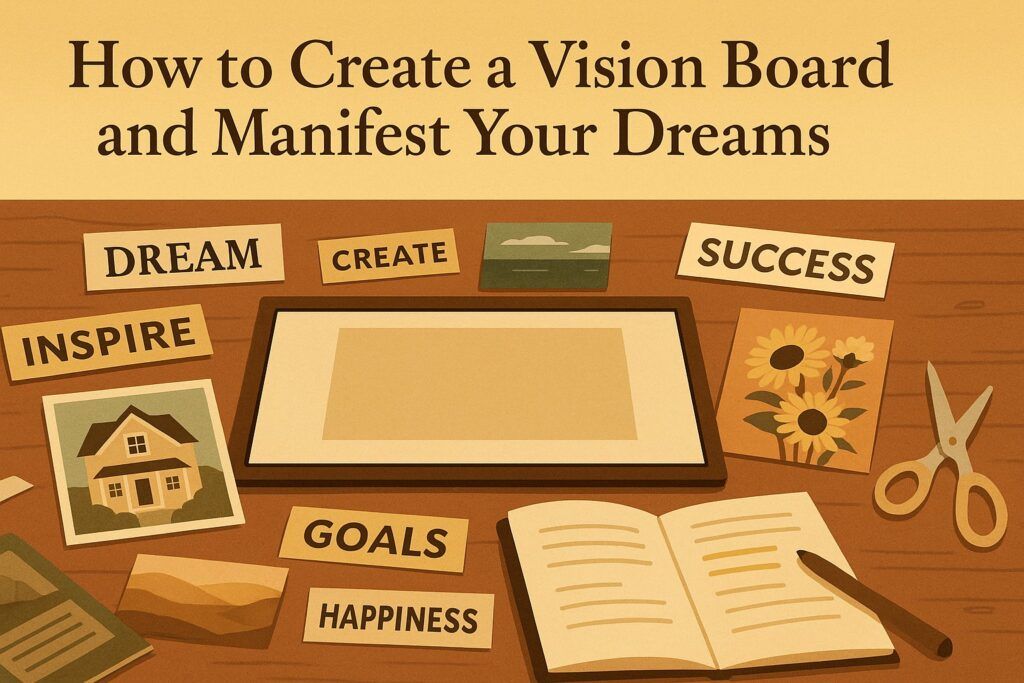
A vision board is a visual reminder of the future you are committed to create.
It is not magic.
It is not a shortcut.
It is not a replacement for hard work, faith, or wisdom.
It is:
- A focusing tool for your mind.
- A daily reminder of what matters to you.
- A way to train your eyes to see opportunities.
- A quiet agreement between your present self and your future self.
You choose images, words, quotes, and symbols that represent the life you are building. You place them where you can see them often. You let them speak to you. Then you move.
My own life taught me a simple formula:
Meaning = {Being, Doing²}
Who you are becoming plus what you consistently do, squared. A vision board helps you with both. It reminds you who you want to be and pushes you to act twice as intentionally.
Step 1: Get Clear On What You Really Want
Before you cut a single picture, you need clarity.
This is where many people get stuck. They create a board full of random beautiful things, but it does not reflect their true calling. Then they wonder why nothing changes.
Start with honest questions
Take a plain notebook or an open document and write:
- What do I want my life to look like in the next 3 to 5 years?
- How do I want to feel when I wake up most mornings?
- Which work would I keep doing even if no one praised me?
- What kind of relationships do I want around me?
- How do I want my body and health to be?
- What kind of impact do I want to have on my community, my country, and the world?
You can also explore these areas:
– Spiritual and emotional life
– Family and relationships
– Health and fitness
– Work, business, and finances
– Learning and creativity
– Contribution and service
– Travel and lifestyle
Do not rush. Clarity rarely comes at high speed. Sometimes it arrives slowly, like a shy visitor.
Tools that can help
- Journaling
Sit with a pen and write freely about your ideal day. Not your ideal fantasy, but a day that feels true to you. Where do you wake up? What do you do first? Who are you with? How do you work? How do you rest? - Quiet reflection or prayer
In our noisy world, even ten minutes of silence can help you hear your own heart again. For some, this is meditation. For others, it is prayer. For me, it is often both: listening to God and listening to my own soul. - Visualization
Close your eyes and picture one key goal already achieved. You are holding your published book. You are standing in your own small office. You are crossing a graduation stage. Notice what you see, hear, and feel. - Honest conversation
Talk to someone who knows you well. Ask them, “When you look at my gifts and passions, what kind of future do you see for me?” Sometimes others see strengths we ignore.
Write your goals in the present tense
Once you feel some clarity, capture your main desires as present tense statements. For example:
– I am a full time author earning a steady income from my books and talks.
– I am healthy and strong, walking daily and eating in a way that supports my body.
– I am living in a quiet home where I can write and think without constant fear.
– I am mentoring young Africans who want to write and think deeply.
Make these statements:
- Specific enough to measure.
- Positive, not negative.
- Personal, not copied from someone else’s dream.
My own story of painful clarity
There was a season when my vision was very simple: survive the war, avoid hunger, stay alive one more week. In that time, a vision board would have had only two images: food and safety.
As life changed, my vision had to grow. When I moved to Juba and later to Nairobi, I started asking bigger questions:
If I live, what kind of man do I want to be?
What kind of work justifies all this suffering?
Those questions still shape my boards today. Your own story will guide you in the same way if you let it.
Step 2: Collect Images, Words, and Symbols That Speak To Your Heart
Now that you know what you want, you can start gathering visual material.
Here is a secret: you do not need fancy magazines or a color printer to do this. Start with what you have.
Where to find ideas and images
- Old magazines and newspapers
Cut out pictures that resemble your goals. A small office. A bookshelf. A happy family. A strong, healthy person running. Even a word or phrase that moves you. - Internet and digital tools
If you have access, you can search for images and quotes that match your goals. Save them in a folder. Tools like simple collage apps, phone galleries, or design platforms can help you arrange them later. - Photos
Use your own photos. You at an event. You with your family. A place you visited that made you feel alive. These remind you of what is already possible. - Words and quotes
Not every vision board has to be full of pictures. Powerful words can work even better. Write or print quotes that shape your mind: – Bible verses or spiritual texts that ground your vision.
– Short phrases like “Disciplined writer”, “Healthy body, clear mind”, “Service before status”. - Simple drawings
If you cannot print or cut pictures, draw. Stick figures are welcome. A small house. A passport. A microphone. A book. The quality of the drawing does not matter. The meaning does.
Make sure your material is honest
As you select images or words, check them against these questions:
- Does this reflect what I truly want, or what I think will impress other people?
- Does this image give me hope and courage, or does it make me feel small and discouraged?
- Is this goal believable if I am willing to grow, or is it pure fantasy that keeps me stuck?
Your board should stretch you, not crush you.
Step 3: Build Your Vision Board In A Way That Fits Your Life
You now have clarity and materials. It is time to build.
You can create different types of boards depending on your situation.
Classic poster board
This is what most people imagine.
- Get a piece of cardboard, manila paper, or any firm surface.
- Sort your images into themes: work, health, relationships, contribution, etc.
- Arrange them on the board before gluing anything. Play with the layout.
- Place your most important goals near the center.
- Glue everything in place. Add titles, dates, or short handwritten notes.
If you live with others and want privacy, you can keep this board inside a wardrobe or behind a door. It does not need to be public to be powerful.
Notebook vision board
When I did not have space on the wall, I used my notebook.
- Take a page for each area of life.
- Glue or draw images on that page.
- Write your present tense goals next to the images.
This becomes a “portable board” you can carry, even if you move often.
Digital vision board
If you spend a lot of time on your phone or laptop, make the device work for you.
Ideas:
- Create a collage and set it as your phone lock screen or wallpaper.
- Create a folder of vision images and scroll through it each night.
- Use a simple app or slide deck with one goal per slide.
- Set reminders with your goals written as notifications.
Digital has one advantage. You can update it easily as your vision becomes clearer.
However, be careful. Do not hide your vision board behind 15 clicks. Make it easy to see.
Place your board where it can speak to you
No matter the format, your board should be:
- Visible. You should see it daily without hunting for it.
- Safe. Protected from damage and from people who might mock your dreams.
- Personal. It is yours. You can share parts of it, but you are not obliged to explain every image to everyone.
Step 4: Use Your Vision Board Daily With Your Mind, Mouth, And Hands
A beautiful board that sits in a dark corner is just decoration.
The power is in how you use it.
Look and feel
Once or twice a day, stop and truly look at your board.
- Read each goal slowly.
- Let your eyes rest on the images.
- Notice how your body responds. Hope. Fear. Excitement. Doubt.
Do not run away from those feelings. A vision that does not scare you a little is too small. At the same time, if the fear is overwhelming, adjust the vision so it becomes a challenge, not a threat.
Speak and affirm
Words shape your mind.
As you look at the board:
- Read your present tense goals out loud, if possible.
- Add phrases like “I am learning to”, “I am growing into”, “I am becoming”.
- Speak from faith, not from empty boasting.
For example:
“I am becoming a disciplined writer who finishes what he starts.”
“I am learning to manage money wisely and build long term stability.”
You are not lying. You are aligning your words with the direction you are taking.
Visualize with your whole self
Close your eyes for a moment.
Pick one image on your board. Imagine:
- Where you are.
- Who is with you.
- What you are hearing.
- What you are touching or holding.
- What you are feeling inside.
This is not about pretending life is already perfect. It is about training your inner world to accept a better future as possible.
Act like someone who is moving toward that life
Here is where many vision boards fail. People look, speak, and visualize, but they do not do.
Every time you look at your board, ask one question:
“What is one small action I can take today that moves me toward this?”
Examples:
– If your board includes “published author”, write 500 words today.
– If your board includes “healthy body”, walk for 20 minutes or drink more water.
– If your board includes “financial stability”, track your spending for the day.
– If your board includes “loving family”, make one sincere call to a relative.
Small daily actions turn pictures into reality.
Vision without action is a beautiful dream that becomes a bitter regret.
Common Mistakes People Make With Vision Boards
Let me highlight some traps.
- Copying other people’s dreams
Do not fill your board with mansions, luxury cars, and private jets if what you really want is a quiet house, a small car, and time to read. Be honest. - Creating a vision based only on escape
It is natural to want to escape pain. But a board that says only “I want to leave here” without any positive direction will not guide you. Ask, “What am I running toward, not only away from?” - Making the board once, then forgetting it
Renew it. Update it. Remove goals that are no longer true. Add new ones as you grow. - Waiting for miracles without movement
I believe in miracles. I have lived them. But every miracle I remember also required some human movement. A conversation. A step. A risk. Do not use the law of attraction as an excuse to avoid responsibility. - Using the board to shame yourself
The board should not be a tool of punishment. If you fail one day, you have not failed forever. Adjust, repent if needed, and step again.
Vision Boards In African Realities
When people teach vision boards, they often assume easy internet, printers, bookstores, and stationery shops.
What if:
– You live where magazines are rare.
– You cannot print color photos.
– Your wall is made of mud or tin.
– People around you might laugh at the idea of “manifesting” anything.
You can still create a powerful board.
Ideas:
- Word board
Use only words. Cut them from newspapers. Write them by hand. Words are strong. “Peaceful home.” “Finished degree.” “Published book.” “Debt free.” “Healthy father.” - Symbol board
Use simple objects. A small stone for stability. A dry seed for future harvest. A broken pencil taped there to remind you of education cut short that you will continue. - Secret board
Use a notebook page slipped into your Bible or another book you read daily. Only you need to see it. - Phone board even without data
Take photos of handwritten goals or small sketches and make that your wallpaper. No internet needed.
Your reality does not have to look like the perfect examples on rich people’s blogs. Your board only needs to make sense to you and push you to live more intentionally.
Turn Your Vision Board Into A Life Of Meaning
A vision board by itself will not change your life.
Your life changes when:
- You dare to name what you want, even after disappointment.
- You hold that picture firmly but humbly.
- You align your words with that picture.
- You take daily actions, even when no one notices.
- You allow God and life to refine your plans as you walk.
When I look back at my own journey, I see many “boards” in my past. Some on paper. Many only in my mind. A boy in a village imagining books nobody else believed in. A young man staring at a cheap computer in Juba, seeing an online future that did not yet exist. A writer in Nairobi rebuilding his website from scratch, imagining readers from every continent.
I did not manifest all this by cutting pictures alone. I wrote at midnight. I learned new tools. I made foolish mistakes. I faced threats for my opinions. I kept moving.
You can do the same in your own path.
So here is your simple assignment:
- Take one sheet of paper.
- Write three present tense goals that truly matter to you.
- Add one word or small drawing next to each goal.
- Place that paper where you will see it tomorrow morning.
- Take one small action toward one of those goals before the day ends.
That small paper is already a vision board. You can decorate it later. The important thing is this:
Your dreams are no longer hidden only inside you. They have stepped onto paper and into your daily choices.
That is how you begin to create a vision board and manifest your dreams, not by magic, but by a life where your Being and your Doing² move in the same direction.

