TL; DR
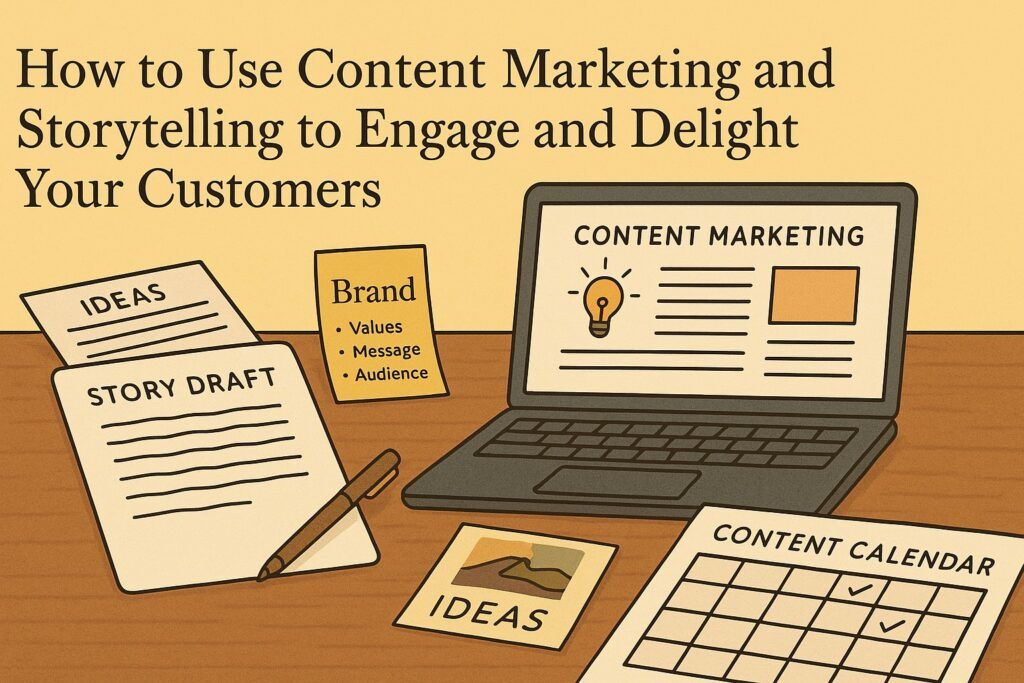
You can use content marketing and storytelling to engage customers by sharing helpful, real stories that reflect their needs, fears, and dreams. Teach them something useful, show how your product fits naturally into the story, and make your customer the hero, not your brand. When you publish valuable content consistently and tell honest stories, people feel connected to you, trust grows, and sales follow.
FAQs
1. What is content marketing with storytelling?
It is the practice of sharing useful content, wrapped in real or realistic stories, to educate, entertain, and build trust with your audience.
2. Why does storytelling make content more engaging?
Stories are easier to remember than facts alone. People see themselves in the story, feel emotions, and stay interested until the end.
3. What kind of stories should I tell my customers?
Share customer success stories, your own journey, behind-the-scenes stories, and simple examples that show how life improves when people use your product or service.
4. How do I find good stories for my content?
Listen to customer questions, reviews, and complaints. Look at your own experiences, case studies, and common problems in your industry.
5. How often should I publish content with stories?
Start with a realistic schedule such as one or two strong pieces per week. Quality and consistency are more important than high volume.
6. Which channels are best for storytelling content?
Blogs, email newsletters, YouTube, podcasts, and social media platforms like Facebook, Instagram, LinkedIn, and TikTok are all useful, depending on where your audience spends time.
7. How do I connect stories to my product without sounding pushy?
Show the problem, tell how the character struggled, then explain how your solution helped. Focus on the result for the customer, not just the features.
8. How can I measure if my storytelling works?
Track engagement such as comments, shares, and time on page, plus clicks, signups, and sales linked to your content.
9. Do I need a big budget for content marketing and storytelling?
No. You can begin with simple tools, your own stories, and consistent effort. Good ideas and clear writing or video matter more than expensive production.
10. What common mistakes should I avoid?
Talking only about yourself, copying others, using boring jargon, posting without a clear message, and forgetting to invite readers to take the next step such as subscribing, booking, or buying.
Introduction
Before I ever heard the phrase “content marketing,” I was already doing it without knowing.
I was writing little booklets by hand in South Sudan, sharing them with friends. Later I wrote long Facebook posts about war, hunger, and hope. Still later, I started posting on my website and on Wealthy Affiliate. I was not running a campaign. I was simply sharing what I knew and what I felt.
The interesting thing is this: the posts that reached people most were never the “10 tips to do X” type. The ones that stayed in their hearts were the stories.
The story of nearly dying as a boy along the Sobat River.
The story of running from bullets, then returning to school as if nothing happened.
The story of writing my first book with almost no money, no laptop, and no mentor.
People would message me and say, “John, that story made more sense to me than all the theory.”
That is the power of content marketing combined with storytelling.
Content marketing is what you share.
Storytelling is how you share it.
Together, they can turn a quiet small brand into a trusted voice in your reader’s mind.
In this article, I will show you how to use content marketing and storytelling in a practical way, using my own journey as a writer, teacher, and pro-humanity entrepreneur. I am writing this especially for the young African creator, the small business owner, the author, and the coach who wants to engage and delight real humans, not just chase likes.
Start With People, Not “Target Markets”
The theory says, “Know your audience.”
I agree, but I prefer to say, “Know your people.”
When I think of my “audience,” I do not see a graph or a pie chart. I see:
– A young woman in Juba, reading on her phone at night when the power goes off.
– A young man in Nairobi, in a noisy hostel, with big dreams and small resources.
– A South Sudanese student abroad, trying to understand who he is and where he belongs.
Content marketing becomes powerful when you stop speaking to “traffic” and start speaking to persons.
How to understand your people
You do not need fancy software to begin. You can start with three simple actions.
- Listen to questions
Pay attention to what people already ask you:
– “How did you publish your first book?”
– “How do you write about painful things without losing your mind?”
– “How do I start an online business with almost nothing?”
Turn those questions into content. - Notice repeated pain points
In my case, I kept hearing:
– “I do not know where to start as a writer.”
– “I am afraid my English is not good enough.”
– “I am confused by all these tools and platforms.”
These pains told me what stories and guides I needed to create. - Create one simple customer profile
Pick one real or imagined person and describe them:
– Age range
– Where they live
– What keeps them awake at night
– What they want most in the next 12 months
– What is stopping them
Give that person a name. When I write, I often write to “the aspiring young African writer.” I see their face. I remember my own younger self. That shapes my voice and my stories.
When you know your people, your content starts to feel like a letter, not a broadcast.
Define Simple, Honest Objectives For Your Content
Content without a clear purpose creates noise.
There was a time when I wrote online just “to put something out there.” It felt good, but there was no clear path for the reader or for me. At the end of a year, I had many posts but no clear results.
Now, before I create a series, I ask:
“What do I want this content to do for the reader and for my mission?”
Your content can serve many purposes, such as:
– Increase awareness: more people know you exist.
– Build trust: people see you as a steady, honest voice.
– Generate leads: people sign up for your newsletter or request more information.
– Drive sales: people buy a book, a service, or a course.
– Deepen loyalty: existing customers feel seen, respected, and supported.
Make your goals specific
Instead of saying, “I want more readers,” you can say:
– “I want 200 new email subscribers in the next three months.”
– “I want to sell 100 copies of my new book in the first 60 days.”
– “I want 10 coaching inquiries from my content in the next quarter.”
This clarity helps you decide:
– What topics to focus on.
– Which channels to use.
– What call to action to add at the end of each story.
A small caution
Do not let metrics steal your soul.
It is easy to start worshipping numbers. Views. Impressions. Clicks. I have fallen into that trap. You see a post with low views and think it failed. Then one day, someone writes and says, “That article saved me from giving up.” That story does not show in your dashboard.
So measure, but remember: you are serving humans, not just charts.
Choose Channels That Fit Your Life And Your Reader’s Life
You do not have to be everywhere.
At one point, I was trying to be active on Facebook, Twitter, LinkedIn, Pinterest, my website, Wealthy Affiliate, and WhatsApp groups. The result was simple: I became tired and shallow. I was present everywhere and impactful nowhere.
Three questions can guide you:
- Where do your people already spend time?
– If your readers love long thinking, a blog and email list might be best.
– If they like short visual content, Instagram or TikTok might work.
– If they are professionals, LinkedIn could be useful. - What type of content do you naturally enjoy creating?
– If you love writing, focus on blogs, newsletters, and written social posts.
– If you enjoy speaking, try podcasts, live sessions, or videos.
– If you like teaching visually, try slides and simple graphics. - What can you maintain consistently with your current life?
– Do not promise daily YouTube videos if your power and internet go off often.
– Do not plan three blog posts a week if you are working two jobs.
For me, my core has become:
– My website (johnshalom.com) for long articles and book-related content.
– Wealthy Affiliate for community-based posts on online business.
– Selected social platforms to point people back to my home base.
– My email list for deeper, more personal writing.
Your mix will be different. The key word is this: focus.
Create Content That Actually Helps Someone Today
Look at your own behavior. When do you stop scrolling and pay attention?
Most of the time, you pause when:
– Something speaks to your current problem.
– Something makes you feel understood.
– Something teaches you a skill you can use immediately.
– Something tells a story that mirrors your own inner struggle.
That is what your content needs to do.
Types of helpful content
You can mix different types, all powered by real stories.
- How-to guides
– “How to outline your first nonfiction book as an African writer.”
– “How to market your book when you have zero budget.”
Add small personal stories to show how you learned the steps. - Behind-the-scenes posts
– Share your writing process.
– Show your messy draft, not only the polished cover.
– Talk about the nights you wanted to quit. - Mistakes and lessons
– “3 marketing mistakes I made with my first book.”
– “What happened when I ignored my email list for six months.”
This honesty builds trust. - Case studies and success stories
– Tell the story of a reader who took your advice and saw results (with their permission).
– Show the journey, not only the outcome. - Opinion and thought pieces
– Share your view on issues in your industry or country.
– Use clear arguments and personal experience, not just emotion.
Give each piece a clear promise
Before you write, finish this sentence:
“After consuming this piece, my reader will be able to…”
For example:
– “…write a simple story-based social media post about their product.”
– “…understand why their customers are not engaging with their content.”
– “…take the first step toward building their own content system.”
If that promise is clear in your mind, your content will stay focused.
Turn Dry Information Into Stories
Now we come to storytelling itself.
As Africans, storytelling is not new to us. Our grandparents used stories at night to teach us. They did not give PowerPoint slides. They gave us characters, conflict, and lessons.
You can do the same for your brand.
Basic elements of a story
You do not need to complicate this. Most powerful stories contain:
- A character
– This can be you, a customer, a community, or even your company personified. - A desire
– Something the character wants. More sales, a better life, safety, healing, meaning. - A challenge
– The obstacle. Lack of money, fear, war, bad internet, corrupt systems, ignorance. - A journey
– The decisions, actions, and failures along the way. - A result and a lesson
– What changed. What was learned. How the reader can apply that lesson.
A simple story example
Let me give you a short example from my own life, written in a content-marketing style.
Hero: A young South Sudanese writer (me).
Desire: To publish books and reach readers globally.
Challenge: No money, no laptop, slow internet, no mentor.
Journey:
– Writes on paper first.
– Saves money slowly to access a computer.
– Learns about Amazon KDP, makes many formatting mistakes.
– Faces rejection and mockery from some people at home.
Result:
– Finally publishes.
– Starts receiving messages from readers in other countries.
Lesson:
– You do not need perfect conditions to start. You need courage, persistence, and a willingness to learn.
Now, imagine I am teaching you “How to use storytelling to market your books.”
Instead of only saying, “Share your journey,” I can tell this story, then show you how to structure your own.
Suddenly, content marketing is no longer abstract. It is grounded in real life.
Practical storytelling templates you can copy
Template 1: Before – Turning point – After – Lesson
- Before: Describe the situation at the beginning.
- Turning point: Describe the event that forced a change.
- After: Describe the result.
- Lesson: Share what you or your customer learned, and how the reader can use it.
Template 2: Mistake – Realisation – New approach – Outcome
- Mistake: Confess what you did wrong.
- Realisation: What made you see the mistake.
- New approach: What you did differently.
- Outcome: What improved and how the reader can avoid your old mistake.
Template 3: Question – Story – Answer – Next step
- Question: Start with a question the reader is asking.
- Story: Tell a short story that addresses it.
- Answer: Give a clear principle or technique.
- Next step: Suggest a small action they can take today.
You can use these templates in blogs, videos, emails, and social media posts.
Use Storytelling Across All Your Channels
Once you learn to think in stories, you can apply the same story in many places, adapted to each format.
Let us say you have a case study of a customer who used your service to grow their small business.
Here is how you can repurpose it:
- Blog post
– Long version with full story, quotes, images, and step-by-step breakdown. - Email
– Medium version. Focus on the main turning point and lesson. Add a link to the full blog post. - Social media
– Short version. Share one strong quote and one key result. Add an image and a link. - Video or podcast
– Interview the customer. Let them tell their story in their own words. Add your commentary. - Slide deck
– Extract key numbers and phrases for a talk or a workshop.
This way, your best stories work harder for you.
A personal example
When I wrote about my Guangzhou experience, where some young men tried to convince me to carry their goods as “luggage,” I did not only write it once.
I used that story to talk about:
– Ethics in business.
– Shortcuts versus long-term reputation.
– African entrepreneurship and the temptation to cheat systems.
I could share it as:
– An opinion article in The DAWN.
– A blog post for my readers.
– A short social media story.
– A part of a future book on African business culture.
One good story can feed many pieces of content, each with its own angle.
Measure What Matters And Improve Your Stories Over Time
Tools are helpful, but they are not the king.
Analytics platforms can show you numbers like:
– How many people saw your content.
– How many clicked, liked, or commented.
– How many subscribed or bought something afterward.
Look at these, but ask deeper questions.
Questions to ask about your content
- Which pieces get sincere responses?
– Not just “nice post,” but real messages like “this helped me decide something.” - Which stories people repeat back to you?
– Perhaps months later, someone says, “John, remember that story about your father killing the dangerous animal? That stayed with me.”
Those stories carry power. - Which content leads to real action?
– Book sales.
– Email replies.
– Event invitations.
– New clients. - Which content you enjoy creating most?
– If you hate making a certain type of content, you will not sustain it.
Use this information to:
– Create more of what works.
– Remove what clearly does not serve anyone.
– Experiment in small ways instead of changing everything at once.
Do not be afraid of low numbers
Some of my most meaningful pieces did not “perform well” in the first 48 hours. They were too honest. Too heavy. Too different. But over time, those same pieces were shared in private groups, mentioned in meetings, or quoted by readers.
A number on a dashboard is only one signal. Listen to the quiet signals too.
Stay Consistent And Authentic
Consistency and authenticity may sound like clichés, but they are the quiet backbone of strong content marketing.
Consistency means:
– You show up regularly.
– Your tone is stable.
– Your values do not change with the wind.
– Your message repeats enough for people to recognise it.
Authenticity means:
– You speak as yourself, not as a copy of the loudest influencer.
– You do not pretend to have results you do not have.
– You admit your struggles and mistakes.
– You keep your promises as much as you can.
I call myself a pro-humanity writer. That is not a slogan for me. It affects:
– Which brand partnerships I accept or reject.
– Which stories I tell and which I keep private.
– How I talk about politics, war, and leadership.
– How I describe people who disagree with me.
Your customers are not blind. They can sense when you are writing only to manipulate them. They can also sense when you are genuinely trying to help, even if your design is simple and your English is not “perfect.”
Consistency with limited resources
If you are in a place with unstable electricity, expensive internet, or other hardships, you may think you cannot be consistent.
You can. You simply need a realistic rhythm.
Examples:
– One blog post every two weeks.
– One email every week.
– Three social media posts per week.
You can also batch create. On a day when power and internet are stable, prepare several pieces and schedule them.
Remember: you are not competing with the biggest agencies in New York. You are building a trustworthy voice in your own corner of the world.
A Simple Action Plan To Start Using Content Marketing And Storytelling Today
Let me turn all this into a short plan you can follow this week.
Day 1: Clarify your people and purpose
- Describe one ideal customer in one page.
- Write three simple objectives for your content for the next 3 months.
Day 2: Choose your main channels
- Pick one main home (blog or email).
- Pick one or two support channels (social media, podcast, etc.).
- Decide your realistic posting rhythm.
Day 3: Collect story material
- List 10 personal stories linked to your work.
- List 5 customer or community stories you could tell (with permission).
- List 10 common questions you get.
Day 4: Write one story-based piece of content
- Choose one question and one story that answers it.
- Use a simple template: Question – Story – Answer – Next step.
- Publish it on your main channel.
Day 5: Share and invite response
- Share your content on your selected social platform.
- Ask a simple question at the end: “Has something like this happened to you?”
- Watch and note any replies.
Day 6–7: Reflect and adjust
- Ask: What felt natural? What felt forced?
- Adjust your next content plan based on it.
If you repeat this weekly, your content library will grow. Your storytelling muscles will strengthen. Your readers will start to recognise your voice.
Conclusion
Content marketing is not about shouting louder than everyone else. It is about speaking clearly to the right people, at the right time, with the right stories.
Storytelling is not a trick. It is the oldest way humans have used to pass wisdom, pain, and hope from one generation to another.
When you combine them:
– You stop creating “content” just to fill space.
– You start creating stories that actually move people.
– Your customers do not only buy from you. They remember you, recommend you, and sometimes even pray for you.
From the Sobat River to Juba, from Juba to Nairobi, from notebooks to websites, I have seen the same pattern: numbers rise and fall, platforms come and go, but honest stories rooted in real service keep working.
So, do not wait for perfect tools or perfect English.
Start where you are.
Serve the people you have.
Tell the stories you carry.
Use content marketing to share them with the world, and use storytelling to make them live in your readers’ hearts.