
TL; DR
A positive and grateful attitude is not about pretending life is easy. It is about choosing where to place your focus, even when life is brutal. You build it by training your mind to notice the good, practicing daily gratitude, reframing painful events, and walking with people who lift you instead of draining you.
My own journey started in places where “positivity” was not a slogan but a survival tool. Along the Sobat River, I saw hunger, war, loss, and repeated goodbyes. I lost many siblings. I saw death before I learned basic grammar.
Yet somehow, I also saw small daily miracles: one shared meal, one relative who stayed kind, one sunrise after a night of gunfire. Those tiny lights taught me this simple truth: if you do not learn to see the good, the darkness will write your story for you.
Cultivating gratitude is not weakness. It is mental strength. It does not erase pain, but it prevents pain from erasing you.
FAQs
What does it really mean to have a positive and grateful attitude?
It means you see reality honestly, including the hard parts, but you choose to focus on what is still good, still working, and still possible. You notice blessings instead of only burdens and you intentionally say “thank you” for them.
How can I practice gratitude when life feels very hard?
Start small. One thing a day. A safe bed. A friend’s message. A glass of clean water. Write it down or say it out loud. You are not denying your pain. You are training your eyes to see more than your pain.
Does being positive mean I ignore my problems or pretend they are not there?
No. That is denial, not positivity. A healthy positive attitude faces problems directly but refuses to let them define your entire story.
What if I grew up around negativity? Can I really change my mindset now?
Yes. Background shapes you, but it does not have to imprison you. With daily practice, new habits, and better company, your inner language can change at any age.
How long does it take to become more positive and grateful?
There is no fixed time. Think of it like physical training. In a few weeks you feel the difference. In a few months others see it. Over years, it becomes part of your identity.
Can gratitude help with anxiety or depression?
Gratitude is not a cure-all, and professional help is still important when needed. However, many studies and real lives show that daily gratitude practices can reduce stress, soften anxiety, and create more emotional stability over time.
1. Why Positivity and Gratitude Matter More Than Motivational Quotes
When you read social media posts about “staying positive,” it can feel shallow. Especially if you come from a background like mine.
I grew up in a world where survival was not guaranteed. There were days when the only “positive” thing was that we were still breathing. I remember nights when gunfire replaced lullabies. Days when hunger refused to leave our village. Moments when news of another death arrived like an unwanted visitor.
In those seasons, no one talked about “affirmations” or “gratitude journals.” Yet somehow, we still found ways to keep going:
- An old joke shared around a fire
- A relative who walked miles to check on us
- The taste of simple food after a long day
- One more sunrise after thinking the night would never end
These were small things, but they were also everything. They did not remove our pain. They just refused to let pain be the only voice.
That is what a positive and grateful attitude really is. It is not blind optimism. It is refusing to surrender your inner world to the worst parts of your outer world.
2. Understanding What a Positive and Grateful Attitude Really Is
A positive and grateful attitude is a mindset. It is not a personality type. It is a habit of:
- Noticing the good
- Naming the good
- Remembering the good
- Responding to the good with gratitude
You do not need a perfect life to practice this. In fact, most people who live this way did not come from comfort. They came from struggle. Struggle forced them to decide:
Will I let bitterness rule me, or will I fight for a different attitude?
A positive and grateful mindset:
- Enhances happiness and satisfaction
- Reduces stress and emotional overload
- Supports better health and recovery
- Deepens relationships
- Builds resilience when life hits hard
You cannot control everything that comes into your life. But you can learn to control your inner response. That is where this mindset lives.
3. Focus on the Positives in Your Life
3.1. The Negativity Bias: Why Your Brain Keeps Replaying the Worst
Your brain is wired for survival, not happiness. It remembers danger faster than blessings. One insult can erase ten compliments. One bad day can overshadow thirty good ones.
I saw this in myself. I could receive several kind messages about my writing, but one insult or threat wanted to sit in my chest for days. My brain replayed the harsh words on repeat while ignoring all the encouragement.
That is the negativity bias. If you do not manage it, it will manage you.
3.2. Training Your Eyes to Notice the Good
You break the power of negativity bias by deliberately counting the good. Not just in theory. In practice. Every single day.
Simple exercises:
- The “Three Blessings” habit
Each evening, write down three good things from that day. They do not have to be dramatic.- Someone listened to you
- Your body did not give up
- You ate a simple but satisfying meal
- The “One Story” reflection
Once a week, recall one small moment where something worked out better than expected. Write the story in detail. This strengthens your memory for positive events. - The “Micro-moment” practice
During the day, pause for a few seconds when something small but good happens.- The taste of tea
- Fresh air on your face
- The silence after noise
Stop, breathe slowly, and say, “This is good. I am grateful.”
Over time, your mind learns a new habit: not just detecting problems, but detecting blessings.
4. Practicing Gratitude, Even When Life Is Not Pretty
4.1. Gratitude Is Not Denial
Some people hear “gratitude” and think, “So you want me to pretend everything is fine?”
No. True gratitude is honest. It says:
- Yes, this part of my life hurts.
- Yes, this loss is real.
- And yet, even here, something remains that I can thank God or life for.
Gratitude does not silence your pain. It sits alongside your pain and says, “You are not the whole story.”
4.2. Daily Gratitude Practices That Actually Work
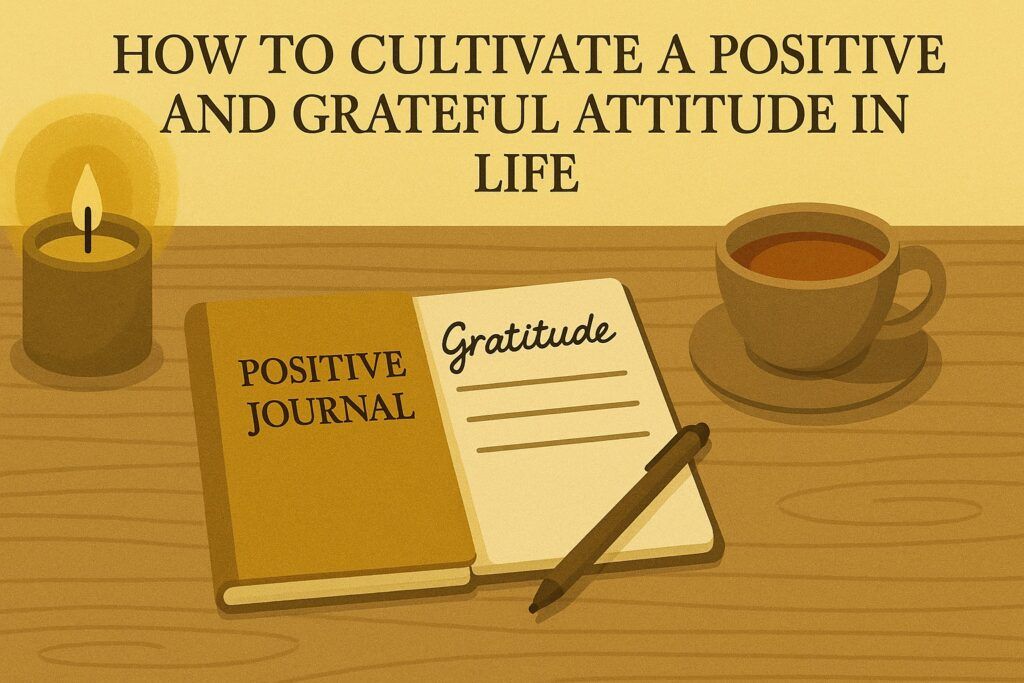
- Gratitude journal
- Write one to five things daily that you feel grateful for.
- Be specific: “My brother called me today,” not just “family.”
- On hard days, read old entries to remind yourself of previous mercies.
- Gratitude letters
- Write to someone who helped or influenced you.
- You may send it or keep it. Both help.
- This practice softens your heart and strengthens relationships.
- Gratitude in prayer or meditation
- Spend a few minutes each day talking to God or sitting in silence.
- Instead of only asking for help, name things you are thankful for.
- This shifts your inner tone from “only need” to “need and appreciation.”
- Gratitude through action
- Help someone in a way you once needed help.
- Give where you can: time, skill, presence, or resources.
- Serving others deepens your own sense of blessing.
I learned this personally. Many times my life was helped by people who had little but still shared. Remembering that makes it easier for me to give back today. Gratitude grows when it flows outward.
5. Reframing Negative Situations Without Lying to Yourself
Reframing is not saying, “It is fine,” when it is not. It is asking a deeper question:
What else might this mean, besides disaster?
5.1. Seeing Challenges as Training
When life pushed me close to death more than once, something changed inside me. It became very hard to take life lightly. Each extra day felt like borrowed time. That awareness did not remove pain, but it did give it a frame:
“If I am still alive after all this, maybe there is something I am supposed to do with this pain.”
You can apply the same idea:
- Losing a job can be a door to new skills or direction.
- A broken relationship can teach you boundaries and self-worth.
- A public failure can teach you humility and wisdom.
You do not need to enjoy the pain. You only need to ask, “What can this teach me?”
5.2. Finding the Silver Lining
Sometimes the “silver lining” is small:
- Losing something forced you to simplify your life.
- A delay protected you from a bigger problem.
- A disappointment pushed you to grow emotionally.
Write it out:
- What happened?
- What did it cost you emotionally, financially, or physically?
- What did you learn that you could not have learned in an easier way?
That small shift turns you from victim to student. Students grow. Victims stay stuck.
5.3. Practicing Optimism Without Naivety
Optimism is not saying, “Nothing bad will happen.”
Healthy optimism says:
- Bad things may happen, yes.
- But good things are also possible.
- And I can do something, even if I cannot do everything.
Focus on three areas:
- What you can control
- What you can influence
- What you must release
When you stop trying to control what is beyond your reach, you free energy to act where you can. That alone increases your sense of positivity and power.
6. Surround Yourself With Positive People
Where I come from, community is your oxygen. You do not survive alone. The same is true for mindset.
If you spend your days around people who only complain, mock dreams, and enjoy gossip, your inner world will slowly copy them.
Positive people are not those who never suffer. They are those who:
- Tell the truth, but still hope
- Avoid constant complaining
- Celebrate your progress
- Correct you with respect
- Encourage your growth
6.1. Where to Find Positive People
You can find them in:
- Some family members
- Faith communities
- Study or professional groups
- Book clubs or writing circles
- Online communities aligned with your values
Look for people who:
- Take responsibility for their lives
- Keep learning
- Speak life into others
- Admit when they are wrong
6.2. Becoming the Positive Person You Want to Meet
You cannot always choose everyone around you. But you can choose who you become.
Start with yourself:
- Stop gossip when you can.
- Do not join every complaint session.
- Offer encouragement when others are tired.
- Respond to good news with genuine joy.
Positivity spreads. Just as one bitter person can infect a room with negativity, one grounded and grateful person can shift the atmosphere slowly.
7. Building Resilience: Gratitude as Emotional Armor
Resilience is your ability to bend without breaking. Gratitude and positivity are two strong pillars of that resilience.
When you practice them over time:
- You recover faster from emotional hits.
- You lose fewer days to hopelessness.
- You maintain clearer thinking under pressure.
- You stay open to opportunities even in crisis.
In my own life, I saw that people who survived emotionally were not always the strongest physically. They were often those who could still say, “Life is hard, but there is still something worth living for.”
Gratitude gives you reasons to continue. Positivity gives you strength while you continue.
8. Practical 30-Day Plan to Grow Positivity and Gratitude
If you want this to move from idea to habit, try this simple plan.
Week 1: Notice and record
- Write three good things each evening.
- Notice any time your mind focuses only on the worst. Gently shift your attention to one small good thing.
Week 2: Express and share
- Each day, thank one person for something specific.
- Once a week, write a short gratitude message to someone who helped shape your life.
Week 3: Reframe and release
- When something frustrates you, write it down.
- Beside it, write at least one possible lesson or hidden benefit.
- Ask, “What can I control here?” and act on that only.
Week 4: Protect your environment
- Limit time with people or media that flood you with negativity.
- Intentionally spend more time with hopeful, grounded people.
- Review your gratitude entries and notice how much you already have.
Repeat. Adapt. Keep going. Your mind will not change in one day. But it will change.
9. Conclusion: Choosing Your Inner Climate
You cannot choose every event in your life. I could not choose war, hunger, or the early funerals of people I loved. You may not have chosen divorce, sickness, financial struggle, or betrayal.
But we can choose the inner climate we live in. We can decide what we focus on, how we speak to ourselves, and what we thank God or life for, even in the storm.
Cultivating a positive and grateful attitude is not an escape from reality. It is the most powerful way to stay fully alive inside reality.
Day by day, thought by thought, note by note in your journal, you are building an inner house that hardship cannot easily destroy.
You deserve that inner strength. And the world needs people who can walk through darkness and still point to the light.

