
By John Monyjok Maluth
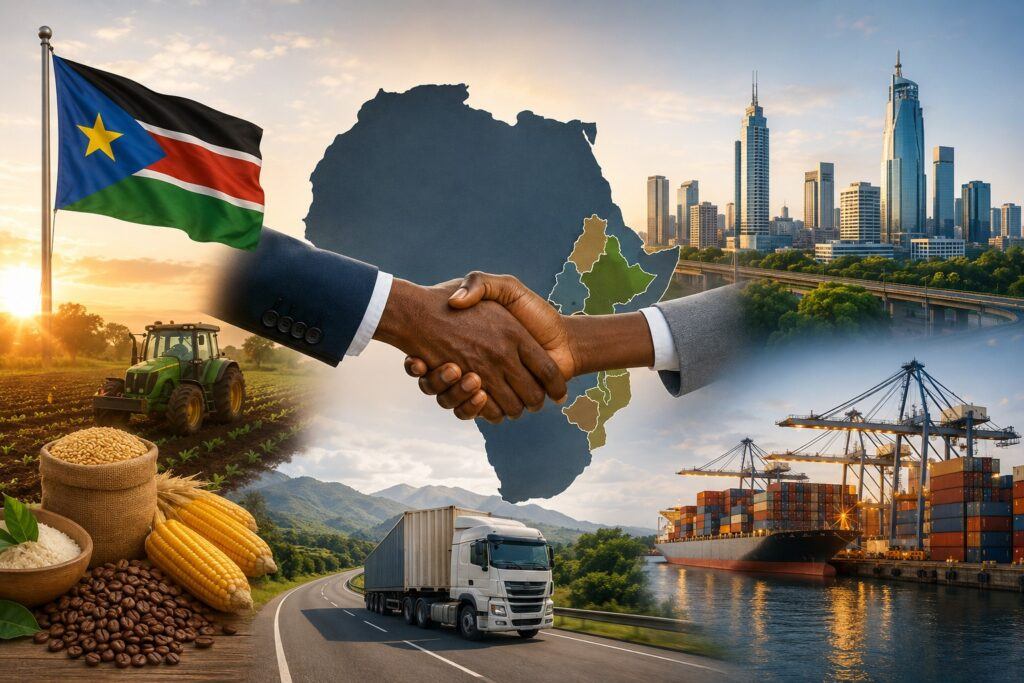
Economic independence begins with where a country buys, sells, and invests. For South Sudan, one of the most important questions is how to integrate regional markets in ways that create jobs, strengthen local industries, and reduce dependence on distant global markets. Our economy has relied heavily on crude oil exports for many years, leaving government revenue vulnerable to international price fluctuations. Building stronger trade relationships within the East African Community offers a more stable path toward long-term prosperity.
Learning how to integrate regional markets is not only about increasing trade. It is about creating an economic system where neighboring countries become reliable customers, suppliers, investors, and development partners. When regional trade grows, wealth circulates closer to home, businesses expand more easily, and economic shocks from distant markets become less damaging.
One practical step is increasing trade with our immediate neighbors. South Sudan already shares borders with several important regional economies. Purchasing manufactured goods, agricultural products, and construction materials from Kenya, Uganda, Tanzania, Rwanda, Burundi, and other East African Community members shortens transport routes and lowers logistics costs. Shorter supply chains help stabilize prices and improve the availability of essential goods throughout the country.
Understanding how to integrate regional markets also requires learning from other parts of the world. Many countries in Latin America spent decades exporting raw materials while importing expensive finished products. This pattern slowed industrial development and left their economies exposed to international financial crises. Similar challenges have appeared in parts of the Middle East and North Africa, where dependence on a single export commodity created economic instability whenever global prices declined.
Other regions demonstrate a different approach. Several countries in Central Asia have strengthened their economies through customs cooperation, regional energy agreements, and shared agricultural markets. Small island states in the Pacific have also benefited by working together through regional trade arrangements that increase their bargaining power in international markets. These examples show that regional cooperation can strengthen national sovereignty rather than weaken it.
For South Sudan, how to integrate regional markets should become a practical national agenda rather than an academic discussion. The country should fully implement the trade commitments contained within the East African Community. Border procedures should become faster, customs systems more efficient, and unnecessary non-tariff barriers removed. A trader should be able to move locally produced goods across neighboring borders with minimal delays and predictable regulations.
Infrastructure is equally important. Roads, bridges, border posts, warehouses, rail links, airports, and digital communication systems connect producers with consumers. A regional market cannot function efficiently if transportation remains slow or expensive. Continued investment in transport corridors should therefore remain a national priority.
Financial integration deserves equal attention. Today, many cross-border transactions still depend heavily on the US dollar. This increases costs for traders and exposes businesses to exchange-rate volatility. Governments and central banks across the region should continue developing regional payment systems and encourage greater use of local currencies for cross-border commerce. Lower transaction costs make regional trade more competitive.
Agriculture provides another opportunity. South Sudan possesses fertile land, abundant water resources, and significant livestock potential. Instead of exporting raw agricultural products with little added value, the country should encourage local processing industries. Milling grain, processing meat, packaging food, and manufacturing timber products before export would create employment while increasing export earnings.
Industrial development should follow the same principle. Rather than relying entirely on imported consumer goods, South Sudan can gradually expand domestic manufacturing by supplying regional markets. Local factories that serve neighboring countries gain larger customer bases than those serving only the domestic market. This creates economies of scale that improve competitiveness.
Knowing how to integrate regional markets also means strengthening public institutions. Ministries responsible for trade, finance, transport, customs, agriculture, and investment must coordinate their policies instead of working independently. Regional integration succeeds when regulations are clear, businesses receive consistent support, and investors have confidence in the legal system.
Private businesses have an equally important role. Entrepreneurs should look beyond national borders when developing products and services. Regional demand offers opportunities for agriculture, manufacturing, logistics, financial technology, tourism, education, healthcare, and professional services. Small and medium-sized enterprises can become regional businesses when governments create favorable trading conditions.
Regional integration also increases Africa’s negotiating strength. A larger integrated market gives African countries greater leverage when negotiating trade agreements with global powers and multinational corporations. Instead of competing individually for investment, regional blocs can negotiate from a stronger position while protecting local industries and workers.
This does not mean turning away from global markets. South Sudan should continue trading with partners around the world, including China, the United States, Europe, the Middle East, and Asia. The objective is balance. Strong regional markets provide resilience while global markets create additional opportunities. The two approaches complement one another.
Ultimately, how to integrate regional markets is a question about national development. Economic sovereignty is strengthened when countries produce more, process more, trade more with their neighbors, and depend less on exporting raw materials alone. Regional integration allows businesses to grow, farmers to reach larger markets, manufacturers to expand production, and governments to build more stable economies.
South Sudan has the opportunity to become an important trading hub connecting East and Central Africa. Achieving that goal will require better infrastructure, stronger institutions, efficient border management, regional financial cooperation, and greater investment in local production. If these priorities remain at the center of national policy, regional integration can become one of the strongest foundations for lasting economic growth and genuine self-reliance.
John Monyjok Maluth
Emerging China-Africa Scholar
Website: https://www.johnshalom.com

