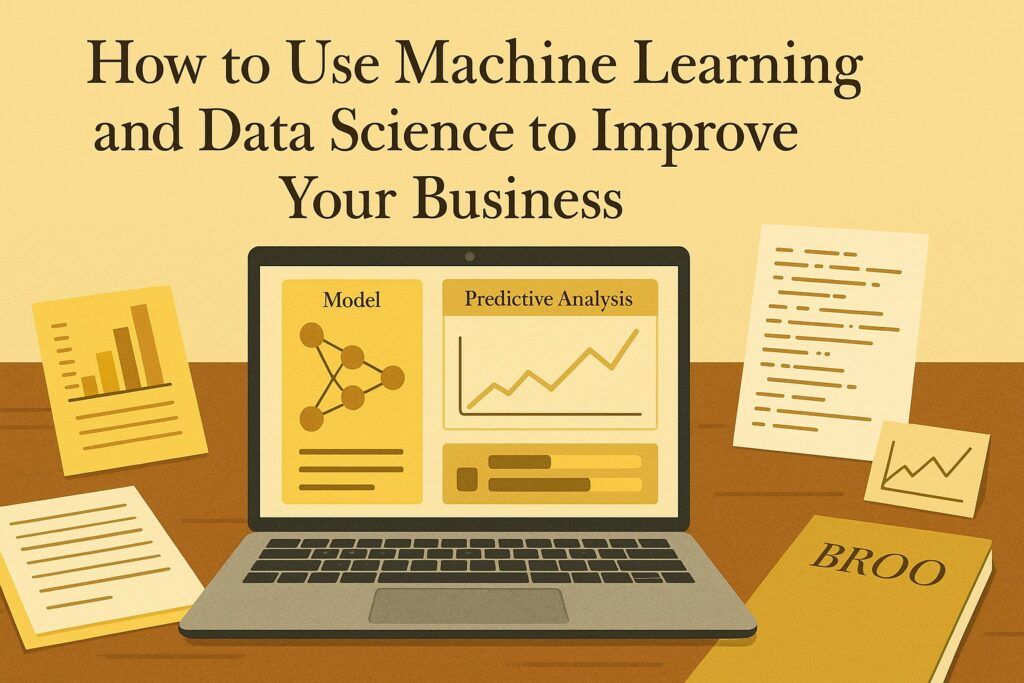
Learn How To Use Machine Learning And Data Science To Improve Your Business Today!
TL; DR
You can use machine learning and data science to improve your business by turning raw data into clear actions. Start with simple questions such as how to reduce costs, increase sales, or keep customers longer. Then collect clean data, build small models or reports, and test them in real decisions. Over time, you can use these tools to predict demand, personalize offers, detect fraud, and automate routine tasks.
FAQs
1. What is the difference between data science and machine learning?
Data science covers the whole process of collecting, cleaning, exploring, and interpreting data. Machine learning is a part of data science that uses algorithms to learn patterns from data and make predictions or decisions.
2. How can machine learning help my business in simple terms?
It can help you predict which customers will buy, which will leave, what demand will look like, and which tasks can be automated. This lets you act earlier, save money, and serve customers better.
3. What are some common business uses of data science?
Typical uses include sales forecasting, customer segmentation, pricing analysis, marketing performance tracking, fraud detection, and operational reports for managers.
4. Do I need a lot of data to start with machine learning?
You do not need millions of records to begin. Even thousands of good quality entries can be enough for simple models. Clean and relevant data is more important than size at the start.
5. What kind of data should my business collect?
Focus on customer data, transactions, website or app activity, product details, and basic operations such as inventory and support tickets. Always follow privacy laws and be transparent with customers.
6. Do I need a team of data scientists to benefit from this?
Not at first. You can start with simple tools, off-the-shelf analytics, or work with a consultant. As value grows, you can hire or train people with data skills.
7. How do I start a first machine learning project?
Pick one clear problem, for example predicting which leads are likely to buy. Gather related data, clean it, try a basic model with common tools, and compare results to your current process.
8. What tools can small businesses use for data science and machine learning?
You can use tools such as Excel with add-ins, Google Analytics, built-in reports from your CRM, and cloud platforms that offer ready models and dashboards without deep coding.
9. How do I know if my data project is successful?
Define a simple measure before you start, such as higher conversion rate, lower churn, better forecast accuracy, or saved staff hours. Then compare results before and after using the model.
10. What risks should I watch out for?
Key risks include poor data quality, biased data, overcomplicated models, and ignoring privacy rules. Start small, review results often, and keep a human in charge of final decisions.
Introduction
The first time I heard the phrase “machine learning,” I was still fighting with basic internet issues in Juba. Power was going off, bundles were expensive, and I was just trying to keep my website alive.
To be honest, it sounded like a luxury. Something for Silicon Valley, not for someone who grew up fishing along the Sobat River and dodging bullets in Nasir.
But as I kept reading and watching what big companies were doing, I noticed something simple. Behind all the complex terms, machine learning and data science were basically doing what our elders had always done:
Look at what has happened before, learn from it, and make better decisions next time.
The difference is that now we have more data than one human mind can handle alone. So we use computers to help us see patterns, make predictions, and test ideas faster than ever.
In this article, I want to bring this topic down to earth. Not to impress you with jargon, but to help you see how you, as a writer, entrepreneur, NGO worker, coach, or small business owner, can benefit from machine learning and data science in a practical way.
I will mix real examples from the business world with stories and lessons from my own journey. The goal is simple: to help you see where these tools fit into your mission, and how to use them without losing your humanity or your integrity.
What Machine Learning And Data Science Really Are
Before the buzzwords, let us use plain language.
Machine learning
Machine learning is when you give a computer many examples, and it learns to make predictions or decisions without you writing every rule by hand.
It is like teaching a child with examples instead of lectures.
You show the model thousands of:
– Transactions marked “fraud” or “not fraud.”
– Emails marked “spam” or “not spam.”
– Images labeled “cat” or “dog.”
– Customers with “bought again” or “never came back.”
After seeing enough examples, the model starts to recognise patterns. Then you give it new data, and it predicts labels or values.
There are different kinds, but for business, you will usually meet these:
- Supervised learning
You have input data and a known answer.
– Example: Predict tomorrow’s sales based on previous sales and seasons.
– Example: Predict whether a customer will cancel a subscription. - Unsupervised learning
You have input data but no labels.
– Example: Group customers into segments based on their behaviour.
– Example: Group products that are often bought together. - Reinforcement learning
The system learns by trial and error, getting rewards or penalties.
– Example: Systems that learn to set prices or allocate resources over time.
– Example: Game-playing agents that learn to win by playing many times. - Deep learning
This uses neural networks with many layers to handle very complex tasks.
– Example: Voice assistants like Alexa.
– Example: Image recognition in medical scans or driverless cars.
Data science
Data science is the wider practice around this. It includes:
– Collecting data.
– Cleaning and organising it.
– Analysing it with statistics and visualisation.
– Building models, including machine learning.
– Turning findings into action and communication.
In other words, machine learning is one powerful tool inside the larger toolbox called data science.
Why This Matters Even For Small And Struggling Businesses
You might say, “John, I am not Netflix or Amazon. I am just trying to sell my books, run my small company, or grow my NGO. Is this really for me?”
Let me answer with a story.
A personal story about small data
Years ago, I started noticing a pattern with my books and articles. Certain topics always drew more attention:
– Purpose, meaning, and calling.
– Survival and resilience in war and poverty.
– Practical digital skills for Africans with low resources.
At first, this was just a feeling. Then I started tracking:
– Which blog posts got more views.
– Which email subject lines got more opens.
– Which book titles and covers got more clicks.
I was doing data science at a very simple level. No fancy models. Just careful watching, counting, and adjusting.
Over time, I learned:
– Which titles attract serious readers.
– Which platforms are worth my time.
– Which topics lead to book sales and long-term relationships.
If you add machine learning on top of this, you can move from:
– “What happened?” to
– “What is likely to happen next?” and “What should we do now?”
That is why this matters, even in South Sudan, Kenya, Uganda, or anywhere with hardships. You can use these ideas to:
– Reduce waste and unnecessary costs.
– Understand your customers better.
– Make smarter pricing, stock, or scheduling decisions.
– Create better products and services.
Let us look at some practical areas where ML and data science can help.
Innovation: Using Data To See Old Problems In New Ways
Sometimes the main value is not in the algorithm itself, but in how data changes your thinking.
Think of a football or basketball team that does not have much money. Traditionally, they would use “expert eyes” to select players. Someone who “looks” talented gets chosen. The rest are ignored.
Then some teams started applying data science. They collected numbers on:
– How often each player scores.
– How they pass, defend, and move.
– How they perform under pressure.
They found players who did not “look” special but delivered great results. Data challenged old beliefs.
The same happened with some delivery companies. They used data and machine learning to:
– Optimise delivery routes.
– Reduce fuel use.
– Shorten delivery times.
The change was not only technical. It changed how managers thought about routing and planning.
What this could mean for you
- NGO or social enterprise
– You may discover that certain interventions work better for specific communities based on data, not guesswork.
– You may find that training plus follow-up calls leads to better outcomes than training alone. - Small retail business
– You might realise that certain products only sell well on certain days, or at certain times.
– Data could show that a small change in layout increases sales. - Online education or coaching
– You can track which lesson formats lead to higher course completion rates.
– You can test different teaching styles and measure retention.
Innovation starts when you stop saying “we have always done it this way” and start asking “what does the data say?”
Exploration: Letting Your Data Surprise You
Not every data project needs a clear goal at the beginning. Sometimes you discover value simply by exploring.
There was a maritime services provider that collected huge amounts of ship data for basic operations. One day, their data scientists decided to explore it further.
They realised that they could use this data to:
– Predict equipment failures.
– Reduce maintenance costs.
– Offer new services to ship operators.
This was not in the original plan. It came from curiosity.
In my own work, I experienced something similar with my website and Wealthy Affiliate posts. When I started exploring:
– Which posts got longer reading time.
– Which ones triggered email replies.
– Which ones led to book sales.
I discovered that some topics I thought were “small” carried huge weight for readers. I also discovered that some heavy topics needed a gentle title and human story to invite readers in.
How you can explore your own data
You can start with simple questions. For example:
– Which products or articles keep showing up in your top 10 every month?
– Which time of day gives you more responses to your posts?
– Which type of email subject line gets the highest open rate?
Even basic exploration can reveal patterns that help you:
– Focus on what works.
– Stop doing what clearly does not work.
– See new service ideas hidden in plain sight.
Prototyping: Testing Bold Ideas With Low Risk
One strength of machine learning is that you can test ideas in a controlled way before going all in.
In finance, some hedge funds have used ML models to test new trading strategies on historical data. The models simulate what would have happened if they had followed a certain strategy in the past. This lets them test many ideas quickly, without risking real money at first.
In healthcare, some teams have used machine learning to analyse images of skin conditions. The models can flag risk cases for a doctor to review, improving accuracy and speed. The point is not to replace the doctor, but to support them.
How this idea applies to your world
- Testing pricing options
– You can train a simple model to predict customer response to price changes using historical data.
– Then you can run controlled experiments on a small segment before changing prices for everyone. - Trying a new product or course
– Use past data on similar offers to estimate demand.
– Test the new offer with a small group and gather data, then refine. - Trying new content formats
– Use engagement metrics to test whether your audience prefers long articles, short posts, videos, or audio for certain topics.
The point is this: instead of guessing, you can use machine learning and data to make smarter experiments.
Optimization: Making Your Operations Lean And Effective
Many companies already use machine learning to fine-tune their operations. For example:
– Retailers use ML to predict demand. That helps them decide how much stock to order, in which locations, and when.
– Hotels use ML to adjust room prices based on demand, events, and competitor prices.
– Logistics companies use ML to plan delivery routes, allocate vehicles, and staff.
These are fancy examples, but the principles are simple:
– Predict what is likely to happen.
– Decide what to do now to get a better outcome.
Simple optimisation ideas for smaller businesses
- Inventory and supplies
– Track sales by day, week, and month.
– Use even simple models or spreadsheet formulas to project future demand.
– Reduce overstocking and stockouts. - Scheduling and labour
– Track busy and quiet times.
– Use data to schedule staff when they are most needed.
– Avoid paying people to sit idle or burning them out at peak periods. - Marketing and content
– Track which channels bring visitors who actually buy or sign up.
– Move more of your time and budget to those channels.
– Reduce effort on channels that only bring vanity metrics.
Machine learning can refine these decisions, but the habit of measuring and adjusting is already a big step.
Personalization: Serving Each Customer As A Person
This is the part most of us have experienced already.
– Netflix suggests films and series based on what you watched before.
– Spotify or Boomplay suggests music based on your listening patterns.
– Online shops recommend products based on your past purchases.
Behind this are machine learning models that:
– Analyse your behaviour.
– Compare you with others.
– Predict what you are most likely to enjoy or buy next.
Banks use similar ideas to:
– Suggest financial products.
– Detect unusual activity in your account.
– Offer loan options based on behaviour, not only raw income.
How smaller creators and businesses can use the same idea
You may not build your own recommendation engine, but you can still apply the principle.
- Email segmentation
– Group subscribers based on what they click.
– Send different messages to different groups.
– Example: readers who like “writing tips” get more craft content, while those who click “business” get more monetisation content. - Product or service bundles
– Track what products or services are often bought together.
– Create bundles and offers based on that. - Content recommendations
– At the end of each article, suggest related pieces based on topic and readership data.
– Create “start here” paths for different reader types.
Personalization is simply using what you know about a person to serve them better. Machine learning helps scale this when you have many customers.
A Story From Africa: Data, Dignity, And Reality
Let me share a story drawn from everyday life in our region.
Imagine a small health NGO working in rural South Sudan. They collect basic data in the field:
– Number of patients in each village.
– Most common illnesses by season.
– Stock levels of medicine.
– Staff workload.
At first, they just file these reports, because “the donor wants them.” Nothing more.
One day, a young worker who is curious about data begins to connect the dots:
– Malaria cases spike in specific villages right after the rains.
– Certain clinics run out of key medicines at the same time every year.
– Staff in some locations are overloaded, while others are underutilised.
They start with Excel, not with machine learning. But once they build a basic dashboard and show it to leadership, something shifts. Decisions become sharper.
Later, with support, they train a simple model to forecast malaria peaks based on weather and previous years. Suddenly, they can pre-position supplies instead of reacting.
I share this because many African organisations are stuck at the stage of “collect data for reports.” With a bit of data science and, later, some machine learning, that same data can turn into:
– Better planning.
– Lower wastage.
– Less suffering for real people.
This is where my pro-humanity stance comes in. These tools must serve people, not crush them.
Ethics: Power Without Wisdom Is Dangerous
Machine learning and data science are powerful. But power without conscience is dangerous.
There are serious risks:
– Privacy invasion when data is collected and shared carelessly.
– Bias when models learn from unfair histories and repeat injustice.
– Opaque decisions when no one can explain why a model denied someone a loan or flagged them as a risk.
– Misuse of surveillance tools by states or companies against vulnerable people.
As someone who has lived through war, displacement, and injustice, I cannot talk about these tools without raising this warning.
If you bring ML and data science into your business or organisation, you must:
- Be honest about data collection
– Tell people what you collect and why.
– Do not take more than you need. - Protect sensitive data
– Use secure storage and access control.
– Think carefully before sharing data with third parties. - Watch for bias
– Look at who benefits and who is harmed by your models.
– Test models on different groups, not only the majority. - Keep humans in the loop
– Do not let a model make life-changing decisions without human review.
– Use models as advisors, not masters. - Align with your values
– Remember my equation: M = {B, D²}. Meaning equals Being plus Doing squared.
– Your Being (who you are) should govern your Doing (what you build with data and ML).
A Practical Roadmap To Start Using ML And Data Science In Your Business
You might now be asking, “Where do I start?”
Here is a simple roadmap you can adapt.
Step 1: Start with a real business question
Forget algorithms for a moment. Ask:
– What do we want to understand better?
– What do we want to predict?
– What decision do we keep making blindly?
Example questions:
– Which customers are likely to leave us in the next three months?
– Which products will we run out of if demand rises by 20%?
– Which marketing efforts are actually leading to sales?
Step 2: Collect and clean your data
Check what data you already have:
– Sales records.
– Customer interactions.
– Website analytics.
– Operational logs.
Start cleaning:
– Remove duplicates.
– Fix obvious errors.
– Standardise formats (dates, names, units).
You do not need perfect data to begin, but you do need usable data.
Step 3: Do basic analysis first
Before you jump into machine learning, do basic analysis:
– Simple counts and averages.
– Trends over time.
– Correlations between variables.
– Simple charts and tables.
Often, these alone will give you actionable ideas.
Step 4: Choose one or two simple ML use cases
Once you have a feel for your data, you can pick one small project, such as:
– A model to predict whether a customer will buy again.
– A model to estimate tomorrow’s demand for each product.
– A model to segment customers into groups based on behaviour.
You do not have to build everything from scratch. There are:
– Cloud services that offer built-in ML tools.
– Open-source libraries for those who can code.
– Consultants and partners who can help you prototype.
The key is to start small, learn, and then decide if deeper investment makes sense.
Step 5: Test, measure, and adjust
After you deploy a model in a small area:
– Compare its suggestions with your old way.
– Measure improvements clearly, such as fewer stockouts, faster response, or higher revenue.
– Listen to staff and customers about how the system affects them.
Then you can:
– Improve the model.
– Expand its use.
– Or stop it if it causes more harm than good.
Step 6: Build skills and culture
Tools change, but skills and culture stay.
– Encourage basic data literacy in your team.
– Train people to ask good questions and read basic charts.
– Hire or partner with at least one person who understands ML and data science at a deeper level.
Over time, you move from “we have some reports somewhere” to “we make decisions informed by data and guided by our values.”
Conclusion
Machine learning and data science are not magic spells for rich countries only. They are tools. Strong, sometimes dangerous tools. But still tools.
Used well, they can help you:
– See hidden patterns in your work.
– Innovate when you have limited resources.
– Test bold ideas with lower risk.
– Optimise your operations.
– Serve each customer in a more personal way.
Used badly, they can:
– Violate privacy.
– Repeat injustice.
– Reduce humans to data points.
As someone who has walked from the Sobat River to Juba, then to Nairobi, and now onto global digital platforms, I see both sides clearly.
I also know this: you do not need to wait until you are “big” to start. You can begin today with:
– A simple spreadsheet.
– A few honest questions.
– A commitment to learning and ethics.
Then, step by step, you can add more advanced tools, including machine learning, as they make sense for your mission.
Remember, Meaning = {Being, Doing²}.
Let your Being guide your Doing, even when your Doing includes algorithms and data. If you keep humanity at the centre of your work, these tools can help you build businesses and organisations that are not only smarter, but also kinder and more just.