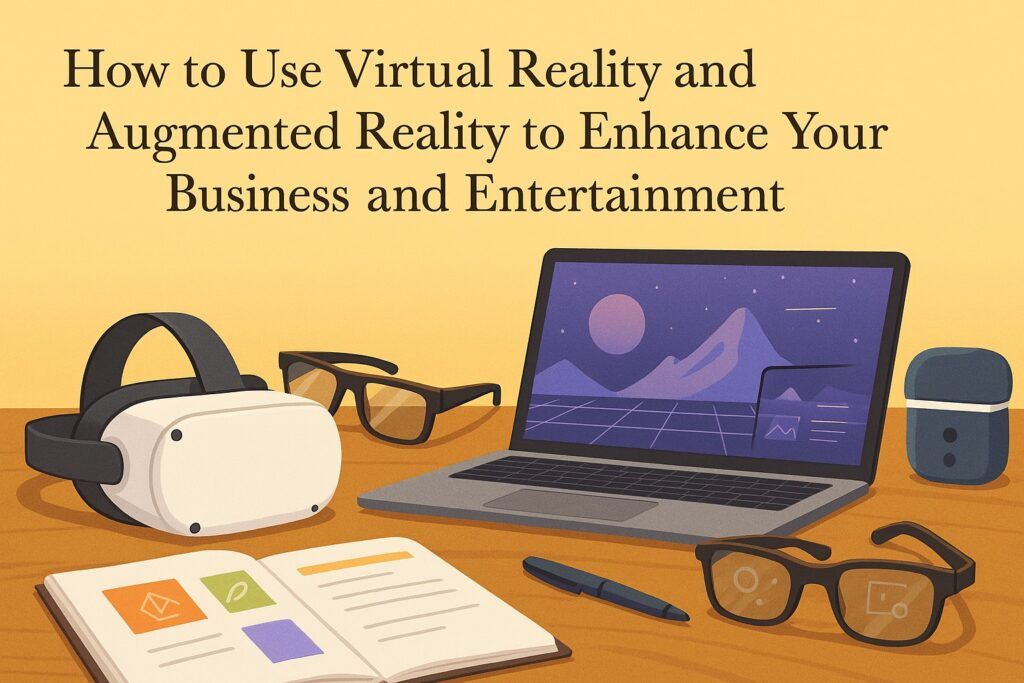
Learn How To Use Virtual Reality And Augmented Reality Today!
TL; DR
You can use virtual reality (VR) and augmented reality (AR) to create more engaging experiences for customers, learners, and audiences. VR places people inside a fully digital world for training, product demos, and entertainment. AR adds digital elements on top of the real world to help with shopping, learning, and games. When you start with simple use cases, use clear goals, and test with real users, VR and AR can help your business stand out and make your entertainment more immersive.
FAQs
1. What is the difference between VR and AR?
VR blocks out the real world and shows a fully digital environment through a headset. AR keeps the real world visible and adds digital images, text, or objects on top of it, often through a phone, tablet, or smart glasses.
2. How can businesses use VR in a practical way?
Businesses can use VR for staff training, virtual tours, product demos, safety drills, and remote collaboration. It lets people practice skills or explore spaces without travel or risk.
3. How can AR help customers during shopping?
AR can let customers see how furniture fits in a room, how clothes might look, or how a product works using their phone camera. This reduces doubt and returns and makes shopping more fun.
4. What are some popular entertainment uses of VR and AR?
VR is popular for games, virtual concerts, travel experiences, and story based adventures. AR is used in mobile games, interactive museum guides, sports overlays, and live event filters.
5. Do I need expensive hardware to start with VR or AR?
Not always. You can begin with affordable VR headsets and mobile based AR apps. High end headsets and custom devices are useful later for advanced projects or professional use.
6. How can small businesses start using VR or AR?
Start with one simple idea, such as a virtual showroom, a 3D product viewer, or an AR guide for using a product. Work with a freelance developer or low code tools, test with a few customers, then improve from there.
7. What skills are needed to create VR and AR experiences?
Useful skills include 3D design, basic programming, user experience design, and an understanding of the hardware platforms. Many tools provide templates that lower the technical barrier.
8. Are VR and AR safe for long term use?
Most people can use VR and AR safely in short sessions. Some users may feel eye strain, dizziness, or motion sickness, so it is wise to allow breaks, adjust settings, and design comfortable experiences.
9. How do I measure success for a VR or AR project in my business?
Track metrics such as time spent, completion of training, sales conversion, customer satisfaction, and support requests. Compare these numbers to your results before using VR or AR.
10. What common mistakes should I avoid with VR and AR?
Do not use VR or AR just because it seems trendy. Avoid complex controls, long sessions without breaks, and unclear goals. Focus on solving a real problem or creating clear value for your users.
Introduction
When I was a boy along the Sobat River, “entertainment” meant real people, real drums, and real dust. If you wanted to see a new place, you walked there, if your legs and the war allowed it.
Years later in Nairobi, I watched a young boy in a shopping mall put on a black headset, and within seconds he started moving his hands like he was fighting monsters in the air. His body was in Kenya, but his mind was clearly somewhere else. He shouted, laughed, stepped back, almost fell. Then he pulled the headset off and said to his father, “I went to space.”
That is the promise and the danger of virtual reality and augmented reality.
Virtual reality, VR, pulls you into a fully digital world. Augmented reality, AR, paints digital information on top of your physical surroundings. Together they are changing how we learn, work, and play, even if in places like South Sudan and Kenya they still feel expensive and distant for many people.
In this article, I want to show you, in simple language, how VR and AR can enhance both your business and your entertainment, and how to use them wisely so that you do not lose yourself in a screen and forget the real world that still needs your attention.
Related: Technology Ultimate Guide
What Are Virtual Reality And Augmented Reality?
Before you think about “using” these tools, you need a clear picture of what they are.
Virtual reality (VR)
VR creates a fully digital environment. You wear a headset that covers your eyes, sometimes headphones, and often hold controllers in your hands. The device tracks your head and hand movements, then shows you a world that reacts in real time.
You can:
- Walk through a virtual factory.
- Stand in the middle of the ocean with whales swimming around you.
- Sit in a virtual classroom with other avatars.
Your body is in one place, but your senses tell you a different story.
Augmented reality (AR)
AR, on the other hand, keeps you in the real world and adds digital information on top.
You can use:
- A smartphone camera that shows your living room with a virtual sofa placed in it.
- AR glasses that show repair instructions while you look at a machine.
- Filters on social media that add ears, hats, masks, or text to your face.
I often say it like this:
- VR replaces your surroundings with a digital world.
- AR enriches your surroundings with digital elements.
Both can be used for serious work and for pure entertainment. The difference is how deeply they pull you away from physical reality.
Major Benefits Of VR And AR
Like any strong tool, VR and AR have real benefits when used wisely.
Immersive learning and training
When I worked with training and capacity building, I saw how hard it is to explain certain tasks using only words or static pictures.
Imagine:
- Training a new driver on a dangerous road.
- Teaching a nurse how to handle an emergency operation.
- Preparing workers for fire, chemical leaks, or conflict situations.
With VR, you can:
- Simulate those conditions without putting anyone in danger.
- Let people repeat the same scenario until they are confident.
- Test their reactions and correct mistakes safely.
With AR, you can:
- Guide someone step by step as they repair a machine.
- Show them digital arrows, labels, and tips on top of real equipment.
- Reduce the need for an expert to be physically present.
In parts of Africa where skilled trainers are few and travel is costly, this can be a major advantage one day.
Safer practice without real risk
There are tasks where a mistake in the real world costs lives or serious money.
Examples:
- Flying a plane.
- Operating on a patient.
- Controlling heavy machinery.
VR allows learners to:
- Make every possible mistake in a virtual environment.
- Receive instant feedback.
- Repeat until the right habits are formed.
You cannot remove all risk from real life, but you can reduce the number of “first-time” mistakes.
Access to places and information that are otherwise unreachable
For many years, I could not just buy a ticket and visit the world’s museums, landmarks, or universities. Even today, many African students will never set foot in certain places physically.
VR and AR can, at least partly, close that gap.
VR can let you:
- Walk through a museum in Europe or America from a classroom in Juba.
- Visit historical sites, ancient cities, or faraway ecosystems.
- Attend a global conference from a small internet café.
AR can let you:
- Point your phone at a piece of equipment and see live data.
- Scan a page in a textbook and watch a 3D model appear.
- Translate signs or labels in real time.
These tools will never replace a real trip, but they can open doors for those who would otherwise see only pictures.
Better memory and engagement
When your brain uses more senses at once, it is more likely to remember.
VR and AR can:
- Combine sight, sound, motion, and sometimes touch.
- Place you inside the story instead of asking you to look from outside.
- Create emotional reactions that stick in your memory.
A lesson about history in a normal classroom can be boring. The same lesson in VR, where you stand “inside” a historical event, will feel different. You are more likely to remember what you saw and felt.
Major Negative Effects Of VR And AR
Now, let us be honest. These tools are not angels. They bring real problems too.
Privacy and data concerns
VR and AR devices can collect:
- How you move your eyes.
- How you move your hands and body.
- Your facial expressions and voice.
- Where you are and what you look at.
This data can be used to:
- Improve the experience.
- Personalize content or adverts.
- Track your behaviour in ways you do not see.
In regions where laws are weak and companies hungry, this can become a serious privacy issue. Whose data is it? How is it stored, secured, and used? Most users never read the terms; they just accept.
Physical and mental health strain
If you have ever used a low quality headset, you know the feeling:
- Dizziness.
- Nausea.
- Eye strain.
- Headaches.
- Tiredness.
Even with better devices, long sessions can cause:
- Loss of spatial awareness when you remove the headset.
- Neck and shoulder pain from holding unnatural positions.
- Deep tiredness from heavy sensory stimulation.
For some people, VR can become a kind of escape. When the real world is too painful, the digital world is almost too attractive. That can lead to unhealthy patterns, like gaming or social VR for hours while life outside falls apart.
Social and emotional risks
These technologies can:
- Reduce face to face interaction if used badly.
- Make people more comfortable with avatars than with real humans.
- Expose users to harassment or abuse inside virtual spaces.
I worry especially about young people who already suffer from low self esteem. If they spend too much time comparing themselves to edited AR versions of others, or hiding behind their own filters, their grip on reality can weaken.
Ethical and moral questions
As VR and AR experiences become more realistic, questions appear, such as:
- Who is responsible for what people do inside these virtual spaces, especially when those actions affect real life?
- Who owns virtual assets, identities, and spaces?
- How much harm can be done by repeated exposure to simulated violence or abuse, even if “no one really died”?
These are not science fiction issues. They are already here. We need philosophers, lawyers, teachers, and communities to think about these questions, not just engineers and business people.
VR And AR In Business
Now let us look at some practical areas where VR and AR can already enhance business.
Training and education
If you manage a team, you already know the challenge of training: time, cost, and uneven quality.
VR can help you:
- Train employees in hazardous environments without real risk.
Example: fire drills, chemical handling, conflict situations. - Standardise training.
Every new employee can experience the same scenario, not just “what the trainer remembers to say.” - Save costs long term.
After the initial investment, you can reuse scenarios many times.
AR can help you:
- Provide step by step instructions while workers look at real equipment.
- Reduce human errors by highlighting the right part to adjust or the right button to press.
- Connect remote experts to local workers, sharing the same view.
In places where skilled technicians are few, AR could allow one expert in the city to support many workers in remote locations.
Product development and prototyping
Designing a new product, especially physical ones like machines or devices, can be expensive. You build, test, change, and rebuild.
VR and AR can reduce this pain.
With VR, designers can:
- Walk around a full size 3D model.
- Test different shapes, colours, and arrangements.
- Notice usability problems early, such as buttons placed in awkward positions.
With AR, teams can:
- Overlay digital designs on real spaces.
- See how a new machine would fit in an existing factory.
- Show clients a realistic preview without building the real thing yet.
This speeds up decision making and cuts down on physically wrong designs.
Marketing and sales
Here is where many businesses first see the power of VR and AR.
Examples:
- Virtual showrooms
A VR experience can let customers “walk through” a car, house, hotel, or store without leaving their home. That is powerful when travel is difficult, like it often is across African borders. - Try before you buy with AR
Customers can:- See how a sofa looks in their real living room.
- Try a lipstick shade on their own face with their phone camera.
- Place a virtual machine in their workshop to see if it fits.
- Immersive campaigns
A brand can create a short VR story that takes users into the “world” of the product. If done with respect and creativity, this can be memorable and increase loyalty.
Of course, gimmicks fade quickly. The real question is: does the VR or AR experience solve a real customer problem, such as reducing uncertainty or saving time? If yes, then it is worth considering.
VR And AR In Entertainment
Entertainment often adopts new technology first. VR and AR are no different.
Live events
Many of us cannot attend the big concerts, sports events, or conferences we see online. Tickets, visas, and flights are not always possible.
VR offers:
- Virtual seats at live events.
You can “sit” near the stage, look around, and feel part of the crowd, without leaving your room. - Multiple viewing angles.
Instead of watching a single TV angle, you can choose where to look.
AR can:
- Overlay statistics or player info on a live football match.
- Add interactive elements to concerts, like lyrics, visual effects, or fan messages visible through an app.
This turns passive watching into a more active experience.
Museums and cultural spaces
I think about African museums and cultural sites here. Many of our stories are not well preserved or are locked in places few can visit.
VR can:
- Build full virtual tours of museums.
- Recreate historical scenes based on oral histories and research.
- Allow schoolchildren in remote areas to “visit” national sites.
AR can:
- Add extra information to physical exhibits through a phone.
- Bring statues or artefacts to “life” with animation when scanned.
- Provide multilingual audio guides for visitors.
This can help preserve and spread culture in ways that go beyond a dusty room with silent objects.
Social media and shared experiences
You already see simple AR in social media filters. That is a small taste of what is coming.
VR is moving toward:
- Virtual meeting spaces where people hang out as avatars.
- Shared “watch parties” where people in different countries watch the same movie inside a virtual cinema.
AR is moving toward:
- More advanced effects on photos and videos.
- Shared AR experiences, for example, friends seeing the same virtual object in the same physical place when they look through their phones.
This can increase connection, but it can also increase comparison and pressure. We will have to choose how we use these tools, not just follow whatever trend appears.
How A Small Business Or Creator Can Start
You might think, “All this sounds expensive and far away.” That is sometimes true, but you can start small.
- Use light AR in your marketing
- Add simple AR filters or effects to promote a book launch or event.
- Use apps that let customers see your product in their environment, if that fits your business.
- Offer 360 degree or immersive content
Even without full VR, you can:
- Record 360 degree videos of a location or behind the scenes process and upload them to platforms that support this format.
- Use these videos to stand out from normal flat content.
- Partner with others
If you cannot build VR or AR experiences yourself, you can:
- Work with a local developer, designer, or agency.
- Join existing platforms that offer VR spaces for events or training.
- Always start with the problem
Before you spend any money, ask:
- What problem for my customer will this solve?
- Will VR or AR make things clearer, safer, or more enjoyable?
- Is there a simpler way to achieve the same outcome?
Technology should serve your mission, not replace it.
Conclusion
Virtual reality and augmented reality are not toys for rich countries only. They are tools that will slowly reach our towns, schools, and businesses, just like the phone and the internet did.
Used well, they can:
- Help us train people better and safer.
- Speed up product design and decision making.
- Give customers more confidence in what they buy.
- Open new doors in entertainment, culture, and social connection.
Used poorly, they can:
- Invade our privacy.
- Harm our bodies and minds.
- Isolate us from real communities.
- Confuse our sense of responsibility and truth.
My simple advice is this:
- Do not fear these tools, study them.
- Do not worship them, question them.
- Do not ignore real life, even as you explore digital worlds.
In the end, VR and AR are only extensions of our old desire to imagine, to learn, and to escape. The real work is still with our hearts, our choices, and our values.
If you decide to use virtual reality and augmented reality in your business or entertainment, let them help you become more human, not less.
Let them support your Being and your Doing, so that your Meaning grows stronger, not weaker, in this very real world that still needs your full attention.