TL; DR:
Nationalism in Africa is often born in songs of freedom, raised fists, and promises to end colonial shame. South Sudan followed that road, from long wars to a new flag in 2011. But after independence, deep problems inside the new country surfaced: tribal mistrust, weak institutions, personal power struggles, and citizens treated as followers instead of partners. Nationalism can be a good force when it protects people, honours diversity, and turns citizens into co-builders of a shared home. It becomes dangerous when it turns into tribe against tribe, or when leaders use patriotic words to hide greed and abuse. The South Sudan story reminds Africa that a flag and anthem are not enough. Real nationhood needs honest citizens, accountable leaders, fair systems, and a bigger loyalty to truth and human dignity than to any group or person.
Introduction: When Flags Go Up and Lives Stay Down
1.1 The day of independence and the day after
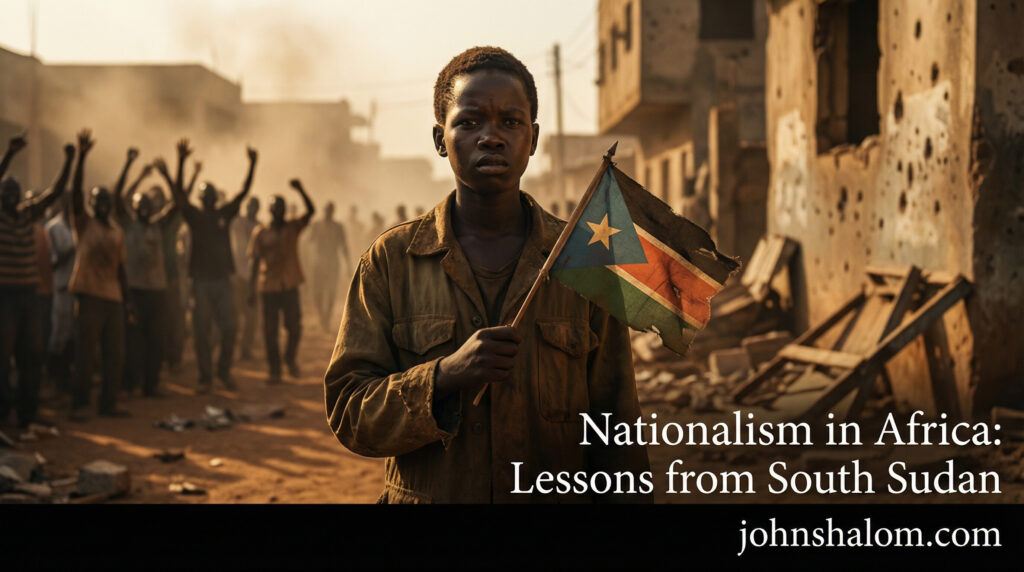
On 9 July 2011, South Sudan’s flag went up before the world. People danced in dusty streets and crowded churches. Those who had buried relatives during the long war felt that the dead could now rest. A new nation had been born.
I remember the stories and the photos, and I remember the quiet questions that followed. What happens after the flag goes up. Does suffering end by decree. Does a new name on a map automatically change the way people treat one another.
Across Africa, many countries know this pattern. Independence arrives with hope. Then, slowly, reality reveals cracks that were already there.
1.2 Why this matters beyond South Sudan
South Sudan is not the only country with this story, but because it is the youngest state on the continent, its lessons are fresh. It is like watching an African drama in fast motion. In a short time we have seen:
- Liberation heroes becoming political rivals.
- Tribal loyalties competing with national promises.
- Peace deals signed and broken.
- Ordinary people wondering if independence was a dream or a doorway.
These are not only South Sudanese questions. They are African questions.
What Is Nationalism, Really?
2.1 Love of country versus worship of country
Nationalism, at its best, is a strong love for one’s country and a desire to see its people safe, dignified, and free. It says, “We are no longer property of foreign powers; we will govern ourselves.”
At its worst, nationalism becomes worship of the country, or more often of a ruling group. It excuses abuse with the slogan of unity. It treats critics as enemies. It says, “If you question the leaders or the army, you are against the nation.”
A healthy love of country leaves space for truth and correction. An unhealthy form tries to silence them.
2.2 The promise of African nationalism
African nationalism promised to end racial and colonial humiliation, recover stolen dignity, and let African cultures breathe again. Freedom fighters spoke about justice, African socialism, pan-African unity, and the right of people to own their destiny.
These promises were not lies. Many were deeply sincere. The problem was that the path from colonial subject to responsible citizen was longer and harder than many expected.
Africa’s Experience with Nationalism in Brief
3.1 From colonial rule to flags and anthems
In the mid and late twentieth century, African states moved out of colonial rule into independence. Borders often stayed as they were drawn in Europe. Inside those borders lived many tribes and regions with old wounds and few shared institutions.
Nationalism in that season had at least three tasks:
- Remove foreign rule.
- Build a sense of “we” among different groups.
- Create systems that could serve all citizens fairly.
Most countries achieved the first task. The second and third remain unfinished in many places.
3.2 From liberation movements to ruling parties
Liberation movements in Africa often became the ruling parties after independence. Some managed the switch with humility and service. Others continued to act as liberation armies in civilian clothes.
Where liberation movements did not transform into accountable institutions, nationalism froze into one-party rule, leader worship, and the use of security forces to protect a few instead of all.
South Sudan: A Young Nation with Old Wounds
4.1 A long struggle for recognition
South Sudan’s nationalism grew out of decades of war and marginalisation inside a larger Sudan. People in the south felt ignored, underdeveloped, and treated as second class. Church leaders, traditional leaders, students, and soldiers all carried this burden.
The desire for a separate state was not just about land. It was about dignity, identity, and the right to shape one’s future. The cost was high. Many died, many fled, many grew up as refugees.
4.2 Independence without inner healing
When independence came, the old external enemy was gone from the new map, but old internal wounds remained. Arms were still everywhere. Trust between some communities was low. Strongmen and commanders had their own loyal forces.
The result was painful. Violence returned, not from the old capital in the north, but from inside the new country. Citizens saw that you can remove a foreign flag without removing injustice, greed, and mistrust from hearts and systems.
4.3 What this reveals about nationalism
South Sudan’s story shows clearly that:
- Nationalism that is built mainly on shared anger against an external enemy may collapse when that enemy is gone.
- If tribe remains stronger than citizenship, a new state can break from within.
- If power is treated as a personal trophy, not as a trust, the nation bleeds while leaders compete.
These lessons are not to shame South Sudan, but to warn and help the rest of Africa, and even South Sudan itself, to take a different road.
Key Lessons from South Sudan for African Nationalism
5.1 Independence is a starting line, not a finish line
Raising a new flag is like cutting a ribbon at the opening of a house that still needs furniture, water, and electricity. Independence gives legal space to build. It does not do the building for you.
If citizens and leaders think the struggle is finished at independence, they may relax at the very moment they need to work hardest on:
- Fair laws.
- Strong institutions.
- Healing between communities.
- A culture of accountability.
South Sudan reminds us that the real struggle after freedom is nation building, not only state creation.
5.2 Tribe cannot be ignored or worshipped
Some African leaders try to ignore tribe, speaking only of the nation. Others openly build power on ethnic lines. Both approaches are risky.
South Sudan shows that:
- You cannot wish tribal loyalties away. They are real and deep.
- You cannot safely build a country by feeding those loyalties against others.
The better road is to:
- Acknowledge tribe as part of identity.
- Protect all tribes equally under the law.
- Teach layered belonging, so that people can be proud of their roots and still act as citizens of one country.
5.3 Peace deals without changed habits do not last
South Sudan has seen several peace agreements. Each one raised hope for a season. But when old habits returned, violence often followed.
This is a wider African lesson. A peace deal is not magic. It must be matched with:
- Real security reforms.
- Inclusion of communities beyond the big men.
- Honest sharing of resources.
- Justice that is seen to be fair.
Without these, nationalism becomes a flag over an unresolved war.
You might also like: The Ultimate Guide to Political Journalism: Ethics, Challenges, and Impact in the Modern World
Rethinking Nationalism: From Emotion to Responsibility
6.1 Nationalism as daily duty, not occasional feeling
If nationalism is only about singing on independence day or cheering the national team, it will not hold a country together.
A healthier form of nationalism looks like this:
- Citizens who obey just laws and challenge unjust ones.
- Civil servants who serve all, not only their group.
- Business people who pay fair taxes and refuse corruption.
- Voters who look at character and ideas, not only tribal ties.
In other words, love of country becomes a daily duty, not an occasional emotion.
6.2 The missing role of the individual
We often blame leaders, parties, or foreign powers for the state of our nations. They do carry big responsibility, but they are not alone.
Every citizen has a role. When ordinary people:
- Pay bribes.
- Hide criminals because they are relatives.
- Spread hate speech.
- Refuse to work with those from other groups.
They are also weakening the country. South Sudan’s story shows what happens when enough individuals act in fear and self-interest instead of in hope and responsibility.
Faith, Nationalism, and Idols
7.1 When nation replaces God
Faith communities in Africa often pray for the nation, which is good. The danger comes when the nation or the ruling party begins to take the place of God in people’s hearts.
Signs of this include:
- Treating leaders as if they cannot be questioned.
- Calling any critic a traitor, even if they speak truth.
- Using sacred language to defend political actions that clearly harm people.
At that point, nationalism becomes an idol. It demands sacrifice at any cost, even when God’s commands about justice, mercy, and truth are being broken.
7.2 A better way to love country
From a Christian view, the better order is:
- God above all.
- Human beings made in God’s image.
- Tribe and nation as gifts to serve those humans.
This order allows you to love your country enough to tell it the truth, to refuse injustice done in its name, and to work for its good even when you are disappointed.
Practical Steps for Citizens and Leaders in African States
8.1 For ordinary citizens
Each person can:
- Learn basic civic rights and duties, not only party slogans.
- Refuse to hate neighbours because of tribe or political choice.
- Vote and speak based on conscience, not just group pressure.
- Support local peace efforts and community dialogues.
- Raise children to see themselves as both members of a people and citizens of a wider country.
8.2 For leaders and public servants
Leaders who have watched South Sudan’s pain can choose to:
- Share power in real ways, not only on paper.
- Build institutions that outlive individuals.
- Protect journalists, churches, and civic groups that tell hard truths.
- Avoid using security forces to settle personal or party disputes.
- Remember that history will judge them by lives improved, not by years in office.
8.3 For writers, teachers, and faith leaders
Stories, sermons, and lessons shape nationalism more than official documents. Those who teach and write can:
- Tell stories of cross-tribal cooperation, not only stories of revenge.
- Explain history honestly, including our own mistakes.
- Connect faith to public life, calling people to integrity, forgiveness, and service.
- Help people see that true patriotism sometimes means saying “no” to injustice done by one’s own side.
Conclusion: A Flag, a People, and a Future
Nationalism in Africa began as a cry for dignity and self-rule. South Sudan’s journey shows both the beauty of that cry and the danger when it is not matched with deep change in hearts, habits, and systems.
A flag is important. It tells the world that a people exists. But a flag cannot feed a child, heal a wound, or reconcile enemies. Only people, acting with courage and humility under God, can do that.
For South Sudan and for Africa, the lesson is clear. We do not need less love for our countries. We need a better type of love, one that:
- Refuses to sacrifice human beings for political games.
- Holds leaders and citizens to the same moral standard.
- Treats tribe as a gift, not a weapon.
- Sees the nation as a shared home, not as a prize.
If we can learn that lesson, even from painful stories, nationalism can grow into something wiser: a steady commitment by both leaders and citizens to build countries where justice, peace, and human dignity are normal, not rare.
If you would like to know more about my path as a writer, including the struggles, lessons, and small signs of progress along the way, you can read the full story on my Wealthy Affiliate blog here: https://my.wealthyaffiliate.com/johnmaluth/blog
FAQS
Q1: Is nationalism always a bad thing in Africa?
A: No. Nationalism helped many African countries break free from colonial rule and recover dignity. It becomes harmful when it turns into ethnic hatred, leader worship, or an excuse for injustice.
Q2: What makes South Sudan’s nationalism story important for other countries?
A: South Sudan is a recent example of a long struggle for independence followed by internal conflict. Its experience shows how quickly hope can be damaged when tribe, power struggles, and weak institutions are not addressed.
Q3: How can ordinary people support healthy nationalism?
A: By living as responsible citizens: obeying fair laws, rejecting corruption, treating other groups with respect, and speaking up for justice and peace in their own circles.
Q4: Can I be proud of my tribe and still be a good national citizen?
A: Yes. You can honour your culture while also respecting the rights of other groups and working for the good of the whole country. The key is not to support wrong actions just because they benefit “your people.”
Q5: What role does faith play in shaping nationalism?
A: Faith can remind people that God stands above all flags and that every human being has value. It can call both leaders and citizens to humility, truth, and mercy, and warn against turning the nation or a leader into an idol.