
TL;DR
In places like South Sudan, you do not learn the meaning of tribalism and nationalism from a dictionary. You learn it from markets, funerals, wedding speeches, and sometimes from the sound of gunfire. Tribalism gives you roots, language, and belonging, but it can also turn neighbors into enemies. Nationalism invites you to widen your loyalty to include all citizens under one flag, but it can become arrogant if it forgets other nations.
I grew up between clans and rivers, first as “one of us” in my tribe, later as a South Sudanese citizen, and now as a writer who moves between many communities. My brother died in a war that was bigger than our family. That loss still asks me a simple question: will I use my voice to defend only “my people,” or will I help build a country where many peoples can live together?
Why These Words Matter Where I Grew Up
When you grow up along the Sobat River, you do not sit in neat classrooms learning the theory of identity. You see tribal lines in who sits together, who marries whom, and who runs when fighting starts.
As a boy, I heard people say “our people” and “their people” long before I heard the word “nation.” I watched relatives argue about cattle and borders, then share the same river water a few days later. I saw how quickly a joke could turn into a tribal insult, and how a small insult could wake up old wounds.
Later, when I moved to other areas and finally to Juba, I began to hear more about “South Sudan” as a whole. There were flags, speeches, and promises. That is when I realized I was carrying two strong feelings inside me: deep love for my tribe and a growing love for a country that was still learning to walk.
Defining The Two Sides Clearly
To avoid confusion, let us define the two clearly:
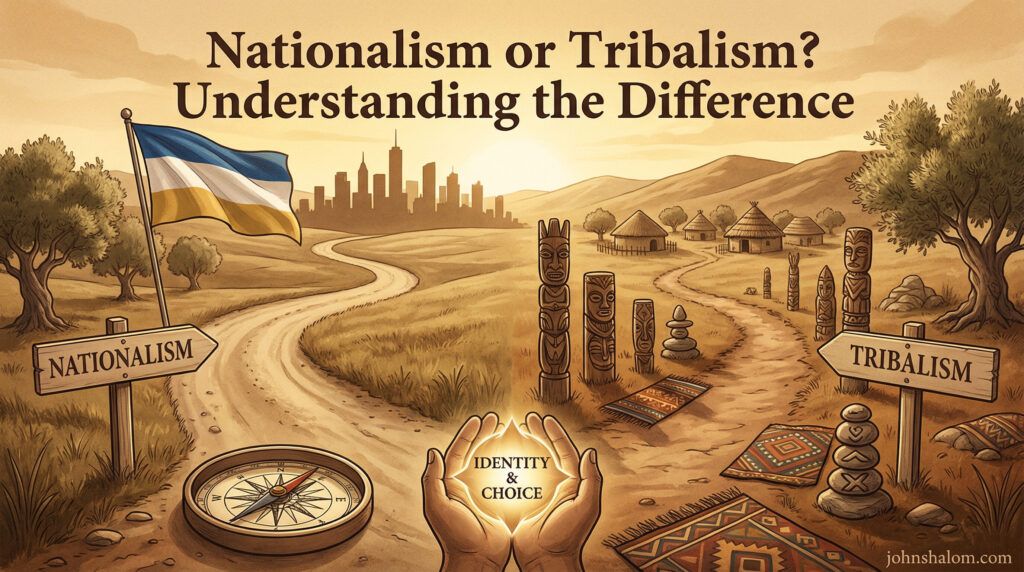
Tribalism is loyalty to your clan, tribe, or ethnic group above all else. It says, “My people first, everyone else later, if ever.”
Nationalism is loyalty to the nation as a whole. It says, “We belong together as citizens, even if we do not share bloodlines.”
Both can sound noble when we speak quickly. The difference is in what they produce.
Tribalism often builds fences.
Nationalism, when healthy, builds bridges.
You might also like: The Ultimate Guide to Political Journalism: Ethics, Challenges, and Impact in the Modern World
The Sweet Side Of Tribalism: Roots And Belonging
Before we condemn tribalism completely, we must admit its sweet side. Your tribe is often your first home.
I still remember evenings when my grandmother told us stories about our ancestors. She spoke of warriors who defended the village, farmers who fed many mouths, elders who settled disputes with patience. Those stories were tribal, yes, but they planted something good in me: identity, pride, and courage.
My tribe gave me:
A language in which to say “I love you” and “I am sorry.”
Songs that held history inside their rhythm.
Names that carried meanings from our land and struggles.
Without that, I would be like a tree without roots. That is one gift of tribal belonging.
The Bitter Side Of Tribalism: When Roots Become Ropes
The same roots that keep you steady can also tie you down. Tribalism becomes bitter when it blinds you to the humanity of others.
As a child, I lived through the fighting between Lou Nuer and Jikany Nuer in the early 1990s. Bullets did not ask for clan names, but human beings did. People suffered not because of what they personally had done, but because of the group they belonged to. I learned quickly that you could become a target because of who your grandparents were, not who you were.
Years later, after violence in another part of the country, a relative called me and said, half serious and half joking, “Why are you not coming to join us in this fight?” Before I answered, he added, “No, stay where you are and fight with the pen.” Even in his joke, you could hear how natural it is for people to expect tribal loyalty first.
I have seen men fight in the market, not over the real problem in front of them, but over stories their fathers told them about “those people.” Tomatoes on the ground, sugar in the dust, and peace gone, all because the ancestors’ anger was still alive in the grandchildren’s mouths.
That is the bitter side of tribalism: it punishes individuals for old wounds and turns neighbors into permanent suspects.
Nationalism: The Bigger Family
Nationalism says, “Yes, I love my tribe, but I also love my country.” It is like taking your family table and adding more chairs.
Instead of feeding only your cousins, you make space for the teacher from another tribe, the nurse from another region, the soldier who protects all citizens, not only yours. You begin to care about roads, schools, hospitals, and laws that serve many communities, not only your own.
True nationalism is not blind loyalty to a government. Governments change. Nationalism is love for the land, the people, and the shared future. It asks you to sacrifice some tribal advantage when it destroys the wider good.
My Brother’s Sacrifice: One Life For A Larger Story
In 1989, my elder brother went to war in the battle of Nasir. He left as a son and brother, but he also left as someone who believed in a larger dream. He did not go only to defend our cattle or our village. He went because people were talking about freedom for South Sudan.
He never came back.
As a boy, I first felt his death as a family wound. As I grew older, I started to see it as part of a national story. He had paid a price that reached beyond our clan. His blood mixed with the blood of others from many tribes who fought on the same side.
When I think about nationalism, I cannot separate it from his face. He reminds me that loving a country is not about flags alone. It is about men and women who choose the bigger picture, even when the cost is their own life.
When Nationalism Goes Wrong
Nationalism is not always pure and gentle. It also has a dark side.
When nationalism becomes extreme, it turns into arrogance. It begins to say, “Our nation is better than all others. Our people matter more than outsiders. Everyone else must bow or leave.” History on other continents shows how such thinking leads to wars, oppression, and even genocide.
In Africa, we have our own versions. A leader can hide selfish plans behind the language of “protecting the nation.” Citizens can use national pride to silence criticism, even when their own people are suffering.
Healthy nationalism builds unity inside and respect outside. Unhealthy nationalism builds walls inside and contempt outside.
Walking The Tightrope: Root And Tree Together
So what do we do with these two strong forces?
We do not need to kill tribal identity in order to love our nation. In fact, a strong nation is often made of strong tribes that know their place within a larger story.
Think of it like this:
Your tribe is your root.
Your nation is your tree.
Without roots, the tree falls over.
Without the tree, the roots rot underground, hidden and forgotten.
Balance means you can proudly say, “I am Nuer” or “I am Dinka” or “I am Bari,” and in the next breath say, “and I am South Sudanese.” The first gives you a starting point; the second gives you a shared destination.
What This Looks Like In Daily Life
All this talk must land in daily choices. Here are some simple ways this balance appears in ordinary days:
You correct your own people when they speak hatefully about another tribe.
You vote, work, and speak not only for your clan’s interest, but for fair systems that help every citizen.
You teach your children their mother tongue and also the national language, so they can communicate beyond the village.
You enjoy your traditional dances and also stand respectfully when the national anthem is played.
In my own life, moving between different communities has forced me to practice this. I have been “ours” and “theirs” in the same week. It has not been easy, but it has taught me that if we build only on tribal loyalty, we will keep reliving the same fights. If we build on nationalism without respect for roots, we will feel shallow and easily divided.
The future belongs to those who can hold both.
A Final Picture For South Sudan
When I think of South Sudan, I do not wish for a country without tribes. That would be like wishing for a rainbow with only one color.
I dream of a South Sudan where many tribes are woven together like threads in one cloth. Each thread keeps its color and story. Nationalism is the hand that weaves them into something that can cover and protect many lives.
In that future, a person can say:
“I am Dinka, I am Nuer, I am Bari, I am Shilluk, I am Anyuak, and I am South Sudanese.”
That simple “and” is the difference.
If you would like to know more about my path as a writer, including the struggles, lessons, and small signs of progress along the way, you can read the full story on my Wealthy Affiliate blog here: https://my.wealthyaffiliate.com/johnmaluth/blog
Reflection Questions
- Do you feel more loyalty to your tribe or to your nation most days? Why do you think that is?
- Can tribal pride and national pride live together in your heart, or does one push out the other when conflict comes?
- What lessons from your tribe’s history could help the whole nation if more people knew them?
- How can you keep your love for your country strong without looking down on other nations or peoples?
- If you were teaching your children about identity, which would you teach first: tribe, nation, or both side by side? Why?
FAQS
- Can I love my tribe and still be a good nationalist?
Yes. You can honor your tribe’s language, culture, and history while also working for fairness, peace, and progress for all citizens. The problem comes when love for tribe makes you support injustice against others. - How do I know when my tribal loyalty has gone too far?
It has gone too far when you defend wrong actions just because “he is our man,” when you hate people you have never met, or when you feel happy about another tribe’s suffering. - What can ordinary citizens do against tribal politics?
You can refuse to vote only along tribal lines, challenge hateful talk in your home and community, support leaders who speak for all citizens, and build friendships across tribal lines. - Is nationalism always good?
No. Nationalism is good when it promotes unity, justice, and shared responsibility. It becomes harmful when it turns into pride, hate for other nations, or blind support for bad leaders. - How can I teach my children both tribal and national identity in a healthy way?
Share stories from your tribe and also from your country’s wider history. Teach them their mother tongue and the national language. Take them to cultural events and national celebrations. Most of all, show them through your own choices that loving your own people never requires hating others.
This article raises an important and timely distinction, especially in a world where identity is increasingly compressed into slogans. I appreciate how it separates nationalism as a shared civic commitment from tribalism as an exclusionary emotional reflex. That difference is often blurred in public debate, to the point where any form of collective identity is treated with suspicion or, conversely, defended without reflection.
What resonated with me is the idea that nationalism can be rooted in responsibility, memory, and care for a shared home, while tribalism tends to shrink moral concern to those who look or think the same. One builds structures. The other builds walls. When fear becomes the primary organizing principle, tribalism thrives, even if it dresses itself in patriotic language.
The article also made me reflect on how easily media and algorithms intensify tribal instincts by rewarding outrage over nuance. In that sense, resisting tribalism today requires conscious effort and humility, not just good intentions.
My question is this: how do you see individuals cultivating a healthy form of national belonging in everyday life without sliding into tribal thinking, especially in digital spaces where identity is constantly amplified and simplified?
Farid, thank you. You framed the difference in a clean way, and your question is the real work.
I think healthy national belonging starts small and stays practical. A person can love a shared home without turning love into a weapon. In everyday life, that looks like choosing civic habits over identity heat: obeying fair rules even when your group could benefit from breaking them, paying your dues, protecting public property, serving your neighbors, and defending the dignity of people you may never agree with. Tribalism is loud. Nation-building is often quiet.
In digital spaces, I use a few simple filters to avoid sliding into “my side” thinking.
First, I separate criticism from contempt. I can challenge a leader, a policy, or even a cultural habit without insulting whole communities.
Second, I refuse identity shortcuts. If a post makes me hate millions of people in one sentence, I treat it as propaganda, even if it flatters my group.
Third, I practice “steel-manning” before sharing. I try to restate the other side’s best argument in one honest sentence. If I cannot do that, I have not understood enough to speak.
Fourth, I keep my moral circle wide even when my loyalty circle is close. I can prioritize my country and still insist that minorities, migrants, and political opponents remain human, protected, and heard.
Last, I watch my emotions. When a post gives me quick pleasure through outrage, I slow down. Algorithms reward anger because anger spreads. A citizen has to be slower than the feed.
If you had to name one pressure that pushes you toward tribal thinking online, what is it for you: fear, humiliation, loyalty to a group, or exhaustion?