TL; DR
This article shows how sharing honest, gentle words at the table can begin to heal damaged relationships. Instead of using meals as silent battlefields, families can turn them into safe spaces for apology, gratitude, and simple stories. Poetry here does not only mean formal poems. It includes kind sentences, blessings, small jokes, and thoughtful words that soften hearts. When people speak with care at the table, they slowly replace bitterness with connection, and the home starts to feel like a place of healing again.
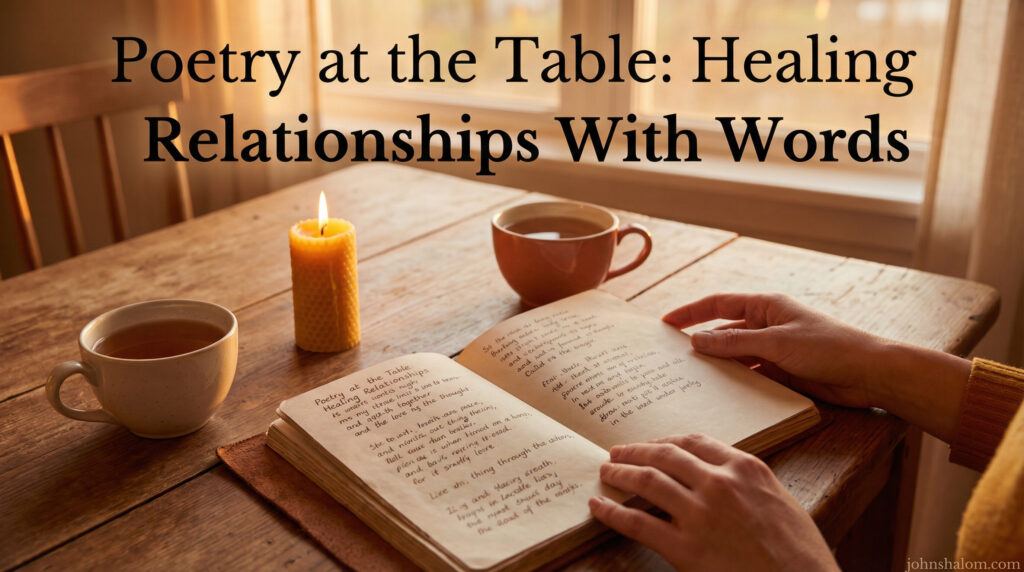
In my childhood home, the table was more than a place to eat. It was a stage for laughter, arguments, advice, and sometimes a silence so heavy it felt like a third parent. Plates were simple, food was often modest, and yet invisible things were always being served with the meal – respect, frustration, affection, disappointment, hope. We did not call it poetry, but looking back, that is exactly what it was. The table was where words took shape and became either knives or bandages.
We did not have fine plates, but we had phrases that returned every evening. We did not always have enough meat, but we always had something to say. Sometimes that “something” healed. Sometimes it hurt. Every child in that house became a quiet student of language long before we learned grammar in school. We learned that “You are lazy” and “You are tired, rest a little” carry very different weights in the same mouth. We learned that one sentence could poison an evening, and another could rescue it.
Words as Daily Bread
We often think of food as what sustains us, but words feed the soul just as much. You can eat a full plate and still go to bed hungry if no one at the table has spoken to your heart. A simple “How was your day?” can be more nourishing than the soup. A parent’s gentle reminder, a sibling’s joke, even a grandmother’s story – these are poetry. Not written in books, but written into memory.
Like food, words can either heal or harm. A kind word digests easily. A cruel one sits in the stomach like a stone. You can swallow it, but you keep feeling it long after the plates are cleared.
I remember one evening when tension was high after a family quarrel. Nobody wanted to speak first. You could hear only spoons touching plates, like tiny metal wars. My mother, instead of lecturing, recited a proverb in a calm voice: “A house divided eats in silence, but a house united eats in song.” We all looked at each other, and someone snorted. Then another laughed. The wall cracked. The quarrel did not disappear magically, but it shrank. Her words were poetry that made peace cheaper than apology.
That was one of my earliest lessons: good words, offered at the right time, can do what long speeches and angry explanations fail to do. They do not force people. They invite them back into relationship.
The Humor of Healing Words
Of course, sometimes healing comes wearing the face of humor. In our home, jokes were often the first aid kit for wounded pride.
Once, I spilled porridge all over the table just as we were about to eat. The hot mess rolled toward my father’s papers like a small white flood. I froze, already tasting the coming rebuke. Instead, he looked at the table and said, “John, this is the first time I have seen food baptized.”
Everyone burst out laughing. The joke did not only save me from a scolding. It also saved the evening. My clumsiness became a shared story, not a private shame. That is the beauty of poetic humor. It turns accidents into memories instead of grudges.
Another time, one of my siblings was offended and refused to talk during the meal. The silence was thick. My father looked at him and said, “Are you on a hunger strike or a talking strike? At least choose one.” Even he could not hide the smile that escaped. The tension fell a little.
Humor in healing words is not about making light of pain. It is about making the pain light enough to carry together. It says, “Yes, something went wrong, but we are still on the same side.”
Poetry as a Bridge Between Hearts
Words at the table are bridges between generations. Children hear their parents’ struggles and victories, and parents hear their children’s dreams and confusions. That exchange is poetry in motion.
At the table, you might hear a father say, “When I was your age, I walked ten kilometers to school.” You might roll your eyes, but part of you also learns about endurance. You might hear a child say, “Today a teacher embarrassed me in class,” and if the parents listen well, that child learns that home is a safe place to bring shame and fear.
Without that bridge, meals become mechanical. People chew fast, escape to their rooms, and build friendships with screens instead of family members. Everyone fills the stomach, but no one feeds the heart. With that bridge, meals become almost holy. Not because the plates are special, but because the words are.
You might also like: The Complete Poetry Writing Guide: From Inspiration to Publication
In South Sudan, where displacement and war often scatter families across borders and camps, the poetry of table conversations keeps roots alive. A simple story about an ancestor, told over stew or dry bread, becomes a bridge between the past and the future. The child who hears, “Your grandfather stood firm in this place” eats more than food. He eats identity.
That is why losing family meals is dangerous. It is not only the food we lose, but the poetry of relationships. When there is no shared table, everyone starts to eat alone – and slowly, they start to live alone, even inside the same house.
When Silence Speaks Like a Poem
Not all poetry is spoken. Sometimes the most healing “word” at the table is silence. Not the heavy silence of anger, where everyone looks down and cuts the food like an enemy. I am talking about the gentle silence that comes after forgiveness, when nobody knows what to say, but everyone feels the storm is over.
A quiet hand passing bread across the table can say more than a thousand apologies. A mother serving food to the same neighbor she quarreled with yesterday speaks a poem with her actions: “We will not stay enemies.” A father who keeps his voice soft when he could shout writes a line of peace his children will remember years later.
Even silence, when shared with love, is a kind of verse. It says, “We are still here together. We have not run away.”
The Table as a Small Parliament
Sometimes I think every nation’s parliament should spend one week acting like a family table. No microphones. No cameras. Just food and honest words.
If poetry can heal families, it can heal nations. Imagine leaders eating together at one table, not reading prepared speeches, but telling real stories. “This is what war did to my village.” “This is what hunger did to my people.” “This is what corruption did to my children’s school.” Then another leader responds, not with an argument, but with a story from his side.
Many conflicts would soften before dessert arrived. Because once you share food and words, it becomes harder to share bullets and bombs. You may still disagree. You may still argue. But it is difficult to fully hate the person whose bread you just tasted and whose story you just heard.
In South Sudan, I have seen warring communities share meals after reconciliation ceremonies. There were speeches, yes, but the real healing happened when plates were passed and jokes were shared. The act of eating together did more to restore trust than any document. Food and words together have a power no signed paper can replace.
The Nation Begins at the Family Table
We sometimes talk about “nation building” as if it only happens in offices, conference halls, and international meetings. But in truth, nations are built or broken at family tables. The child who hears only insults and curses at home may grow up to speak that same language in politics. The child who sees forgiveness practiced at the table may carry that habit into offices, schools, and armies.
If we want leaders who do not insult, belittle, and threaten, we must raise children in homes where such language is not normal. The table is where that training begins.
Every time a parent says at dinner, “We do not talk like that in this house,” a future citizen is shaped. Every time siblings are guided toward peaceful words, future communities become slightly safer. Every story about an ancestor who kept peace instead of revenge is a small investment in national healing.
We want peace agreements. We also need peaceful tables.
Poetry For The Wounded
Not every table is a safe place. Some readers know tables where words are used as weapons. Where every meal is a test. Where children eat quickly to escape comments that cut deeper than knives.
If that is your story, then you know how powerful words can be. You know that a sarcastic remark can spoil a plate of good food. You also know how rare and beautiful a kind sentence can feel.
The good news is that painful tables do not have to define the future. One person can start to speak differently. One new family can build a healthier pattern. One day, you may sit at your own table and decide, “In this house, we will not repeat what harmed us. We will speak a different kind of poetry.”
Pausing To Listen
Poetry at the table is not only about speaking. It is also about listening. You cannot heal relationships if your mouth is always full of your own stories.
Real listening is a kind of respect. When a child tells a long, confused story about their day and the parent stays present, that is poetry. When an elder repeats the same story for the tenth time and the grandchildren still listen, that is honor. When a husband allows his wife to finish a painful sentence without cutting in with excuses, that is healing.
Listening tells the other person, “Your inner world matters to me. You are not alone with your thoughts.” The table becomes a safe place to unload the day’s burdens.
When we stop listening at the table, people start looking for other places to be heard. Sometimes they find good places. Sometimes they find dangerous ones.
My Mother’s Quiet Legacy
My mother was not a published poet, but her table verses remain carved in my memory. She did not stand in pulpits, but she preached through questions, proverbs, jokes, and prayers.
She could correct us with one short line: “Anger burns faster than food.” She could comfort with another: “Even the poorest family is rich if they eat together.” She could end a conflict by pushing a plate toward the person who had just offended her. That simple act said, “You are still one of us.”
Her leadership was quiet but strong. Through her, I learned that poetry is not only something people write. It is something people live. The right words, shared at the right time, can heal a family faster than medicine.
Her legacy challenges me today. When I sit at a table with others, I ask myself: What am I serving with this food? Just calories, or also courage? Just plates, or also peace?
A Call To Recover Table Poetry
Today, many homes have a new “guest” at the table: the phone. Parents scroll. Children watch. The television talks louder than family members. The poetry of the table is replaced by background noise.
We do not need to hate technology to fix this. We simply need to decide that, at least once a day or a few times a week, the table will be sacred. Phones away. Television off. People present.
Start small:
“Tell me one funny thing from your day.”
“What is worrying you this week?”
“What did you learn today that surprised you?”
These questions are not complicated. But if you ask them regularly, they create a rhythm of sharing. Over time, that rhythm becomes normal. Children grow up expecting the table to be a place where hearts are fed, not just stomachs.
Poetry at the table does not require special education. It requires attention. It is not reserved for writers. It is available to any parent, any elder, any young person who chooses words that build instead of break.
The next time you sit to eat, remember: you are not only serving food. You are serving sentences. You are not only washing plates. You are washing hearts. The table is waiting. The poem is yours to speak.
If you would like to know more about my path as a writer, including the struggles, lessons, and small signs of progress along the way, you can read the full story on my Wealthy Affiliate blog here: https://my.wealthyaffiliate.com/johnmaluth/blog
Reflection Questions
- What words at your family table still echo in your heart today, whether from parents, grandparents, or siblings?
- How has humor helped heal conflicts during meals or conversations in your home or community?
- In what practical ways can daily words act like poetry that feeds and repairs relationships, rather than damaging them?
- How can families revive the art of meaningful table conversations in a distracted world filled with phones and screens?
- What “poetry” do you want to leave behind for your children or community through the way you speak and listen at the table?
FAQs
- What does “poetry at the table” actually mean?
It means using thoughtful, kind, and creative words during shared meals. This can be short prayers, blessings, honest feelings, or small stories that bring people closer instead of pushing them apart. - How can words at the table help heal relationships?
Because the table is where people sit face to face. When we choose gentle words instead of attacks or silence, we open doors for apology, forgiveness, and understanding. Over time, these small moments rebuild trust. - Do I need to be a poet to practice this idea?
No. You only need a willing heart. Simple sentences like “Thank you for cooking,” “I am sorry for yesterday,” or “I am proud of you” are already poetry when they are sincere. - What if my family is not used to talking during meals?
You can start slowly. Ask one easy question, share one short story from your day, or offer a simple word of thanks. Consistency matters more than perfection. Over time, others may join in. - Can this work in tense or broken families?
It will not fix everything in one night, but it can begin a new habit. Even in tense homes, one calm voice that chooses healing words can change the atmosphere step by step, especially when joined with patience, prayer, and wise boundaries.