TL; DR
This article explains how traditional rituals help tribes and communities heal after violence and war. Instead of only signing peace agreements on paper, people gather under trees, in churches, at rivers, or in village squares to confess, grieve, exchange cattle, share meals, and call on God or ancestors as witnesses. These rituals of peace restore broken trust, honor the dead, and remind former enemies that they still share land, language, and future children. When done honestly, they turn raw pain into a shared promise: “We will not repeat this.”
When I was a boy, I thought peace came from shaking hands and saying, “Sorry.” Grown men would stand in front of a crowd, nod at each other, and everyone would clap. I believed that was it. Later, I discovered that for tribes, peace is far more complicated, and far more beautiful. It is not just speeches. It is rituals.
These rituals are like bridges, carrying communities from bitterness back to belonging. They remind enemies that they are also brothers and sisters, bound by blood, cattle, land, stories, and even shared jokes. They do what ordinary words cannot do.
Why Rituals Matter After Conflict
Conflict does not only wound bodies. It wounds trust.
A spear heals faster than a broken relationship. You can bandage a cut. You cannot bandage suspicion. People might stop shooting, but still sleep with their shoes on, ready to run. They may walk on the same road, but their hearts walk on separate paths.
That is why promises are not enough. You can say “We forgive” in public and still plan revenge in private. Rituals are different. They turn peace into action. They make forgiveness visible. They tell everyone, from children to elders, “We are starting again.”
Think of rituals as medicine. If the wound is deep, you cannot just blow on it and walk away. You need a process, a treatment plan, something serious and shared. Rituals carry that weight. They are not decoration. They are a kind of surgery for the soul of the community.
My First Memory of a Peace Ritual
I remember one gathering after a fight between two clans. I was still a boy, standing at the back, half curious and half afraid. Tension hung in the air like smoke.
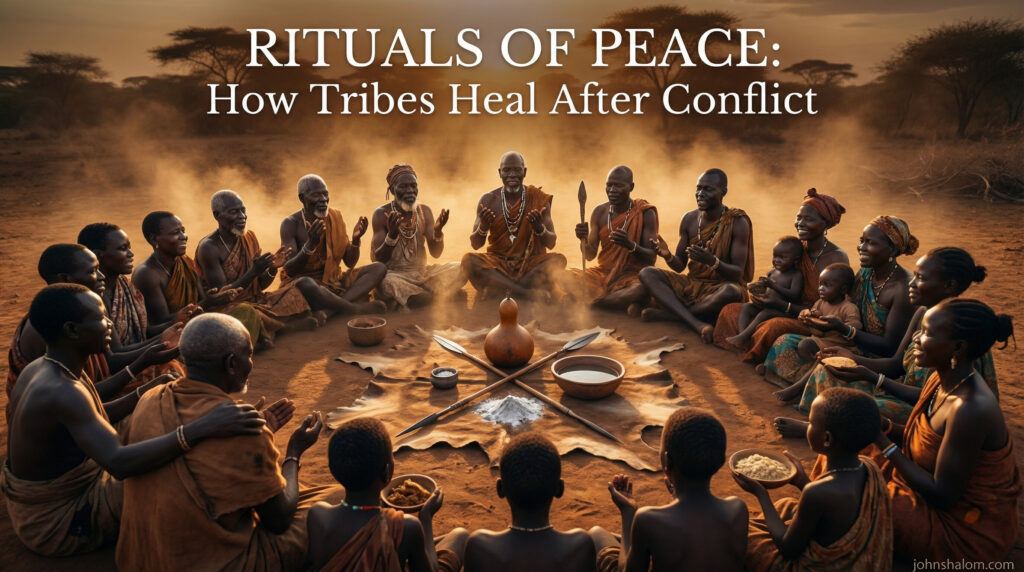
The elders brought a white bull. People sat in a large circle. You could see old scars on some faces, fresh anger in others. Yet everyone remained. No one walked away.
The elders spoke. They named the dead. They named the wrongs. They named the shame. Then they led the bull forward. Prayers were spoken in slow, careful words. The bull was slaughtered. Blood touched the ground.
After that, something important happened. The meat was shared between the two sides. Men who might have faced each other in battle now tore the same meat with their hands. Children carried pieces to people they had been warned to fear. Women stirred pots that would feed former enemies.
As a child, I did not understand why killing an animal could bring peace. Later, I realized the bull was a symbol. By eating together, the clans were saying, “Your life is safe with me. My fire will not cook your blood again. My spear will not hunt you.”
The ritual made peace taste real. It moved the agreement from the mouth to the stomach, from the air to the body.
What Rituals Do Inside the Heart
Words of peace can be cheap. Rituals are not. They demand time, presence, and often sacrifice.
Rituals of peace usually carry three strong messages:
- We are willing to lose something for peace.
Cattle are expensive. Goats, grain, or beer all cost something. When people bring these to a peace ritual, they are saying, “I give up part of my wealth so this relationship can live.” - We are willing to be seen together.
It is one thing to whisper forgiveness in private. It is another to sit side by side in public, in front of children, elders, and neighbours. Rituals force people to be visible. That visibility holds them accountable. - We are willing to share risk.
Drinking from the same gourd, eating the same meat, sitting under the same tree: all these acts say, “I trust that you will not poison me, stab me, or ambush me after this.” That shared risk is what rebuilds trust.
You can tell a child, “We are at peace now.” But when that child sees former enemies eating together and laughing, the lesson lands much deeper.
Humor in Peacebuilding
Even peace rituals carry moments of comedy. In fact, some of the most healing seconds arrive through mistakes.
At one event, an elder rose to bless the people. He wanted to mention two rival clans by name, asking peace on both. In his nervousness, he mixed up the names. The wrong clan came first. Then he tangled the words completely and had to start again.
The crowd burst into laughter. For a moment, everyone forgot who had fought whom. The elder laughed too and said, “Even my tongue is tired of fighting.”
That small joke did something important. It released tension. Faces softened. Shoulders dropped. People who had been sitting stiffly now relaxed. Humor did not replace the ritual, but it opened the heart so the ritual could do its work.
Sometimes a shared laugh in the middle of reconciliation does more than a long, serious speech. It reminds everyone, “We are human again, not just enemies.”
Rituals Across Tribes
Different tribes have different ways of healing after conflict, but the purpose is the same. They all declare, “We are bound again.”
Some common patterns include:
– Sharing food:
Eating from one pot, one animal, or one gourd. Food turns strangers into guests, and guests into friends.
– Exchanging cattle or gifts:
Cattle paid as blood compensation, or goats given as a sign of regret. These are not just payments. They are physical signs that life is valued.
– Washing hands together:
Water is poured over hands from the same container. It symbolizes cleansing of past wrongs.
– Planting trees:
A tree grows slowly. Planting it together says, “We are planning to live long enough to see this grow.”
– Dancing and singing:
Former enemies dance in the same circle. Songs change from war songs to songs of praise, thanksgiving, or unity.
In South Sudan and other parts of Africa, one powerful sign is drinking from the same gourd. It is risky. You could be poisoned. That is why it is powerful. When someone drinks first and passes the gourd, they are saying, “I am not here to kill you. I am here to live with you.”
You might also like: The Ultimate Guide to Political Journalism: Ethics, Challenges, and Impact in the Modern World
What Modern Peace Processes Often Miss
Today, many peace deals are signed in hotels, under air conditioners, far from villages where bullets actually flew. Leaders shake hands for cameras. They sign documents, pose with foreign envoys, then go back to guarded compounds.
These steps matter. Laws, agreements, and written texts are important. But if peace never reaches the cattle camp, the market, the church, the mosque, the riverbank, or the village path, it remains weak.
Rituals bring peace down to the ground.
Imagine if, after signing papers in the city, leaders went back to the villages and joined elders in traditional rituals. Imagine them eating from the same pot as former enemies, dancing the same dances, sitting in circles where widows and orphans could see them.
Paper can announce peace. Rituals help people believe it.
Peace Rituals at Home
Rituals of peace are not only for tribes. Families also need them.
My mother had her own simple way of making peace after quarrels. When voices had cooled and anger was still hiding in corners, she would say, “Let us eat.” She did not wait for perfect apologies. She just called us to the table.
We would sit there, awkward at first. Then someone would crack a joke. Someone else would smile. Slowly, conversation returned. Food did what arguments had failed to do.
Her rule was consistent: no one slept hungry and angry if she could help it. Eating together became our small ritual of peace.
You might think, “That is just a meal.” But that is the point. Rituals do not have to be grand. They have to be repeated. They have to carry meaning. In our house, eating together after conflict said, “We belong to each other, even when we have hurt each other.”
The Cost of Skipping Rituals
When communities skip peace rituals, wounds remain open, even if guns go quiet. People return to their homes, but their hearts do not return. They keep stories of pain alive without giving them a road toward healing.
That is when cycles of revenge continue. A boy grows up hearing only about how “they killed us,” with no memory of how “we made peace.” He carries that one-sided story into adulthood, and one day he may act on it.
Rituals give the next generation another story. They allow parents and elders to say, “Yes, there was war. Yes, there was blood. But there was also this day, when we sat, ate, prayed, laughed, and decided to stop.”
If that story is missing, the past remains open like an untreated wound.
Adapting Peace Rituals for a New Age
The world is changing, but the need for peace rituals remains. The question is how to adapt them without emptying them.
Some ideas:
– Combine traditional and faith-based practices.
Elders can lead cultural rituals. Pastors, imams, or other faith leaders can pray and teach. Both voices can support each other instead of competing.
– Involve youth actively.
Let young people help organize, record, or sing at these events. Some may film the ritual so that the story of peace, not just the story of war, spreads online.
– Add shared work to shared meals.
After a ritual, tribes can clear a road, repair a school, or dig a water point together. Working side by side continues the message: “We are building something together now.”
Rituals must stay meaningful, not just become shows. The heart of the ritual is more important than the form: real risk, real sacrifice, real togetherness.
The Quiet Strength of Rituals
In the end, rituals of peace are not magic tricks. They do not erase history. They do not guarantee that conflict will never return.
But they do something very important. They give communities a turning point they can point back to. A day, a place, a shared act where enemies chose a different road.
For a boy watching from the back of the crowd, that turning point becomes part of his inner map. Years later, when he faces anger or revenge, he remembers that day. He remembers the white bull, the shared meat, the laughter, the tears, the prayers. And he knows another path is possible.
Rituals of peace do not only heal old wounds. They also teach the next generation how to walk away from new ones.
If you would like to know more about my path as a writer, including the struggles, lessons, and small signs of progress along the way, you can read the full story on my Wealthy Affiliate blog here: https://my.wealthyaffiliate.com/johnmaluth/blog
Reflection Questions
- What peace rituals from your culture or community have you witnessed or heard about?
- How does sharing food or drink change the atmosphere after conflict, even inside a family?
- What role does humor play in dissolving tension during reconciliation, whether in tribes or in homes?
- How can modern nations learn from tribal peace rituals to build stronger unity, beyond paper agreements?
- What small “ritual of peace” could you practice in your family, school, church, mosque, or community today?
FAQs
- What are “rituals of peace” in tribal communities?
They are agreed practices used after conflict to repair relationships. This can include public apologies, cleansing ceremonies, shared meals, compensation with cattle or other goods, prayers, and symbolic acts such as breaking weapons or washing each other’s feet. - Why are these rituals important after conflict?
Because war does not only break bodies and houses, it breaks trust. Rituals give people a structured way to face what happened, name the wrongs, mourn the losses, and begin living together again without constant fear and revenge. - How do rituals of peace involve both justice and forgiveness?
Many traditions combine payment or compensation for harm with words of apology and blessing. Justice is honored when losses are recognized and repaid as far as possible. Forgiveness is invited when both sides publicly agree to stop revenge and move forward. - Can modern courts and tribal rituals work together?
Yes. Courts can handle crimes according to national law, while rituals of peace deal with community relationships, spiritual wounds, and ongoing coexistence. When they work side by side with respect, both law and culture are strengthened. - What lessons can wider society learn from these tribal practices?
That healing after conflict is not only about signatures and speeches. It requires honest storytelling, shared mourning, visible acts of repair, and repeated promises kept over time. Without this, peace stays shallow and can easily break again.