TL; DR
This article explains why roads, hospitals, schools, and clean water cannot grow on lies. Taxes are the shared fuel of development, but trust is the engine that makes them move. When citizens believe their money is stolen, they hide income, avoid paying, and treat the state as an enemy. When leaders handle public money with honesty, report clearly, and punish theft, people are more willing to contribute. The piece argues that no amount of foreign aid or big projects can replace a simple agreement between citizen and state: “I will pay fairly, and you will use it faithfully.”
When I was young, I thought taxes were like curses. We don’t have words for them in other parts of the country, even in 2026. Grown-ups lowered their voices when they spoke about them. I would hear, “The government eats our money,” and in my mind I saw officials chewing coins like roasted groundnuts. Nobody sat me down to explain what taxes were for. All I heard was anger, suspicion, and jokes.
Later, as I learned more about how nations work, I discovered something important. Taxes are not the curse. The real curse is when taxes are collected and managed without honesty. Because once trust disappears, even the best development plans collapse like a hut built on wet sand.
Why Taxes Matter
Every road, clinic, school, and public service needs money. That money does not fall from the sky. It comes from people. Taxes are simply the way a community or nation agrees to contribute so that shared needs can be met.
In many African villages, people understand this principle very well, even if they do not use the word “tax.” Think of the community goat. Everyone contributes a little, so that when there is a funeral, wedding, or emergency, there is meat available. Without that goat, everyone scrambles in panic when a big need comes.
In the same way, without taxes, nations scramble, beg, and borrow for every bridge, every hospital, and every teacher’s salary.
The principle is simple:
Citizens contribute.
Leaders manage honestly.
Everyone benefits.
The problem begins when one part of this equation disappears, especially honesty.
Trust: The Currency Behind the Currency
Tax systems run on more than money. They run on trust.
People do not just hand over cash. They hand over confidence. They are saying, “I believe this money will be used for something that benefits us all.”
If citizens see new roads, working street lights, medicine in hospitals, and teachers in classrooms, they may complain about taxes, but they will still pay. They feel the connection between their contribution and their daily life.
But if they see leaders driving luxury cars while schools have no chairs, if they see hospitals without medicine and roads full of potholes, they begin to feel foolish. Why should they pay into a system that seems to reward only a few?
I once asked a friend why he did not bother with taxes. He laughed and said, “Why should I? The last road they promised still looks like a cattle path.”
His answer was not really about money. It was about honesty. His heart had already withdrawn long before his money did.
Humor in Taxation
Taxes also produce comedy. People often express their deepest frustration through jokes.
I heard of a man who claimed his ten goats were “dependents” so he could reduce his taxes. The officer asked, “Do your goats go to school?” He said, “Yes, they learn how to eat grass.” The whole office laughed.
On the surface, it is just a joke. Underneath, it reveals something serious: when people no longer trust the system, they use humor to cope and to protest. Laughter becomes a safe way to say, “We do not believe you anymore.”
You can measure the health of a tax system by listening carefully to the jokes people make. When every joke about taxes is about theft, waste, and foolish leaders, trust is already broken.
Lessons From the Market
Markets are living classrooms for understanding taxes and trust.
A market seller pays a small fee for her stall. She may complain about it, but she pays if she sees the benefits:
– The market is cleaned.
– There is some security.
– The space is organized enough for customers to move.
She feels the link between her payment and the order around her.
But if officials collect that fee and never clean the market, never fix the broken latrine, never provide security, something changes. The seller begins to say, “Why should I pay? Nothing comes back.” She hides her income, refuses the fee, or pays only when forced.
Trust and service walk together. When service disappears, trust soon follows. When trust disappears, people stop cooperating, even if the law demands it.
My Mother’s Goat and the Nation’s Budget
My mother taught me honesty long before I knew what a tax form looked like. In our home, food was often limited, but fairness was not.
If there were five pieces of bread and six children, she made sure no one was cheated, even if she went hungry. When she shared meat, she watched each plate carefully so arguments did not break out.
Her message was simple:
– Everyone matters.
– What is shared must be shared fairly.
– A leader eats last.
That kind of honesty built trust in our home. We knew she would not steal from us, even quietly. We knew her decisions, even when hard, were for the good of all.
Nations need the same spirit. Leaders who are willing to “eat last”, to lose personal comfort in order to serve the public, become the foundation of real development. Budgets, taxes, and public funds are simply larger versions of the family pot at home.
You might also like: The Ultimate Guide to Political Journalism: Ethics, Challenges, and Impact in the Modern World
Why Development Needs Honesty
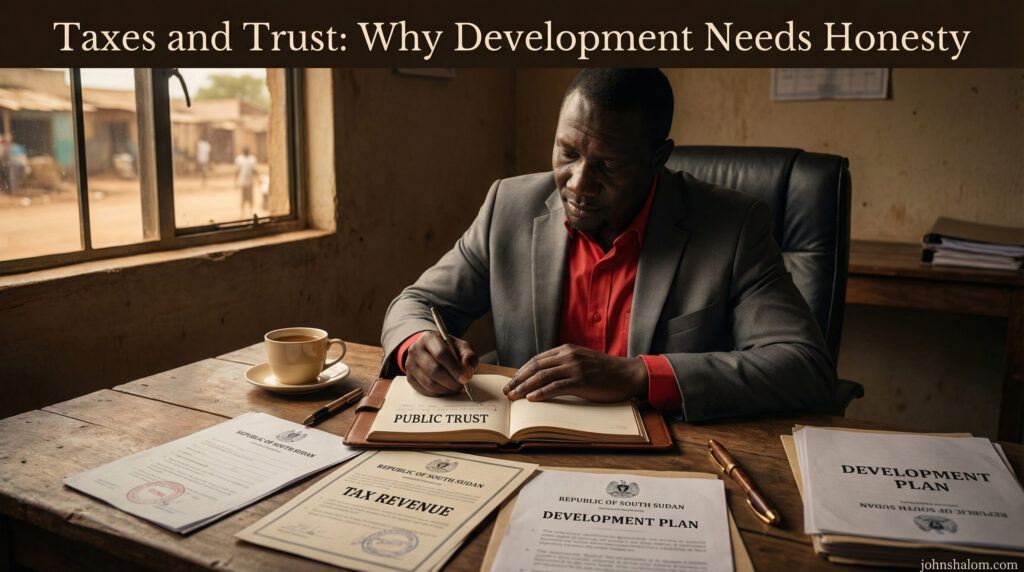
You can collect all the taxes in the world. You can write excellent development plans, hire consultants, and produce beautiful documents. But without honesty, all of that remains paper.
Without honesty:
– Roads stay broken because the money for repairs disappeared.
– Hospitals remain empty because medicine was sold privately.
– Schools crumble because construction funds were “lost” on the way.
– Water projects stop halfway because someone took a shortcut for personal gain.
Citizens do not only pay for projects. They pay for trust that their money serves a real purpose. When trust is gone, two things usually happen at the same time:
- Citizens evade taxes.
- Leaders steal more to fill the widening gap.
The result is a slow collapse. On the outside, the nation may still look stable, but underneath, foundations are cracking.
Honesty is not a decoration in development. It is the foundation. Without it, everything else eventually falls down.
When Citizens Also Cheat
It is easy to point fingers at leaders, and often that is justified. But citizens also have a responsibility.
Complaining loudly about corruption while secretly dodging taxes is like refusing to contribute to the community goat and then demanding meat at the funeral. It is easy to say, “The system is corrupt, so I will not pay.”
There is a painful circle here:
– Leaders steal because they can.
– Citizens refuse to pay because leaders steal.
– The government raises new taxes or borrows heavily because income is low.
– Citizens feel punished and cheat even more.
Breaking this circle requires courage on both sides. Leaders must choose to manage honestly even when others before them did not. Citizens must choose to contribute fairly even when temptation to hide income is strong.
A healthy tax system is a partnership. Both sides need integrity.
Faith, Conscience, and Public Money
For many of us, faith is not separate from daily life. It guides how we handle money in private and in public.
If God cares about truth, justice, and the poor, then taxes are not just a technical matter. They become spiritual questions:
– Am I willing to contribute to the common good?
– Am I willing to say no to bribes, even when I am in charge of public funds?
– Am I willing to see taxes not only as loss, but as part of loving my neighbour?
The same God who sees how we give in church also sees how we treat public money. A person who prays loudly but steals quietly becomes a walking contradiction. Nations full of such contradictions struggle to rise.
Rebuilding Trust: Small Steps, Big Change
Rebuilding trust in taxes and development is slow, but not impossible. It starts with small, visible steps that connect money to results.
For leaders, this can look like:
– Publishing simple, clear reports on how tax money is used.
– Completing small, realistic projects that people can see and touch.
– Refusing bribes and making that refusal known.
– Punishing corruption fairly, even when it touches friends or relatives.
For citizens, it can look like:
– Paying what is required when it is fair and lawful.
– Asking questions respectfully about how funds are used.
– Supporting honest leaders instead of only voting by tribe or gift.
– Practicing honesty in business, even when nobody is watching.
Trust grows when promises and reality begin to match. When people see a road repaired because funds were managed well, something shifts inside. The next time they are asked to contribute, they hesitate less.
Taxes, Trust, and the Future
In the end, taxes are not just numbers on paper. They are part of the story a nation tells about itself.
A corrupt tax system says, “This country belongs to the few.”
An honest system says, “This country belongs to all of us.”
Development is not built on money alone. It is built on money plus trust, leadership plus conscience, citizens plus responsibility. When honesty joins them all together, even a poor nation can move forward.
When I hear people complain about taxes today, I no longer imagine officials chewing coins. I imagine a table, like the one in my childhood home, where resources are placed in the center and divided. Then I ask myself:
Are we dividing fairly?
Are we thinking of everyone at the table?
Are we leaving something for those who will sit here after us?
If the answer is yes, then taxes become more than payments. They become acts of shared responsibility, building a future that all of us can walk on, drive on, learn in, and heal in.
If you would like to know more about my path as a writer, including the struggles, lessons, and small signs of progress along the way, you can read the full story on my Wealthy Affiliate blog here: https://my.wealthyaffiliate.com/johnmaluth/blog
Reflection Questions
- Do you see taxes in your community as a curse, a blessing, or a wasted effort? Why?
- How does honesty or dishonesty, in leaders and citizens, affect your own willingness to contribute to shared responsibilities?
- Can you think of a time when laughter or humor about taxes or government revealed people’s distrust in the system?
- What lessons about honesty in small settings, like families or markets, can apply to national taxation and development?
- If trust is the “currency behind the currency,” what practical steps can both leaders and citizens take to rebuild it where you live?
FAQs
- What does “taxes and trust” mean in this article?
It means that collecting money from citizens is not enough. People must trust that their taxes are used for the common good. Without trust, tax systems become a game of hiding and cheating on both sides. - Why is honesty so important for development?
Because development relies on long term investment in roads, health, education, and security. When public money is stolen or misused, projects stop halfway, services collapse, and citizens lose hope. Honest management turns small tax payments into visible change. - How does corruption affect tax payment?
If citizens see leaders living in luxury while hospitals lack medicine, they feel foolish paying taxes. Many then avoid paying, which reduces government revenue and deepens poverty. Corruption breaks the moral contract that makes taxation work. - What can governments do to build trust around taxes?
They can publish clear budgets, allow independent audits, punish those who steal public funds, and show visible projects funded by taxes. When people see roads, clinics, and schools linked directly to their payments, confidence grows. - What is the role of ordinary citizens in this relationship?
Citizens must pay what is due, refuse bribes, keep records, and speak up when money is misused. By choosing honesty in business and daily life, they support a culture where development money reaches the ground instead of disappearing in private pockets.