TL; DR:
Humanity speaks thousands of languages, each carrying history, humor, and identity. The idea of one global language feels attractive because it promises fewer misunderstandings and easier cooperation. But language is more than a tool; it holds memory, culture, and belonging. Forcing one tongue on everyone would risk flattening that richness.
Instead of chasing a single language, we can aim for better understanding through technology, translation, listening, and shared human experiences such as laughter. The real goal is not one vocabulary for all, but one shared commitment to hear and honor each other while keeping many tongues alive.
A Village Tongue In A Crowded World
When I was a boy along the Sobat corridor, my world felt small but complete. Our village language did everything. It carried jokes, warnings, lullabies, and rebukes. You knew you were in trouble not by the words alone, but by how your name sounded in that tongue when your mother called it.
In those early years, I thought our language was the center of the universe. It was the river that all sentences flowed through. Then life widened. I met other tribes. I heard words that sounded like singing, others that sounded like drumming. Later, I discovered English and other global tongues.
That is when I realized: my language was not the river. It was one stream feeding into a massive sea of human speech. This realization did not weaken my love for my mother tongue. It only raised a question that has followed me ever since:
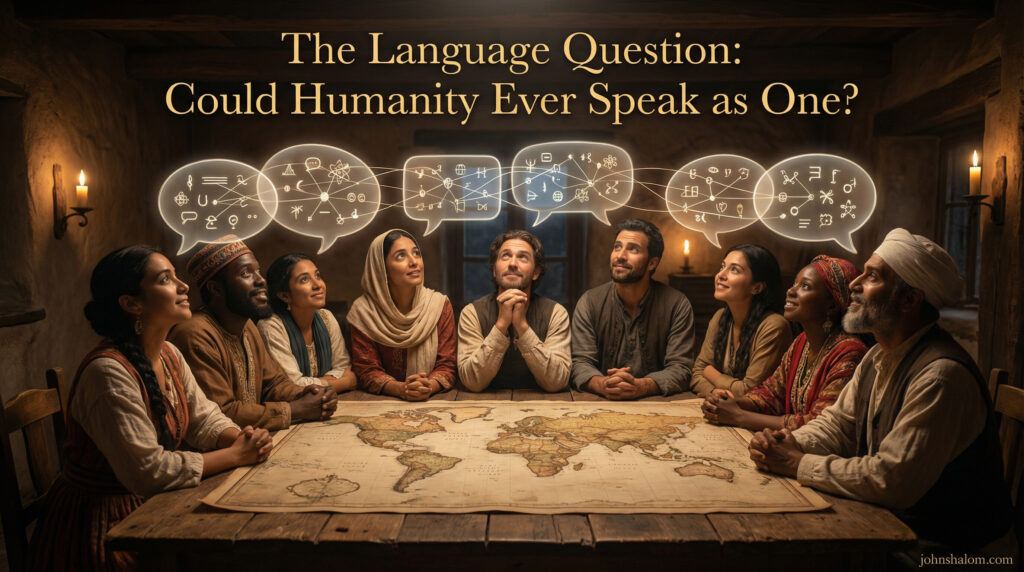
If we are one human family, could we ever speak as one?
The Tower Of Babel And The Question Of Unity
The first time I heard the biblical story of the Tower of Babel, I sat there imagining God scattering languages like a farmer throwing seeds. One group walked away speaking like Dinka, another like Nuer, another like English speakers, and so on, until nobody could understand anyone else.
The story explains, in symbolic form, why communication is so hard. People do not just disagree in ideas; they disagree in words. A simple phrase in one language becomes a confusion in another.
Yet the same story also reveals something important: language is powerful. If united speech can build towers toward heaven, then divided speech can limit what we manage to do together. No surprise that people dream about one global language.
Imagine it for a moment:
- No need for translators at international conferences.
- No awkward menu pointing in foreign restaurants.
- No couples arguing over “That is not what I meant” in cross-cultural marriages.
On the surface, one language for all looks like a shortcut to unity. But underneath that wish sits a harder question: at what cost?
The Comedy And Pain Of Misunderstanding
Languages do not only cause trouble; they also create comedy.
I once tried to translate a proverb from my mother tongue into English during a teaching session. In our language, it is a wise saying about patience and cattle. In English, the version that came out sounded more like a joke about cows with stomach problems. The audience laughed for ten minutes.
In that moment, the proverb failed, but humanity won. We all shared the joy of misunderstanding. The joke built a small bridge. That is one way languages work: they confuse, then connect.
Anyone who has lived between languages knows this:
- You mispronounce a simple word and accidentally insult someone.
- You read a sign in “broken English” that is so funny you buy something just to reward the courage.
- You try to teach a song and end up teaching something completely different.
These stories stay in our minds. They remind us that misunderstanding is part of being human. The comedy softens the pain of confusion.
Could One Language Truly Work For All?
4.1 The rise of “big languages”
Humanity has already tried forms of “one language.”
- Latin once controlled religious and academic life in Europe.
- For centuries, Arabic linked traders and scholars across huge regions.
- Today, English dominates aviation, business, and the internet, while Mandarin has the highest number of native speakers.
These tongues show that a language can stretch far beyond its original home. But none of them has replaced all others. People still think, joke, pray, and dream in many speech systems.
Technology adds another layer. You can write in Arabic, translate to French, and send to a friend in Korean within seconds. Emojis and memes travel even faster, ignoring grammar altogether. It looks almost like a peaceful takeover, with global languages as the main actors.
However, there is a difference between one language being very useful and one language replacing all others. The first is already happening. The second would cut into something much deeper than convenience.
4.2 Language as identity, not just utility
Languages are not screwdrivers that you drop when you find a better tool. They are homes. They hold:
- Ways of greeting that carry respect or intimacy.
- Shades of meaning that decide whether a sentence is comforting or cruel.
- Proverbs that pack entire histories into one line.
- Humor that makes no sense when translated word-for-word.
Asking humanity to speak one language only is like asking everyone to eat the same dish every day. It might solve some problems, but it would also flatten taste and joy.
You might also like: The Ultimate Guide to Political Journalism: Ethics, Challenges, and Impact in the Modern World
What Happens When A Language Dies?
5.1 My mother’s proverb about shadows
My mother never studied linguistics, but she knew more than many experts. She used to say, “When you lose your language, you lose your shadow.”
A shadow is always with you, even when nobody else notices it. It shows your shape without giving all your details. Your language does the same. It follows you, shapes how you see the world, and quietly reminds you who you are.
When a language disappears, people lose more than words. They lose prayers, jokes, curses, nicknames, songs, and names for the land. They lose ways of comforting a crying child that cannot be reproduced in another tongue.
5.2 Children between tongues
Spend time with children in diaspora or in multi-lingual cities, and you will see the struggle. At home, parents speak one language. At school, children use another. On phones, they switch to a third full of internet slang.
I once asked a boy born abroad, from a South Sudanese family, what tribe he was from. He thought for a while and said, “I think I am Wi-Fi.” We laughed long and hard, but behind the joke was a quiet sadness.
He felt more fluent in the language of the internet than in the tongue of his ancestors. That is not his fault. It is a sign that if we are not careful, some languages will fade into memory while screens glow in many homes.
Technology: Enemy Or Ally For Many Tongues?
6.1 Translation as a new tower
Today, you can carry small devices or apps that listen to one language and speak out another. You can watch videos with subtitles in your own tongue. You can write in Arabic and have it appear in English on someone else’s screen.
In one sense, this is a new kind of tower, but this time built to connect rather than to reach heaven. The question is whether this tower will crush small languages or protect them.
Used well, technology can:
- Record elders telling stories before they pass away.
- Create online dictionaries for minority languages.
- Allow people to write books, blogs, and songs in tongues that have never been printed before.
- Translate between local tongues and global tongues so ideas can travel both directions.
Used badly, technology can:
- Reward only big languages with lots of content.
- Turn children away from their mother tongues because they feel “slow” or “less important.”
- Fill screens with one accent, one style, one way of talking about life.
The tools are neutral. Our choices are not.
6.2 Keeping many doors open
The best use of technology is not to erase difference, but to clear obstacles. If translation and online tools can help a Dinka speaker, a Japanese speaker, and a Brazilian Portuguese speaker understand each other without dropping their home languages, then we move closer to a healthier world.
The goal should be:
One shared understanding made possible through many tongues, not one tongue that replaces all others.
Laughter As Humanity’s Shared Tongue
If there is already one language that humanity speaks without training, it is laughter.
I have heard laughter in refugee camps, in crowded churches, in hospitals, and in funeral gatherings. Sometimes people barely share any vocabulary, yet one clumsy act or funny face sends everyone into the same sound.
Humor often survives where grammar fails.
- A child mispronounces a serious word and turns it into a joke.
- A pastor mixes up two phrases during a sermon and says something about goats instead of God.
- A translator chooses the wrong term, and the whole hall dissolves into joy.
In those moments, nobody stops to ask which language the joke belongs to. Everyone simply feels human together. Laughter does not cancel sorrow or disagreement, but it builds small bridges that words alone struggle to build.
If we want more unity across languages, we might start by sharing more clean, kind humor and fewer angry speeches.
Faith, Story, And Listening: Deeper Than Vocabulary
Language is not only about syllables. It is also about how we listen and how we hold each other’s stories.
8.1 Faith beyond one tongue
For people of faith, prayer often flows first in the mother tongue. That is the language in which tears and hope mix most honestly. Translating faith into other languages is important, but something unique happens when you call on God using the words your grandmother used.
Yet faith also teaches that God hears beyond grammar. The same God understands cries in Arabic, English, Dinka, Nuer, and silent tears that contain no words at all. That means unity does not require identical speech. It requires shared trust, love, and humility.
8.2 Story as a longer kind of sentence
Stories travel more easily than vocabulary lists. A story about a hungry child, a lost sibling, or a funny accident can cross borders even when translation is imperfect. The feelings carry people across the gaps.
If humanity ever wants to “speak as one,” we might focus less on forcing shared vocabulary and more on telling more honest stories and listening more carefully. Stories are longer, deeper sentences that reveal our common needs, fears, and joys.
Could Humanity Ever Speak As One? A Different Way To Answer
If “speaking as one” means everyone using the same language, the answer is likely no, and maybe that is a blessing. We would lose too much of the flavor, drama, and color that many tongues bring to our shared life.
If “speaking as one” means something else, the answer changes. It might mean:
- Hearing each other’s pain and responding with compassion, even if we need translation.
- Laughing together at human weakness, even if the joke travels through three languages.
- Working together on shared problems, such as climate, war, poverty, and injustice, while keeping our own songs and sayings.
- Teaching children to honor their mother tongue while learning one or two other tongues for communication and work.
In that sense, yes, humanity could speak as one without forcing all people into one linguistic uniform. We could practice a deeper unity that lives in listening, respect, and shared purpose.
Practical Ways To Honor Many Tongues While Seeking One Understanding
10.1 For families
- Speak your mother tongue at home as much as possible, especially with children.
- Tell family stories in that language so children associate it with warmth, humor, and wisdom.
- Allow children to learn global languages without apologizing for your own. Make it clear that knowing two or three tongues is a strength, not a shame.
10.2 For schools and communities
- Encourage teaching in local languages in early grades while adding a widely spoken language as children grow.
- Invite elders to share proverbs, songs, and stories in their own tongues.
- Use school projects to document local words for plants, animals, and places before they vanish.
10.3 For people who move or live in diaspora
- Keep some simple home routines in your mother tongue: greetings, prayers, sayings at the table.
- Organize cultural evenings where children can see traditional dances, hear original songs, and taste food linked to the language.
- Use technology to stay connected to radio, sermons, and content in your first language while you learn those of your new country.
10.4 For writers, artists, and creators
- Include words from your mother tongue in your work, with explanations, so others can taste your language.
- Work with translators to move your stories across linguistic borders.
- Help record and preserve languages that are at risk, especially if you come from those communities.
- Conclusion: Many Tongues, One Humanity
The question, “Could humanity ever speak as one?” sounds simple, but it hides a whole world of fears and dreams. Some fear division and long for one voice. Others fear losing themselves and cling to their tongue as their last stronghold of identity.
From where I stand, I do not pray for one language. I pray for one heart in many languages. I want a world where:
- My mother’s proverb about shadows still makes sense.
- A child in Japan can laugh at a story from South Sudan, even in translation.
- A refugee can call home in their own language and still work in another abroad.
- Technology opens doors instead of closing mouths.
We may never sound the same. But we can choose to listen as if every language on earth is a different accent of one human voice.
Maybe the real miracle is not everyone speaking identical words, but everyone deciding that no language, however small, is unworthy of respect. That choice would allow us to keep our proverbs, our jokes, our prayers, and our songs, while slowly learning to understand one another.
That, to me, is a better dream than one tongue for all: one humanity, many words, one shared willingness to listen.
If you would like to know more about my path as a writer, including the struggles, lessons, and small signs of progress along the way, you can read the full story on my Wealthy Affiliate blog here: https://my.wealthyaffiliate.com/johnmaluth/blog
FAQS
- Q: Do you think a single global language would unite or erase humanity’s diversity?
A: A single global language might make communication easier, but it would risk erasing much of humanity’s diversity. Language carries culture, humor, and memory. If one tongue had to replace all others, many small languages would die, and with them proverbs, songs, and ways of seeing the world. Unity is better built through respect and translation than through forcing everyone into one speech system. - Q: What is the funniest misunderstanding you have experienced across languages?
A: One of the funniest moments was when I tried to translate a proverb from my mother tongue into English. In our language it was a deep saying about patience and cattle. In English it sounded like a joke about cows with serious stomach problems. The audience laughed for a long time, and my “wise teaching” turned into comedy. That moment reminded me that mistakes in translation can create shared joy, not only confusion. - Q: How does your mother tongue shape the way you see the world?
A: My mother tongue shapes how I think about family, land, cattle, suffering, and faith. It holds words for certain feelings and relationships that do not exist in the same way in English. It also carries my people’s history in proverbs and names. When I switch languages, I also slightly switch the angle from which I see life. My mother tongue keeps me rooted even when I speak other languages. - Q: Could technology replace the need for one global language, or will it push us toward it?
A: Technology can reduce the pressure for one global language by making translation faster and easier. If devices and apps can help people understand each other while keeping their own tongues, then we gain connection without losing identity. But if technological systems only support a few major languages, smaller ones may be pushed aside. The outcome depends on how we design and use these tools, not on the tools alone. - Q: If laughter is already universal, how can we use it to bridge cultural and linguistic divides?
A: Laughter can bridge divides by reminding us that we are human before we are speakers of any particular language. Clean, kind humor about our shared weaknesses, daily struggles, and small embarrassments can connect people who differ in tribe, religion, or nationality. When we laugh together at harmless mistakes, it becomes easier to listen to each other about serious matters. Laughter cannot solve every conflict, but it can open hearts that would stay closed to plain argument.